
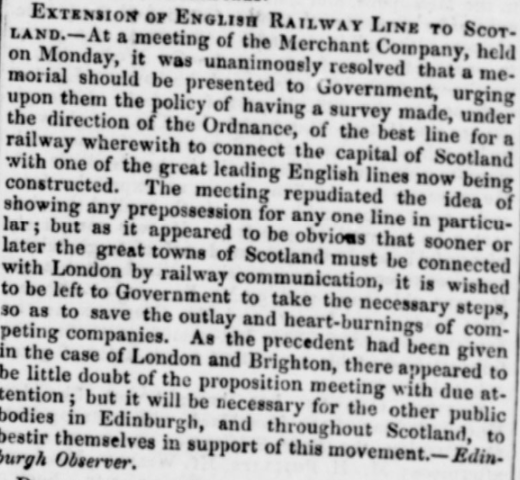

Since I’m now obsessed with this new archive, something that I hadn’t given much thought about is how in 1837 they were starting to wonder how they were going to connect England and Scotland by rail.

The businesses in Scotland were quite exercised by this, the opportunity for new trading opportunities started to become available and the initial thought was that this was all so complex and expensive that there would only be one line needed.
The very first comprehensive rail link between the English and Scottish networks wasn’t created until 1846 by the North British Railway, which opened its line from Edinburgh down to Berwick-upon-Tweed. This route connected the Scottish capital to the burgeoning English railway system, although it was not a continuous track journey into London initially, as it involved two “water breaks” which were crossings of the River Tweed at Berwick and the River Tyne at Newcastle, which necessitated road or ferry transfers. Only later, when bridges were built, did passengers finally get to stay comfortably aboard without the indignity of a ferry detour. It also transpired that the North British Railway made more of their money from transporting minerals around the place than they did from their passenger services.
A fully continuous, uninterrupted railway line between the two capitals for the first time came shortly after with the opening of the Caledonian Railway’s (and they were the big rivals of North British Railway with absolutely no love lost there at all) main line between Glasgow and Carlisle on 15 February 1848, which then linked to the English London and North Western Railway, finally establishing a complete, high-speed rail route between Glasgow and London.