
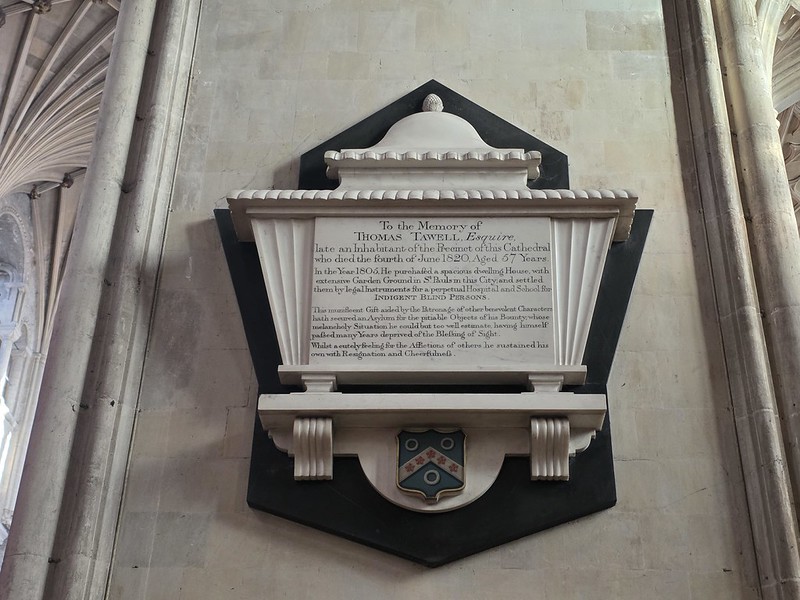

This is certainly a rather lovely place to have a memorial tablet and it commemorates the life of Thomas Tawell (1763-1820). Tawell was born in Wymondham in 1763 and he was born into a wealthy family, although his father died when he was just ten. He went to work for his uncle, a Norwich ironmonger, and Thomas managed to build up quite a wealth for himself.
Perhaps now best known for his generosity, his turn toward charity was rooted in his own experience with sight loss. While he was a successful merchant buying and selling his iron, he became blind, a condition that lasted for several years before he partially recovered his sight. This ordeal inspired him to help those who did not have the means to support themselves in a similar situation.
In January 1805, Tawell spoke at a public meeting at the Norwich Guildhall to propose an institution for the blind. To ensure the project moved forward, he took direct action by purchasing a large house and three and a half acres of land in Magdalen Street for the cause. He also donated 1,000 guineas, which is estimated to be worth approximately £86,000 in modern terms. He was particularly adamant that the institution should not just educate the young but also care for the elderly, a requirement he made a central part of the charity’s rules.
The building on Magdalen Street was known as the Asylum and School for the Indigent Blind (I didn’t know what ‘indigent’ meant, but it’s someone who is poor and/or needy). That building has since been demolished, but the organisation lives on, later called the Norfolk and Norwich Association for the Blind and, since 2020, now the more snappy ‘Vision Norfolk’.

The text reads:
“To the Memory of THOMAS TAWELL, Esquire, late an INHABITANT of the Precinct of this Cathedral who died the fourth of June 1820, Aged 57 Years.
In the Year 1805, He purchased a spacious dwelling House, with extensive Garden Ground in St. Paul’s in this City; and settled them by legal Instruments for a perpetual Hospital and School for INDIGENT BLIND PERSONS.
This munificent Gift aided by the Patronage of other benevolent Characters hath secured an Asylum for the pitiable Objects of his Bounty; whose melancholy Situation he could but too well estimate, having himself passed many Years deprived of the Blessing of Sight.
Whilst acutely feeling for the Afflictions of others he sustained his own with Resignation and Cheerfulness.”
He sounds a really quite positive man by all accounts. Incidentally, I’m very impressed at this art collection which was sold off a couple of months following his death, the auction catalogue notes:
“ALL the valuable PICTURES, Prints, Coins, and curious Articles, of THOMAS TAWELL, Esq. deceased, at his late Dwelling-house, in the Upper Close, Norwich; comprising some fine specimens of the old Masters, Ostade, M. A. Carraveggio, Wyke, Zuccorelli, Frank Hall, Old Frank, Teniers, Rysdael, &c. &c. proofs and fine impressions from Bartolozzi, Vasseau, Wille, Earlom, Sharpe, Edelinck, Woollet, &c. Cupid in Psyche, Bacchus and Ariadne, Venus in statuary marble—Italian workmanship, very fine; a large collection of gold, silver, and copper coins, Roman urns, and a variety of curious antique articles.
In the Books will be found Jeremy Taylor’s Works, Shakspeare’s in folio, Mant’s Bible, Josephus, Clarendon’s Rebellion, Statutes at Large, Robertson’s Charles, America and Scotland, Hume’s England, Burke’s Works, Annual Register, 62 vols. Blackstone’s Commentary, Hook’s Roman History, &c. &c.”
Owning a Caravaggio is really quite exciting. Although if I owned one, I’d be stressed worrying someone would pinch it and I dread to think what the insurance cost would be. I’d worry about it every time I looked at it, so I think on that basis I won’t buy a very valuable old painting for several million pounds. Although there’s another limiting factor within that last sentence, but I digress.
At least this memorial is of a man who made a great contribution to the people of Norwich, and not a tomb to a bishop that oversaw the execution of people who had a slightly different belief to him.