
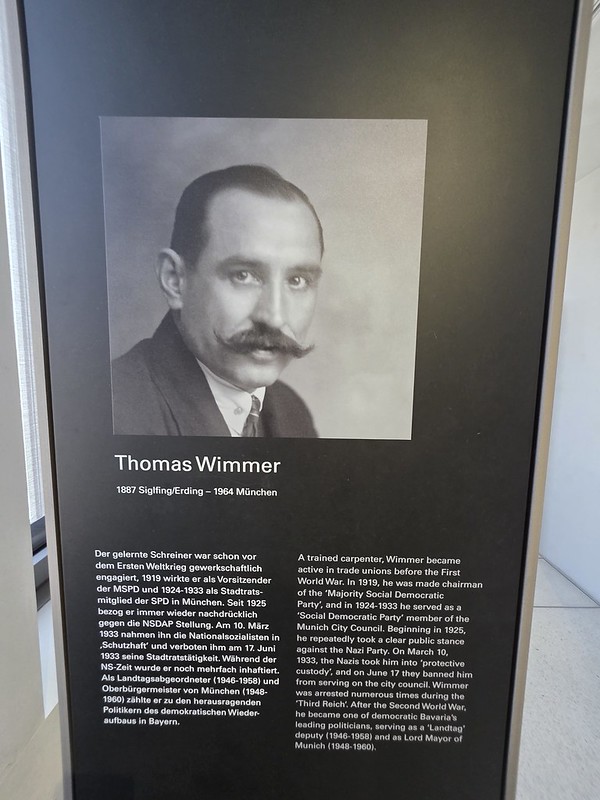

Thomas Wimmer (7 January 1887–18 January 1964) was the Social Democratic mayor who became the public face of Munich’s post-war recovery, one of the heroes of his generation. He had been born in Siglfing near Erding, the son of a blacksmith and a domestic worker and he trained as a cabinet-maker, joined the woodworkers’ union in 1907 and the SPD in 1909 before settling in Munich after years as a journeyman. In the First World War he served briefly at the front before being released as an armaments worker and after 1918 he worked at the city labour office and was active in municipal politics. He sat on the city council from 1924 to 1933 and, with the collapse of the Weimar Republic, was arrested a day after the Nazi takeover in Munich, spending time in Stadelheim prison and at Landsberg, and later facing repeated Gestapo detentions. After the 20 July 1944 attempt on Hitler’s life he was held for six weeks in Dachau concentration camp, perhaps very fortunate to have managed to stay alive during this process. I rather suspect that if the Nazis had remained in power for just a little longer, his future would have been more in doubt.
After liberation the American military authorities reinstalled Karl Scharnagl as mayor, Wimmer returned to City Hall as third, then second mayor, and in 1946 served in Bavaria’s constitutional assembly and entered the Landtag. When the SPD topped the 1948 city elections he was chosen as Oberbürgermeister, a post he held until 1960 while also representing Munich in the Bavarian parliament through the 1950s. These were hard years of shortages and ruins and Wimmer pushed pragmatic measures such as the “Holzaktion” to secure winter fuel and, most famously, the citizen clean-up “Rama dama” on 29 October 1949, when more than 7,500 volunteers, shovel in hand, the mayor among them, shifted an estimated 15,000 cubic metres of rubble in a single day. The Bavarian dialect slogan stuck, and the image of a hands-on mayor helped rally a city to reconstruct itself.
Politically he resisted post-war schemes to drive a motorway-scale traffic cut through the historic centre, arguing that the city should be rebuilt for people rather than exhaust fumes. Twice directly re-elected (1952 and 1956), he left office in 1960 with a reputation for plain speech and practical administration. Wimmer died in Munich in 1964 and was buried at the Ostfriedhof. The city named the Thomas-Wimmer-Ring on the Altstadtring after him, and he was made an honorary citizen of Munich in 1957, receiving the Bavarian Order of Merit in 1958 and the Grand Cross of the Order of Merit of the Federal Republic of Germany in 1955 (with Star in 1959). For many Munich residents, though, his memory is still tied most strongly to a broom, a shovel and the decision to clear a path back to normal life.
As a politician, his strength must have been substantial to have resisted the Nazis for so long and to have remained steadfast in his views. To have then been given the opportunity to influence the post-war Munich was at least some justice in his life and it’s evident that he continued to surprise and delight the communities which he served. I hadn’t heard of him before visiting the museum, but I very much like that they have a section on those heroes of their generation who stood up to the Nazis.