
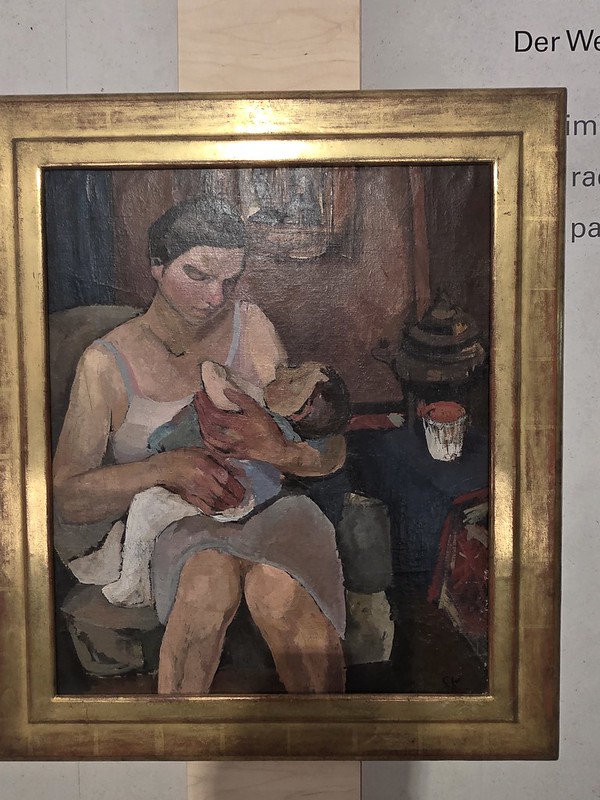

This painting is one of the items in the “Memory Is” collection which is on display at the museum until May 2026. The painting, by Karoline Wittmann, shows her sister Maria and her sister’s son, Georg. Georg had been born in 1928 and opposed the regime and was sympathetic to the suffering that he saw the Jews were enduring, secretly wearing a Star of David on his undershirt. The museum describes him as a “rebellious spirit” and it’s evident that he wasn’t what the Germans considered to be a well-behaved young man. However, Georg’s father had been killed in Ukraine in 1943 and his mother was required to do wartime labour.
In February 1945, he and a friend entered a bombed out villa in Bogenhausen and got drunk on bottles that they found in the wine cellar. The police arrested them but as there was no space in Munich’s prisons by that time, he was sent to Dachau concentration camp and thrown into Barrack 27. His bereft mother took him food parcels in the attempt to help and protect him, but it’s not thought that they ever got through to him. She and Karoline went to Dachau on 10 April 1945 and the authorities admitted that Georg had died on 3 April 1945 and they claimed he had died of blood poisoning and that he had been cremated, giving his mother some of his ashes. The camp was overrun by typhus and famine at the time, it was likely that this combination is what made Georg unwell.

The friend arrested with Georg survived the war and he later explained that he was actually thrown alive onto a pile of corpses and left to die. There were no crematoria in operation at the time, he was buried in a mass grave and the ashes given to his mother weren’t his. Georg was her only child and his mother suffered terribly until her death in 1984, never allowing any mention of her son. Georg was nicknamed Schorschi by his friends and his death at the age of 16 was just another unnecessary casualty of war, being killed shortly before Dachau was liberated by the Americans on 27 April 1945. What looked liked just a typical painting from the period transpired to have a story behind it which the museum has done well to uncover and to explain to visitors.