
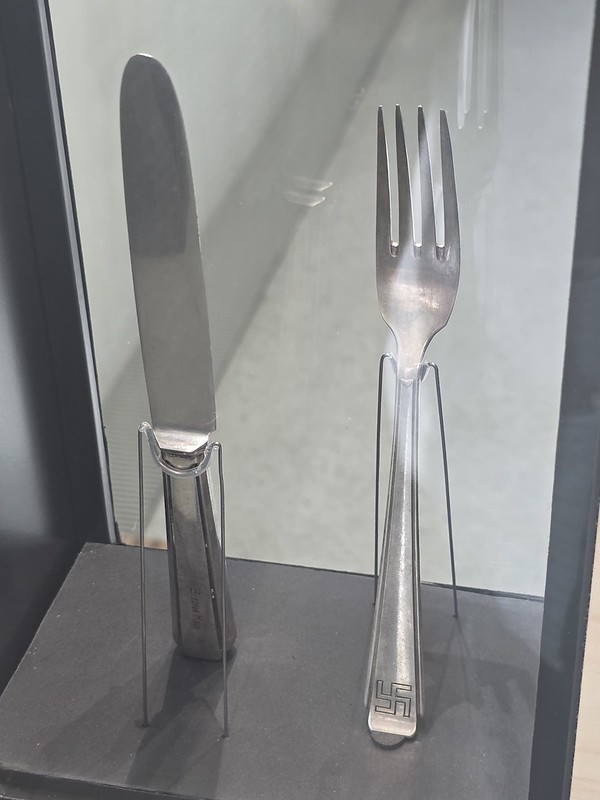

This is one of the exhibits at the museum which questions what the visitor thinks about them being present, noting “what kind of feelings do these traces of the past trigger in us?” as they’re cutlery from the Brown House which was formerly on this site. The Brown House (Braunes Haus) was the Nazi Party’s headquarters in Munich, set on Brienner Straße between Karolinenplatz and Königsplatz. The building began life in 1828 as a neoclassical city palace, later known as Palais Barlow, designed by Jean-Baptiste Métivier. In May 1930 the NSDAP bought it, financed in part by donations and loans from industrialists such as Fritz Thyssen and Friedrich Flick and they then had architect Paul Ludwig Troost refit the villa into a suitably imposing party HQ. It opened for business in early 1931 and served as the movement’s nerve-centre until the end of the regime. The house was badly damaged in wartime bombing, effectively destroyed, and its ruins were cleared in 1947. For decades the plot remained an empty scar in a quarter that had also included the Führerbau and other party buildings framing Königsplatz, a showpiece space the Nazis had reworked for rallies and ceremony.
The Munich Documentation Center for the History of National Socialism (NS-Dokumentationszentrum) opened here in 2015, bringing a more positive use to the previous empty space. This seems the ideal place for exhibits such as this to be displayed, they’ve survived for nearly a century now and they may as well be on display in locations which explain the war and the reasons for it. It’s an intriguing survival and the Brown House is where the Blutfahne, or Blood Flag, was stored and Hitler had offices, the centre of where the Nazi movement grew in the early 1930s. If forks from the Brown House can trouble us, it is because they expose how the regime embedded itself in rooms that felt safe and respectable.