
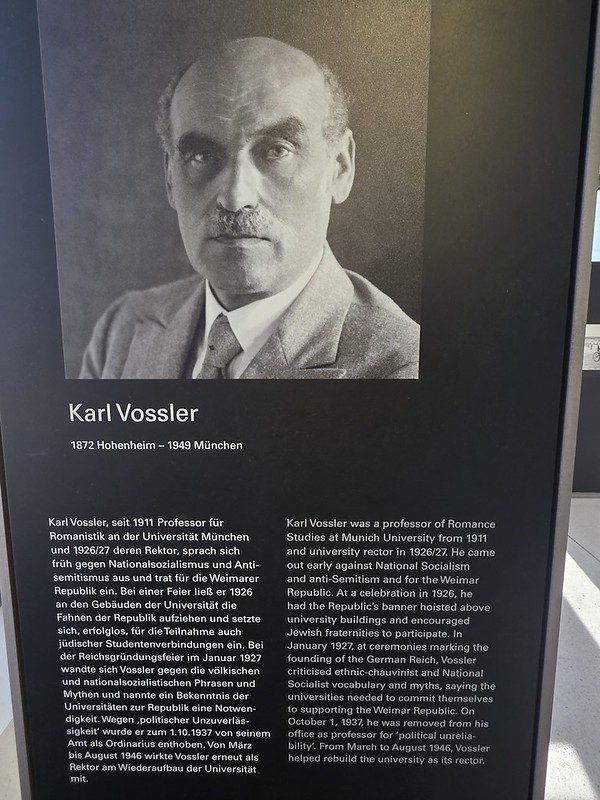

Karl Vossler (6 September 1872 – 18 May 1949) was a German Romanist and linguist who became one of the leading European scholars of Romance literature before 1933, then a conspicuous academic opponent of Nazism in Munich. It’s for that opposition to the Nazis that has led this museum to feature him and his bravery in opposing the regime. He was born in Hohenheim near Stuttgart and Vossler studied German and Romance philology in Tübingen, Geneva, Strasbourg, Rome and Heidelberg, taking his doctorate in 1897 and his habilitation in 1900. He held the chair at Würzburg from 1909 and moved to the University of Munich in 1911, where he taught for the rest of his life. His standing brought election to the Bavarian Academy of Sciences and, in 1926, the Pour le Mérite for the arts and sciences.
Politically he was no revolutionary in 1914, signing the wartime ‘Manifesto of the Ninety-Three’ (an interesting document in its own right), yet by the 1920s he was speaking publicly against rising antisemitism and the völkisch right. In a 15 December 1922 lecture to students he likened the swastika to barbed wire and during his 1926–27 term as rector he insisted on including Jewish student fraternities in university ceremonies while ordering the republican black-red-gold flag to be flown on campus. After Hitler’s takeover Vossler tried to shield colleagues, notably defending the philosopher Richard Hönigswald’s position in 1933. The regime soon branded him “politically unreliable” and on 1 October 1937 he was forced into early retirement and barred from teaching, a measure the Nazi lecturers’ association justified by casting him as an ideological opponent.
When the war ended he returned to public academic life, serving as rector of the University of Munich from March to August 1946 to rebuild the institution and he delivered the memorial address that November for the university’s victims of National Socialism, including the White Rose. Vossler died in Munich on 18 May 1949 and was given an honorary grave in the city’s Waldfriedhof. At least he got to see the Nazi regime that he so hated coming to an end and he is now one of the city’s heroes.