
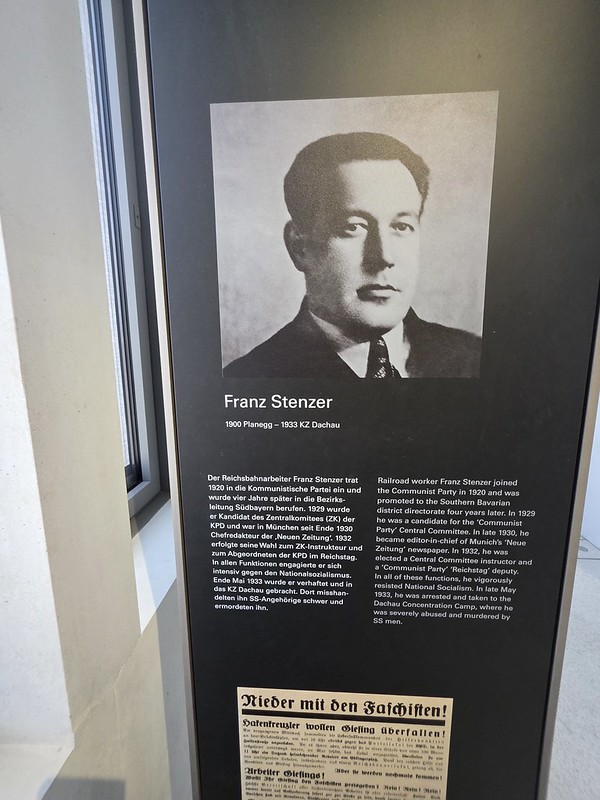

Franz Stenzer (9 June 1900 – 22 August 1933) was someone that I hadn’t heard of before visiting this museum and he was featured in a section of individuals who opposed the Nazi regime. He was born in Planegg near Munich, he moved to the city as a teenager, served briefly in the navy at the end of the First World War, then found steady work at the Bahnbetriebswerk in Pasing. Colleagues repeatedly elected him to the works council, and in 1919 he joined the local KPD group, cutting his political teeth in workplace and union battles during the turbulent early Weimar years.
By the mid-1920s Stenzer had risen into the leadership of the KPD’s South Bavarian district. From autumn 1928 to spring 1929 he attended the International Lenin School in Moscow, returned to Munich as a full-time organiser, and was elected to the Pasing city council in 1929. He later edited the party paper Neue Zeitung in Munich and, at the November 1932 election, won a Reichstag seat for the KPD and in 1932 he also joined the party’s Central Committee.
After Hitler came to power Stenzer stayed in Bavaria, working underground to coordinate the KPD’s illegal network and this displeased the new regime. The police could not find him at first and on 19 April 1933 they took his wife Emma (who lived until 1998) hostage, leaving their three young daughters at home. He was seized in Munich on 30 May 1933, taken the next day to the newly established Dachau concentration camp, and singled out as a prominent opponent of the regime. On 22 August 1933 SS men removed him from his cell and murdered him with Nazi newspapers claiming he was shot while trying to escape, a story later disproved by an investigation that established he had been killed with a close-range shot to the back of the head.
Emma Stenzer was released for the funeral, then fled with the children via the Saar and Paris into Soviet exile before returning to Germany after the war. Franz is commemorated among the murdered members of the Reichstag in Berlin, and in Munich in 2023 a memorial sign was installed at his former home on the 90th anniversary of his killing in 2023. In the GDR his name was also given to the substantial ‘RAW Franz Stenzer’ railway works in Berlin-Friedrichshain. The news of his death wasn’t secret and was reported in the British media of the time and it must have been something which caused some concern to a few readers who could foresee what was going to happen. He is significant for many reasons, but not least as the first member of the Reichstag to be murdered by the Nazis.