

I’m not really that engaged with the bierhaus type concept where it’s all about quantity of alcohol rather than a focus on quality beer. The shared tables, music and lack of beer that inspires me doesn’t bode entirely well. However, I was pleased that we did pop into this brewery to see what went on.

On a Thursday afternoon it was busy, very busy. It’s hard to argue with that level of popularity, even if your heart belongs to little taprooms down side streets.

The place can seat over 3,500 people and we struggled to find a table space.

Hofbräu München began in 1589 when Duke Wilhelm V set up a court brewery at the Alter Hof to supply his household with brown beer. The first brewmaster was Heimeran Pongratz, and within a few years the new brewhouse had become a fixed part of Munich’s court economy. Under Wilhelm’s son, Maximilian I, the focus shifted to wheat beer and in 1602 he secured a princely monopoly over Weissbier across Bavaria and expanded production so rapidly that, in 1607, the wheat brewery was moved to a new site at the Platzl while the brown-beer operation continued at the old court. Opening sales to Munich innkeepers in 1610 turned Hofbräu from a court supplier into a business with a city-wide market and they became an important part of the local economy.

The drinks menu with the ‘exciting’ beers that are available, with the prices not being unreasonable.
Back to the history though…. In 1614 the brewmaster Elias Pichler introduced a strong Ainpöckisch-style beer that became Hofbräu Maibock, the city’s archetypal spring bock. During the Thirty Years’ War the beer acquired legend as when the Swedes occupied Munich in 1632 they accepted, alongside a cash tribute, a consignment of Hofbräu beer, much of it Maibock, and left the city largely unscathed. As for the beer, it obviously complies with the Reinheitsgebot, which I consider as something bad, but the brewery inevitably view it as something good. After the Bavarian kingdom was proclaimed in 1806 it was known as the Royal Hofbräuhaus and in 1808 the brown-beer plant also moved to the Platzl complex to gain space. In 1828 King Ludwig I formally allowed hospitality on the premises, creating the beer hall tradition visitors know today and in 1852 ownership passed from the crown to the Bavarian state, where it remains as the State-owned Hofbräuhaus in Munich. Industrial growth in the late nineteenth century pushed brewing out of the cramped city-centre buildings and between 1894 and 1896 Hofbräu built a modern brewery on Innere Wiener Straße in Haidhausen, and in 1896 the architect Max Littmann refitted the Platzl as a purpose-built tavern.
There was a more sinister period for the building in the inter-war period as on 24 February 1920, Hitler unveiled the Nazi Party’s 25-point programme at a meeting attended by around 2,000 people. He returned to the venue on numerous occasions to make speeches and it’s where he made the “Warum sind wir Antisemiten” speech where he started to define who the enemies of the state were (mainly Jews) which was to underpin what came next. This entirely sub-optimal piece of history came to an end of sorts when the beer hall was largely destroyed by bombing in 1944, although it was then reconstructed after the war, with the grand Festival Hall reopening for Munich’s 800th anniversary in 1958. Production stayed in Haidhausen until a major fire in the malthouse and offices on 6 April 1987 forced an accelerated move to a new, purpose-built plant at Munich-Riem. The Riem brewery was inaugurated in November 1988 and remains Hofbräu’s production site today.

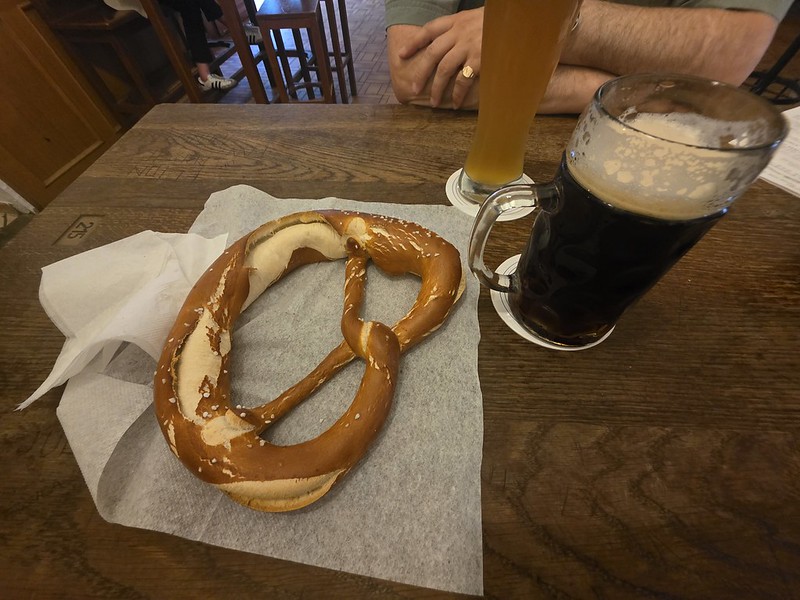
The pretzels are sold by people who walk around and these can only be purchased with cash. This tasted of a decent quality, it’s something that works well with beer.

There is lockable storage for 616 steins which are used by locals, some of these are over 100 years old.

The area where customers can wash their stein, all very handy and this was used by some locals when we were there.

I evidently sat at an appropriate location, although this obviously wasn’t me involved with such vandalism. In terms of seating, we walked around a couple of times before finding an empty table. It is appropriate and allowable to ask others to join their table, or at least the other end of it, but I’m too British for that. If we had gone in an evening, I suspect we would have had to be much more sociable if we wanted somewhere to sit. One advantage in sitting at the side was that I couldn’t hear the live music, which isn’t a complaint about the quality as I’m sure it was excellent, but I can’t be doing with all this raucous fun.

The glasses, which unlike the one served to me were generally clean.

Service was routine and equally brusque to everyone, which is almost comforting. Card payments are accepted with a hint of theatrical reluctance, you’re marched to a terminal and treated to a convoluted process that lasts just long enough to question your life choices. But, I can forgive this, they’re serving a large number of people who speak any number of languages and it’s fast-paced, I understand they’re not going to spend time building up a rapport with customers. We didn’t have to wait too long to be served, although it took nearly ten minutes for the beers to actually arrive.
As for the Dunkel, it was sweet and malty, but it was generic, served in a dirty glass with lipstick marks and it was quite a basic beer lacking any depth of flavour or taste. Ultimately, they’re not going to change the taste of this beer as it’s long standing, so this all becomes a matter of mass production whilst the quality of other beers overtakes them. I did try some of the wheat beer that Richard ordered and that was better and tasted refreshing, but it still seemed quite basic and generic.
Overall, this is a tourist attraction and it’s evidently doing very well at that as it’s busy and clearly professionally managed to be able to serve this much food and drink to customers. If coming with a group, I think that works better with the whole theme and I’m sure that a pleasant evening would be had with traditional German beer and drink, but I was underwhelmed by the bland beer to be honest. However, I’m glad to have experienced an authentic Munich bierhaus although there’s part of me just a little sad that the small breweries in the city are producing some amazing beers but they have to compete with this mass production facility.