
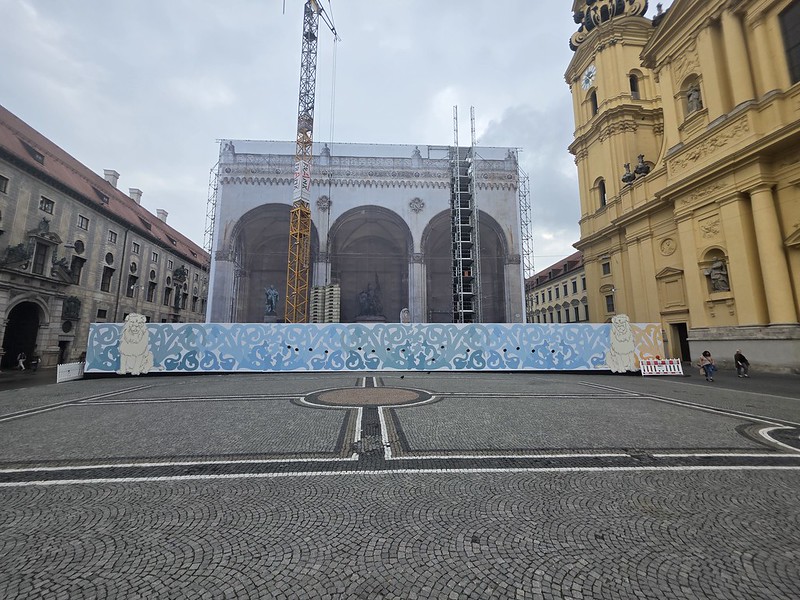

Richard and I visited the exterior of Field Marshal’s Hall (Feldherrnhalle) as part of a self-guided walking tour, but more on that in a future post. There’s actually a limited amount to see here as the building is being restored and there’s a temporary frontage on at the moment. This does at least give a representation of what the building looks like.
The hall was built between 1841 and 1844 at the behest of King Ludwig I of Bavaria, who admired the decadence and grandeur of Italian art and architecture. He wanted something in Munich that echoed the grace of Florence’s Loggia dei Lanzi, and so he entrusted Friedrich von Gärtner with creating a Bavarian version. Rather than a sombre fortress, it was conceived as a dignified and open structure, a kind of outdoor gallery honouring military greatness which is something that Bavarians rather quite like.
Inside the three arches stand bronze statues of two of Bavaria’s martial icons, Count Tilly, famed from the Thirty Years’ War, and Karl Philipp von Wrede, who battled Napoleon’s forces. These figures were cast from melted-down cannon, an aesthetic and symbolic link to war itself. Later, in 1892, a third bronze ensemble was installed in the centre, commemorating Bavaria’s role in the Franco-Prussian War. Marble lions flank the steps, one snarling at the Residenz palace, the other more demurely facing the church, added in the early 1900s.
But, the building is perhaps best known for something more sinister that happened in 1923. That was the year of the failed Beer Hall Putsch when Adolf Hitler led 2,000 followers around in his ‘revolution of the people’. They were met by Bavarian police in front of this Hall and four police officers and sixteen insurgents were killed. Hitler was arrested and imprisoned soon after, but within a decade he was leading the Nazi Party into Government.
Hitler made this into something of a memorial after 1933 and it was under permanent ceremonial guard by the SS. A monument known as the Mahnmal der Bewegung was added to recast the sixteen insurgents as heroes of the people. This memorial was smashed and destroyed by local residents on 3 June 1945, with the area soon being restored by the authorities back to its pre-1933 appearance.
It did feel a little strange standing in the location when just over 100 years ago this hatred took place. At that time it was Hitler who was the enemy of the people as far as the police were concerned, but things changed with alarming speed in that regard.