
[I originally posted this in July 2018, but have reposted it to fix the broken image links]
Many years ago I watched the landmark World at War series, produced in the early 1970s and at the time the most expensive documentary ever produced. The very first episode begins with some film of Oradour sur Glane, and I’ve remembered that for some time, and I’ve wanted to visit the site.
So, I decided to spend the day here and got the bus from Limoges. I’ll do another blog post about that, as it’s not the easiest bus to find, and I noted that there were no other tourists using the service.
So, back to what Oradour sur Glane is. In 1944, the German military entered the town one summer’s day and started to round everyone up. The process didn’t take that much time, the citizens were compliant and rather confused as to what was going on.
Oradour at the time was part of Vichy France, so the section of France that was self-governed, almost as a puppet state. However, it wasn’t controlled militarily to the same degree as the occupied part of France, and the local French police force were expected to keep order across the territory. So, the villagers of Oradour weren’t used to seeing Germans in the town, something limited usually to just a couple of Germans soldiers perhaps visiting a restaurant.
The men were taken to various garages and barns across the town, and the women and children were taken to the town’s church. It was said that the men were shot by machine guns in the legs, so as to harm them, but not kill them. They were then set on fire, so for most, they were burned alive.
The women and children in the church heard the shootings across the otherwise quiet town. The women did their best to comfort the children, but the Germans used a suffocating gas to try and kill those inside. They then finished their killing with machine gun fire, to catch anyone who had survived.
The Germans killed 642 people on that summer’s day in June 1944. Of those, 205 were children.
There is no questioning this chain of events, but there is much historical debate as to what happened here to cause this. It was one of the worst war crimes ever committed and it took place without warning or because of any particular reason.
The German military were, for the most part, disciplined and effective in implementing orders. There’s no doubt that there are very many war crimes throughout the German occupied territories over the period of the Second World War, but they were usually official sanctioned from senior Nazi figures. Concentration camps were used to kill millions of Jews and political prisoners, Warsaw was bombed to try and prove a point, that reprisals wouldn’t be tolerated.
So, this gives a problem as to what happened in Oradour. Adolf Diekmann was the military commander who went to Oradour, and it was he who ordered the killings of everyone in the town. Diekmann was killed just a few weeks later on Normandy, meaning that the story of what he was ordered to do was never revealed. But, senior German military officers who had given him his commands were said to have ordered him to take thirty men hostage to try and use as a ransom for the return of a German officer who had been seized by the French resistance.
So, either Diekmann entirely ignored what he was told to do, or he really had been told to kill hundreds of people to act as a warning to those involved with the French resistance. That the French resistance were a problem to the Germans in undeniable, but if Oradour was meant as a warning, then why didn’t the Germans publicise it? Instead, they covered it up as best they could. And why would Diekmann ignore orders, if he was a loyal German officer?
So, the attack remains a mystery in its intentions. It is likely that it was a response to the attacks made on the Germans by the French resistance, but it has been suggested by some historians that the Germans had the wrong facts and perhaps entirely the wrong town.
One decision was made after the end of the Second World War, which was to keep the ruins of the town undisturbed and to not repair the damage done. A new town was created, just a short distance away, and the former site was to be kept as a permanent reminder of the massacre which took place here.
That brings me to my visit. I was there at the opening of the museum and I went straight through to the former village site, instead of going to the museum section first. This meant that I had the first half hour of the site to myself, which means that I was able to take the photos that I wanted.
I did take a lot of photos today, and I also made sure that I took photos of the signs which described what each building was. I’ve just uploaded en masse some of the photos, just to give an indication of the size of the site and what’s there, with apologies for the lack of tagging in some of them. If anyone is particularly intrigued by an individual property, message me, and I’ll bore you for ages with what they all were.

The old town is now sealed off, so that visitors have to go through the visitors centre. Above is where the road used to go straight down, but it now bends off to the right.

The visitor centre, which has a museum, shop, toilets and an information desk. Visitors can just walk straight through the entrance area if they don’t want to visit the museum area. Visitors also aren’t allowed to take photos in the museum area, just in the main part of the site.

This is what visitors see when they come up from the underground passage which goes under the road from the visitor centre.


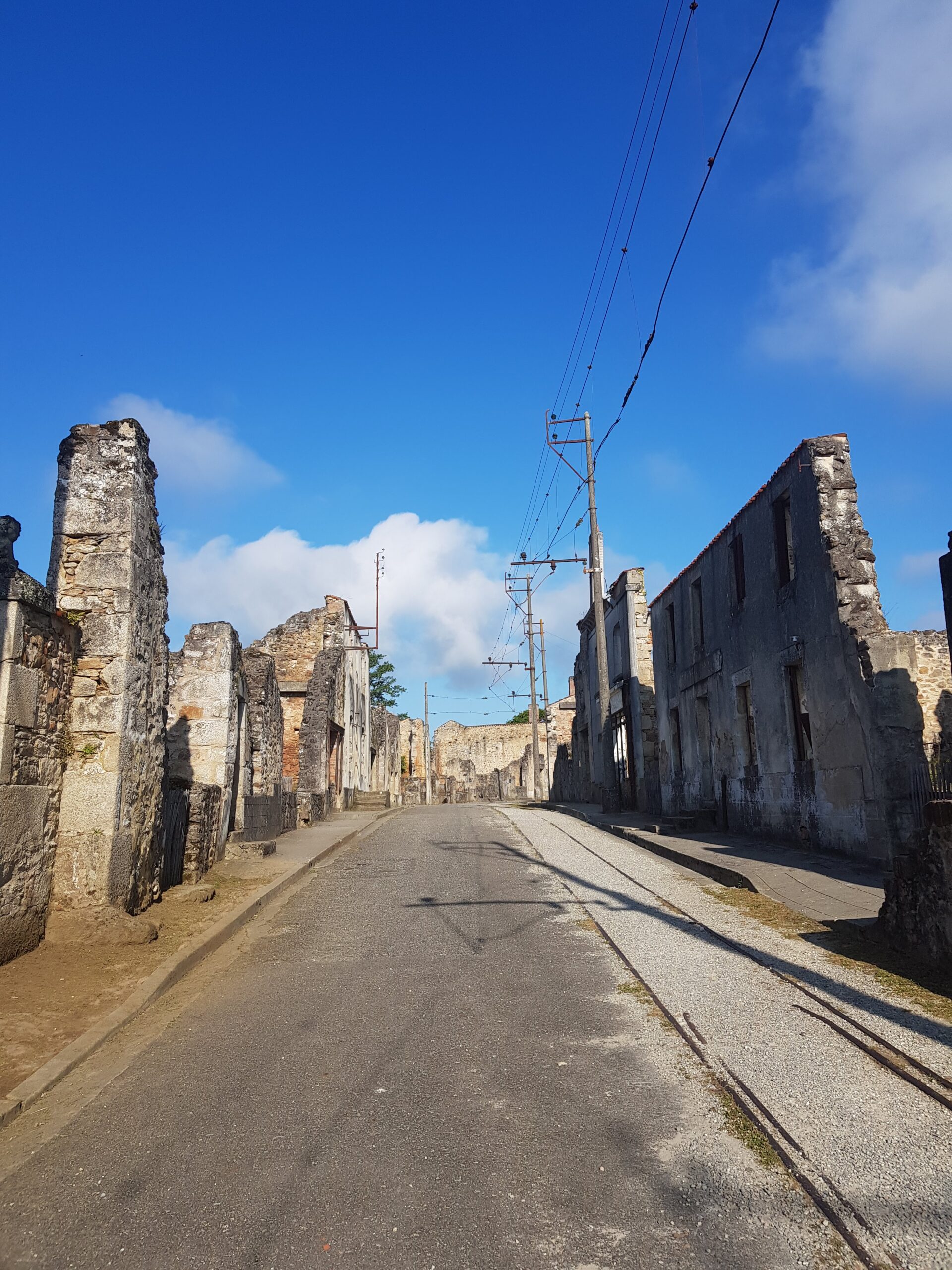
Walking around did feel very surreal, as if this was some sort of open air museum. The beautiful sunny day meant that it didn’t feel like the site of a massacre, and so coming across signs noting people died on a particular spot was always a shock. I also found it interesting to see the buildings themselves, and all of the different layers of history within them, such as when extensions had been added or there were changes in building styles.


Above a number of photos along the main road of the former town, showing that it was a relatively substantial settlement. What look like power lines in the above two photos are tram lines, as there was a tram service which operated to Limoges.
On the day of the attack in 1944, a tram came into the town from Limoges, and the Germans stopped it. They shot dead the engineer and sent the tram and its driver back to Limoges, a decision that didn’t quite make sense to me. Nor did the fact that the tram then picked up more passengers and went back to Limoges, where it was stopped again. The passengers were allowed to go free, as long as they didn’t go into Oradour, but it’s another strange sequence of events which suggests that there was some considerable confusion on the day.


The above photos are of the church, where the women and children of the town were killed. The lump of metal are the bells, which melted in the heat of the fire which was started after the killings. There are also bullet marks still visible in the walls of the church.


The exterior of the former town garage.


There are several of these markers around the site, they show where the men were killed during the day.


There’s an underground memorial on the site to those who died here, although I feel it’s a slightly strange design. I’m not sure why it needs to be underground like this, but it does feel quite atmospheric.

A sign in the memorial centre.

A list of those who died in the Oradour massacre.


The above photos show the range of material which was found in the houses following the looting and destruction of them. Much of the material, particularly that relating to children, is rather emotive.


As can be seen from the above lettering, this was once the town’s tram station and I’m intrigued that the trams went such long distances.


Above are photos of the town’s graveyard, which is within the enclosed historic site. Many of those killed have graves here, and they’re all remembered at the official memorial. The coffins with bones in are another reminder of the horrors of the massacre, but the graves are well tended and dignified. Some of the graves have photos on them of those were killed, which adds a more personal feel to them.

This phone box felt out of place, and it wasn’t actually here when the Germans raided the town. It was installed shortly afterwards for the visit of Charles de Gaulle when he came to see the damage done at Oradour.

As an historical site, I’m very pleased that I got to visit Oradour sur Glane after so many years of knowing about it. It wasn’t busy, which meant that I felt that I got a fuller experience. I’d also recommend that others go if they’re interested in history and I’m sure most people would find their experience memorable.
I did though note that someone left a negative review on TripAdvisor about the site. They said that it was a bit boring, and perhaps there could be some reenactments at the site to make it more interesting. A more stupid idea I don’t think I’ve ever heard, if they ever let people dress up as Nazis to reenact a massacre then I think I’d be the first to be writing a letter of complaint. Fortunately, wiser heads have prevailed and the site is dignified, peaceful and well maintained.

A newspaper article published in the Liverpool Echo around a week after the massacre. It’s an interesting first perspective as to what was being reported at the time. It’s a little hard to read as it’s a screenshot, but it’s just readable if you click on the image and stare closely at the screen….

This sign is present on the main exits to the site. Remember.