
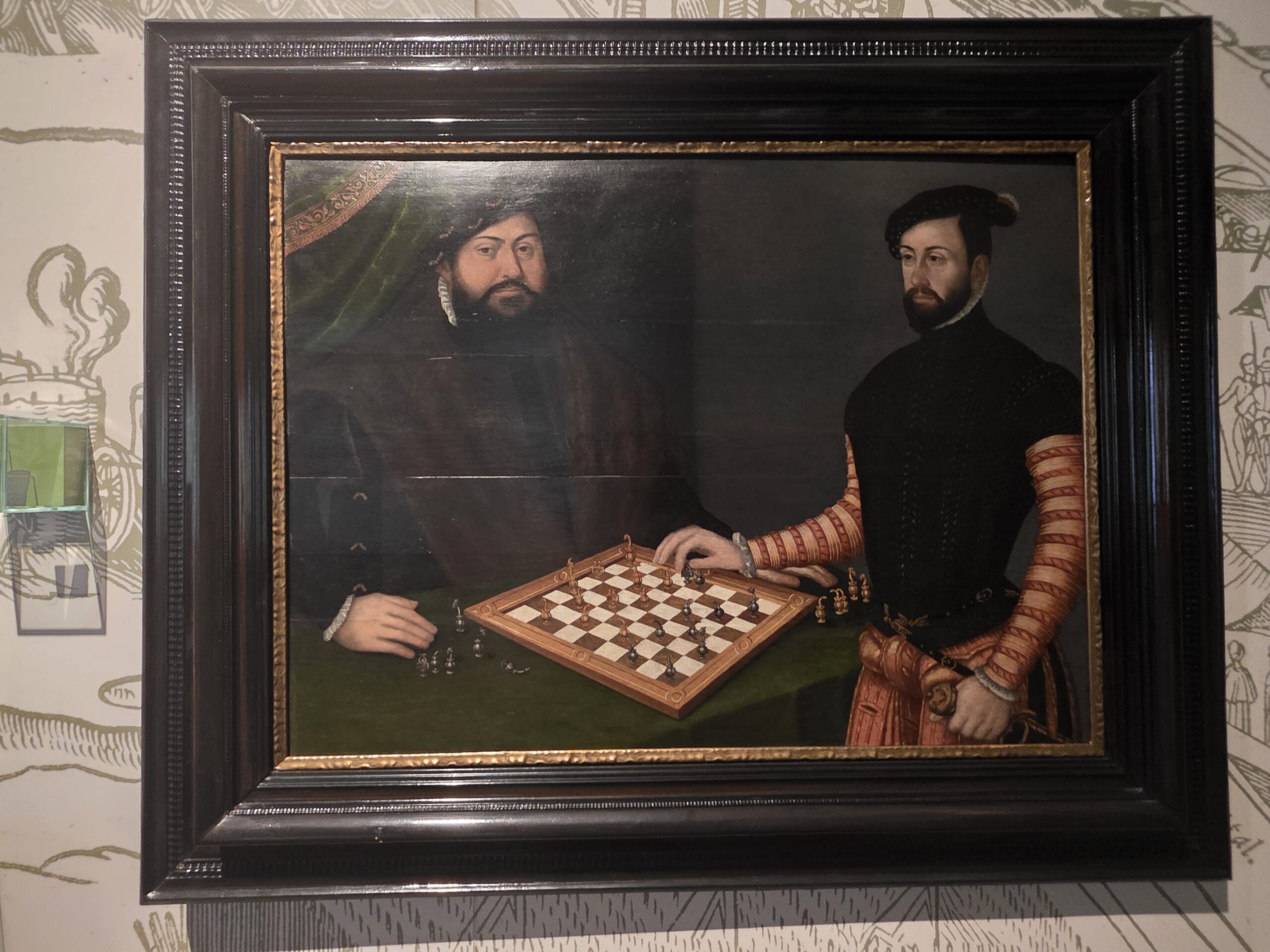

I love a bit of political symbolism in artworks (I don’t get out much) and this is a suitably interesting example of it. The painting shows Elector Johann Friedrich I of Saxony (1503-1554) on the left, also known as Johann Friedrich the Magnanimous, who was captured in 1547 after the Battle of Mühlberg during the Schmalkaldic War. He was taken prisoner by Emperor Charles V, and his defeat marked a major blow to the Protestant cause within the Holy Roman Empire.
This portrait, which was painted after his capture, symbolises both his imprisonment and his resilience. The chessboard here is important, it is meant to represent the great game of power between the emperor and the elector. The artist, who I don’t think is known, is showing Johann as a man of calm demeanour and a man who is still playing the game, even in defeat.
Johann was actually already in checkmate in political terms, although he did get freedom in September 1552. As an aside, he married Sibylle of Cleves, who was sister of Anne of Cleeves, perhaps best known (rightly or wrongly) for actually managing not to get killed by her husband King Henry VIII.