
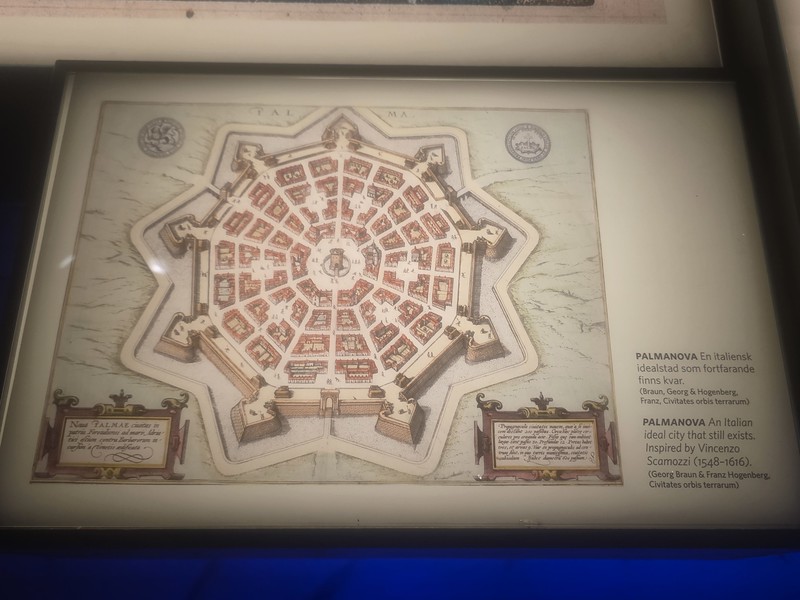

I discovered two things from this map in the museum. It’s the layout of Palmanova, which stands testament to the Renaissance ideal of the “perfect city”, although I’d never heard of it before. Designed in 1593 by architects like Vincenzo Scamozzi, the Italian city was built as a nine-pointed star with mathematical precision, intended to serve as both a military fortress against the Ottoman Empire and a harmonious utopian society where every road and square had a specific geometric purpose. It’s all still there, I’ve decided that I need to visit it.
And the other thing I discovered is that this piece of meticulous urban planning directly mirrors the foundation of Gothenburg itself. Founded in 1621, Gothenburg was not a town that grew organically over time, it was also a “planned city”, which was constructed from scratch on marshland by Dutch engineers. Much like Palmanova, the early layout of Gothenburg was defined by its rigid, zigzagging fortifications and a strategic network of canals that provided both defence and drainage.
Gothenburg over time has developed in a rather less planned way and so the original design clarity has somewhat been lost. However, the organised grid layout is visible today along with the defensive fortifications, it just took the museum to point them out to me.