
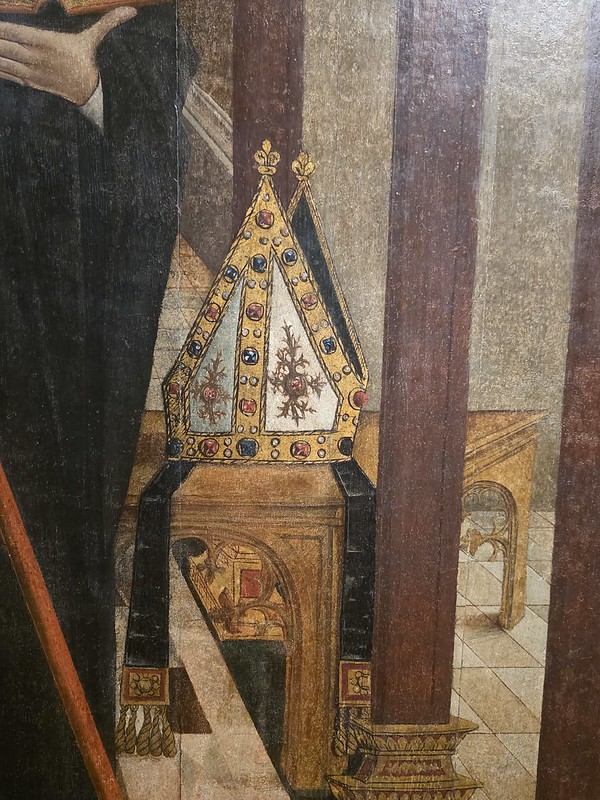

There’s a lot to be said for paintings where the gallery isn’t actually sure who is in the image, that ensures that there’s room for some debate. The gallery knows it’s from Funchal Cathedral, they think it’s from Portugal, they think it’s fifteenth century and they think it might be St. Benedict.

A close-up of the mitre and ChatGPT agrees, noting:
“This is almost certainly St Benedict of Nursia. The clues are the black monastic habit (Benedictines are traditionally shown in black), the open book (his Rule, or monastic learning more generally) and the abbot’s crozier (the staff, marking him out as an abbot or founder figure rather than just “generic monk”). The very calm, frontal pose in a grand architectural setting is also a common way Renaissance and late medieval painters present major founders and reformers: not mid miracle, more “here is the authority figure, in his element”.”
Incidentally, Benedict is known for his guidelines on how to be a decent monk, and I rather like the:
“Chapter 30 directs that a wayward brother who has left the monastery must be received again, if he promises to make amends; but if he leaves again, and again, after his third departure all return is finally barred”
Even Christians have their limit of tolerance it seems.
Going back to AI, which I know is now a running theme on this blog, but I asked it about the age of the painting and it noted:
“Visually, it’s very much in that early Renaissance habit of showing a saint as a solid, frontal presence in a carefully constructed architectural space. The big tell is the perspective: the receding arcade, the coffered or ribbed vaulting and the tiled floor are all doing that 15th-century “look, I can do depth properly” thing. The gilded decorative bits around the arches feel like a hangover from late medieval taste, which is also common in the earlier part of the Renaissance rather than the later, more fully naturalistic 16th century. I would put it plausibly at say 1480 to 1510.”
That’s entirely in keeping with what the gallery thinks and I rather like the way in which this logic on dating is being explained. Work on Funchal Cathedral was coming to an end in 1508, so my best guess (helped by AI) is that they acquired this for when it opened.