
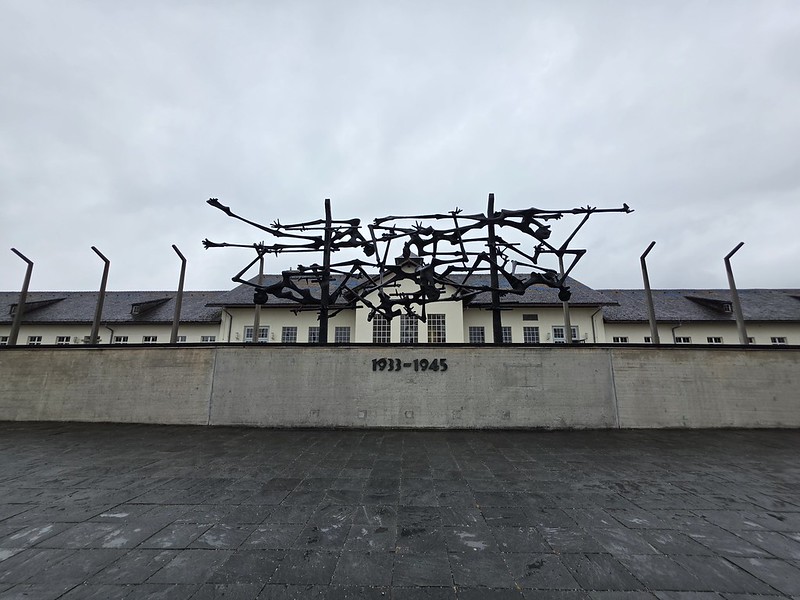

This sculpture sits on the wall marked “1933–1945” in front of the former maintenance building, which now houses the main museum at Dachau. The monument was created by the Yugoslav sculptor Nandor Glid (1924-1997), a Jewish partisan whose father was murdered at Auschwitz, and it was chosen through an international competition organised by the committee of former Dachau prisoners. It was unveiled in September 1968 and from a distance the work reads like fencing, uprights and strands that echo the camp’s perimeter but it’s then evident that it resolves into emaciated human forms entangled in barbed wire. The design is to allow the visitor to see the fence as more than infrastructure and the bodies as more than symbols. It is deliberately spare, without heroics or narrative scenes, so the viewer is left with the simple geometry of a system and the people it consumed.

The main monument is large, roughly sixteen metres wide and over six metres high, and it anchors the roll-call square where prisoners once stood for hours in all weather. Nearby is this low relief showing interlinked prisoner triangles, the coloured badges used by the SS to classify inmates by category.
The whole arrangement is powerful, especially the way in which it faces the parade ground where the ridiculous roll-calls would take place, designed to humiliate and exhaust the prisoners. I quite like these hefty sculptures, but there doesn’t seem much point trying for subtlety here when the focus needs to be on confronting what happened at Dachau.