
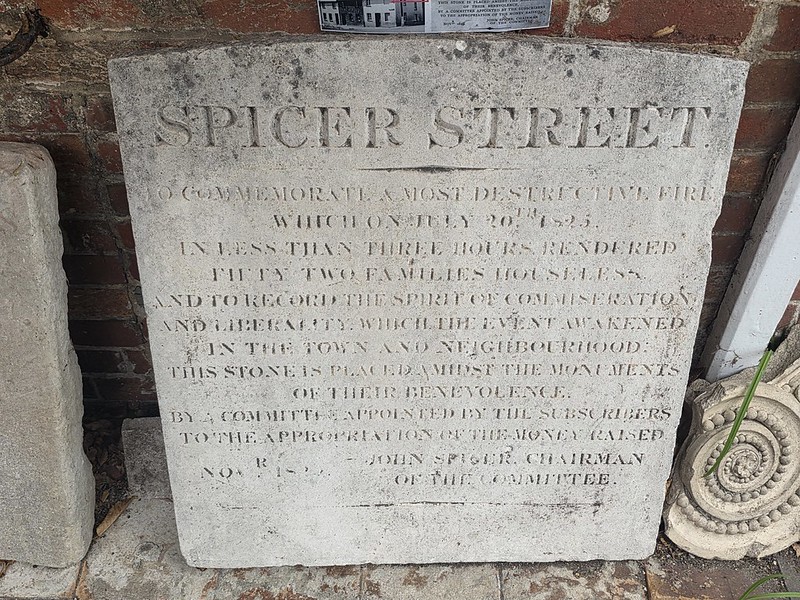

This stone memorial is located in the garden of the Red House Museum in Christchurch and it reads:
“SPICER STREET
To commemorate a most destructive fire which on July 20th 1825 in less than three hours rendered fifty two families houseless, and to record the spirit of compassion and liberality which the event awakened in the town and neighbourhood this stone is placed amidst the monuments of their benevolence.
By a committee appointed by the subscribers to the appropriation of the money raised.
Novr. 1825
John Spicer, Chairman of the Committee.”
The house that this memorial was attached to was demolished in the late 1930s, so it has made its way here. The day after the tragedy, a national newspaper published a letter written by a local:
“As you will hear of the distressing fire which happened this morning in this town, I think it best, to prevent your uneasiness on my account, to state the case as far as it has at present proceeded. The fire broke out at about eleven o’clock, in the New Town, a little above Mr. Aldridge’s, and had the wind continued as it then was, the destruction of the whole town it appears would have been inevitable; but very providentially the wind took the direction of the fields, and thereby is is hoped many houses will be saved. Some time since I heard there were at least 50 houses burnt down, and the fire, though much subdued, is still burning in various parts. You can scarcely think with what rapidity it spread, the houses being chiefly thatched, and many of mud walls—the intense heat of the weather, and the dryness of the buildings, no doubt contributed to the work of desolation.—What renders it very afflicting is, that the sufferers are chiefly poor people, who, although it is hoped they have saved many of their things, will still be great losers. The bellman has just been through the town, calling a meeting of the inhabitants this day, at four o’clock, to take into consideration what will be the best mode of providing for their present relief. They will, I should think, have to sleep to-night in the fields, which are strewed with beds, &c. that are saved. It is on this account a happy circumstance that the nights are so hot. I hope something will be done to reinstate them in their dwellings, and that the destructive element will be shortly subdued. Some person in each house will no doubt sit up all night, for there is a general alarm.”

The museum has a photo of where the commemorative stone was once placed, seemingly blocking up the view from Mrs Preston’s window. Anyway, it’s marvellous that the stone has been kept so that at least the memory of what happened 200 years ago isn’t forgotten.