
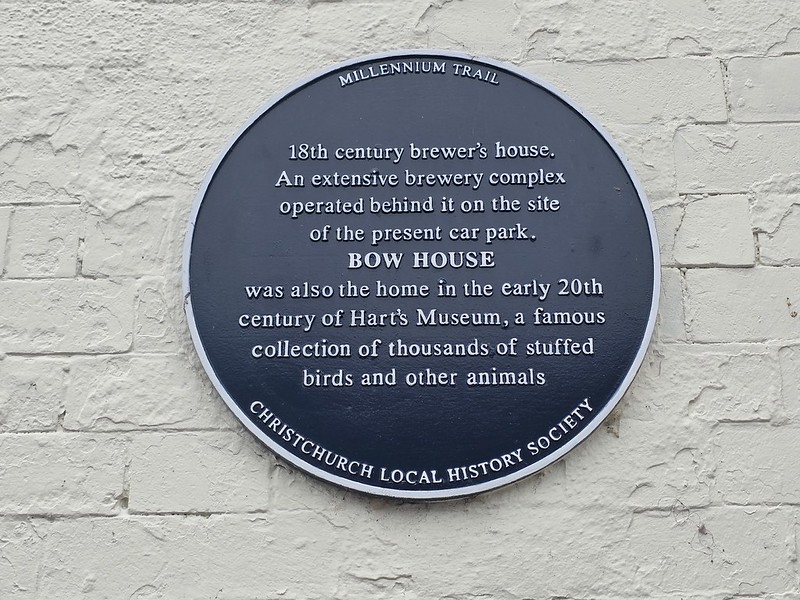

I like a blue plaque and Christchurch Local History Society has placed a fair number of these around the town. Bow House was built as a brewer’s house in the eighteenth century, it was then occupied by the taxidermist Edward Hart before becoming a building society in the twentieth century and it’s now a dentists.

It’s perhaps the period when it was occupied by Edward Hart (1847-1928) that is the more interesting time as he turned it into a museum of the things that he had stuffed. There’s plenty of information about him on the Hampshire Cultural Trust website and they mention:
“Edward worked at William’s [his father] new premises for several years, learning the art of taxidermy, until he opened his own business at 23 High Street (The Bow House).
As well as preparing animals and birds for local sportsmen, Edward started his own collection. Most of his specimens were taken between 1867 and 1897. In 1866, his collection was large enough to open a museum in ‘The Bow House’, which is now the Portman Building Society.
Hart’s Museum received many visitors, including Sir Robert and Lady Baden-Powell in March 1914. The building was described as ‘warm, well-lit and very clean, the ideal of a private museum, every part of which is crowded with rare and beautiful birds.’
The Public Natural History Museum for Bournemouth attempted to buy the collection to keep it in one piece, but that didn’t work out.
“After the death of John Hall, the collection was passed to Stowe School in Buckinghamshire where they remained until 1983. The collection was, by this time, in a sad state of neglect and staff at Leicester Museum took them on for conservation and safe storage. Unfortunately a number of cases were beyond repair and had to be disposed of. In the early 1980’s, Stowe School offered the collection for sale and they were purchased by the Horniman Museum, Leicester Museum and Hampshire County Council Museums Service (HCCMS). Twenty two cases were purchased by the latter and chosen, not only as fine examples of taxidermy, but also because the backgrounds show Christchurch at the time the birds were shot.”
The building is listed and this states:
“C18. Painted brick facade with dentilled eaves cornice. Tiled roof. 2 storeys and attic with a pedimented dormer. 2 bays each of 3 windows, unbarred sashes. Doorway with pilasters, broken scroll pediment and door of 6 fielded panels, the top 2 panels cut away and glazed.”
The Christchurch Brewery was located behind this house, but that history was all swept away in the 1970s when they wanted to build a lovely new car park. Looking at old maps, it’s not entirely clear that there was a great deal to preserve from this period and I’m not sure that the buildings were very notable.