Category: Ickworth

  • Ickworth House – Painting of Catherine Poley, Mrs Edward Barker

    Ickworth House – Painting of Catherine Poley, Mrs Edward Barker

    20250413_132005

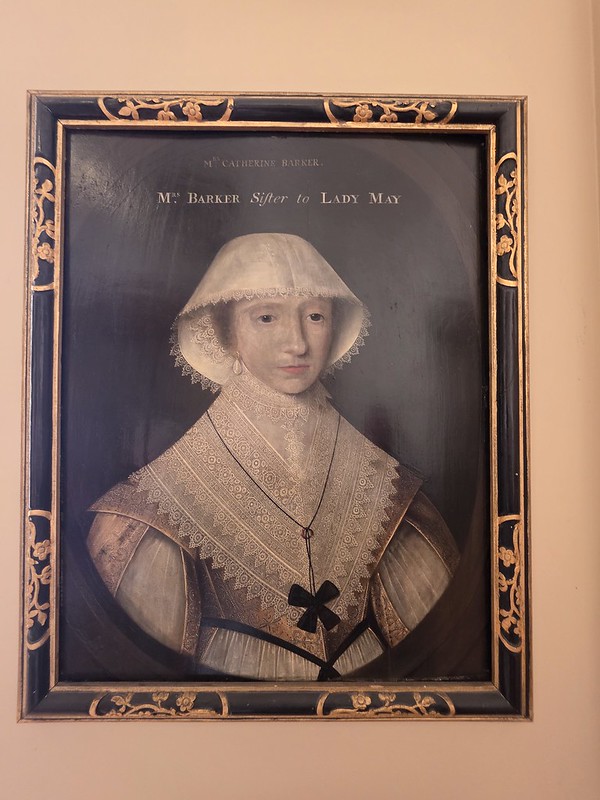
    This painting is located within the collections of Ickworth House and the sitter is Catherine Poley, Mrs Edward Barker (1600-1665). It was painted at some point between 1630 and 1669 and the artwork was acquired by the National Trust in 1956 having been accepted by HM Treasury in lieu of tax. On the back of the painting it apparently states “My Ladie Harvis picter when I am dead” which I assume to mean “My Lady Harvis’s picture when I am dead”, or please keep this portrait after she died. The front states “Mrs Barker, Sister to Lady May” and I assume that’s Isabella May (1625-1686) who married Sir Thomas Hervey and it’s the Hervey family who owned Ickworth.

    I rather like the formality of it all, this wasn’t a time to show joviality and excitement, instead it’s formal, rigid and stiff. And that lace wouldn’t have come cheap, might as well show that off to anyone who might see. It’s so severe that perhaps there’s an element of the Puritans about it, although the Hervey family were pro-Monarchy during the Civil war and they even raised a regiment of men to fight against the Parliamentarians.

  • Ickworth House – Frederick Augustus Hervey and the Grand Tour Theme

    Ickworth House – Frederick Augustus Hervey and the Grand Tour Theme

    20250413_130434

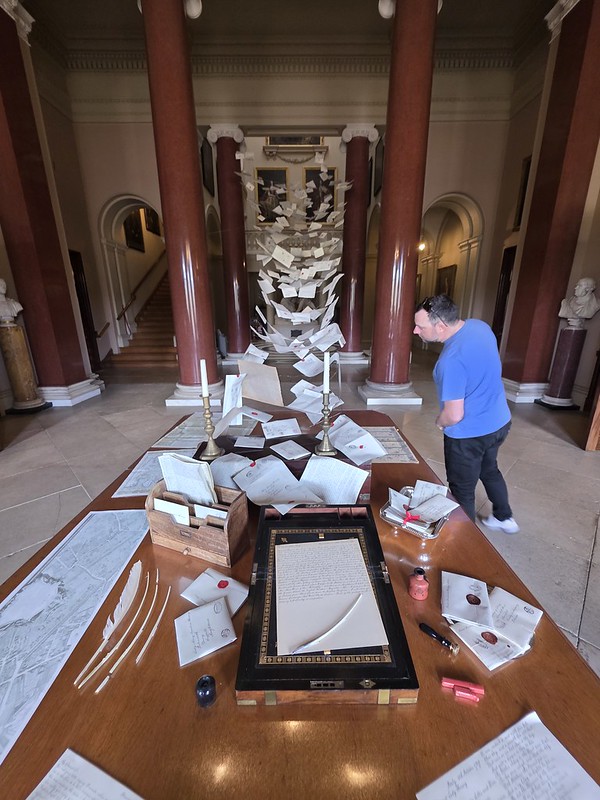
    When we entered Ickworth House the friendly volunteer explained numerous things, including that they’ve got a theme this year of the Grand Tour and hence the decorative element in the main entrance hall. A little disappointingly, there’s nothing I can find on-line from the National Trust about this focus and the curation didn’t flow very well at the house either and they had put odds and sods around the place.

    Going back, the driving force behind Ickworth House was Frederick Augustus Hervey (1730-1803), the 4th Earl of Bristol and Bishop of Derry. He was a little odd, or eccentric, whichever you prefer. On that theme, perhaps the most infamous anecdote illustrating his disregard for social and religious norms occurred in Siena. According to accounts, he deliberately threw a tureen of pasta from his hotel window directly onto a passing procession carrying the Host, the consecrated elements central to Catholic belief. The locals were not best pleased. As a more positive legacy, one of the Earl-Bishop’s most enduring legacies stems directly from his eccentric travel habits. His reputation as an epicurean and a demanding traveller, who insisted on the highest standards of comfort, cuisine and wine, became widely known across Europe. Consequently, numerous hotels seeking to advertise their quality and luxury began naming themselves “Hotel Bristol”, although there’s more on this theory at https://en.wikipedia.org/wiki/Hotel_Bristol.

    Hervey owned Ickworth Lodge, which was really just a decadent farmhouse, but he wanted to create a country house with classical elements that would surprise and delight others. He declared that he wanted to “unite magnificence with convenience and simplicity with dignity, no redundancy, no superfluity, no one unnecessary room, but the necessary ones to be noble and convenient” which seemed an admirable aim.

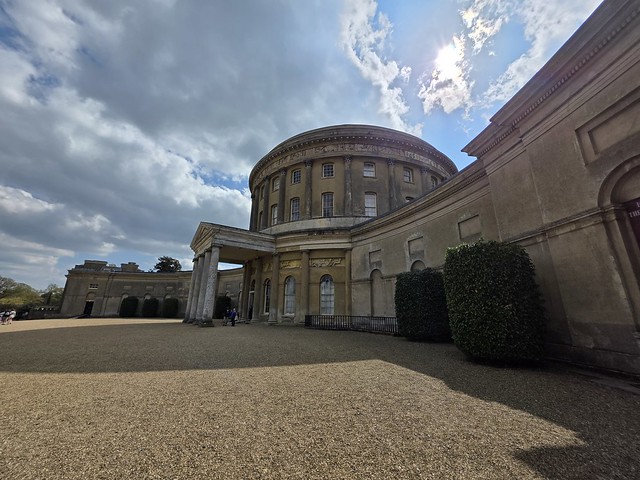
    The Earl Bishop travelled extensively across Europe, particularly focusing on Italy, and he wanted to move the Italian Neoclassical architecture to his Suffolk estate. Central to this was his engagement with the work of Italian architects, specifically Mario Asprucci the Younger (1764-1804). The Earl-Bishop had seen Asprucci’s work, most notably at the Villa Borghese in Rome, and commissioned him to provide designs for Ickworth. The commissioning of an Italian architect for a major English country house, based on direct experience of Italian models, highlights the cosmopolitan nature of elite architectural patronage during this period. It’s also why the house looks and feels like it does today.

    But, it’s a fascinating theme for the National Trust to pursue, I’ve wondered before just how inspirational a grand tour across Europe must have been in the 1700s and 1800s.

  • Ickworth House

    Ickworth House

    20250413_130212

    Liam and I popped into Ickworth House on the way back to Norwich and I realised that I hadn’t visited here for 40 years. I don’t wish to linger on this thought as it doesn’t fit the obvious truism (obvious to me) that I’m a millennial.

    20250413_135433

    The parkland in front of the property.

    20250413_125722

    The rather nice second hand bookshop, but I restrained myself from buying anything.

    20250413_133805

    Liam playing bagatelle, which is likely a forerunner of bar billiards. On that point, I haven’t yet mentioned in detail my day at the World Championships, I’ll get to that soon hopefully… Although there’s a lot of stuff on this blog I’m meant to be getting around to.

    20250413_132419

    I loved that they’ve put books into lots of niches around the house. If I had a large property, which is unlikely and a bit unnecessary, I’d likely do something similar and the situation would soon get out of control. Liam commented something similar, but I ignored him.

    Anyway, to set the timeline here:

    1779: Frederick Hervey (later the ‘Earl-Bishop’) inherits the Ickworth estate.

    c. 1795: The Earl-Bishop commissions initial Neoclassical designs for a new house from Italian architect Mario Asprucci the Younger. The concept is primarily for an art gallery.

    1795 / 1796: Construction begins. Irish architects Francis and Joseph Sandys adapt Asprucci’s designs and oversee the work.

    1798: The Earl-Bishop’s extensive art collection, intended for Ickworth, is confiscated in Rome by Napoleonic forces.

    1803: The Earl-Bishop dies in Italy. Construction halts, leaving the house, primarily the Rotunda, as an unfinished shell.

    c. 1821 – 1830: Construction resumes under the Earl-Bishop’s son, Frederick William Hervey (later 1st Marquess of Bristol). The main structure, including the wings, is completed. Architect John Field is involved in adapting and completing the interiors.

    1829: The 1st Marquess and his family move into the completed house. The East Wing becomes the family residence, and the Rotunda is used for display and entertaining. The West Wing remains largely unfinished.

    c. 1830: Interior fittings, including marble fireplaces, Scagliola columns, and coved ceilings, are largely complete.

    c. 1879: The 3rd Marquess commissions architect Francis Penrose for internal improvements. The Pompeian Room (decorated by J.D. Crace) and the Smoking Room are created in projecting bays off the linking corridors.

    c. 1907 – 1910: The 4th Marquess commissions architect Sir Reginald Blomfield (or possibly A.C. Blomfield) for further interior alterations, including remodelling the main staircase in the Rotunda and modernisations in the East Wing.

    1930s: Theodora, Marchioness of Bristol, renovates the servants’ quarters in the Rotunda basement, adding modern amenities like electricity and improved plumbing.

    1956: Following the death of the 4th Marquess, the house, contents, park, and endowment are transferred to the National Trust via HM Treasury in lieu of death duties. The Hervey family retains a lease on the East Wing.

    1998: The 7th Marquess sells the remaining term of the lease on the East Wing to the National Trust, ending the family’s residential connection.

    2002: The East Wing is converted and opens as The Ickworth Hotel, operated under lease from the National Trust. Childs Sulzmann Architects are involved.

    2006: The previously unfinished West Wing is completed and opened as a visitor centre, restaurant, shop, and events venue, in partnership with Sodexo Prestige. Hopkins Architects are associated with this phase.

    2018 – 2020: The major ‘Ickworth Uncovered’ conservation project takes place, involving the complete re-roofing of the Rotunda dome and East Link corridor.

    As is my wont, I’ll post numerous other things separately about the property, but I was genuinely very impressed with the volunteers here who were pro-active, engaging and keen to tell visitors about the history of the building. As I like wittering on about history, this did extend our visit somewhat, but it’s always a delight when there’s an enthusiasm from everyone involved with the project. The navigation route around the house was also carefully laid out and it was clear where to go, there has been a lot of thought put into this entire operation.