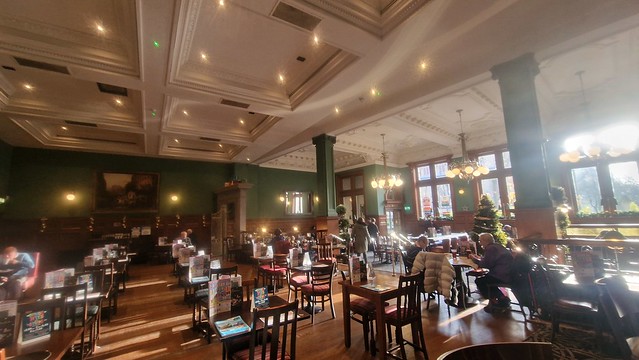
With just my usual element of incompetence I didn’t get many photos of this lounge as it was so busy, so I’m using a promotional photo to add just a little colour to arrangements. I got into the lounge earlier than the three hours they allow before the flight and I noticed that there was a sign saying the lounge was full, but you could join their on-line waiting list. This has worked well for me at Stansted Airport and so I signed up to patiently wait and as there wasn’t an estimated waiting time I went to ask at the reception desk, but she kindly said I could come in immediately as I was on my own. Most lovely and there were no issues with using my Priority Pass card.
Another promotional photo…. There’s no charge for alcoholic drinks, other than a surcharge for Prosecco, but it’s all bar service.
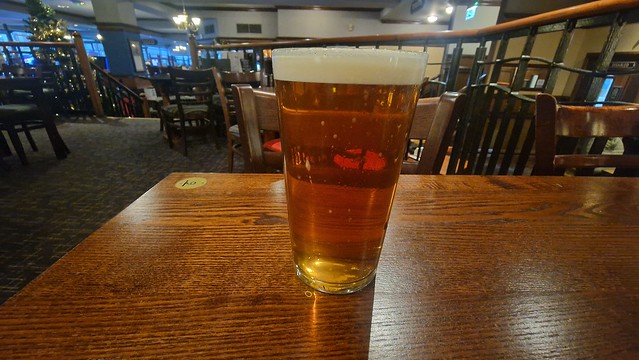
I found a power point that worked to charge my ailing phone and it might be evident that this isn’t a promotional photo taken by the lounge. The food selection was actually surprisingly good, there were a range of different sandwiches and I very much liked the stew and dumplings. The beer is the John Smiths Extra Smooth and my friend James would have been proud of me for choosing that. The stew had a depth of flavour and the dumplings had just the right firmness to them, they were the best part of my airport visit to be fair.
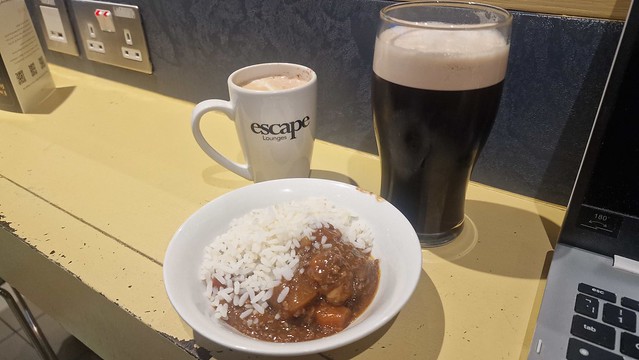
More stew and dumplings with some rice added to the mix, alongside a Guinness this time as well as a coffee.
The lounge remained very busy and for about twenty minutes the entire Manchester United youth team came in, although they didn’t eat or drink much, so I’m not sure if there was much value to that. And this lounge is expensive, just shy of £40 for walk-ins, although cheaper rates are available for advance purchase. Despite how busy it was, I thought that the staff were doing really very well to keep up and they remained friendly throughout. The lounge is unusually highly rated, so there must be an element of the excellent customer service shining through there.
When writing about the terminal in my last enthralling post, I mentioned that it was used nearly entirely for Ryanair and British Airways passengers. Most of the angry reviews are from customers of the latter, not least this:
“In thirty years of traveling and using lounges all over the world, tonight I encountered something for the first time: no seats. Not just crowded but not one single seat available. A small, shabby looking lounge to begin with has outdone itself. So ahead of an 11-hour flight, I now have to stand around until boarding. Shame, BA.”
There are a few angry BA passengers out there…. The signage is initially just a little unclear as it points two ways for the Escape Lounge, but it appears that they have a second area. It was all closed off when I was there, but I suspect it’s opened up during busier periods of the year, as otherwise this lounge must be regularly at near capacity. Anyway, I was very pleased with this lounge visit, I left with sufficient power in my devices, a couple of beers and more than enough food. What more could I want from life?
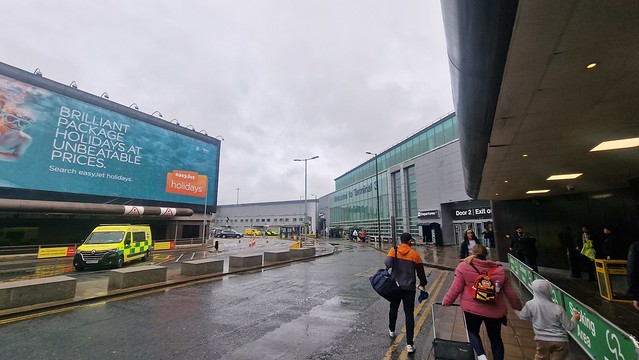
After a very lovely weekend of six of us celebrating my birthday early in Manchester (I’ll get to posting about that soon enough….), Liam kindly dropped me off at Manchester Airport. He didn’t offer to pay £5 to drop me off in front of the terminal (mind you, he wouldn’t pay £5 to drop himself off, hence the famous walking incident he took his wife on at Stansted many years, but I digress), so I had to make do with the free bus shuttle that runs every fifteen minutes.
Seventeen minutes after being dropped off the shuttle arrived and I was the only person on it. I was departing from Terminal 3 and although I wasn’t asked this, I proffered this information to the friendly driver anyway. We get to Terminal 1 and he calls down the bus that this is where I can get off. That was actually very helpful, I hadn’t realised Terminal 1 and 3 are next to each other so I might have been sitting on a shuttle bus going around and around before realising what was happening. Terminal 3 is a very odd mix, it’s effectively only used by Ryanair and British Airways.
And here we are at Manchester Airport Terminal 3, the first time I’ve flown from here.
I always try and be positive, but this is a bloody dreadful airport terminal. Looking at surveys, Manchester Airport regularly appears at the bottom of the lists and this terminal is the worst rated. There was no seating available before security so I tried to go through. My boarding pass was rejected at the automatic gate and a staff member came over to check and he suggested trying again later. That’s not overly helpful in terms of I didn’t know when “later” would be, although it transpired that you can only go through 3 hours and 40 minutes before the flight. That doesn’t feel like a time that anyone might actually guess, it might have been useful for them to mention this in signage as some airports do. Anyway, I’m then stuck waiting there for the 15 minutes (I was just under 4 hours early, as some things never change) trying not to get in the way of other passengers and unsure where to wait for the best.
I have huge amounts of sympathy for airport security staff, it’s a thankless task in very many ways. They were always polite here, but some of them looked worn down and there was no shortage of rude passengers. The queueing system was a bit illogical, crammed into too small a space and just uncomfortable, it made things feel a little too much like a cattle pen. The signage in the airport was muddled to say the least and the airport management hadn’t overly troubled themselves with having the airport terminal cleaned. I think much of this is that they simply don’t have enough space, there are too many passengers in the space that they have and there’s not enough seating. I don’t need to sit down (being young and strapping, or something like that….) but many people do, with the set-up here feeling sub-optimal. There is though a massive investment going in to improve the space, so matters might improve somewhat over the next couple of years.
Anyway, after 25 minutes getting through security, which seemed longer than it actually was, I thought I’d try and get into a lounge a little early to escape the chaos and limited facilities. More on which in the next post….
Back to Poznan Airport and this is a sculpture by Henryk Gida Bakalarczyk, it makes quite an impact in the departures area just before security.
There’s my flight to Luton Airport, using the Wizz Air all you can fly pass that I decided to get to try it out, so that means it’s £8.99 for the flight.
After visiting the lounge and going through border control, the non-Schengen area of the airport is quite sizeable with plenty of seating.
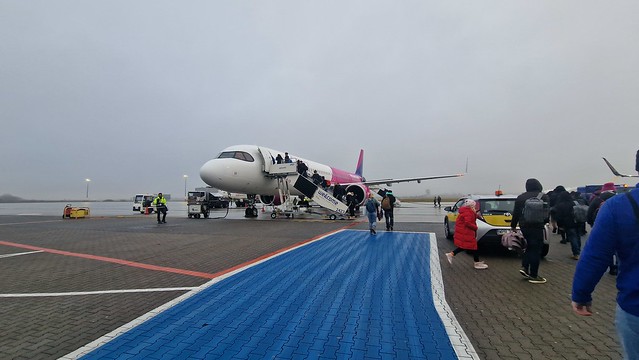
They were boarding the aircraft early and, as ever, it was all efficient and organised.
And boarding.
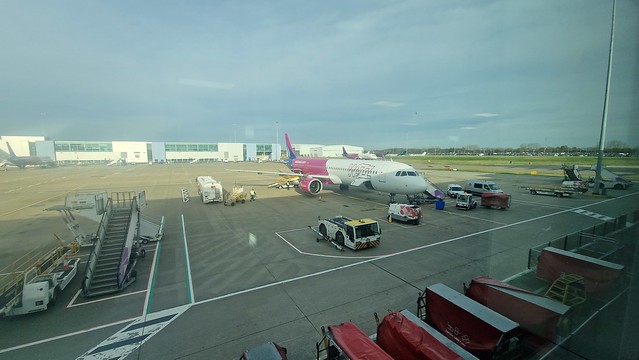
I take these photos in the hope of capturing the registration of the aircraft, otherwise I have to look it up. And it isn’t visible, so I did have to go and look it up, it’s G-WUNA, I don’t think it’s an aircraft I’ve been on before. By chance, it was the first anniversary of Wizz Air bringing this aircraft into service, but they didn’t provide us with cake or anything to mark that milestone.
And safely back into Luton Airport. It wasn’t the most comfortable journeys as I was in the middle seat and felt a little cramped on this journey, but it’s a relatively short flight and I amused myself watching stuff on my phone. There were some winds from Storm Darragh which added some extra excitement in terms of the landing, although it was otherwise uneventful. There was absolutely no delay at all with getting through border control as there was no queue, so plenty of staffing once again at Luton Airport.
It was very lovely, thank you Wizz Air. I still like this all you can fly pass, it wasn’t the longest stay in Poznan, but there seemed to be a suitable choice of destinations that I could go to. I’m already occupied with other things this week, but hopefully I’ll get to use the pass again in December and perhaps quite a lot in the new year.
The sun was shining and Luton Airport glistened once again with its raw beauty and charm. I find this one of the better airports to fly through, it’s not necessarily the most decadent in many ways, but it does tend to have sufficient staff. It took just four minutes to get through security, although as ever I’d allowed for it to take an hour. The flight was the first one that I had booked with the All You Can Fly pass.
A quick visit to Big Smoke using my Priority Pass card, it’s a handy place to charge devices and sit in relative comfort and peace. The card really is a useful little thing and I like that they’re generous with how it can be used at a number of restaurants at some airports. The staff at Big Smoke are helpful, although they don’t like card holders sitting in the bar area which is where I’d naturally default to, just because it’s QR code only ordering there. Card holders get £18 to spend there, which covers these chicken tenders and this time I went for the Medicine Man IPA, which is hoppy, juicy and with a taste of pineapple. It was better than I remember it being a few weeks ago, but maybe I was just in a good mood. This location is very fast paced, but the staff never give the appearance of being panicked, even when they have some customers who seem to be quite challenging.
When the server came along, I mentioned that I would wait ten minutes for the lunch menu to start, but the server mentioned he’d take the order immediately and send it through to the kitchen and the chicken tenders arrived promptly. They taste decent and along with some craft beer, it’s a comfortable place to wait.
Then off to Avalon to use the Priority Pass card again. I could have also gone to the lounge and the Italian Nolito, but I felt this was more than enough. They stack the amount up to the full £18, but it was handy to have a sandwich for later on. Always friendly staff at Avalon and the coffee tastes good. Incidentally, I always thought that Cawston Press had some sort of presence in Norfolk, but reading the can (I don’t get out much) its Head Office and centre of operations is Kettering. Now, I know Kettering (permanently linked with James Acaster now) is perfectly acceptable as being the home of a drinks company, but it’s just not quite what I expected. If not Cawston, I’m sure they could have opened a little place in Aylsham.
Mine was the 12:25 to Poznan, so I meandered off to the gate content that I’d had a coffee, beer and chicken tenders. This seems to me to be the very basis of a balanced diet.
A view of the area in front of the airport that I’ve never much noticed when walking to the gate. I can’t say that this is exactly riveting, but it amused me for about three seconds.
And safely at the gate. Even though I did work for British Airways for a long time and so have a natural bias, they never really sorted out the efficiency of their check-in process, it varied enormously even within the same airport. Wizz Air are very precise, timely and it works for me to stay seated until the queue has nearly gone through and I join the back. No stress, no faffing about in groups and just easy boarding.
Boarding, again all efficient and most passengers worked out which door they had to board through.
I’m a little cheap and so I refuse to pay for seat selection, but the airline Gods smiled upon me and I ended up with a window seat anyway which was handy.
Safely in Poznan and it was raining, which made my decision for me, I wasn’t going to walk to the hotel. I rarely have much to write about these flights, partly because I fall asleep and partly because they’re so standard because they’ve got the processes sorted. The crew are welcoming, they do their swoop down the aircraft selling food and drink, then they have a go at selling other things and then we land. They’re very alert to safety issues and manage the take-off and landing processes well, they never really give me any cause for concern or annoyance.
For the sake of completion, since I wrote about my visit to the other JD Wetherspoon in Preston (the Twelve Tellers) before I went on a tour of the Preston pubs that are listed in the Good Beer Guide. This is the Grey Friar, a modern venue and JD Wetherspoon note about the name:
“This is named after the Franciscan monks (known as Grey Friars from the colour of their habit) who founded a nearby friary in the early 13th century. The friary was founded around 1220. It gave its name to Friargate, but was actually in Marsh Lane (formerly Friars Lane), between Lower Pitt Street and Ladywell Street. The Franciscans, or Grey Friars, are also remembered in the name of this pub.”
I went for the Hoppy Christmas from Conwy Brewery and it wasn’t great, it was well kept but there was no depth of taste here and an almost unpleasant bitterness. It was tolerable and I had thought it was the best looking of the three Christmas beers that they had. Not that I wanted a Christmas themed beer, it was just the only three guests that they had were all Christmas themed. Service was slightly sluggish, but I wasn’t in a rush and it was all polite and friendly enough.
As usual, I felt that need to have a look at the reviews as some of the angry ones at a Wetherspoon pub often entertain me as I don’t get out much.
“Ive been coming to Grayfiers for the past 10 years, being nearly 30 and recently been a great place to meet my friend who works at country hall. Tonight the lady serving me (assuming manager) decided to ID me. Since bring a regular, local and with contactless i no longer bring my wallet out. I dont look under 25 and have facial hair. Yet she refused to serve me. Although flattering ive not been ID’d anywhere now for over 3 years. Today was my last day i will step foot in greyfryers. Its also the last day all of my fellow club members will meet for socal gatherings in fryers. A short walk to 12 tellers and ive been served here. So i guess we will all meet here from now on.”
All because they ID’ed a 30 year old that they thought looked 25? I love a bit of drama.
“Went for breakfast before shopping . Food was served freezing cold, hard egg and what looked like a chewed up piece of bacon. I had to eat because we didn’t have time to wait for more food. I did complain and the young boy said “oh sorry” no offer of refund or free drink.”
I never really understand these, it looks awful, eat it and then wonder why no refund…
“I called in for some lunch this afternoon I will not be returning!!!! I have never felt so insulted and belittled in my life. My food didn’t arrive and when I questioned politely we’re my food was got a mouthful of abuse from a member of staff. I am 40 years of age and dined in pubs for years I have never been spoke to like that. I will not be returning and would recommend others do likewise, my family and friends will be.”
I mean, who knows, but how can “I questioned politely” go to a team member deciding to insult and belittle a customer? I’m always intrigued about the missing part of the story.
“Went with my friends to this weatherspoons today, ordered a glass of milk, mushy peas and a buiscuit. We waited around a hour for this order, before asking one of their workers where it was. He then said “oh do you want a glass of milk”, we said “yes of course” then my friend said “if there’s anything else on the order, could we have it”, he then said “I might do”. This was a very rude response and he completely lacked in customer service skills. We then decided to go to the till after waiting half a hour for our order, and they said “well we thought it was a joke, so you’ve been refunded” stating this in a very snotty and unprofessional way. Even the manager was very rude. I will never be returning to this weatherspoons again”
Oh, the Wetherspoon game, order a load of rubbish to a table, wonder why it isn’t brought out and then rate the pub 1/5 after trying to put the staff in an awkward position.
“We were enjoying ourselves when got told to turn our music off as they don’t have a license which I thought was unjustified as only we could hear it”
Good.
“I went to Preston for a city break. I usually go to Wetherspoons when in a new town, and headed straight there. All the staff were chatting to the locals – fair enough – got served my pint amid gales of laughter from all. Again – fair enough – after all I’m a stranger. But then I realised they were laughing at me, because I’d ordered a Carlsberg and not a real ale.”
If that is true, that is horrendous, although Wetherspoon seem to sell a lot of lager, so it seems a bit odd. Anyway, I digress and I’m pleased to note that no-one commented on my Christmas drink purchase, so all was well. It’s not the most exciting of interiors, unlike their sister pub not far down the road, but it’s cheap, cheerful and sizeable. A reliable pub and there’s cheap coffee, it’s one of those which is charging £1.04 for unlimited hot drinks at the moment. What a time to be alive and all that….
I’ve been to this pub before, but I felt that a revisit was needed as my last time here was before I decided to try and visit every Good Beer Guide pub in the country. There’s some rail heritage to the Lion, it’s named after the locomotive that worked the Liverpool to Manchester Railway. This locomotive was made in 1838 and it’s now on display at Liverpool Museum, with this pub opening in 1840.
Interesting even from the exterior and the pub is listed on the CAMRA Historic Interior register and they note that:
“This richly appointed pub has a layout very similar to others on Merseyside in this guide, namely the Stork Hotel, Birkenhead, and the Prince Arthur, Liverpool. It has an L-shaped corridor wrapping round the public bar on the street corner, and with spaces leading off it. A plan of 1903 shows the public bar as now, but in 1915 the Lion expanded into the building next door. The corridor was then created along with a news room (so-named in the window glass) in the newly acquired area, and a lounge beneath a skylight (the dividing walls were, sadly, taken down in 1967). The corridor has a mosaic floor and a lovely Art Nouveau tiled dado, above which is a timber and etched glass screen, with openings allowing service to drinkers in the corridor. The back fitting in the public bar seems to be Victorian: the dado tiling here is to the same design as in the corridor. There is a fine set of old carved screens in the front windows carrying advertising, something that is occasionally seen in Scotland but rarely in England.”
One of the entrances, I like pubs with character like this and there are plenty of them in Liverpool.
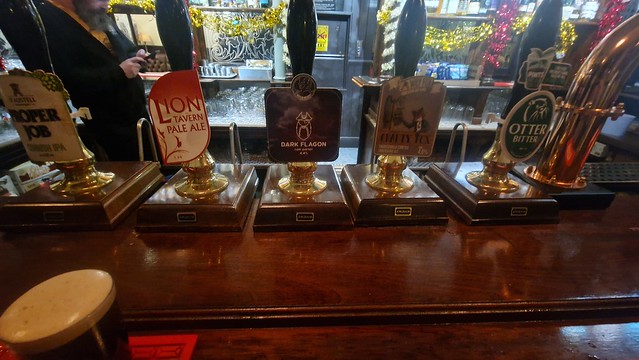
The beer range which I thought was reasonable with some quality ales there to choose from.
One of the two bars, I was surprised by the lack of customers although there were a couple in the other side.
I went for half a pint of the Dark Flagon from Wily Fox Brewery, which I’ve had a couple of times before and enjoyed. It’s an excellent cask beer, there’s an initial hit of chocolate and then a rum finish. It’s smooth, decadent and just a little sweet.
It’s a beautiful pub and although it was quieter than I expected, the atmosphere was welcoming and the member of bar staff was friendly and engaging. It’s very well reviewed on-line, although I always feel the need to have a little look at the negative reviews to see what excitement has taken place, but there’s not much other than one customer who said he reported the manager to the police for being rude to him. I can imagine that the police were thrilled. The pub prides itself on its free jukebox, but a couple of customers are irritated that their choices have been deleted, but other than that, plenty of happy customers.
The real ale range seemed reasonable and interesting, the pub had character, the service was friendly and the surroundings were comfortable. All rather lovely and I can see why it’s listed in the Good Beer Guide.
I have a slight problem at the moment with rail travel and that’s trying to keep the fares down whilst I’m travelling around the country. I’m simultaneously too young and too old to have a railcard and the fares can be challenging without using some ingenuity of split ticketing. I’ve also been hitting delay repay claims with some frequency recently and have had three turned down or refunded at a different amount, but all three fully reinstated on appeal due to ‘operator error’ or similar phrases. They don’t really have much choice as the Conditions of Carriage are very clear and it’s a bit of a faff, but we get there in the end.
So, mostly for my own amusement, here’s the story of today and endless changes of trains….. It’s actually evident to see why rail operators are struggling to unpick some of these delay repay claims and today’s will be another one when East Midlands Railways get it this weekend.
That’s not a great photo of Liverpool Lime Street, although I was taking photos to remind me at what time I was at each station. Half of the station has gate lines, the other half doesn’t and this was one of those tracks, track 6. Incidentally, on the way into Liverpool, we stopped at Broad Green railway station and I looked at the station history on Wikipedia (yes, I do this a lot) and discovered that it’s the oldest railway station in the world that is still operating, having opened in 1830. On that theme, Liverpool Lime Street is the oldest still operating grand terminus mainline station in the world, opening in August 1836.
The first train of the day was on time, the 10:08 West Midlands Train service to Crewe.
I liked this train, relatively empty and there were power points which are useful for journeys such as this. There was a passenger on board telling his friend Tony (he said the word Tony at the end of every sentence so I soon got to know Tony’s name) who gave a near constant verbal flow of railway facts on our journey. To be honest, I found it all quite interesting, so fair play.
Crewe, it’s not my favourite place in the world if I’m being honest, but I wasn’t leaving the railway station and so it didn’t much matter.
Here’s the EMR train service to Long Eaton.
More power points and an annoying customer who was playing music loudly sitting opposite. I’m generally quite immune to these things, but when it’s so loud it’s over the volume of my headphones, it probably is a bit much. Someone else sat opposite and stared at him, which meant he later on stopped, so that was a relief for us all.
Only here briefly, but a quick photo at Stoke railway station to send to Łukasz who sometimes meets me here. The train was delayed into Long Eaton, but this didn’t much matter as the one I needed to connect to was also late and was coming in on the same platform.
Long Eaton railway station which was opened in December 1888 as Sawley Junction.
An information board about Midland Railway Sheet Stores.
Right, I can still get the 12:40 because it’s going at 12:46.
Here it comes sweeping in to take me to Leicester.
And there’s Leicester in all its raw beauty and there’s been a railway station on this site since 1840.
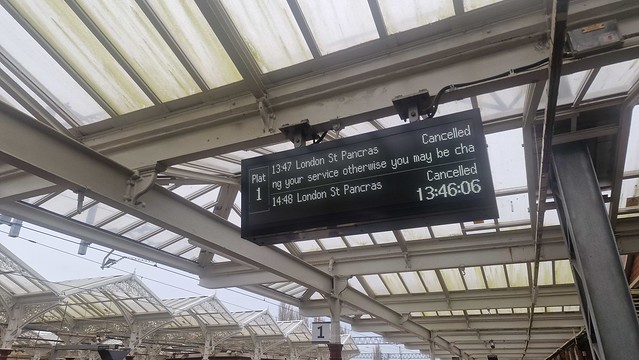
This train into Leicester was busy and I couldn’t get photos inside and it was running fifteen minutes late, meaning I’d miss my connection. But, as luck would have it, the train I was connecting to was once again also late and coming in on the same platform. I boarded three different trains today that had an end destination of London St Pancras and all three had the seat reservations cancelled as the on-board computers had gone wrong.
I boarded the East Midlands train to Kettering and it was at this point that the network was entirely falling apart due to electrical cabling issues. There weren’t really enough staff to help at Kettering and no announcements to help passengers at the station, it wasn’t great for those who didn’t know their way around railway apps and the like.
I went to find someone (not pictured above) and she told me which train to connect, telling me to get on a train to Bedford.
I had a little walk around Kettering railway station which was originally opened in 1857. I find it very hard to be in Kettering and not think about James Acaster and the Kettering Town FC song. Incidentally, that bridge to the other platforms was only put in as late as the 1990s.
This is a nice reminder of how railway stations have been such important locations in times of war.
And here’s the canteen that it’s referring to. There are an awful lot of structures on railway stations, it’s a shame that more can’t be done with a great deal more of them, although at least this one hasn’t been demolished.
Aaaahh….
Another train boarded, this is the one to St. Pancras yet again. I was fortunate incidentally to get a seat on every service despite them being so busy. Most trains had power points and customers seemed to be generally calm and content.
And safely at Bedford. I thought it was positive that the train guard told anyone with flights from Luton Airport that they were fearing they’d miss to tell the platform staff so that they could do something about it. I’m not sure what the platform staff were planning to do about it (and even if they knew the train guard had been telling passengers this), but it was a nice gesture.
For reasons unknown even to me, I’ve started noting in this blog post when railway stations were first opened, so keeping that theme alive, this opened in 1859 although it’s moved about a bit. When I say that, I mean it’s moved down the line a bit, they haven’t relocated Bedford railway station from Truro or something.
I waited patiently here for the Thameslink train I was told that I could catch as they were accepting EMR tickets given the network issues. Of course, it changed its departure platform which involved more stairs. This is how I stay healthy I think.
But, it arrived on time and took me to Luton railway station and incredibly the only service of the day actually running to schedule. I arrived into Luton just under 50 minutes later, so that’s a 50% delay repay of the ticket and I thought I did well to actually get to the final destination not that late.
I am perhaps one of the few people who likes this kind of adventure, I’ve also been suitably productive working on trains and also in numerous waiting rooms that I didn’t take photos of today. And now, I’m safely in Luton. I can’t say that this is exactly a Michael Portillo Great Rail Journeys type of post, but it amused me and maybe in my old age I’ll relive the excitement all over again and return some fancy destinations as Crewe, Long Eaton, Kettering and Bedford. Incidentally, I should add, there are more direct ways of getting from Liverpool to Luton, this was just the cheapest one for me, even if not the most convenient.
With an hour left until my train, this was the last pub in Preston that I was able to visit in my little expedition around their Good Beer Guide listed venues. It was known as the Otter’s Pocket when it opened in November 2018, but was renamed to its current name in March 2020. Prior to that it had been a shop and then previous to that it was a Mediterranean restaurant for several years.
The pub interior, it’s relatively spacious as there are a few more seats at the rear, but it’s still ultimately a micro-pub and I can imagine that it gets full relatively quickly.
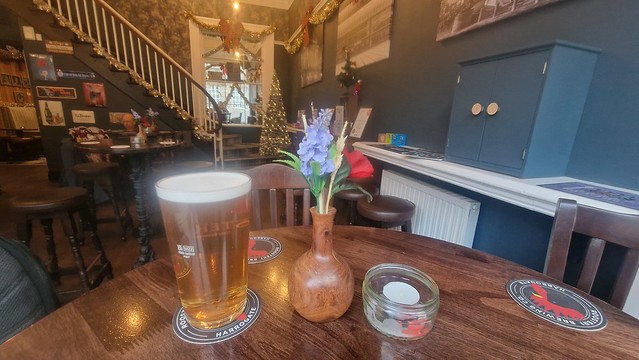
That’s not a lined glass, so this is a short measure. It’s the Jelly Swirl Trifle pale Ale from Play Brew Co, but it had considerable flavour for a cask beer. It does what it say on the can (well on the Untappd screen), sweet, jelly and like a dessert.
My second beer, which was a third of the Gingerbread Latte from Vault City Brewing. Often Christmas beers really aren’t very good, but this is one that I can absolutely get behind. It was smooth, boozy, decadent and had an excellent mouthfeel with tastes of ginger and cinnamon.
I didn’t take a photo of the screen, although their beers are listed on Untappd for anyone who is interested in perusing their menu. The service was polite, but the atmosphere felt a little stilted and it wasn’t perfectly clean as the table was sticky and the handwash in the toilet had run out, but I accept that these things happen. They weren’t doing food when I was there, but they have pies, burgers, salads and light bites on Wednesday to Sunday lunchtimes and Wednesday to Saturday evenings, a relatively large menu given the size of the premises.
Certainly an interesting venue and I can see why they’re in the Good Beer Guide with their choices of real ales. The craft beer selection was excellent and that Vault City beer was a joy to behold, a beautiful beer on which to end my little trip to Preston. All really rather lovely and I look forwards to visiting again to see what craft beer that they have to surprise and delight me.
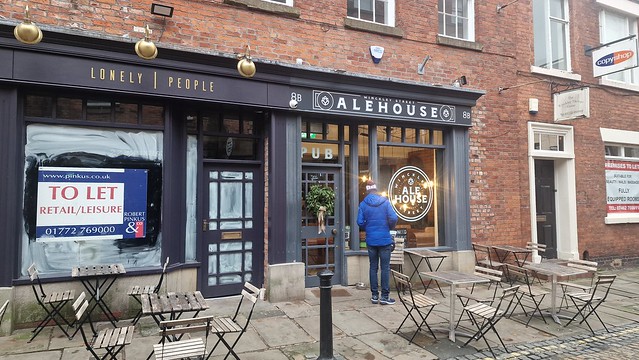
Next in my Good Beer Guide expedition was the Guild Ale House, which was the town’s first micro-pub when it opened in February 2016 in place of the former Hospice charity shop who previously occupied the premises.
The only two customers in the entire pub were sitting in front of the bar pumps, but fortunately they had a drinks screen which made matters easier. There’s a choice of cask and keg on the screen, but they also have a bottled selection as well including some Belgian options.
I went for the Bullet Tooth Tony from Wilde Child Brewing Company, which was well-kept and had some fruit tones, but I found it quite bland. I’ve always rated Wilde Child’s darker beers rather better, but it wasn’t an unpleasant beer.
The pub’s interior which is spacious and there’s a reasonable amount of space. They frequently have live music and other events, although they don’t play background music which is something I think they’re doing right.
I noted CAMRA’s comment of “worth noting they may close earlier than stated times dependent on footfall”, so I didn’t risk going in the evening and went at lunchtime. The venue is though very well-reviewed and in the eight years they’ve been trading they haven’t picked up a single 1-star review on Google, and only have two 2-star reviews. That’s a fairly impressive piece of pub management, so it’s no surprise that they’ve also won several CAMRA awards. Anyway, this seems to be a consistently good real ale pub and long may it continue.
The Twelve Tellers in Preston is a JD Wetherspoon operated pub and isn’t in the Good Beer Guide, although I managed to visit just about all of the central Preston pubs that are in the book.
That’s a quite impressive view. I visited at 11:00 and so wasn’t going for alcohol, my unlimited coffee cost just £1.04 and the pub is on one of the lowest price bands for the chain in the country.
Those two doors are located either side of the main room.
The twelve tellers which the pub is named after and one of the doors is also visible here.
It’s just about readable. but there’s a longer version on the JD Wetherspoon web-site:
“This imposing grade II listed building now occupied by J D Wetherspoon stands on the site of the former Preston Savings Bank, Church Street, that was purpose built. The foundation stone was laid by WP Park, chairman of the trustees in October 1905 and the building opened to the public in 1907 as the company’s headquarters. The bank later became part of the Trustee Savings Bank Group where the public was served inside the grand banking hall by twelve tellers from behind the 65-feet long counter.
The former bank stands on the site of an older bank, established in 1776. It was originally a private residence and in 1715 was owed by Mr Eyre. Later that year, Jacobite rebels entered Preston and proclaimed Prince James Edward Stuart King of England. They used Mr Eyre’s house as their headquarters until it was ‘recovered by a large party of dismounted troops’. The marble and mosaic flooring in front of the counter includes the arms of the Borough of Preston. Preston derives its name from the old English words ‘Presta’ and ‘tun’, meaning ‘priest’s town’. The Holy Lamb emblem is centuries old, associated with St Wilfred, a patron saint of the City of Preston.”
The TSB closed the bank in 1997 and the building could have easily fallen into disrepair, with Bass trying to turn it into a super pub in 2000, but those plans were rejected. It’s, I think, an undeniably careful and thoughtful conversion into a public house and there’s plenty more seating in the rear part of the building, and another area upstairs in what was formerly the board room.
As for the reviews, I’ve found that nearly every JD Wetherspoon venue gets a score of between 3.8 and 4.1 on Google Reviews, with this one no different at 4.0%. Looking at the reviews…..
“My wife and I waited for 18 minutes but no one showed up to take our order, one waiter was on the phone the whole time we were there. He kept on looking at us but didn’t bother coming over or sending someone else”
I think I can work out the problem here with the customer wondering why the waiter didn’t come over.
“Me and my partner walked in here 50 mins ago and ordered 2 drinks each on the app. Drinks still not arrived. Been sat here waiting nearly an hour, yet I’ve seen people walk up to the bar and walk away with their drinks within minute. There is no way to cancel an order on the app so we are stuck here indefinitely. Rubbish. Will be leaving whenever they finally arrive.”
I think I might have walked over to the bar at this point. I wonder if they’re still there.
“THANKS FOR SIMONELLA POISNING! There food is absolutely awful me and my 16mouth daughter got Simonella poisning from the chicken and burgers.”
Interesting spelling. And likely complete piffle.
Anyway, I didn’t order any beer, but I noted that they had four guest ales including from Oakham, Sambrooks, Robinsons and Batemans, all at £2.29 a pint which is something of a bargain. I thought that the whole arrangement was interesting and well managed, and it maintained a decent atmosphere despite being of quite a cavernous size.