Category: Norfolk

  • Norwich – General Regulations of the Bethel Hospital in 1861

    Norwich – General Regulations of the Bethel Hospital in 1861

    Bethel Hospital Regulations (in .pdf format)

    The above PDF file (thanks to archive.org and the Wellcome Library) is the General Regulations of the Bethel Hospital in Norwich which were issued in 1861. They’re surprising forward looking to what I had expected, although still regimented as might be expected from a Victorian institution. It was noted that staff should not “strike the patients or speak harshly to them”, but should be “kind and indulgent”.

    On the last page of the document are the meals that were expected to be served to the patients, which weren’t ungenerous. Women were generally allowed the same menu as the men, although they weren’t to be given as much of it.

    The milk broth for breakfast was commonplace at the time, although it’s not something you see in many restaurants and hotels today. Or not the ones that I go to anyway. Wednesdays don’t sound too bad, the evening meal was either sausages, potatoes and beer, or, a sausage roll, potatoes and beer. Indeed, beer is provided on a regular basis, although not in large quantities, but extra was given to patients helping with the washing, laundry and in the workshop. I’m not sure that patients in the N&N get to do the washing and laundry today, although perhaps some would help if there was beer provided for their assistance.
    There was the bonus of roast beef and plum pudding on Christmas Day, although even then the plum pudding term was misleading and that would be what we call Christmas Pudding today. For that week there were also mince pies and cake, so perhaps not that much has changed over the last 160 years. On Shrove Tuesday, there was also coquilles, which were effectively Hot Cross Buns without the cross.

    Incidentally, I’m not quite sure what the male patients were encouraged to do during their recovery, but the document notes that the women should be “encouraged to occupy themselves in needle and household work”. Men and women were encouraged to take the air though, and to also read wholesome books and periodicals.

  • Norfolk Regiment – October 1914 War Diary

    Norfolk Regiment – October 1914 War Diary

    Diary (in .pdf format – the war diary of the 1st Battalion of the Norfolk Regiment for October 1914)

    I’ve downloaded most of the war diaries of the Norfolk Regiment from the National Archives (currently free of charge whilst the reading rooms are closed) and have become endlessly fascinated by them. They’re a real snapshot of what life must have been like, even though much of the detail is quite short. I’m also reading up on the lives of those who fought in the First World War, so this adds a fair chunk of detail to my understanding of where they were. And, this is why I’m trying to get a better understanding of where the battalion was, so I can try to have an understanding of the journey that the men went on.

    Unfortunately, the August to September 1914 records for the 1st Battalion have got lost somewhere, so we have to start in October. I do know though that the battalion was fighting in Ireland when the First World War started, they mobilised on 4 August and then left Belfast on 14 August. From there, they arrived in Le Havre, France, a few days later. The diary for the month of October starts with the 1st Battalion marching to Droizy, with mention that it was cold.

    On 3 October 1914, the battalion set off to Longpont (the photo above, © IWM Q 47947, is of Longpont, but shows the French defense in 1918, it was much quieter when the Norfolk Regiment arrived), which is around 15 kilometres away and it took them just over four hours. Longpont is only around 90 kilometres from Paris and this must have been something of an adventure for those there. The horrors of war weren’t yet perhaps quite obvious from this far away from the front line.

    Longpont is dominated by an abbey which was forcibly closed during the French Revolution, and the troops arrived at 22:00 and slept in the woods in the village. They stayed the next day, 4 October, in the village and I wonder whether they were involved in training or had chance to look around the small village. After spending a day in the village they then went on a night march to Pondron and it took them around four hours, arriving on the morning of 5 October.

    I like a night hike and find that there’s a sense of adventure in them, but I can’t quite imagine what it must have been like in wartime and in a military capacity. I’m assuming that the troops walked down the road and so looking at Google Street View, it’s possible to see what the men would have gone by. It’s not very built up now, so this would have likely been similar to walking in the Norfolk countryside in terms of the scenery. It was noted that the journey was inconvenienced with the number of French motors passing by, something I know from my walking can be a bloody nuisance (not French motors in particular, just cars in general). It would interesting to follow their journey, although they did later go by rail and road, although most of their route would be easy to walk (along with the occasional train journey).

    On the 6 October, they marched from Pondron to Bethisy, where they stayed overnight, before crossing the River Oise on 7 October. I’m unsure why that needed a specific mention in the diary, unless the road wasn’t available and so they had to cross on foot, which would have been quite notable…. From here they went overnight by train to Abbeville, which must now have felt much closer to the front line action, should the men have been aware of what faced them.

    After arriving in Abbeville (the painting above – © IWM Art.IWM ART 5394 – is by Olive Mudie-Cooke, an ambulance worker, painted in Abbeville in 1916/1917) at 04:00 on 8 October, the men then marched to Neuilly, where they arrived after seven hours of walking. They then had a period of rest before, later that same day, marching for over six hours to Boufflers. That couldn’t have been an easy day of walking, especially with the fear of the unknown that must have hung over them.

    On 9 October, the men were meant to be transported by road, but the vehicles didn’t arrive. Instead, on 10 October, the men were taken by car to La Thieuloye and on the following day, 11 October, they marched to Bethune. At the time, this location was becoming increasingly important as a military meeting area and it was here that the men helped reinforce a French Cavalry outpost. This might have been when the Norfolk battalion started to meet other French troops for what could have been one of the first times.

    The diaries note that the Germans took the nearby village of Vermelles on 12 October, with the Norfolk Regiment moving to Festubert that evening. Just to the south of this is the village of Givenchy and on 13 October, the Dorset and Bedford Regiments were attacked, with the Norfolk Regiment being ready to support, but the Germans didn’t pursue them.

    It’s clear now that the movements were going to be slower, with the troops remaining at Festubert until the 16 October before making a few minor travels, and then ultimately, spending the rest of the month at Festubert. Two of the men were injured on 20 October, with Lieutenant Foley killed on 25 October. This must have felt pivotal, as although things were clearly getting more dangerous, to see a colleague lose their life must have been hugely challenging.

    I couldn’t find any photos of the 1st Battalion of the Norfolk Regiment at Festubert, but this photo (© IWM Q 90282) was taken in the village a few months later, showing the Royal Field Artillery.

  • Greater Anglia : London Liverpool Street to Norwich

    Greater Anglia : London Liverpool Street to Norwich

    The Prime Minister hadn’t quite made his latest announcement (or u-turn if you prefer) by the time that I was about to board the 13:30 Greater Anglia train back to Norwich from London Liverpool Street. But, when that statement was made, it was effectively saying that London was now entering Tier 4 and that from midnight the residents of the city shouldn’t leave the area. Things appear to have gotten worse with a new virulent strain of the virus, which is not ideal at all.

    There were reports in some elements of the media that there were huge flurries of Londoners rushing out to the countryside, although that appears to have been dismissed by the rail companies who said few trains were actually full. Either way, the train that I was on didn’t seem particularly busy, so I had a block of four seats around a table to myself for the journey. And, for those who note my annoyance on this matter when Stansted Express trains are pushed into service, this train did actually have tables. I bought my ticket over a week ago, another bargain priced £10 advance single fare.

    The most interesting part of the journey for me was annoyance at myself for either being asleep or not paying attention, I can’t remember which (and couldn’t at the time, so I was probably asleep) whilst pulling into what I think was Manningtree station. The driver made a furious announcement, although made professionally, that he had been forced to sound the train’s horn as he nearly hit a passenger’s bag which was being carried so near to the platform as to have actually been mostly off of it. The driver said several times, in excess of four, that the person responsible was a male, in carriage D and with a duffel bag. I was positively disappointed not to be in the carriage as otherwise I could have looked and tutted, to show my British displeasure, at this act of idiocy. I say idiocy, as that’s what the driver called it, along with other words.

    Anyway, I quite liked that the driver made his coffee order over the announcement system and that the refreshment team made one back, apologising for not having the biscuit he wanted. It was sufficiently light hearted to add some humanity back to the journey and I think it calmed the annoyed driver down.

    And here we are back in Norwich, on time and that really is the end of my travel for 2020. I didn’t think in early November that I’d be travelling again in 2020, but this twelve-night stay in London was worthwhile and interesting. What I’m more disappointed about now is that travel in early 2021 is looking effectively impossible. I’m likely to cancel my trip to Bilbao, whereas British Airways have already cancelled my trips to Lisbon and Dublin. I can’t imagine that I’ll be going to Inverness or Palma either, which are both in January, although haven’t yet been cancelled by British Airways.

  • Great Melton – All Saints’ Church (exterior)

    Great Melton – All Saints’ Church (exterior)

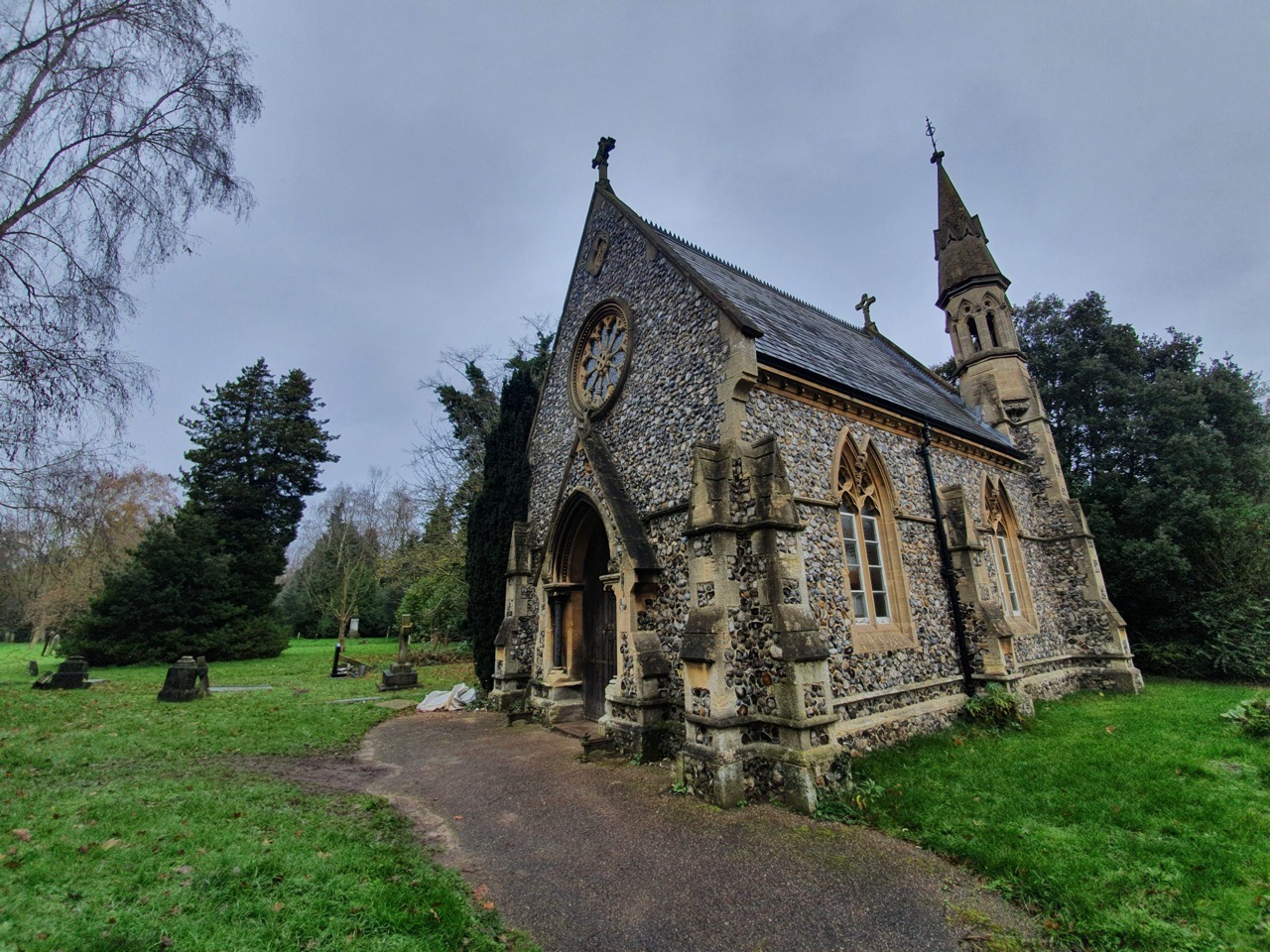
    There are two churches in the same churchyard in Great Melton, the other is the now ruined St. Mary’s, visible in the above photo.

    And this is All Saints’ church, which is still in use and there may have been a religious building here since the eighth century, although the earliest part of the current church is from the eleventh century. The churches were both independent until the eighteenth century, but then it was decided to merge the two and just use St. Mary’s. A decision was later made that St. Mary’s was too small, so they decided to fix up the by now roofless and slightly fallen down All Saints’ Church. And to do that, they knocked all of St. Mary’s down other than the tower, then reused much of the building material at All Saints’.

    This is the quite understated entrance to the joint churchyard.

    The church originally had a round tower, but was replaced by this in the mid-fifteenth century. There’s some good news as well about the church’s future, as it has now been removed from the Heritage at Risk Register as numerous organisations came to together to fund some much-needed repairs.

    I’m not quite sure what they’re doing here, the metal mars the beauty a little, but it’s still a graceful church and that structure looks temporary. The nave is the oldest part of the church, dating to the eleventh century, whilst the chancel is later, dating to the fifteenth century.

    That looks like Roman brick to me on this now closed up doorway. Incidentally, this church had no roof for over 170 years until the nineteenth century repairs, but the walls still remained standing, a testament to the early builders.

    And a niche, although this looks out of place and has perhaps been moved or maybe was a window at one point.

    We were fortunate enough to be able to look inside the church as well, more on that in another post.

  • Wramplingham – St. Peter and St. Paul Church

    Wramplingham – St. Peter and St. Paul Church

    Wramplingham has had a church on this site since at least the early eleventh century, but it probably has Saxon origins. The probable situation here is that the nave is the oldest part of the church, then the base of the tower and then the chancel and then the top of the tower. Views differ though to make things more complex.


    The tower with its lancet window is likely thirteenth century with a later fourteenth century octagonal top section, although some have dated the whole lot to the fourteenth century. My limited knowledge of architectural history doesn’t allow me to have a view either way…..

    The join between the tower and the nave, the latter of which dates from the eleventh or twelfth century.

    That Norman door looks out of place there on a Victorian extension, but that’s because they moved it from its previous location opposite the south door.

    And here is the plan of that, designed by Augustus Edward Browne in 1872.

    The rather beautiful chancel (I liked it, hence the multiple photos), which must have looked quite the thing when it was installed. It’s later than the nave, dating from the mid-fifteenth century.

    Internally, looking back towards the tower, and I was pleased that the church was open when we visited.

    The quality of the chancel work is visible inside, allowing light to flood in (well, it doesn’t when you visit at near sunset to be fair).

    The former steps to the rood loft screen. There’s an article about the church by FR Barff which is located near to the entrance (in very small type) and he mentions that the rood loft survived until 1843, when it was removed by the first of two Victorian restorations. That seems to be a relatively late survival, shame it was taken down.

    The peaceful setting of the churchyard as the sun starts to set. There are some very neat lines of graves, particularly near to the tower, with rather large gaps nearby, so I do wonder whether some of them have been reset.

    In June 1873, the rector, Charles Philip Paul Jodrell, took the Great Eastern Railway to court on behalf of the church. The church had sold lead from its roof, which was apparently in excellent condition, and they despatched over 6 tons of it by rail. On that journey, the rail network managed to lose 8lbs of it and the church wanted that value back, so they demanded in court 8 shillings and 6 pence (about £28 today). The railway said that this was a perfectly reasonable loss given how much they carried and thought that there was no case. The judge agreed with Great Eastern Railway, but he clearly didn’t want to upset God too much and so he refused costs to be awarded to them.

    Anyway, a remote church which has retained its beauty.

  • Wramplingham – Name Origin

    Wramplingham – Name Origin

    I’m quite intrigued by the village name of Wramplingham, particularly how it hasn’t lost its ‘W’ over the years if it’s not pronounced. As an aside I’ll mention now, from 2003 until 2013, Bill Bryson lived in the village, quite a claim to fame (for the village I meant, although perhaps for him)…. Anyway, back to the village name, The Concise Oxford Dictionary of English Placenames notes:

    Wramplingham, Norfolk. Wranplincham in Domesday Book, Wramplingham in 1185. The first element is a tribal name, connected probably with words such as wramp ‘a twist’ (17th century), wrimpled (wrinkled, c.1430). It may be derived from a nickname formed from the base of these words.

    I think it’s fair to say that no-one has a clue exactly how this village got its name. It’s just that someone likely had a nickname of Wramp, and this was his homestead and that of his followers. But back to why this village name hasn’t become Ramplingham over the centuries. It seems (I had to look this up) that the ‘W’ was pronounced until sometime around the sixteenth or seventeenth centuries. As I understand, it was more of a hard ‘V’, so it might have been pronounced as Vramplingham.

  • Wramplingham – War Memorial

    Wramplingham – War Memorial

    Wramplingham War Memorial, which was unveiled in 1920 and is quite a tall and slender piece of stone. There were seven men killed from the parish during the First World War and one during the Second World War. This seems quite a high number for such a small village, especially as there were no Pals Regiments from Norfolk where friends were fight (and often die) together. Some of those who died didn’t live in the village, but had relatives here, but, it must still have been a great loss for Wramplingham.

    The names of those who died are listed on the stone, although they’re a little hard to read and some attention is needed here to restore them. Those who died in the First World War were:

    Arthur Yorke Bailey

    John Stanford Cavalier

    William Robert Collings

    John Robert Howes

    Frederick William Mitchell

    John Robert Oldfield

    Percival Ernest Thompson

    And, the following servicemen died during the Second World War:

    William Leonard Tolver

    There’s no point in me working through the histories of these individuals, as it has already been done at http://www.roll-of-honour.com/Norfolk/Wramplingham.html.

  • Great Melton – St. Mary’s Church

    Great Melton – St. Mary’s Church

    St. Mary’s and All Saints’ share a churchyard in the village of Great Melton, similar to the situation in South Walsham.

    This is where the nave of St. Mary’s once stood (I’m standing in front of the tower to take the photo), with All Saints’ visible on the left. The churches were both independent until the eighteenth century, but then it was decided to merge the two and just use St. Mary’s. A decision was later made that St. Mary’s was too small, so they decided to fix up the by now roofless and slightly fallen down All Saints’ Church.

    The church remained in use until 1883, it’s a shame in my view that the Victorians decided to take down most of the building, although I understand that some of the stone was used in the rebuild of All Saints’. It was reported in the Thetford & Watton Times in 1883 that the locals did want to keep both, but given the lack of finances they wanted to preserve what they considered to be the more historic of the two churches, and that was All Saints which had Saxon origins.

    A trig mark at the base of the tower.

    Looking up at the tower, which is in pretty good shape. Well, bar the big holes in it. I understand that English Heritage have provided some money to secure it, which I think relates to the brickwork at the top as opposed to the bit of wood propping the walls up at the front of the photo.

    Rather beautiful….

    The tithe map, with St. Mary’s being the lower of the two churches.

    The enclosures map.

  • Wramplingham – Village Sign

    Wramplingham – Village Sign

    I like this, Wramplingham village has, by design, placed its sign in the River Tiffey. I say by design as it’s in the water in all the photos that I can see.

    The sign itself features the water mill on which much of the village’s history is around, although the rather lovely mill itself was knocked down in 1945.

  • Norwich – Earlham Cemetery (Alan George Gibling)

    Norwich – Earlham Cemetery (Alan George Gibling)

    This is the war grave of Alan George Gibling, located at Earlham Cemetery in the main area and not within the military section. I can’t find out anything about his period in the First World War itself, but the story here (for me anyway) is that this is the first time I’ve submitted a request for the CWGC to change information on their web-site.

    But, going back a bit, Alan was born on 3 June 1896, the son of George Joseph Gibling and Ellen Gibling (nee Dix). At the 1901 census, he was living with his parents and his brother John Charles and his sister Margaret Ellen, as well as a servant Baldry Gibling, although it’s confusing why she shared the same surname with no obvious family links. They lived at 191 College Road in the city and Alan was educated at Avenue Road School and then at the City of Norwich School between 1 September 1908 and 20 July 1912.

    At the 1911 census, the family were still living in the same property and this time the family has been joined by Geoffrey Dix, with the servant now 19-year old Alice Nichols. This census also reveals that George and Ellen lost one child at some point during their marriage.

    Alan’s war records seem to have been lost in the fire during the Second World War, as so many were, but he joined the Norfolk Regiment, but I’m not sure whether or not he would have seen active service. Alan died on home soil on 17 October 1915 at the age of 19.

    Back to the CWGC, the record on their web-site lists him as Allen George, and I wonder whether someone has looked at his mother’s name and got muddled up. Mistakes are not uncommon due to the challenging way that the information was gathered around a century ago, with the CWGC noting they make changes to their database most days based on details provided. All of the other war details, mentions on war memorials, his school records and censuses have him listed as Alan George. I was going to just leave the CWGC record incorrect rather than spend time compiling the evidence that they required, but it seemed the right thing to do for Alan’s permanent record to be correct.

    Although we’ll likely now find out that I’ve misunderstood something and no change is needed, but we shall see….