Category: Melton Constable

  • Melton Constable – St. Mary’s (Burgh Parva) Old Church : Grave of Arthur Charles Gibson

    Melton Constable – St. Mary’s (Burgh Parva) Old Church : Grave of Arthur Charles Gibson

    20250202_135716

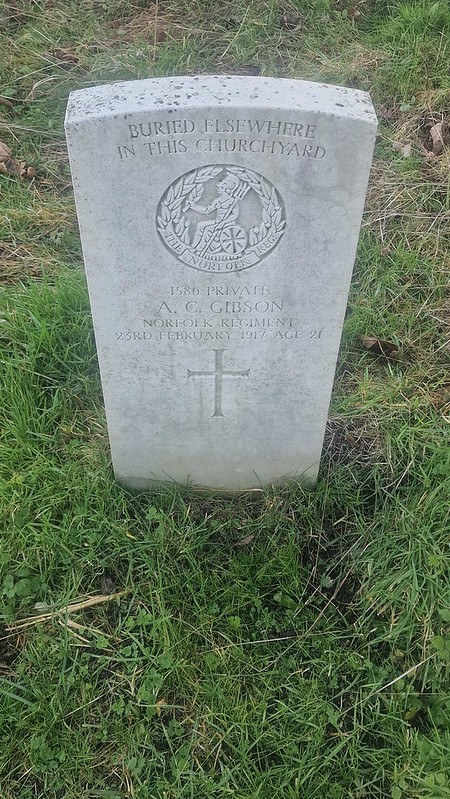
    This is the war grave of Arthur Charles Gibson who is buried at St. Mary’s church in Burgh Parva, located near to Melton Constable. I’ve never seen a war grave with the words “buried elsewhere in this churchyard” on it, but in this case it’s because Arthur wasn’t listed on the Commonwealth War Graves Commission list, but in 2015 he was added to the United Kingdom Book of Remembrance.

    Arthur’s record at the 1911 census when he lived on Gordon Road in Melton Constable. He lived with Walter Stangroom’s family, with Walter being his brother-in-law, and he worked as a telegraph operator. They also lived with Arthur’s mother, Ellen Gibson, who had been widowed. His military records note that he signed up voluntarily on 3 January 1912, but he was discharged on 19 July 1916 due to ill health. I’m not sure if he was injured abroad, or whether he was injured whilst working at the Melton Constable railway works, which was an important industry for the war effort. It seems unlikely to me that he was serving abroad, as otherwise he would have been more likely to have been listed on the Commonwealth War Graves Commission list. His military number was 1586 and he was a Private in the Norfolk Regiment, dying in London on 23 February 1917 at the age of 21, with his death certificate noting he died of empyema. He doesn’t seem to have a headstone of his own from the time, with his stone being added here in 2015.

  • Melton Constable – St. Mary’s (Burgh Parva) Old Church : Grave of HWT Stimpson

    Melton Constable – St. Mary’s (Burgh Parva) Old Church : Grave of HWT Stimpson

    20250202_135756

    Located at St. Mary’s church is the gravestone of Henry William Thomas Stimpson, the son of Henry Thomas Stimpson and Deborah Stimpson.

    Henry was born in 1891, but wasn’t baptised until 18 October 1894 when he lived in Briston. He signed up to the military in 1911 when he was 18 on a 4 year territorial force contract, when he was still living in Briston but he was working as a coach painter at the railway works. Above is the 1911 census record for the family.

    As he reached the end of his territorial contract, he was discharged from the military on 14 January 1916 when the documents note him to be 24 years old and 5’6″ tall. He lived at 5 Gordon Road in Melton Constable and he worked as a coach painter at the railway works. His character was noted to be “steady and sober”, but he wasn’t sent overseas to fight as it was noted he was serving at home from 5 August 1914 until 14 January 1916, I assume on what was defined as war work. He committed some minor offence on parade in Dereham on 30 November 1914 and was fined one day’s pay. He joined the National Union of Railwaymen in 1916 at the age of 24.

    He served as a Private in the Norfolk Regiment, with service number 1385. I’m unsure how he died, but I’m going to take a guess that it was at the railway works as his body is located here and he doesn’t seem to have travelled overseas at any stage during his military career. I might well be wrong, I often am…..

    According to his grave, he died on 13 November 1918 at the age of 28, although I’m really not sure that age is correct as it doesn’t fit in with the other dates and the death register notes him at 27 which seems correct.

  • Melton Constable – St. Mary’s (Burgh Parva) New Church

    Melton Constable – St. Mary’s (Burgh Parva) New Church

    20250202_140228

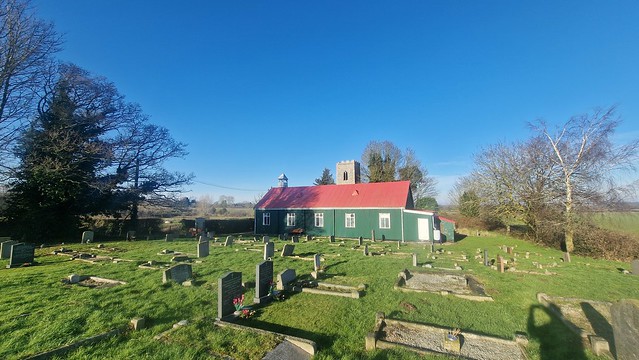
    The old church at Burgh Parva has mostly fallen down and if the village of Melton Constable hadn’t been transformed by the railways, then the remains of that building are likely all that would remain today. However, the village population increased tenfold in just a few decades and it was evident that a new church was needed.

    20250202_140422

    This building wasn’t meant to be permanent, but they’ve never quite built a new one. On 4 April 1903, the Norfolk Chronicle reported that:

    “During the process of excavating and levelling the land round the old church for the purpose of the new churchyard, the foundations of the walls of the old churchyard have been found.”

    This churchyard in the front of the image above is the newly opened section. It was reported in the local press later in 1903 that:

    “Mr Ritson Batson Woods, at the age of 97, has constructed an oak lectern and presented it to the new Burgh Parva (temporary) Church of St. Mary, to be transferred to the permanent building as soon as it has been restored.”

    There seems to have been a difference of opinion between whether to restore the old church or whether to construct an entirely new modern church instead, which is perhaps why a decision was never quite taken on what to do. There were fund raising exercises that went on for some time, but there is something quite homely about this tin construction.

  • Melton Constable – St. Mary’s (Burgh Parva) Old Church

    Melton Constable – St. Mary’s (Burgh Parva) Old Church

    20250202_135803

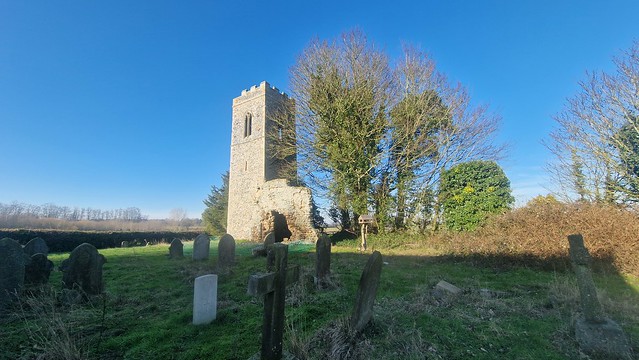
    This is what remains of St. Mary’s church which is located near to Melton Constable, in what was once the parish of Burgh Parva. This medieval village has long since gone and the church was always a relatively small one. It’s thought that the church was constructed during the later part of the fifteenth century and the early part of the sixteenth century. David Kennett in his Norfolk Villages book notes:

    “In 1845, White’s Directory described Melton Constable with Burgh Parva as a fertile parish of 1,700 acres. They had 114 inhabitants in 1831, but only 75 in 1841, several families having emigrated to America”.

    There’s otherwise very little historical text that I can find about this church, just guesswork about the exact building dates.

    20250202_140027

    The Norfolk Heritage web-site mentions that the church was likely ruinated in the reign of King Charles II, but the chancel had likely gone following the Reformation as some of the stone has been repurposed into the nearby hall. The tower is looking remarkably robust given how long it’s been standing, although it’s evident that there have been some repairs over recent decades. As can be seen, an advanced system to keep people out has been erected around the church.

    20250202_135944

    The door had been filled in with stone before the church mostly fell down. I accept that I wonder about strange things, but it would be interesting to know when the last person to walk through that door was (the actual door, not the new hole that has appeared).

    20250202_135359

    The church evidently wasn’t that large judging from the size and there’s no evidence of there being any aisles.

    20250202_135637

    There’s one other section of wall remaining which seems to be near the end of the former nave.

    20250202_135436

    Inside the church tower.

    20250202_135420

    The former roof line is still visible. There have been some Saxon and early Norman finds here and it’s possible that there was a church here at that time, although equally, the stone might have been moved across to this as a new site.

    Due to the substantial increase in the population of nearby Melton Constable, a temporary iron church was constructed in 1903 and it’s still there. But more on that in the next riveting instalment of this blog….

  • Melton Constable – What’s Left of the Railway Station

    Melton Constable – What’s Left of the Railway Station

    20250202_142651

    Richard and I were off back on our church spotting and I had one of my marvellous ideas (which often actually aren’t) to combine that with a visit to Melton Constable. I’ve known this as the centre of railways in North Norfolk, but I’ve never managed to go there. We walked across from the church along the former railway line which led on to Holt and Sheringham. Melton Constable is mostly a planned village built to house railway workers, with the population going from just over 100 in 1881 to over 1,100 by 1911.

    20250202_143153

    The former track which closed to passengers in early 1964. I didn’t expect just how sharp the drop off was at some stages along this line, there were considerable earth movements made to construct this line.

    20250202_144751

    Melton Constable became a railway hub as two lines crossed there and this is the site of where they met. One was the line which went from Bourne in Lincolnshire across to Cromer and Great Yarmouth, whilst the other was the line which ran from Sheringham to Norwich, via Holt. The former of these lines closed in 1959 and the writing was very much on the wall at that point, as only the service from Melton Constable to Sheringham remained and the village became a terminus. In April 1964, that service was brought to an end and the railway station was closed.

    The cursor marks where we were standing.

    20250202_144816

    The village beacon.

    20250202_144905

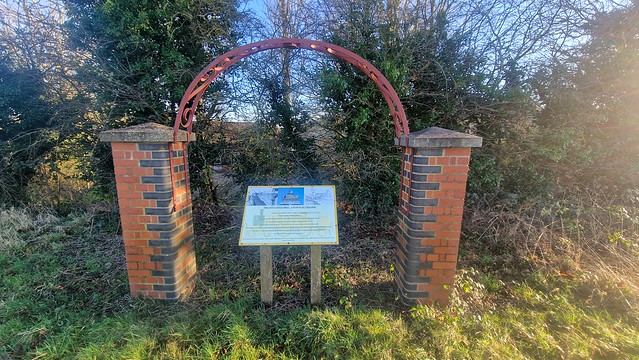
    I was hoping for an information board about the railway’s past and I wasn’t disappointed. The metal structure here is original, it’s the one that’s in the below photo. The brickwork is recreated from the original, more on which in a moment. The road layout has changed a little here, but this is effectively where the railway station itself was located.

    A postcard of the station as it once looked. The station was constructed on land which was owned by Lord Hastings and his involvement was rewarded as he was given a private platform and waiting room, which seems quite a grand arrangement for any individual. Perhaps Elon Musk might try and get himself a private platform at London Waterloo or something….

    20250202_144936

    The steps down to the railway works. These works were a major employer for the area and they were constructed here soon after the railway opened in 1883. The works employed over 1,000 people at their peak and the village became known as “the Crewe of North Norfolk”. The workers here primarily repaired locomotives, constructed carriages and they also provided maintenance for a whole range of railway infrastructure. There was also a concrete works at the site and the still exciting concrete railway sign at West Runton was made here.

    20250202_144940

    This maps shows how the railway station, the railway works and the sidings used to dominate the village. The planned housing can be seen quite clearly here and they have something of a northern industrial town feel to them.

    20250202_145150

    And here’s the original location of the steps, with the original brick pillar still in situ.

    20250202_145211

    They’re not clearly visible in this photo through the foliage, but the original steps down to the railway works are still there.

    20250202_145221

    And this is where the railways buildings were located, with the large engineering shed on the right still there.

    20250202_145322

    And another old railway building.

    It’s disappointing that they’ve demolished so much of the railway heritage here, although the area is quite remote and after they demolished the railways tracks it made it rather hard to get to. In the summer of 1964, a regular bus service was put on for the 30 residents who needed to get to Holt and there remains a service operating to this day. It’s rather quiet now and it’s hard to imagine just how many trains used to come through this station and how many people once worked here.