Category: Martham

  • Martham – War Memorial (Herbert Sims)

    Martham – War Memorial (Herbert Sims)

    Herbert Ernest Sims is listed on the war memorial in Martham and he was the son of James (born in 1851) and Alice Sims (born in 1852) who lived at Gibbet Vale in Martham. Herbert was born in 1889 and at the 1911 census he was 22 and was living with his parents and his brother Edgar who was 20, having been born in 1891. Both the brothers worked as market gardeners and had been born in Ormesby, with two older siblings, James and Julia who had moved out of the family home.

    He joined the 6th battalion of the Royal Dublin Fusiliers and went with a multi-national military force to fight the Bulgarians as part of the Salonika Campaign. Noel Drury, a member of the same battalion as Herbert wrote about the conditions:

    “Our overcoats are frozen hard, and when some of the men tried to beat theirs to make them pliable to lie down in they split like matchwood. The men can hardly hold their rifles as their hands freeze to the cold metal.”

    Corporal Herbert Sims died on 17 November 1916, at the age of 29. He is buried at Struma military cemetery in Greece, another British soldier left a long way from home.

  • Martham – War Memorial (Robert Rivett)

    Martham – War Memorial (Robert Rivett)

    Robert Alfred Rivett is listed on the war memorial in Martham and, in my previous post about Elijah Long, I mentioned the burnt war records. And Robert’s war records survive, although they are partly burnt, which makes looking at them moderately challenging as some information has been lost. Robert, who worked as a fisherman, was the son of David Moore, who lived at Somerton Road in Martham. He was enlisted in Great Yarmouth on 10 August 1914 into the 3rd Battalion of the Norfolk Regiment, which he joined as a private on 26 September 1914, service number 3/7837. Robert was 5’9″ in height, was aged 37 and weighed 12 stone.

    Robert’s war records show that he was wounded in action on 18 March 1915 and a few weeks later there is a request from his family to see him, where he was described as “seriously ill”. A doctor noted that he had “developed paralysis of the diaphragm”, which would have likely meant he had been caught by the poison gas which the Germans were using at the time. Robert died at the Royal Victoria Hospital in Netley, Hampshire, on 4 January 1916 and the cause of death was “gunshot wound to the spine”. He was duly buried in the church at Martham, in the churchyard extension.

    In the records, there’s a copy of the letter written by David Moore, Robert’s father, which mentioned that his wife Emma Moore had died and that he was Robert’s next of kin. Unfortunately, as it’s partly burnt, it’s hard to get a wider context of the letter, but the long chain of letters to and from David Moore to the army are highly unfortunate and there seems to have been a misunderstanding. The army wanted to know the address details of Ernest Rivett, who was Robert’s brother, to send him the 1914 star medal and David wrote to the army on 1 August 1919 saying “why are you not more careful and indifferent of our feelings? Anyway you have got what you want”. The confusion appears to have been the different surnames and there are some inconsistencies with the information provided by Robert, so the cause of the difficulty is perhaps understandable.

  • Martham – War Memorial (Elijah Long)

    Martham – War Memorial (Elijah Long)

    Elijah Long is listed on the war memorial in Martham and it’s initially puzzling as to why he’s here as he served in the Hampshire Regiment, he is buried in Sculthorpe, in another part of the county, and his parents didn’t live in the village during the First World War. He did though have a connection, and a strong one, insomuch as he lived on White Street when he worked in the village as a grocer’s assistant after his parents, George and Ruth Long, had left Martham and moved to Sculthorpe. He had been born in Attleborough on 24 October 1889 where he lived for a couple of years until his parents moved to Martham.

    Around 60% of British army records were destroyed during air raids in the Second World War, a sad loss to the war records of four million men. Around two million records do remain, although many are damaged, but separately to this, the records of those invalided out of the army in the First World War are still intact. And this is the case with Elijah Long, so there is a multitude of information about him and his war efforts.

    The first page of the file shows that Private Elijah Long was invalided out of the British Army on 19 July 1917, when his discharge papers were processed. Elijah’s discharge was handled in Exeter and the files note that he was 27 years and 9 months old, he was 5’7″ with a fresh complexion, blue eyes and dark brown hair. It was noted that he had a scar on his right shoulder and he was planning to live with his parents whilst he recovered, at Grove Cottage in Sculthorpe. The notes mentioned that he had good character and was trustworthy, but was wounded whilst fighting in the Somme. The discharge papers noted that he had been in the army for one year and 214 days, being located in East France between 16 August 1916 and 30 April 1917.

    The file then shows Elijah’s sign-up papers, he was examined in Great Yarmouth on 8 December 1915. His height was listed then as 5’5″ and he weighed nine stone, with his two vaccinations at birth having been noted. He was sent to fight for the 3rd battalion of the Essex Regiment, initially with the service number 28095. He later transferred to the Hampshire Regiment and his service number changed to 26532.

    The medical records show that he was wounded on 5 November 1916 in France when he was hit by shrapnel, although the hospital report wasn’t until 1 May 1917 as he had spent time at a casualty clearing station. There the doctors noted that his reflexes were shot and he was incontinent, and although the shrapnel had been removed he remained weak and had very extensive bed sores. There was no way that Elijah could continue fighting, so the doctor’s recommendation was to discharge him from the military. The medical board issued its decision on 28 June 1917, which was that he should be invalided out of the army over the next few weeks as although Elijah’s health had improved, he had lost feeling in his legs and was permanently unfit to serve. The stamp of “total disablement” on the documents told the story.

    Elijah got home and his parents started to take care of him, but his injuries meant that he died at their house on 16 March 1918 at the age of 28. He was duly buried at the Church of Saint Mary and All Saints in Sculthorpe, a tragic waste of a life for a soldier who spent just ten weeks on the front line before being so badly injured.

  • Martham – War Memorial (Beryl Applegate)

    Martham – War Memorial (Beryl Applegate)

    Beryl Applegate was one of ten names added to the village’s war memorial following the end of the Second World War, a twelve-year old girl who was killed during an air-raid. Beryl was injured during an air-raid which took place on 4 September 1940 and she died two days later at the Norfolk & Norwich Hospital. The local press reported the funeral, although noted that Beryl was aged 10, writing that during the service the hymn ‘There’s a friend for little children’ was sung. The funeral was well-attended, including by Beryl’s friends from school and her teacher was also present. Beryl lived at 14 Council Houses (a development of properties on Somerton Road in the village which were built in 1925), and the paper noted that at least one resident from every house on this street was present at the funeral.

    Beryl was the daughter of Charles Applegate (born on 25 September 1898) and Phoebe Applegate (born on 24 October 1900). Charles worked as a farm labourer and Phoebe was a housewife, with the 1939 register noting that they lived with their three children, Frederick (born on 14 June 1924) who was already working as a farm labourer, Beryl (born on 13 March 1928) and Roy (born on  22 February 1930). There are also two other people listed as living with the family, likely two younger children, but these names are redacted from the register as they’re either still alive or were living relatively recently (one of them hasn’t been very well redacted, so I can see it was a male born on 22 June 1932).

  • Martham – War Memorial

    Martham – War Memorial

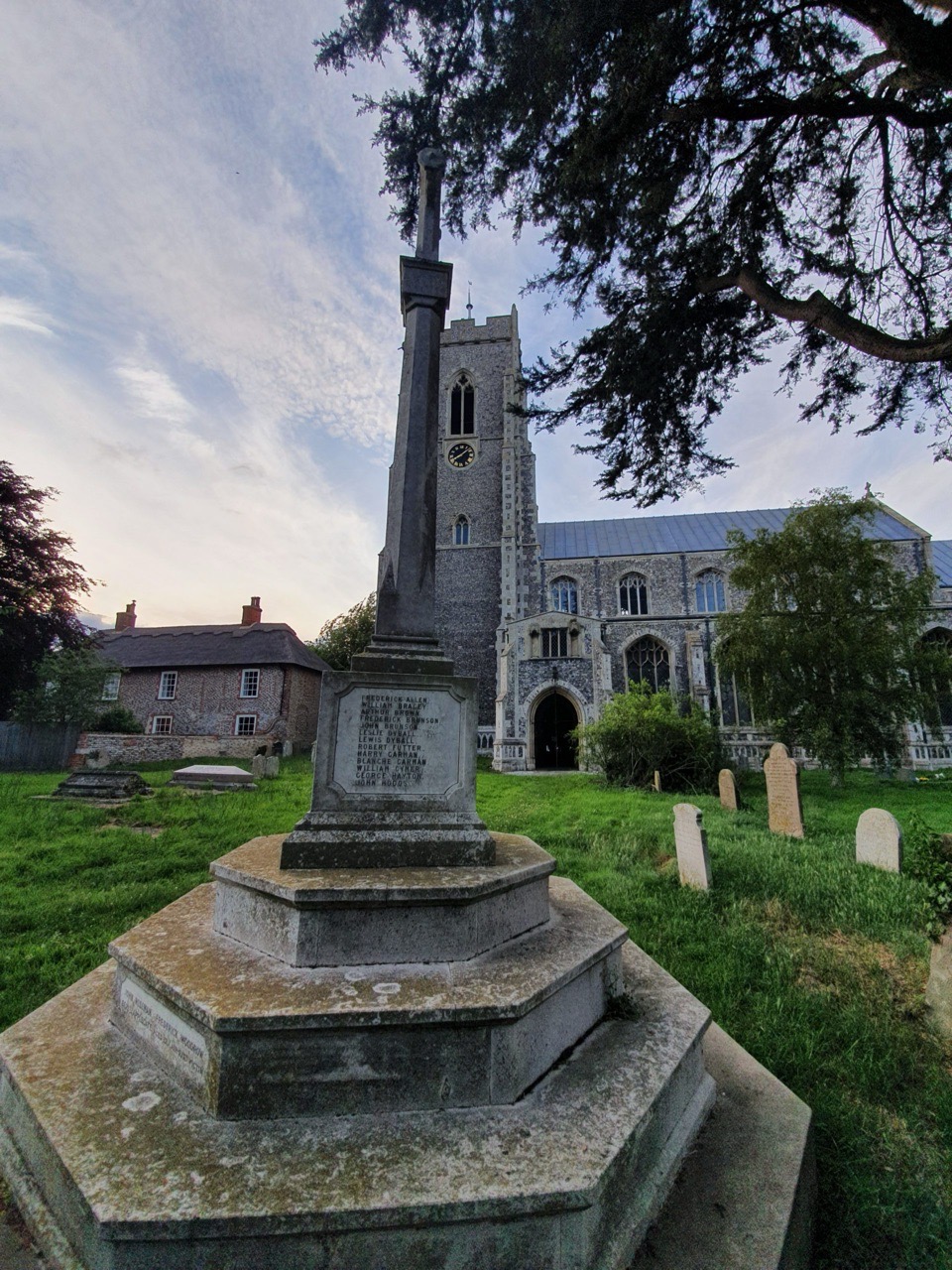
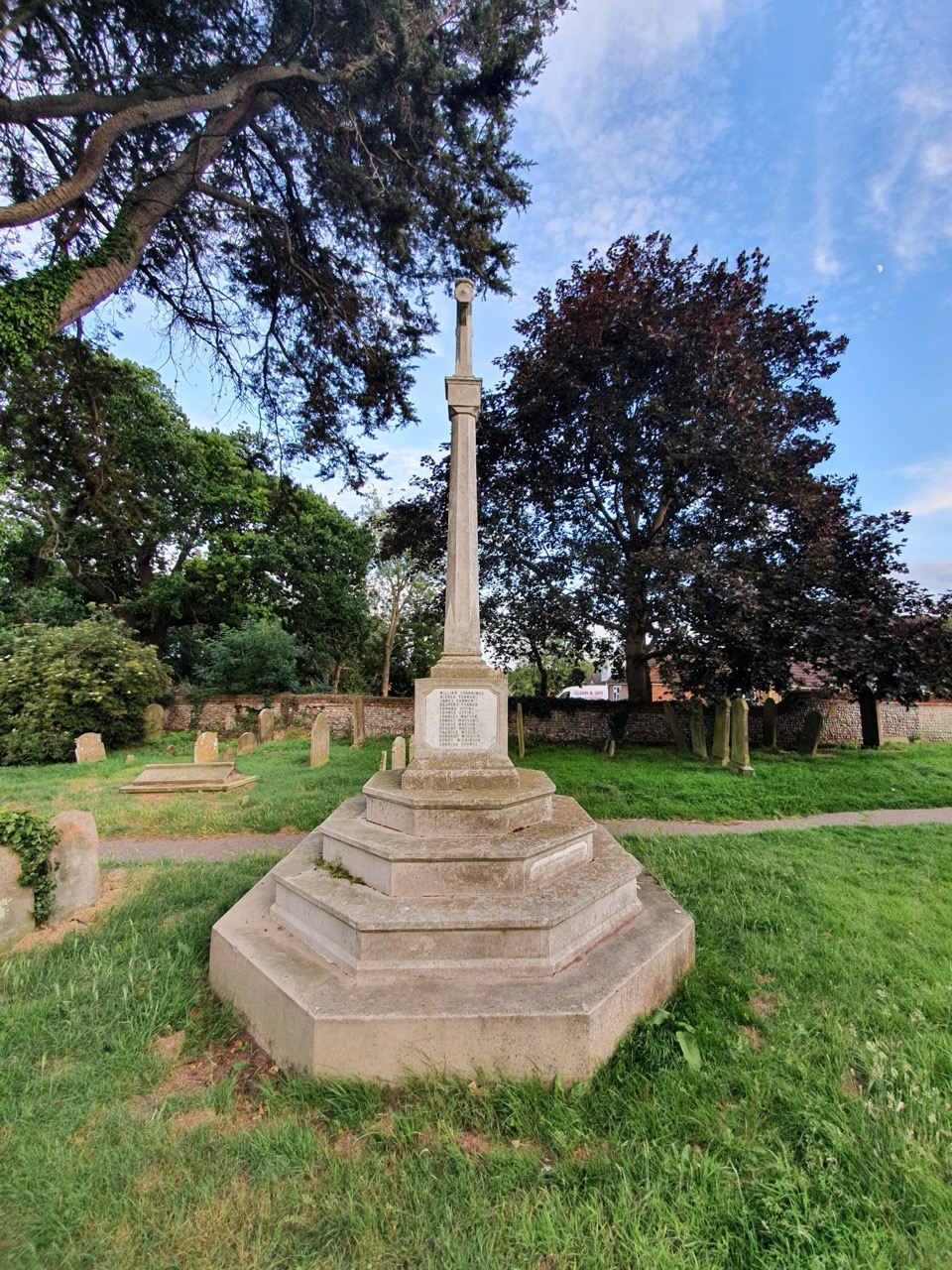
    Martham’s war memorial is located in the churchyard of St. Mary’s Church and was erected here in 1920, designed by F Perfitt of Stalham. It commemorated the 41 people from the area who were killed during the First World War, noting:

    “To the glory of God, the giver of victory and in memory of those of this parish who gave their lives for us in the Great War 1914 to 1919”.

    The 41 names are:

    Allen, Frederick
    Bracey, William
    Brown, Arthur
    Brunson, Frederick
    Brunson, John
    Dyball, Leslie
    Dyball, Lewis
    Futter, Robert
    Garman, Blanche
    Garman, Harry
    Guymer, William
    Hayton, George
    Hodds, John
    Johnson, Leonard
    Johnson, Ralph
    Knights, Harry
    Larter, John
    London, Henry
    London, Leslie
    Long, Elijah
    Mays, James
    Moore, Ernest
    Nichols, Edmond
    Rivett, Robert
    Sale, George
    Sims, Herbert
    Smith, Harry
    Starkings, William
    Turner, Alfred
    Turner, James
    Turner, Redvers
    Utting, Edward
    Utting, George
    Watson, Charles
    Watson, Ernest
    Watson, George
    Watson, Robert
    Wedge, Maurice
    Widdick, Herbert
    Wilkinson, Henry
    Youngs, Charles

    The Yarmouth Independent reported on 24 July 1920:

    “With all fitting circumstance and solemnity, Martham’s War Memorial was dedicated on Sunday afternoon. Glorious summer weather shone upon the ceremony. Remarkably impressive proceedings were heralded by a muffled peal on the church bells. A large number of ex-servicemen paraded on the Green, and marched to church, under the command of QMS Sumser. A troop of Boy Scouts from Winterton, under the lead of Scoutmaster Dyble, attended and assisted the police in keeping the entrance to the church. The beautiful church was crowded, even standing room being unavailable, and many remained in the churchyard.

    The names of the forty brave men and one noble young woman who made the supreme sacrifice were read out by Archdeacon Lisle Carr, vicar of Yarmouth, who also gave a touching and hopeful address, expressing the deep debt of gratitude to those who had fallen in a great cause, and also to those who had returned, and heartfelt sympathy with the relatives and friends of the departed, urging the thought of ‘what they had gone to’ rather than ‘what they had gone from’, and the inspiration to duty and noble sacrifice which the cross in the churchyard should be to both the present and future generations”.

    A further ten names were added to the memorial following the end of the Second World War, the names being:

    Cubit Armes
    Stanley Bean
    Robert Chamberlain
    Robert Durrant
    Reginald Frazer
    Harry Miller
    George Moll
    John Wiseman
    Frederick Woodrow
    Beryl Applegate (a young air-raid victim)

  • Martham – St. Mary’s Church

    Martham – St. Mary’s Church

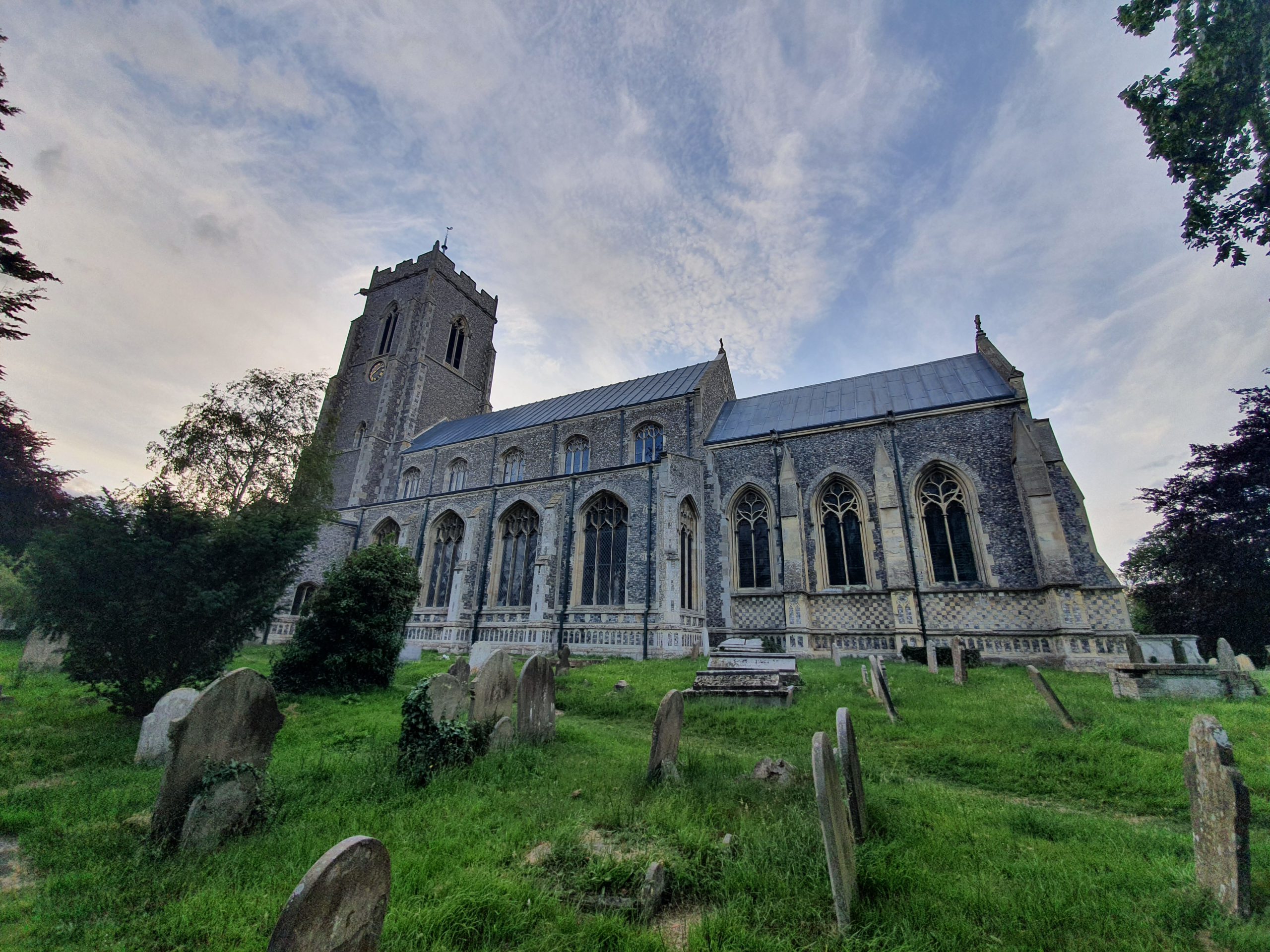
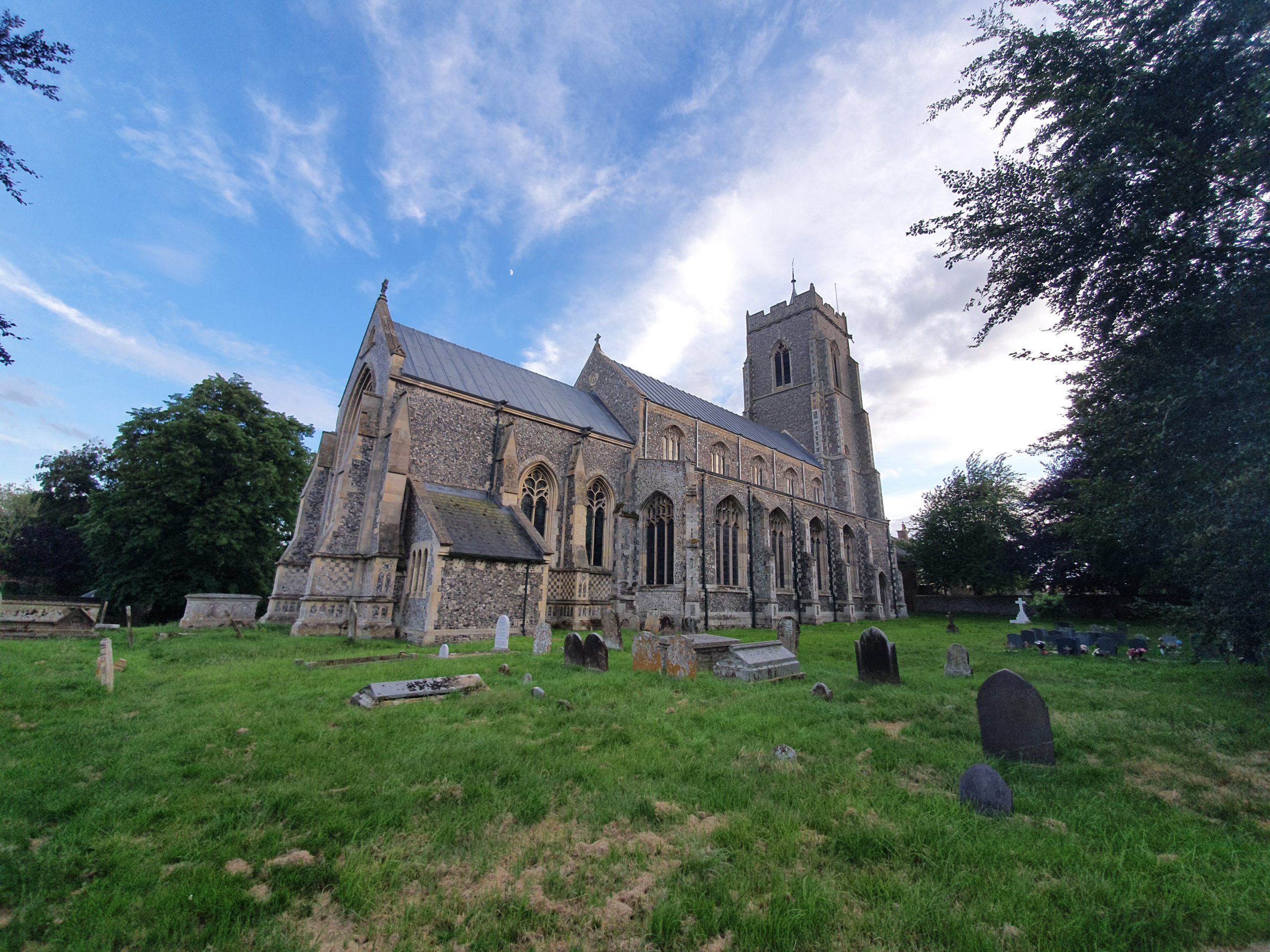
    There was probably a church on this site in late Saxon times and a recent archaeological dig discovered the foundations of a round tower from the twelfth century. What stands today though is primarily from the late fourteenth and early fifteenth centuries.

    I must admit to being a little unimpressed with the printed ‘NO ENTRY’ paper signs that the church has placed on the locked porch doors. For those who had hoped to see when the church might be once again open for prayer, they weren’t informative nor did they offer any guidance to parishioners. Given that their web-site is telling people that the rector is once again available daily in the church, it all felt a bit unwelcoming.

    Known as “the Cathedral of the Fleggs” as it’s the grandest church in the area, the tower stands over 100 feet in height. The church’s original chancel was completed between 1456 and 1469 by Robert Everard, who also designed the spire of Norwich Cathedral. I would have liked to have seen this, but as it was falling down by the nineteenth century, it was replaced with an entirely new chancel between 1855 and 1861 which was designed by Phillip Boyce. Pevsner was impressed by the quality of the workmanship completed by Boyce, so that’s good enough for me…..

    It’s a slight shame that this red-brick building is stuck here under the tower.

    The tower itself has four stages and the floor was lowered in 1999, which must have been an interesting project and a chance to see the hidden history of the building.

    There’s an interesting article from 1858 about the restoration of the church, which gives a perspective of why the modernisation of the building was seen as important.

    “Martham church was once, many generations ago, a fine, indeed an extraordinary structure even amongst the many noble village churches of Norfolk, but the hand of time, and the still heavier hand of man, did much to impair its beauty, and to render nugatory that which art and taste had constructed. Massive, ill-contrived boxes, gradually usurped the place of seats, simple and light in appearance, and many exquisite productions of art, treasures in tracery, and beautiful specimens of carving, were ruthlessly buried amidst rubbish or covered over with the ‘improvements’ of some modern Goth, and lost, too many of them, for ever.

    Old seats were swept away, and cumbersome and heavy galleries soon disappeared. It was found that the original seats had been built over and upon and fine old relics in carving and tracery were recovered, and no less than fifty ancient and beautiful poppy heads were taken from their hiding places and set in their proper positions.”

    Much as I like seeing box pews, which can add much character and some depth to a church, the argument to remove them is also strong. Some of the poppy heads which had been damaged were altered during their repair process and they’re all still visible in the church today.

    This is another church that I’ll have to come back to in order to see the interior….