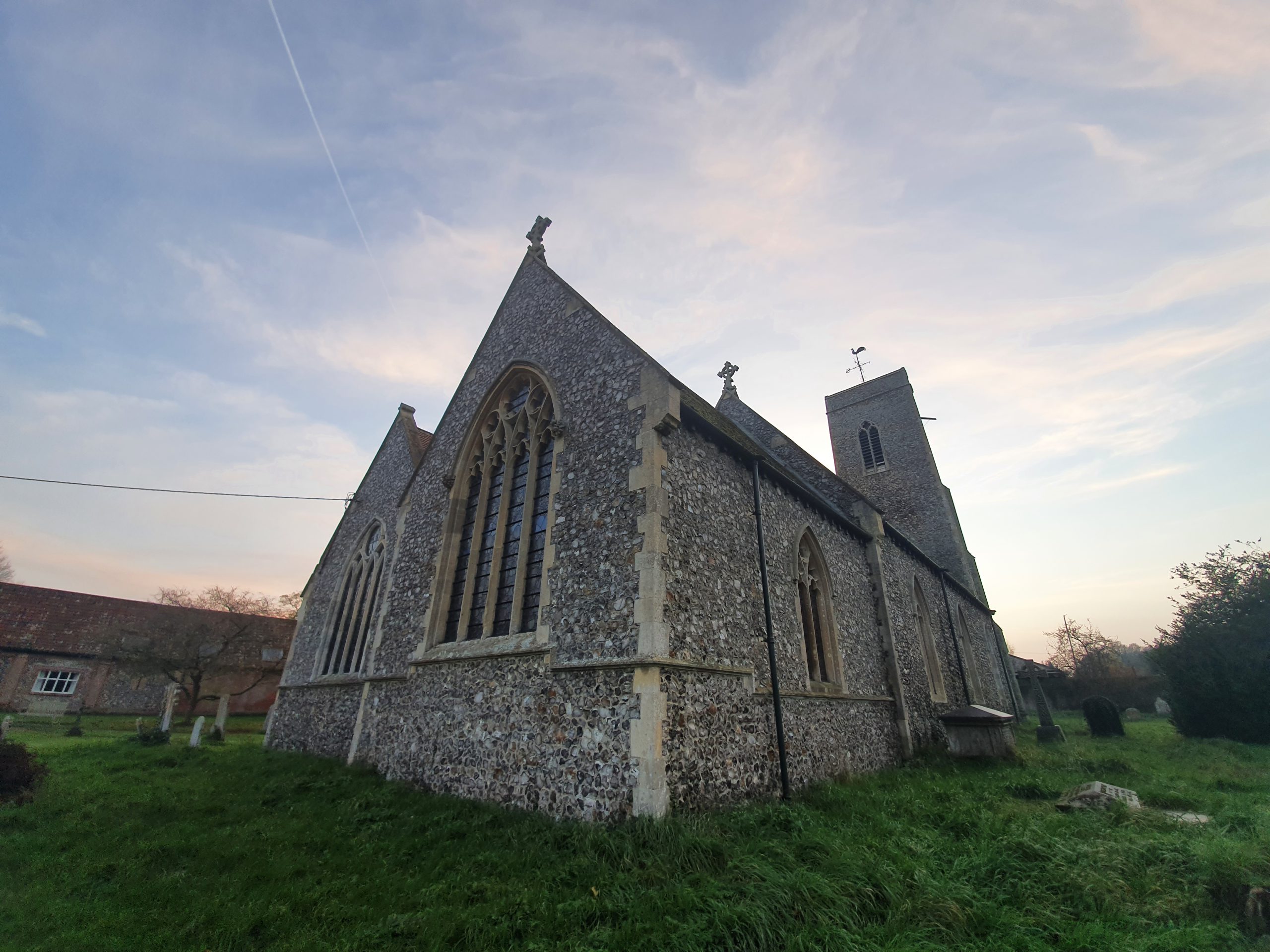
What looks like a quirky and intriguing church is actually somewhat less exciting (although just a little), it’s a rebuild from 1879 incorporating some older parts of the building. The four-stage tower, chopped off vertically and looking rather out of proportion, is the only substantial older part still standing, dating from the fourteenth century.
It seems that the building wasn’t in a great state by the mid-nineteenth century (the Bury and Norwich Post said that it “was in a very bad state of repair from age and decay”, so the restoration overseen by Richard Makilwaine Phipson, the Diocesan architect, perhaps saved the building. The rebuilding work was undertaken by Messrs Cornish and Gaymer of North Walsham at a cost of £2,100 (equivalent to around £140,000 in today’s money). It also didn’t go over budget, a testament to the efficiency of the architect and the builders.

The tower, showing the vertical amendment, something rather different to the more commonly seen chopping the entire top half off. The Norfolk Chronicle noted in 1879 about this restoration:
“Architecturally the old lines have been carefully followed and novelties and innovations judiciously eschewed. Previously the piers and arches and nearly the whole building were of brick in a tottering condition. These have all been rebuilt, with the exception of the tower, the belfry, the north wall, which have, however, been repaired where necessary. The church, the outer walls of which are faced with flint, with stone dressings, now consists of a nave, chancel, south aisle, south chapel (an old chapel, dedicated to St. Nicholas, and forming a portion of the chancel) and south porch. Its roof is of pitch pine, waggon-headed, with curved trusses at intervals over the pillars. Open benches of pitch pine supersede the old seats in the nave, and the fittings of the chancel are of oak; but the chancel is not yet benched, and the old pulpit is a dreadful eyesore which it is satisfactory to know only awaits a sufficiency of funds to be replaced.”

The chancel and side aisle, unlikely to have been an original layout.

It’s still quite an imposing building

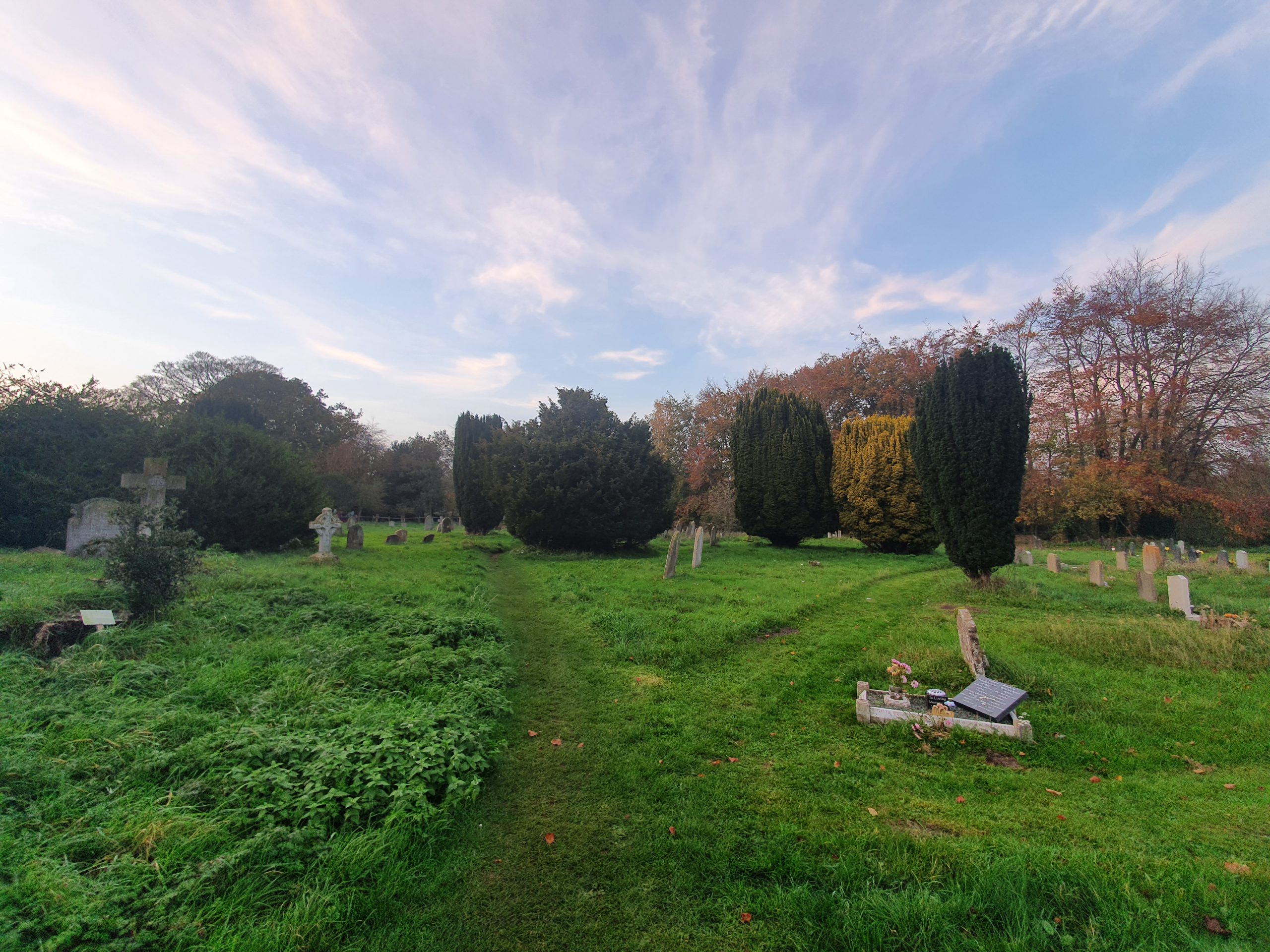
There’s a relatively substantial churchyard, although I could only find mostly stones dating from the nineteenth century onwards. The churchyard felt unusually damp, with the gravestones not in the best of condition.

The part of the tower which is still looking like it did when constructed. The interior of the church, which is closed at the moment, apparently has interesting stained glass (some by Edward Burne-Jones) and an historic rood screen.
There are also two Commonwealth War Graves here, commemorating the lives of Alfred Jackson and Vincent Noel Giri.