
Category: Haveringland

  • Haveringland – St. Peter’s Church (Cecil Albert Mace)

    Haveringland – St. Peter’s Church (Cecil Albert Mace)

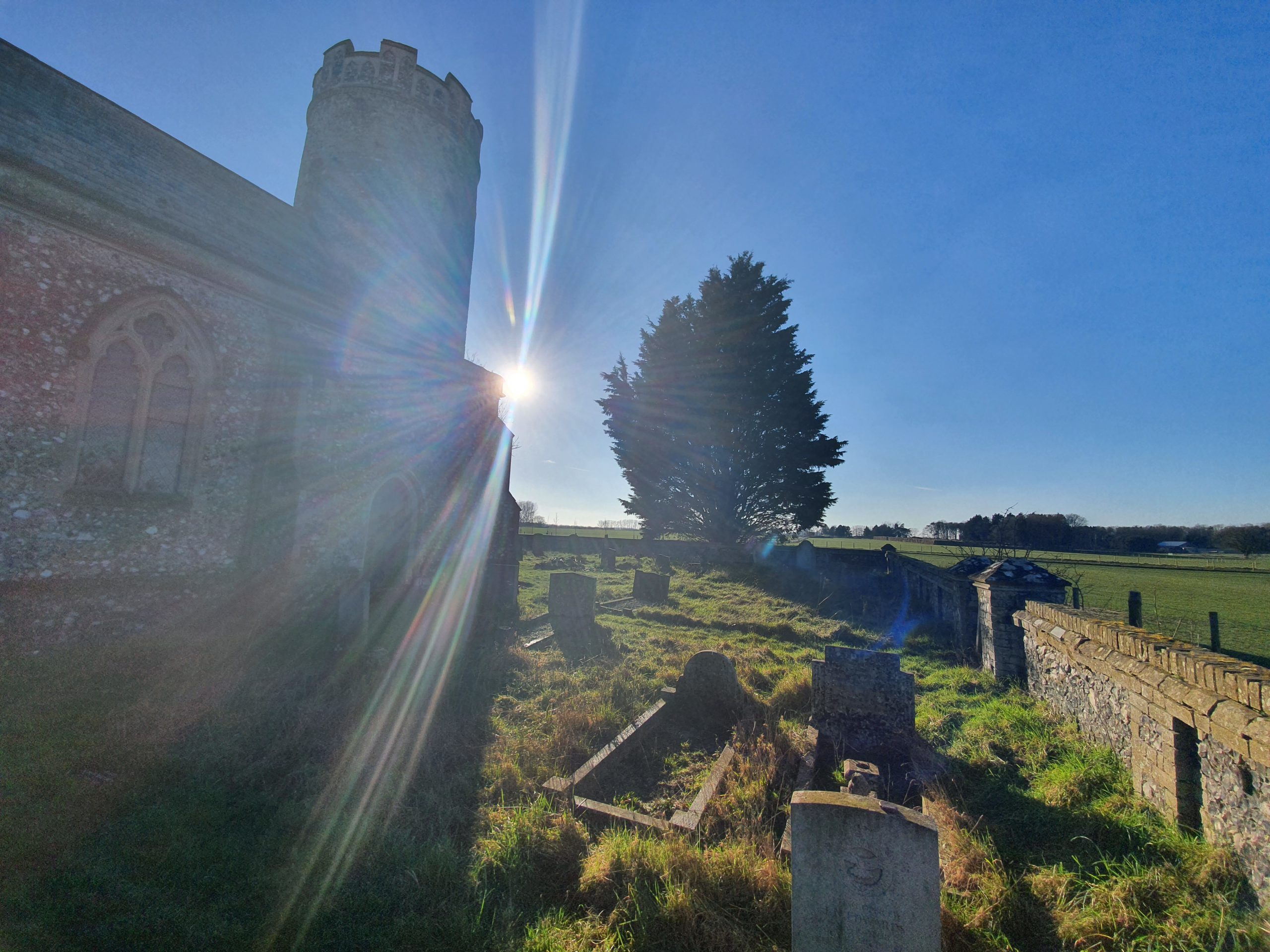
    This is the grave of Cecil Albert Mace, located at St. Peter’s Church in Haveringland. Cecil was born on 21 February 1907 and was the son of Henry Mace and Alice Mace (nee Hawkins). The family lived at 48 Canterbury Place, later moving to 61 Exeter Street, with Cecil going to Heigham Street Infants School and then St Stephen’s Infants School.

    At the 1911 census, the family were living at 61 Exeter Street, with Henry and his wife both being 31 and he was working in the boot trade. The children were Henry (aged 9), Ernest (aged 6), Cecil (aged 4), Walter (aged 2) and Alice (new-born). This census listed how many children had died, which was relatively high at the time, but Henry and Alice hadn’t lost any. I can imagine they were pleased with Alice to at least get a girl in the family, after four boys.

    At the age of 18, Cecil joined the Royal Tanks Corps on 24 January 1924, enlisting at St. Stephen’s in Norwich and being given service number 2208658.

    Cecil married Eva Mary Harrison in 1933 at St. Stephen’s Church in Norwich, although sadly his father had died by this time. Eva was aged 23, having been born in 1910, and she was working as a domestic servant, whilst Cecil’s occupation was listed as a motor driver. The couple were living at 28 Shadwell Street in the city and the marriage was witnessed by Albert Harrison and George William Hensley. As an aside here, I wrote briefly about Shadwell Street a few days ago.

    Cecil joined the Royal Air Force Volunteer Reserve, service number 902706, assisting the war effort given his previous military experience. Cecil died on 23 August 1947 at the age of 40. Unfortunately, none of the usual databases give any information as to what happened and it’s rare not to have a cause of death for an airman. There don’t seem to be any media reports of the death, which means it’s probably more likely a death from natural causes rather than being killed in a military accident. I’m also unsure why he was buried at St. Peter’s, which at the time was effectively the church on the airfield, given that he was married, but perhaps it all just felt more appropriate to the family.

    The grave registration form for Cecil and Jeffrey Edwards.
  • Haveringland – St. Peter’s Church (Jeffrey Neil Edwards)

    Haveringland – St. Peter’s Church (Jeffrey Neil Edwards)

    This is the military grave commemorating the life of Jeffrey Neil Edwards and it’s located at St. Peter’s Church in Haveringland.

    Jeffrey was born in West Ham (then in Essex) in 1922, the son of Arthur Edwards and Ethel May Edwards (nee Roberts), of Wanstead in Essex. He became a Flying Officer service number 172240, flying with the 157th squadron of the Royal Air Force. His home address was listed as 8 Cambridge Park in Wanstead, which was the residence of his parents.

    Jeffrey was named in Despatches on 5 February 1944 for his bravery, something for which his parents must have been enormously proud of. Sadly, Jeffrey was killed on the night of 22nd/23rd December 1944 when returning from an enemy raid in his Mosquito TA392 RS-K aircraft. He reported to Flying Control that he was having problems with the ailerons and the aircraft crashed at the airfield also killing his pilot Flight Lieutenant W Taylor. There’s a report of the crash at the Aviation Safety web-site.

    The military grave record, with Jeffrey dying at the age of just 22. The probate details were confirmed in 1946, with Jeffrey’s assets of £332 18s 6d being transferred to his father, Arthur.

  • Haveringland – St. Peter’s Church (Bithiah Howard)

    Haveringland – St. Peter’s Church (Bithiah Howard)

    This stone is located just outside the porch of St. Peter’s Church in Haveringland. It’s an interesting first name, I think it’s Bithiah, but there’s more on Wikipedia about this. Although the burial records survive at Norfolk Record Office, the actual church mostly doesn’t as it was rebuilt in the 1850s (other than the tower).

    I suspect that this stone was once above a tomb inside the church, which would explain why it has survived in good condition since Bithiah’s death in 1769 (or more precisely, she died on 31 December 1769 and was buried on 3 January 1770). Personally, I don’t think this stone should be outside, it’s part of the heritage of the church and so would be better off inside and protected.  I’m only guessing, but the stone was probably broken on lifting it in the 1850s and so they just removed it. It’s also missing from the comprehensive list of memorials which the church prepared in 1981.

    Bithiah was born in 1693, but, unfortunately, other than finding her name in the parish death register (and I had to search it manually as the transcriber couldn’t read it), I can’t find anything else. I think there are problems with the transcribing of that first name, there are all manner of variants out there. The nature of the stone suggests that the family likely had some wealth and was perhaps connected with Haveringland Hall.

  • Haveringland – St. Peter’s Church

    Haveringland – St. Peter’s Church

    Initially, not a lot made sense about this church as the road layout was illogical and the building was set back about 200 metres from the road. It’s not entirely normal for a church to be located at the end of a long concrete (or whatever it is) track and nor for there to be such a lack of road access.

    This is though the answer, the airfield of RAF Swannington, which was in use between 1944 and 1947. There were plans to turn it into a larger airfield after this, but those plans didn’t come to fruition and the land was sold by the RAF in 1957 and the land returned to agriculture. The church is just visible on the above map (which is an Ordnance Survey map, just out of copyright) on the extreme right-hand side.

    We pondered whether this was wide enough to be a runway, it didn’t feel quite right in terms of the size, but it was the map which confirmed that this was the perimeter of the airbase. Sections of the runways themselves are still visible on overhead maps, but not to the size that they once were.

    Some of the memorials relating to the airbase.

    Onto the church, I saw this and was a little disappointed as it’s just Victorian (not that everything Victorian is bad, but it does mean the medieval heritage of the building isn’t going to be there). With the exception of the tower, the church was demolished and rebuilt in 1858 by the owners of the nearby, and now demolished, Haveringland Hall. The listed building record notes that the thirteenth century font has been kept, but everything else is Victorian. The church was locked, but I’m not entirely sure that there was much to see inside.

    Ignoring all the nearby concrete of the former airfield, it’s a remote and quite charming area.

    A gateway that has long since fallen into disuse.

    The porchway is Victorian, but that tower looks magnificent. It was noted in a newspaper article in the 1890s that the scale fern that was on the building had now been removed, a decision which was probably beneficial to the structure of the church. It’d have been a shame if that tower was covered in ivy, not just as it would be damaging to the stonework, but because it’d hide the beautiful round tower.

    Some of the Victorian stonework on the side of the porch.

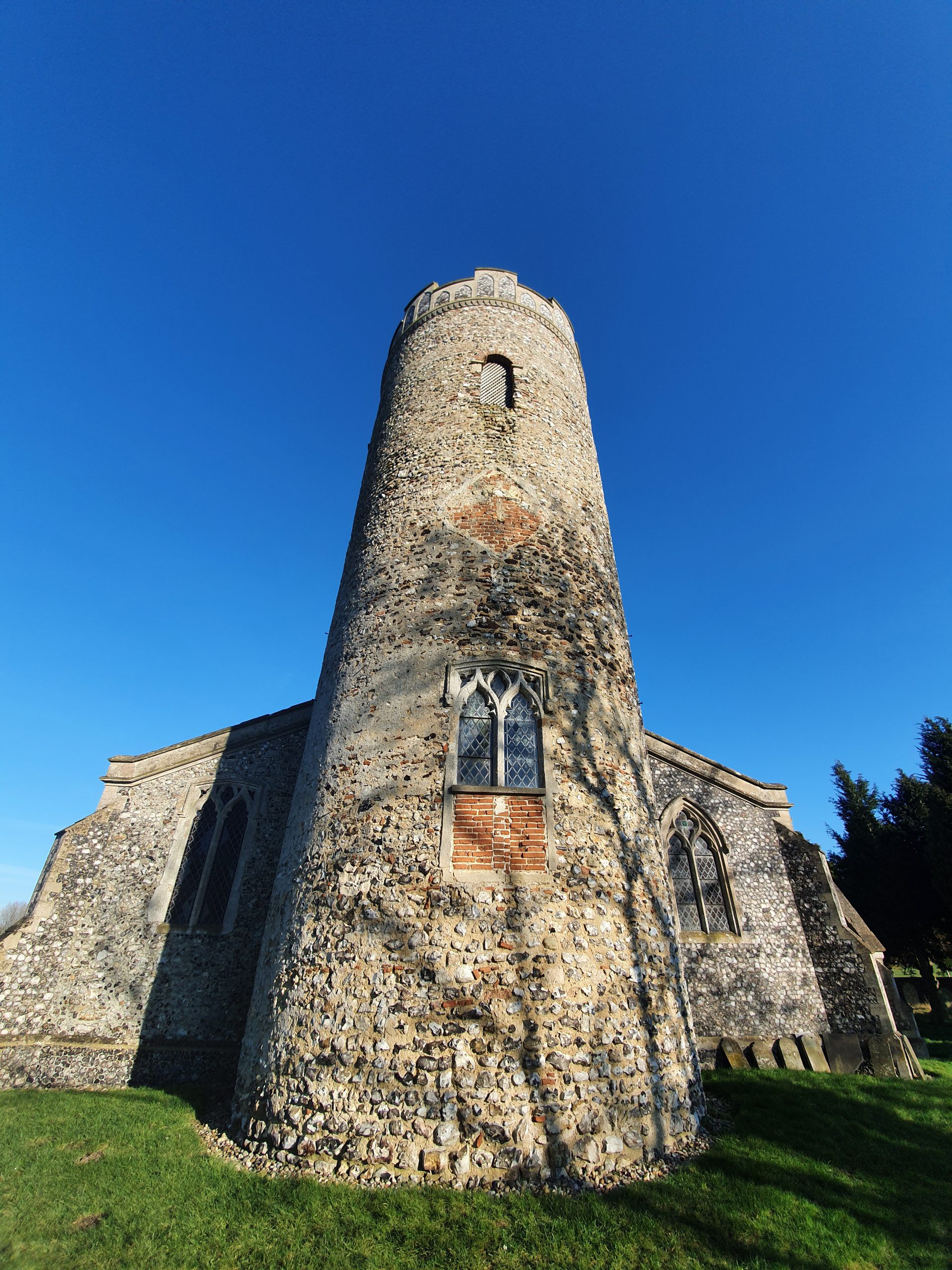
    So, onto the round tower, which dates from the eleventh century. It’s one of the oldest surviving round towers in the country, although they faffed about with the top of it during the Victorian rebuild.

    I think that’s Roman brick.

    The window height has been changed on the tower and bricks placed under the new window, but it gives it all some character. Some of the tower has been rendered, likely in the 1850s, although some of that has since fallen away and not been replaced.

    I’m not quite sure what all of these metal attachments are to the church tower. Perhaps they were used to stabilise the tower whilst they were demolishing the rest of the building in the Victorian period, or as some sort of support for plants. Although the bulk of the historic church has been lost, at least this tower remains, having spent centuries looking over agricultural workers and then for a few years there were military aircraft taking off in its shadow. The tower at least is perhaps an unlikely survivor, but at nearly 1,000 years old it’s not looking in bad condition.