
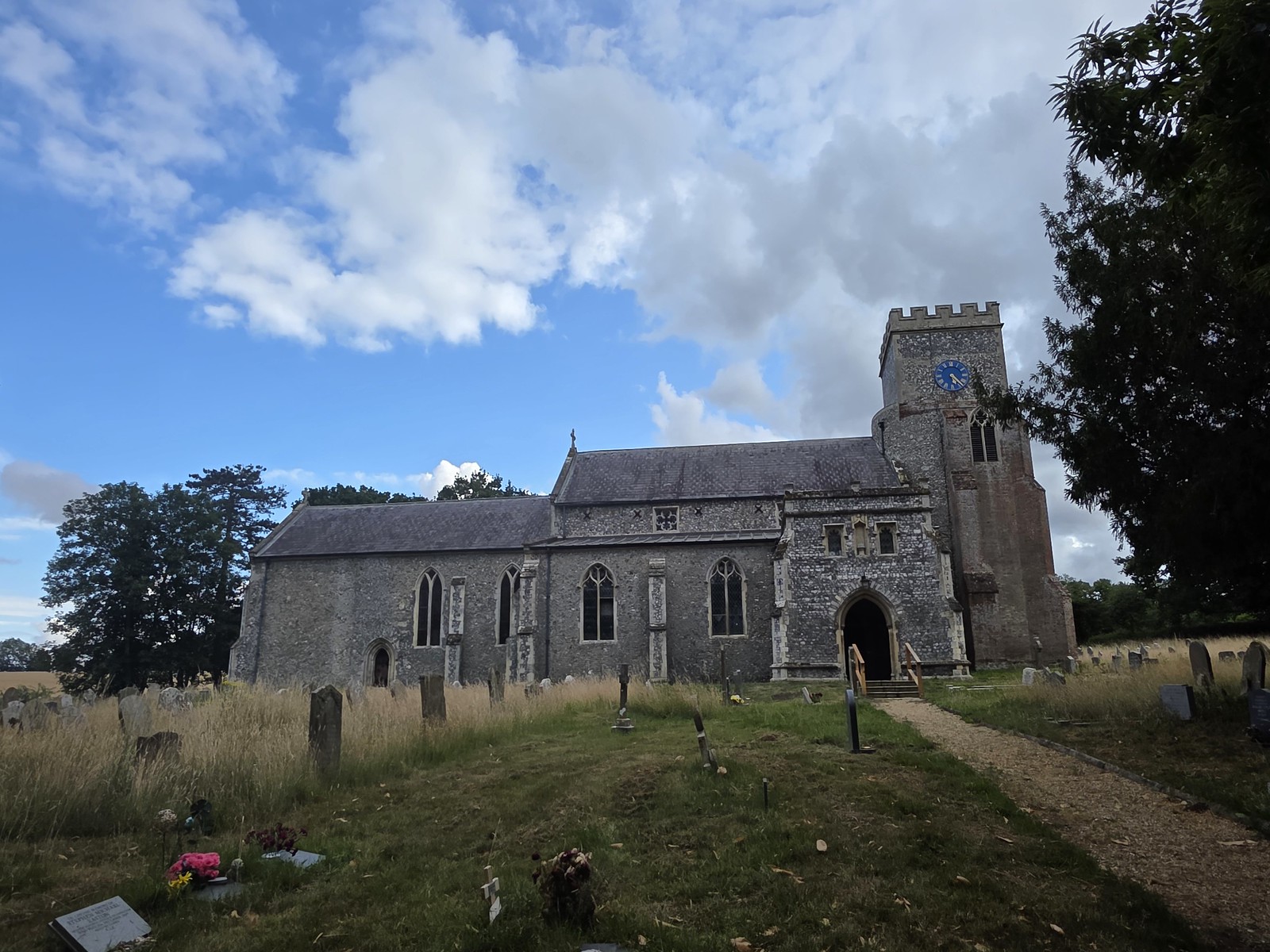

St Mary’s parish church in Denton, Norfolk sits rather quietly off the beaten track and it doesn’t even front onto a public road, it requires a walk (or drive in Richard’s car) past the rectory and then up some steps. There has though been some disabled access added to the church which avoids those steps. Denton is a village on the Norfolk and Suffolk border, with the name meaning ‘village in the valley’ in old English. The original Denton was located around the church, but it shifted after the plague in 1665 and the heart of the village is now a little to the north.

The first sight of the church is really rather memorable because of one of the more quirky tower arrangements that I’ve seen in Norfolk.

There was likely a religious building here during the Saxon period, but the Normans constructed a round tower, although this was rebuilt in something like the thirteenth century.

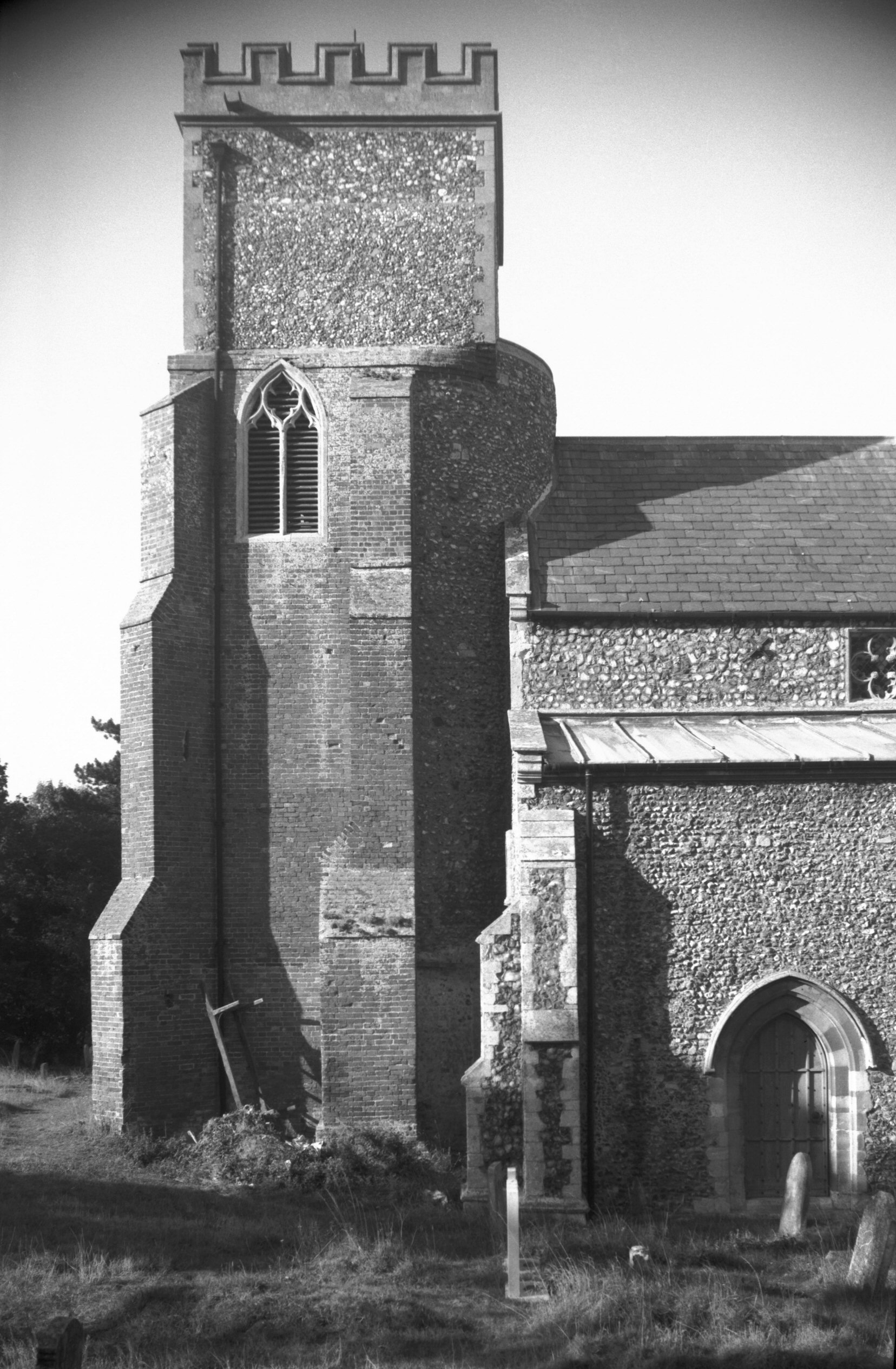
Then in the sixteenth century, there was the sub-optimal situation that most of the church tower fell down. This wasn’t a time when the church was the most wealthy or loved, so it took some time to fix the arrangement. In 1714, the locals finally built a square brick tower against what remained of the collapsed tower, leaving what would have been a slightly untidy arrangement, but at least one which let them have a complete tower and bells to put in it.

The entirely rebuilt section of tower.

In 1843, not wanting to be outdone by previous generations, the Victorians decided that they wanted to raise the height of the tower by around ten feet and later in the nineteenth century, they decided to shove a clock on it as well. As the church puts it, “a square tower in a round hole”, with the Round Tower Churches Society including it in their list.

The bulk of the rest of the church’s structure dates to the fourteenth and fifteenth centuries. George Plunkett has a photo of the church from 1976. Recently, the lead roof has been replaced with something that is terne coated steel that looks like lead but is rather less useful to any thieves who might be passing.

And there’s a rather glorious ceiling that I think is nineteenth century.

The chancel dates to the late thirteenth century, albeit that was also faffed around with in the nineteenth century.

The Perpendicular north porch is from the fifteenth century and rather grand with a room above, accessed from within the church, which was in the Victorian period used as a schoolroom for the local children, but was likely used to store church treasures when it was constructed. There’s a niche at the front of the porch that would have housed a statue of the Virgin Mary, but that has long gone.

Inside the impressive porch with its roof bosses.

The church has a sizeable chest, there would be no moving that in a hurry.

This is rather outdone by the Denton Chest, located in the chancel, which has medieval painted panels on it which likely date from the early sixteenth century. It’s not entirely known where these are from, but they are likely from the church’s rood screen, or potentially the rood loft. The paintwork has faded somewhat, the photograph makes these panels look much brighter than they actually are.

The fourteenth century chancel was ‘improved’ by the Victorians, under the influence of the rector, William Bouverie, with the floor being lifted up. The Victorians made lots of changes around the nave as well and, as ever, I’m not entirely sure they’ve really improved matters as there’s some heritage that feels like it has been knocked out.

This East Window in the chancel is an interesting arrangement and it comprises pieces of stained glass that were collected by Archdeacon Postlethwaite and they were then arranged by Joshua Price between 1716 to 1719, using a financial legacy left by the Archdeacon. It’s an impressive sight now, lots of bits of glass treasure and a fair amount of heraldic glass, with the whole arrangement thought to be the first of its type in the country. There’s more about the stained glass in the church at https://norfolkstainedglass.org/Denton/Denton.pdf.

The design which was completed for the church by John Brown of Norwich in 1839.
This is one of the most impressive churches that I’ve visited so far in Norfolk, there’s plenty of history here, but it’s also nice to come to a church which is left permanently open and that’s something they’ve done for over a decade. It feels a welcoming place, there’s an effort that has been made to explain the building’s history and everything feels in good order. It also feels like a loved church and that has been essential as a lot of repair work has been needed in recent years to protect the interior and exterior.