Category: Bintree

  • Bintree – St. Swithin’s Church (Grave of John Gill)

    Bintree – St. Swithin’s Church (Grave of John Gill)

    20250511_152129

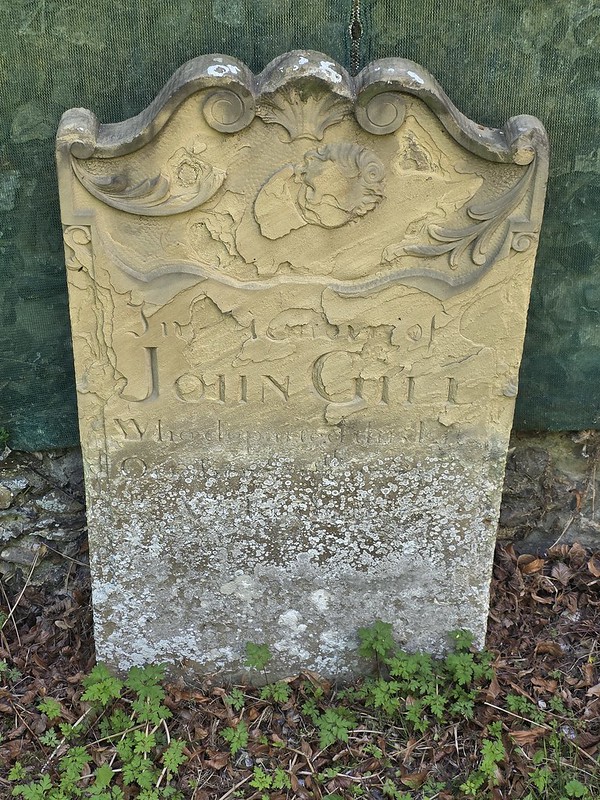
    This grave is located at St. Swithin’s Church in Bintree and I took a photo of this gravestone as some sort of record given the perilious state that it’s in. It has transpired to be older than I had realised as the only evidence I can find of a burial at this church of a John Gill was on 15 October 1773. He married Anne Brooke at the church on 4 June 1759 and they had a son also called John Gill, but I’m not sure that the younger one was buried here. Looking at the photo in some detail does seem to suggest that the 1773 date is still visible, but it is very hard to read.

    I thought that the gravestone looked early nineteenth century, but ChatGPT thinks:

    “This style of headstone—with its scrolled “shoulders,” rococo shell-and-cherub motif at the top, and the deeply incised lettering—was most popular in the mid-18th century. My best guess is that this grave marker dates to around 1740–1760, making it roughly 260–280 years old.”

    Google Gemini comes in with:

    “I would estimate the gravestone likely dates from the late 1700s to the early 1800s.”

    So, this sandstone gravestone is something of a survivor, dating back to 1773, although I’m not sure how many more decades it’ll hold out for.

  • Bintree – St. Swithin’s Church (War Grave of Ernest George Vince – Deserter)

    Bintree – St. Swithin’s Church (War Grave of Ernest George Vince – Deserter)

    20250511_151925

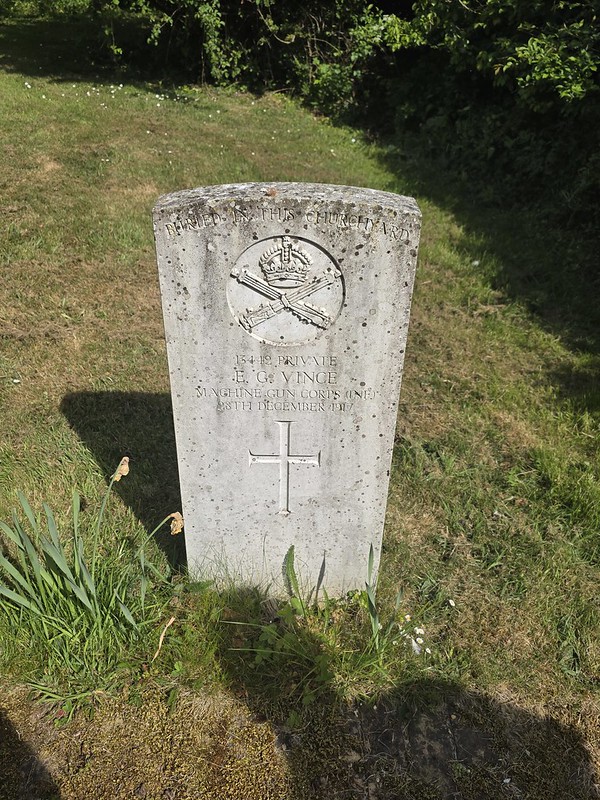
    Located at St. Swithin’s Church in Bintree is the Commonwealth War Grave of Ernest George Vince.

    Ernest was born in 1888, the son of George Vince and Susanna Vince, the younger brother of James and Emma. George and James worked as bricklayers and this is also the trade that Ernest went into a few years later and he’s listed on the 1911 census as being the only child of the family still living with his parents. I can tell he struggled at school as his records are on-line and he was last in the class and on 11 July 1900 it was reported by the school that he was working illegally and I can imagine that he was being inducted into the bricklayer trade early on.

    And herein lies what is likely a tale of woe and an individual probably not really given a chance before things went wrong. Over the next few years there was a constant run of criminality, including stealing a watch on 20 March 1907, stealing a bicycle on 1 July 1916, stealing a bicycle on 28 August 1916 and, once again, stealing another bicycle on 4 April 1917. He was also found guilty of larceny with intent to defraud, obtaining food and lodging by false pretences and numerous other cases of cheating. On 24 March 1917, the press reported that he had deserted from the British Army and when arrested by soldiers he had managed to escape from them. He lied about being a soldier to a lady in order to get food and accommodation, deciding not to mention he was a deserter.

    He was a private with the service number 13442 in the Machine Gun Corps (infantry), formerly 18316 in the Norfolk Regiment, but his service records don’t seem to exist in any useable form. Ernest died on 28 December 1917 and was buried on 4 January 1918.

  • Bintree – St. Swithin’s Church

    Bintree – St. Swithin’s Church

    20250511_152542

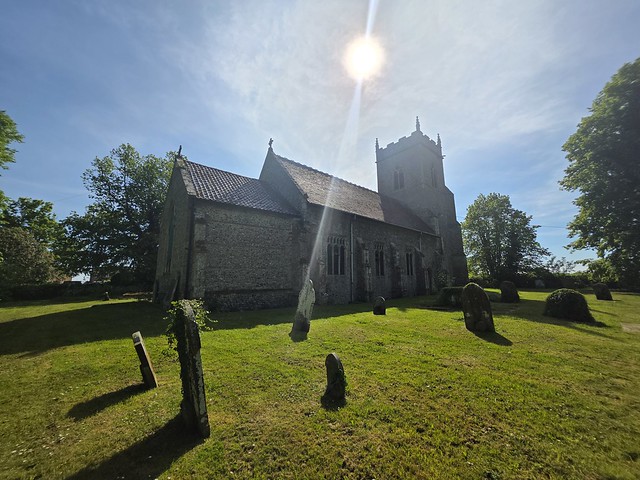
    Next on the tour that Richard and I took around was to visit St. Swithin’s Church in Bintree, which was unfortunately another one which was locked up which achieved protection against anyone stealing anything and also protection against anyone seeking religious solace. Its dedication to St Swithin isn’t the most common and there’s a fascinating list of the numbers at https://www.blanchflower.org/cgi-bin/qsaint/qsaint.html, showing Swithin at 47th. The village of Bintree is listed in the Domesday Book, so it’s likely that there was some sort of religious building in the village during the Saxon period.

    20250511_152431

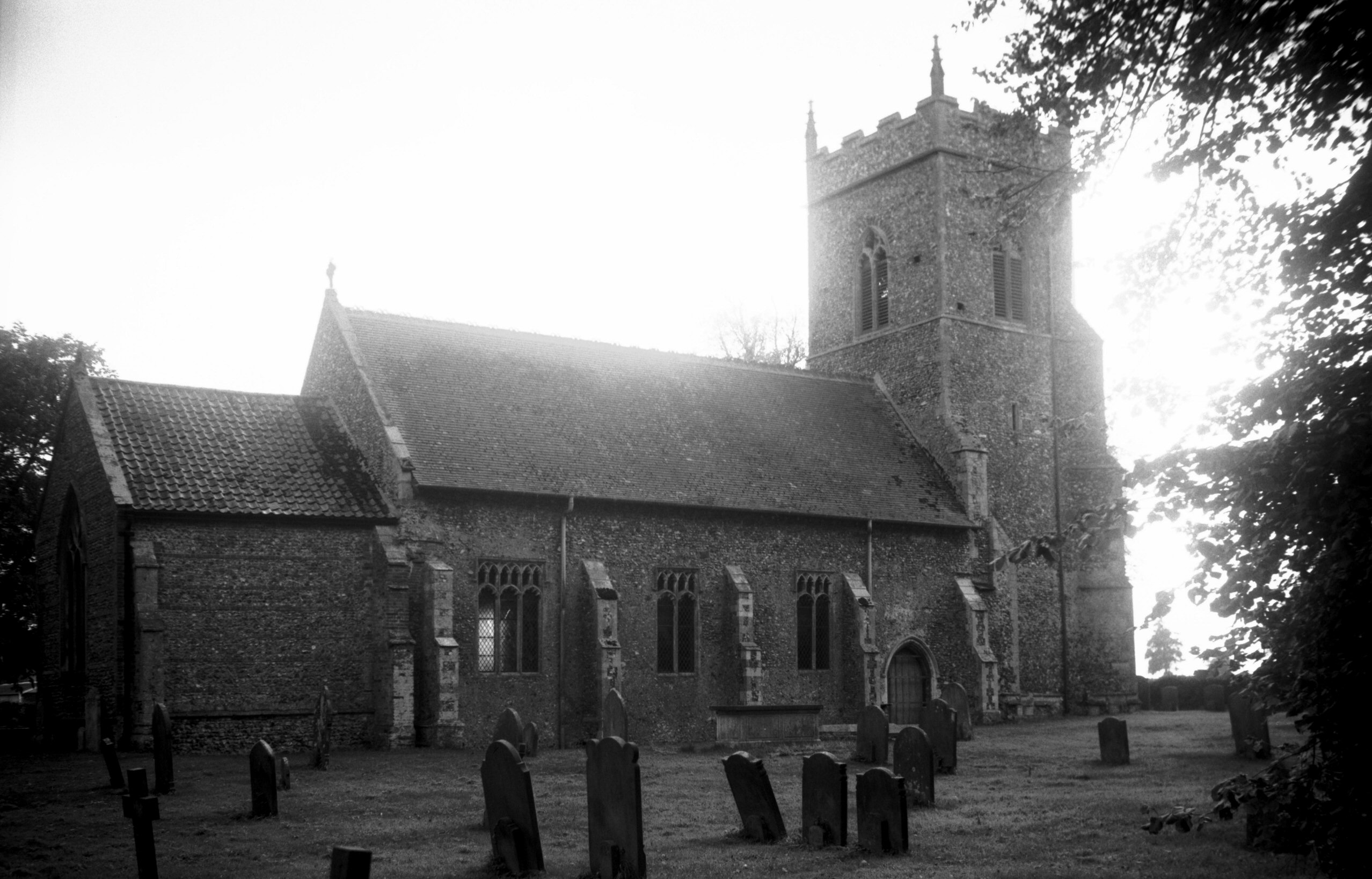
    The bulk of the church dates from the fourteenth century, but there are some twelfth century elements so perhaps that was the date of the first stone building on this site. It’s all quite clean and ordered without the usual mismatch of windows and features that are evident in churches. Whether that’s because it was all constructed at the same time, or rebuilt in the late nineteenth century, I’m not entirely sure. George Plunkett has a 1992 photo of the church taken from a similar angle to this one.

    20250511_152328

    The chancel is quite stubby and not very interesting from the exterior, but this is primarily as it fell down in 1806 and a smaller replacement was completed in 1815, which was then faffed about with by the Victorians in 1865. It was mentioned in the local media in 1903 that the church was in a poor state of repair, but enough money had been found to reroof the nave, so this feels like it has been a slightly neglected arrangement at times and I wonder whether it wasn’t given the same extensive modernisation (effectively often entire rebuilds) that other buildings were given by the Victorians. It has been a rather High Church arrangement in the past, but I’ll come to that separately as there are some interesting stories relating to that.

    20250511_152251

    This is quite exciting, it’s a grave cover that is thought to be that of Richard de Langbrigg, a parish priest who died in 1270. It’s an impressive survivor and it has its own Grade II listing, although he’s a little unlucky as he was located within the former larger footprint of the chancel and he’s now stuck just outside of it.

    20250511_152049

    The end of the chancel, representing the rebuild after the previous one fell down. It’s all neat and tidy to be fair.

    20250511_152053

    Helpfully dated, but I don’t yet know who those initials relate to.

    20250511_152056

    I don’t know what this is, perhaps a stone-mason’s mark?

    This church has seemingly endless contradictory dates in various sources and there doesn’t seem to be as much information about its history in common sources as some other nearby churches, even taking into account that it was historically often called Bintry Church to add extra confusion. It appears that they’ve been reluctant to routinely open this church for some time, but it is now operated by the Diocesan Churches Trust which is effectively a sign that it has fallen out of use but they just don’t want to deconsecrate it. It’s an intriguing building, hopefully I’ll be able to get to see inside at some point. This is one of those churches that I have a suspicion I’ll find out a lot more about at some stage, but at the moment it feels like something of an enigma.