Category: Westminster (Borough of)

  • London – Westminster – Tate Britain (Distant View of York by Alexander Keirincx)

    London – Westminster – Tate Britain (Distant View of York by Alexander Keirincx)

    This isn’t a great photo of this artwork, which is a distant view of the city of York.

    Fortunately, the gallery has released copies of its artworks on-line, so here’s a better one. This painting was one of ten that were commissioned by King Charles I to show some northern and Scottish scenes. It was then housed at Whitehall Palace, before being sold at a sale of Commonwealth assets on 3 May 1650, the second of such disposals (and more were to come) of the Monarch’s property. This painting was purchased at the sale by Remigius van Leemput for his collections and it came to Tate Britain in 1986, so it has been on a long and circuitous journey to end up nearby to Whitehall once again.

    The artwork was painted by Alexander Keirincx (1600-1652), a Flemish landscape painter who specialised in wooded scenes and imagery of English castles and landscapes. He painted this series of artworks in 1639, before moving to Amsterdam in 1641 where he lived until his death.

    Work by the Tate suggests that the painting isn’t entirely historically accurate, so it’s unclear whether or not the artist did visit York or he just shoved something together from existing drawings. Interestingly, six of the paintings from the same series came up in the late twentieth century, two of which ended up at the Scottish National Portrait Gallery in Edinburgh and the other at the Yale Center for British Art in New Haven, Connecticut (which has the largest collection of British paintings in the world outside of the UK). Some of the other paintings that came up for sale didn’t sell, so they could be anywhere at the moment.
  • London – Westminster – Tate Britain (An Unknown Lady by Marcus Gheeraerts II)

    London – Westminster – Tate Britain (An Unknown Lady by Marcus Gheeraerts II)

    Nothing is known of this lady, other than she’s pregnant and wealthy, that’s about the limit to what can be worked out. This is a shame, here she is presented in one of the world’s finest art galleries and no-one knows who she is. They’re not even entirely sure who painted the artwork, but it’s probably Marcus Gheeraerts II (1561-1636), who worked at the court of Queen Elizabeth I.

    The artwork was painted in around 1595 and the gallery has done a huge amount of work on it, including analysing most of the paintwork and putting it through an x-ray machine. For a while, the artist was thought to be William Segar and it was only after cleaning of the painting that it was re-attributed. Most of this work was done just after 2001, which is when the painting came to the Tate in lieu of tax. There’s a bit of a gap in the provenance of the painting, although the gallery knows that it was owned by Walter Waring in the eighteenth-century, namely because he wrote this on the back of the artwork. Handy.

    But, to whoever the lady in the painting is, her image is now seen by hundreds of people every day, so I’m guessing that she’d probably be quite pleased.

  • London – Westminster – Tate Britain (Lady Elizabeth Grey by Paul Van Somer)

    London – Westminster – Tate Britain (Lady Elizabeth Grey by Paul Van Somer)

    Lady Elizabeth Grey, the Countess of Kent (1582–1651), looks a formidable character in this painting by Paul Van Somer (1578-1621). She was married to Henry Grey, the 8th Earl of Kent, a land-owner and MP, but they didn’t have children to pass their wealth onto. Grey’s interesting, er, display in her painting wasn’t unusual for a mature woman of the time, but only one from the middle or upper classes would get away with that.

    The artwork was painted in around 1619, but what is perhaps the most notable about this is that it became part of the art collection of King Charles I. It was later acquired by Friends of the Tate Gallery in 1961, although there’s no other provenance listed on the gallery’s web-site, so goodness knows where it has been for the last few centuries…..

  • London – Westminster – Tate Britain (Wire and Demolition by Prunella Clough)

    London – Westminster – Tate Britain (Wire and Demolition by Prunella Clough)

    I’m still working with my theme that it’s lazy to generalise all modern art as difficult and pointless, when much of it has meaning and depth. But, along with that, I’m suspecting that when a gallery has nothing to say on it either, then it probably doesn’t have a great deal of meaning. It might still have value, but if no-one can offer any perceptive comment on it other than just a guess, then you could just have a drawing by a child on the wall.

    This painting, or whatever it is, is by the esteemed artist Prunella Clough (1919-1999) and the gallery has decided not to put anything in its summary of the artwork. So, the entirety of what the gallery has to offer here is:

    “Clough’s paintings of urban and industrial scenes were often inspired by objects the artist noticed during walks around sites of interest. Here Clough references a piece of old wire discovered on a building site.”

    But, yet, there are many artists who have reflected on the urban theme and have given something a little more defined whether it be in photographs, drawings, paintings or sculpture. Each to their own though, the gallery acquired this in 1982 and so its been shoved on the wall now for the best part of 40 years.


  • London – Westminster – Tate Britain (Karl Lagerfeld Bean Counter by Anthea Hamilton)

    London – Westminster – Tate Britain (Karl Lagerfeld Bean Counter by Anthea Hamilton)

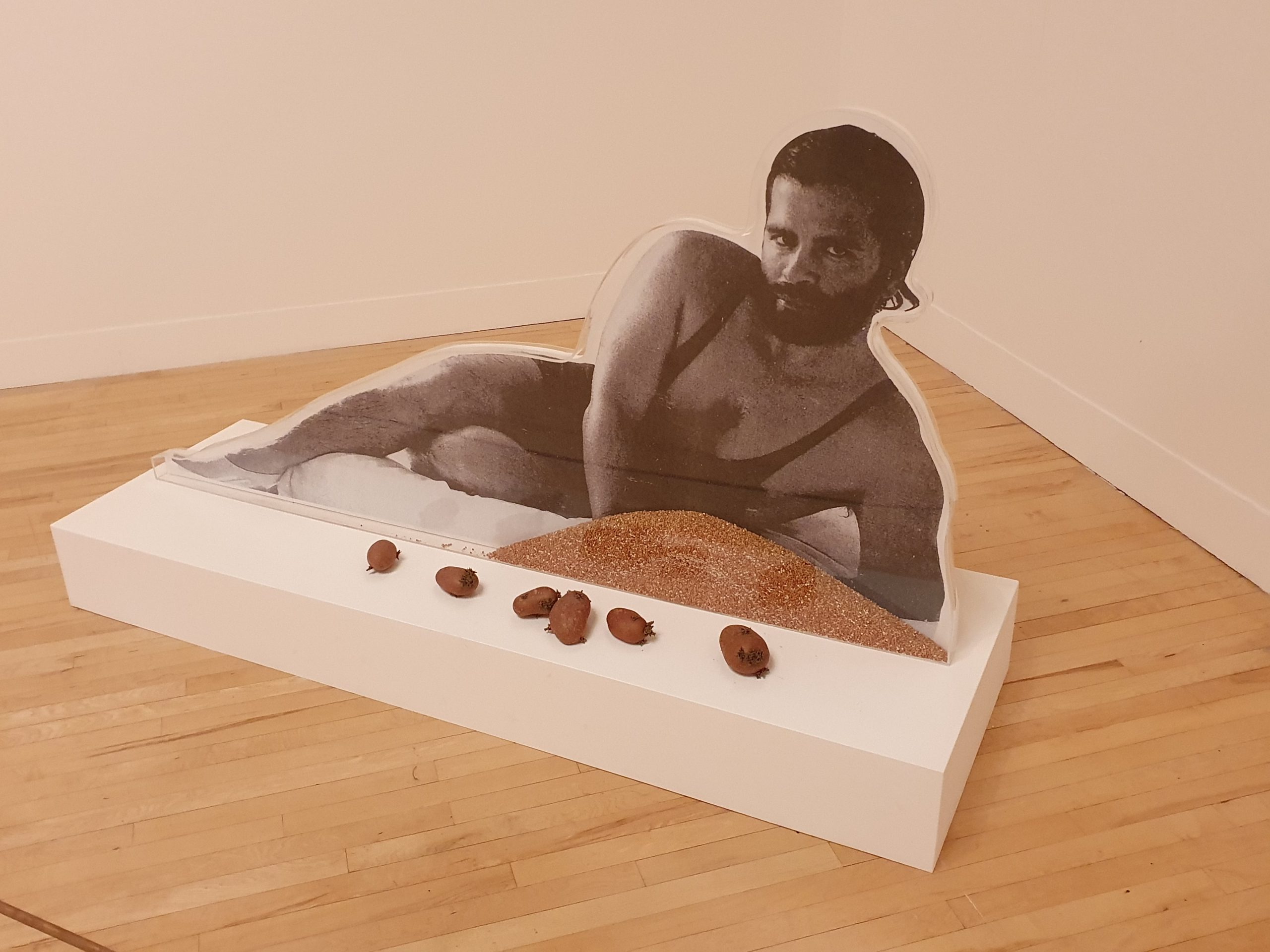
    Tate Britain acquired this artwork in 2019 and the artist is Anthea Hamilton (1978-). I’m not entirely sure I understand it, but I think it’s trying to raise a debate about the essence of how an individual is viewed by society and the processes involved with that. Karl Lagerfeld has quite a defined image today, but this is him when younger as part of some fashion shoot. I don’t understand the potatoes and buckwheat, but perhaps that it’s just to create an informal and humorous foreground to the imagery.

    The Guardian said “there are plenty of cues but you have to keep improvising the lines” with regards to works by Hamilton, which seems a suitable comment. Some modern art annoys me when it seems pointless, but when it provides cues, it gives it some relevance. Anyway, it’s clear that I don’t know what I’m writing about, but I like that the artwork isn’t pretentious.

  • London – Westminster – Tate Britain (Horizontal Stripe Painting by Patrick Heron)

    London – Westminster – Tate Britain (Horizontal Stripe Painting by Patrick Heron)

    I don’t understand great swathes of modern art, but there’s becoming an easy way to see if the art gallery that the artwork is located in has a clue either. Sometimes, the gallery can produce detailed information about the thought processes behind a painting, and that can give me an understanding of what is happening.

    It’s clear that the Tate Britain has absolutely no idea here with this artwork by Patrick Heron (1920-1999). They haven’t even bothered to fill in the artwork summary, as I’m not sure that they have anything to say. Their entire comment on this (bearing in mind a lot of their paintings get paragraphs of text) is:

    “Heron resisted the total abandoning of subject matter and even such works as this have been seen in relation to landscape, the horizontal bands and colours perhaps suggesting the horizon at sunset.”

    The gallery acquired this artwork in 1972, so after nearly fifty years, they’ve found nearly nothing to say on it. It was designed for an office (Lund Humphries), where they needed to change it for another of Heron’s works, and Heron himself noted:

    “I believe that the actual spatial sequences of the room which has been designed at Lund Humphries are in a sort of contrapuntal relationship with the illusions of space which my canvas creates from its floating position on one of the walls in that room. Actual space is chopped up, marshalled, articulated and as it were modelled by the screens and counter and the hanging slatted ceiling, and this is done in such a way that this actual space marries with the illusionistic space in the stratified spatial bars which ascend in chords of different reds, lemon-yellow, violet and white up the length of my vertical canvas. As your eye climbs the “steps” of differentiated colour in my canvas, so you yourself may step back into the actual spatial areas of the room. Seen from straight in front, the bars of colour in the canvas ascend directly into the parallel bars of the slats overhead, which advance not only towards the bars of the painting, but into them—or so it seems, since the slats are brought right up against the surface of the canvas at a point 3 ft. below the top of it. The top yard of the canvas is thus designed to be read through the slats of the hanging ceiling. There is, therefore, a continuous progression of horizontal parallels right from the foot of the painting in front of you, up the canvas, and then backwards, right over your head, along the hanging grid of slats under which you are standing or sitting. And not one of these parallel horizontals is equal to another, either in colour, breadth, or in the interval of its placing. The colour bands on the canvas are obviously dissimilar in every respect; but that the double row of slats overhead should also be uneven in appearance is due partly to perspective and partly to the different spacing of the upper and lower rows of slats.”

    Crystal clear. Anyway, I don’t like it, I think it looks ridiculous. I don’t expect the art world will be too bothered by this announcement of mine…. What I have started to establish here is when galleries don’t seem to have a clue what an artwork is about either.

  • London – Westminster – Tate Britain (Lady Anne Pope by Robert Peake)

    London – Westminster – Tate Britain (Lady Anne Pope by Robert Peake)

    This artwork is of Lady Anne Pope (?-1629), the daughter of Sir William Pope and Anne Pope, and is likely to have been painted in an attempt to find a suitor for her. It didn’t work as she remained unmarried, with the pearls, long hair and cherries all indicating a pure and virtuous woman. The painter was Robert Peake (1551?-1619) who worked in the Royal Court under Queen Elizabeth I, before later becoming the Serjeant Painter to King James I.

    It is really just an early version of Tinder and it must have been quite a nuisance to have to find a date by having a painting drawn by an expensive artist (although by all accounts, Sir William Pope could afford it). But such were the responsibilities no doubt of the upper classes at this time, they had to find someone appropriate. Peake also painted the portrait of Elizabeth Pope, who was Anne’s sister-in-law, at the same time, and in this case, the artwork might have perhaps been more of a status symbol.

    The Tate acquired this painting, which was presented anonymously to them, in 1955. At that time, the artwork was in Wroxton Abbey in Oxfordshire, although the lease had been taken over by Trinity College, Oxford University. It’s not likely that the artwork ever left Wroxton Abbey, as this was the family estate rebuilt by Sir William Pope. And so here in Tate Britain it now permanently resides.

  • London – Westminster – Tate Britain (An Allegory of Man)

    London – Westminster – Tate Britain (An Allegory of Man)

    I’m quite interested in medieval religious imagery (yes, I know, it’s not exactly a drunken weekend in Ibiza with friends), but I found this a moderately unsettling artwork. It’s later, from after 1596, and it’s not known who painted it, but it’s unusual as it’s a painting of a religious subject which has survived from a time when Protestant values wouldn’t have wanted this to be displayed. It would have been displayed as a devotional piece, but it’s quite dark and moralistic, I prefer the more gentle interpretations of Jesus or Mary.

    The gallery has kindly provided the text which is on the artwork:

    “‘O MAN THOW WRETCED CREA ¦ TVRE HOW MAIEST THOVE DEL ¦ ITE IN RICHES BEWTY STRENGTH ¦ OR OTHER WORDLY THINGE. RE ¦ MEMBRINGE THINE ENEMYES WHICH CONTINVALLY ¦ SEEKE THEE TO DESTROYE & BRINGE THEE TO NOTHING ¦ BVT SINE SHAME AND FYER EVERLASTINGE. THEREFORE ¦ FAST WATCH & PRAYE CONTINVALY WT FERVENT DESIER ¦ VNTO IESVS THE MIGHTIE CAPTAYNE WHO ONLY IS ¦ HABLE TO DEFEND THEE FROM THEIR FIERIE ASSAWLTS.’ in bottom cartouche; ‘COVETVSNES’ on the miser’s arrow, lower left; ‘GLOTONY’, ‘SLOWTH’ and ‘LECHERY’ on the lady’s three arrows, centre left; ‘GRATIA ME SVFICIT TIBIE, 2 COR[.] 12.’ on scroll by Christ, top; ‘BE SOBER THEREFORE & WATCH FOR ¦ THOW KNOWEST NEITHER THE DAY NOR ¦ THE HOWRE.’ on scroll, centre right, above Death the skeleton; ‘BEHIND THEE Y STEALE ¦ LIKE A THEIF THE TEM / PORAL LIFE TO DEVOWER’ on shield (oval target) of Death; ‘PRYDE’, ‘WRATH’ and ‘ENVYE’ on three arrows of devil, bottom right; ‘TEMPORANS’, ‘GOOD REISINES’, ‘CHASTITY’, ‘ALMES DEEDS’, ‘AND COMPASSION’, ‘MEEKENES’, ‘CHARITY’, ‘PACIENS’ on scroll encircling central figure of Man.”

    For a long time, the artwork was thought to be a little earlier, from the mid sixteenth century, but then the wood went through a dendrochronological analysis and the earliest that it could be was from 1596. Which goes to show that sometimes even the collective wisdom of numerous art experts can still be wrong at dating an artwork. The painting was given to the museum in 1990 as a gift from the Patrons of British Art.

    As an aside, Tate Britain is one of the most excellent galleries which makes an attempt to establish the provenance of all of its artworks and presents that information on-line. Until 1913, this painting was owned by John Charles Robinson (1824-1913), who was married to Elizabeth Newton who was the daughter of a Norwich alderman. Between 1880 and 1901, Robinson held the role of the Surveyor of the Queen’s Pictures, a role later held by Anthony Blunt.

  • London – Westminster – Tate Britain (Captain Thomas Lee by Marcus Gheeraerts)

    London – Westminster – Tate Britain (Captain Thomas Lee by Marcus Gheeraerts)

    I like the sign to the left of this painting by Marcus Gheeraerts (1561/2-1636) which reads “what would you wear in a photo if you really wanted to impress someone?” as this certainly looks like some sort of dare. But, it’s not, it’s very serious and it was the uniform of an Irish soldier, who kept their legs bare for reasons that I’m not sure that I can understand (but is probably related to the need to fight in Irish bogs). The embroidered top isn’t quite part of the uniform, that’s just an indication of how wealthy Captain Thomas Lee (1551-1601) was. The painting is also seen as an attempt by Lee to impress Queen Elizabeth I, although his life plan didn’t quite work out as he was executed at Tyburn in 1601 and the Queen didn’t stop it.

    The artwork was painted in 1594, which was the prime of the artist’s career as he fell a little out of favour after this. The museum holds a few paintings by Gheeraerts, but I’d say that this one is the most spectacular looking and the gallery was able to acquire this painting in 1980.

  • London – Westminster – Tate Britain (Lady Kytson by George Gower)

    London – Westminster – Tate Britain (Lady Kytson by George Gower)

    This artwork doesn’t make Lady Kytson (1547-1628) look the most glamorous, but it wasn’t the done thing at this time to smile for portraits. She was a brave lady and remained a Catholic at a time when this wasn’t perhaps entirely wise under the Protestant rule of Queen Elizabeth I, meaning that Kytson was arrested and her activities were monitored.

    The artist was George Gower (1540-1596) who was a popular portrait painter of the period (there were more P’s there than I initially intended). This artwork was acquired by the Tate in 1952 and is the oldest surviving work by Gower, along with the portrait of her husband, Sir Thomas Kytson. By 1581, Gower had become the Serjeant Painter to Queen Elizabeth, meaning that he had become something of a court favourite. As an aside, the gallery only worked out what the hat she was wearing was meant to look like when the painting was thoroughly cleaned in 1995.