Category: Lincolnshire

  • Gainsborough – Gainsborough Hotel (White Hart)

    Gainsborough – Gainsborough Hotel (White Hart)

    20240716_104427

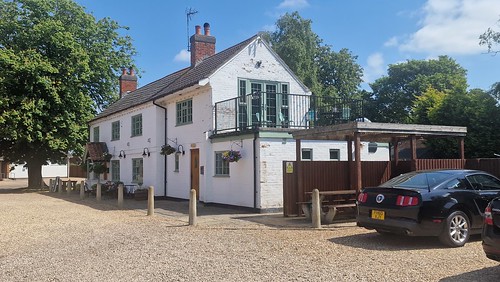
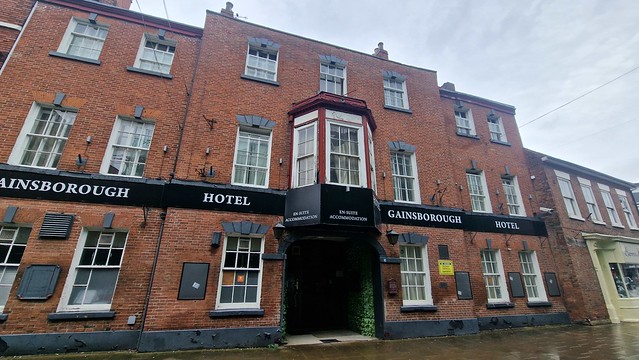
    This rather charming hotel seems to have had an interesting few years. It has a long history since it opened in the eighteenth century, but the police and licensing authorities shut it down in 2018 following a series of drug incidents and violent disorder. The owner was a former councillor, so the local media seems to have had a field day reporting that. It was known as the White Hart, but was rebranded after the closure as the Gainsborough Hotel to try and give it a new lease of life. It now appears to be closed and locked up, a sub-optimal situation for the owners. I can’t see anything in the local media as to why it’s closed, or whether it’s reopening again soon, although the reviews suggest that it has had a troubled couple of years. It’s a shame that it’s closed though, the building is beautiful and in its prime it must have been an important part of the local community. The cost of renovating a hotel such as this would be substantial though, especially as it’s a Grade II listed building.

  • Gainsborough – 40 Day Capital of England

    Gainsborough – 40 Day Capital of England

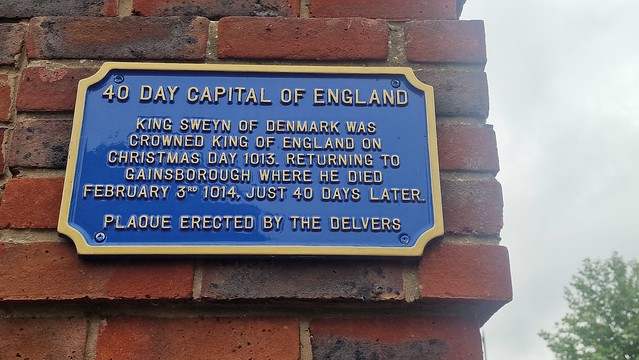
    20240716_105702

    Back on Christmas Day 1013, Sweyn Forkbeard (the son of Harald Bluetooth) swept into England and pronounced himself as King. He arrived in Gainsborough by sailing up the River Trent, then legend states that his forces spread across the country and everyone became supporters. That might perhaps be aspirational, but it’s clear that he took control of some significant parts of England and he established himself in Gainsborough to plan his new empire. He then, rather inconveniently for his new nation, died on 3 February 1014, but it’s not known for sure how his death occurred. It did mean that 50-day Liz Truss did manage to outlast at least one leader, although I think it’s fair to say that when her forces spread across the country not many people became supporters. Anyway, I’ve digressed into politics.

    Æthelred the Unready, which actually is perhaps a name that Liz Truss could have used (the Unready bit, I’m not sure Æthelred would have suited her, but I’ve very quietly digressed again), took over the country after Sweyn’s death and Gainsborough’s brief period as the national capital came to an end. History might have been somewhat different if Sweyn had managed to live just a little bit longer, perhaps Gainsborough might have become a regional powerhouse. But, instead, it’s a useful fact that local tourist officials have tried to make something of.

    This blue plaque was erected by the Delvers, a local history group in Gainsborough, who seem to do much good work in the area promoting the town’s heritage.

  • Gainsborough – Thoughts of Pevsner

    Gainsborough – Thoughts of Pevsner

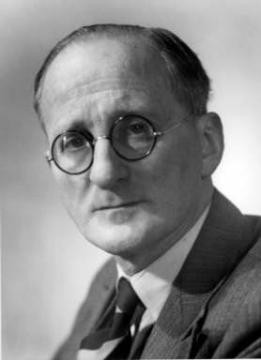
    Sir Nikolaus Pevsner is my favourite architectural historian. Actually, he’s the only one that I can name, but he is such an authority and his judgement always seems sound to me. I was interested to read what he thought about the Lincolnshire town of Gainsborough, but he really wasn’t that keen. He describes it as:

    “One of the dreariest of the Midland red brick towns. The factories are all red brick, and those in the centre cannot for a long time have been proud of the appearance of their buildings. Neither the manufacturers nor the council seem capable of thinking of their town in post-Victorian towns.”

    Pevsner writes interesting walks, or perambulations as he called them, of towns, but he says about Gainsborough:

    “A perambulation around Gainsborough is not necessary nor advocated.”

    Ouch. I actually suspect he would have been less impressed at how it is today, as the council of the 1960s demolished some of the interesting heritage buildings in their road expansion obsession.

  • Gainsborough – All Saints Church

    Gainsborough – All Saints Church

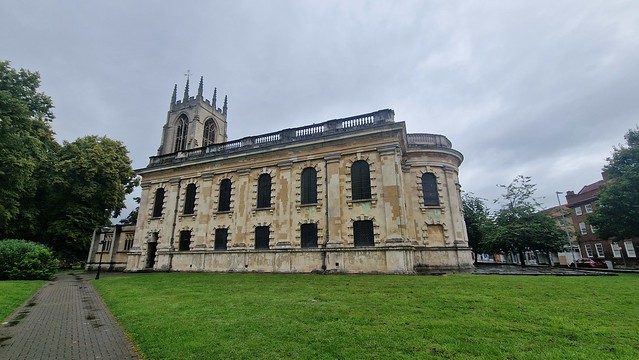
    20240716_103535

    This church looks a little out of proportion as the nave and chancel were entirely rebuilt between 1734 and 1744 when the previous structure was thought to be too dark and dingy, but the tower, which dated from the fifteenth century, was kept. After three years of construction, the new church opened on 16 September 1744 and it reminds me of how some of the slightly later churches in the United States, such as Old North Church in Boston, look.

    20240716_102824

    The church is kept locked, but you can request the key from the cafe on-site, which I did. It’s well proportioned internally and I can imagine the excitement when it opened, with its two levels of seating and plenty of space. It’s certainly bright, which would have been in contrast to the previous building.

    20240716_102844

    Looking back to the organ. The chandelier is a survivor from the previous church.

    20240716_102906

    The pulpit, which was installed in 1869.

    20240716_102940

    It’s spacious and would have been able to cater for several hundred worshippers. The National Churches Trust notes that:

    “The architect of the present building was Francis Smith of Warwick (1673-1738) who was greatly influenced by James Gibbs, the designer of St Martin in the Fields, Trafalgar Square.”

    20240716_103343

    The height of the box pews were reduced by 12 inches in the 1860s.

    20240716_103013

    Alan Stephenson, who served as the organist here for twenty years between 1913 and 1933. He was also the last organist to play at Coventry Cathedral before its organ was destroyed during the 14 November 1940 air raid.

    20240716_103303

    The eighteenth century benefactors.

    20240716_103332

    The memorial to Francis Elliott, who had served as the District Commissioner of Jubaland. He was the son of the Rev. Canon J. R. Elliott, M.A., of 1, Greenstone Place, Minster Yard, Lincoln and Francis died at the age of 35 on 2 February 1916. He’s buried at the Mogadishu African War Cemetery where there are 182 burials, but the Commonwealth War Graves Commission is currently unable to access the site. Unfortunately, the site has been desecrated and the graves destroyed and vandalised, there’s more at https://adeclewlow.com/2018/11/07/discovering-the-commonwealth-war-graves-cemetery-in-mogadishu/.

    20240716_103411

    The entrance to the church.

    20240716_103415

    What I assume is the entrance to the bell tower.

    20240716_103446

    The tower, which I think is the most magnificent part of the structure. The authorities had to raise money in 1871 for the church’s protection as they were worried about bits of it falling down, which was considered sub-optimal. Also, a local cabinet maker, Mr. Knighting, had been walking across the church yard on a dark Sunday evening and a slab gave way and he nearly plummeted three feet down into a vault, located near to the base wall of the tower.

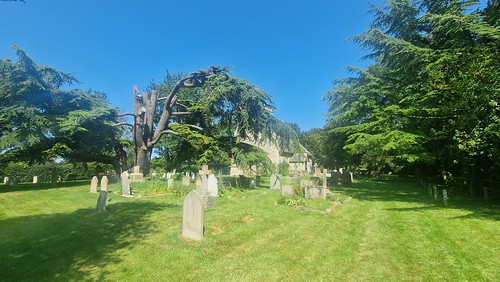
    20240716_103450

    The graveyard, stripped of all its gravestones. There has been some controversy about this and the idiotic decision was enacted in 1961, stripping the area of its historic relevance and interest. They said at the time that it tidied the area up as it had become overgrown and gravestones were damaged. I mean, perhaps repair the gravestones and cut the grass? Anyway, it’s a memorial garden now.

    20240716_103430

    Richard Rollett’s gravestone was saved as it was thought to be of interest as he was the master sail maker on HMS Resolution, which Captain James Cook captained.  The Captain Cook Society has more information on the life of Rollett at https://www.captaincooksociety.com/cooks-life/people/cooks-officers-and-crew-and-contemporaries/richard-rollett-1750-1824. Although that’s it, the rest of the stones and their memories have gone.

    It’s a wonderful example of eighteenth century church architecture, although there’s surprisingly little history here to see beyond that. They’ve knocked the old church down, the tower is inaccessible and the gravestones have been removed. Pevsner was very rude about Gainsborough, but he didn’t make any personal comment on his thoughts of the church’s architecture.

  • Thurlby – St Germain’s Church

    Thurlby – St Germain’s Church

    20230603_151109

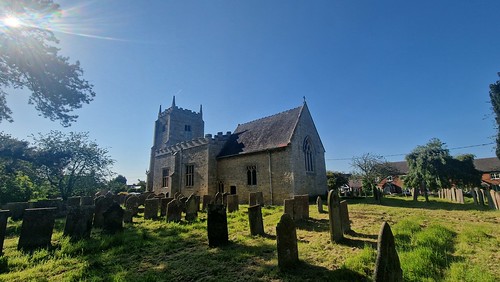
    St Germain’s Church in Thurlby is Grade II* listed, with its origins from the eleventh century. The north aisle was reconstructed in 1820, using the same foundations as the 1300 construction. In 1843, the chancel was restored by Sir Edward Ffrench Bromhead, although it’s not clear to me whether the chancel and nave have always had a shared roof. He was from the local Bromhead family who occupied Thurlby Hall, perhaps most notable for Gonville Bromhead who fought in the defence of Rorke’s Drift, with Michael Caine playing Bromhead. The porch is also of interest, built with rubble there’s the old Norman stone doorway within which dates to before 1200.

    The Thurlby bit is a little confusing as there are a couple of other places in Lincolnshire with the same name, with villagers in June 1968 seeking formal permission from the Royal Mail to change their name to Thurlby St Germain’s after the church. The Royal Mail weren’t having any of it though, saying that “it would cause us a lot of trouble and work”, with the village name remaining unchanged to this day.

    20230603_150443

    It has one of the more attractive churchyards, with the medieval standing stone cross still in situ which was restored in 1842.

    20230603_150935

    There are 30 war graves from the Second World War in the churchyard, all from airmen who died during the conflict. There are another 26 post-war service graves, again all airmen.

    20230603_150428

    The church was closed when we visited, but the listed building record notes that it has a fifteenth century octagonal font, a nineteenth century rood screen and a nineteenth century pulpit and pews.

  • Norton Disney – Green Man

    Norton Disney – Green Man

    20230604_113246

    The Green Man in Norton Disney has one of the more detailed pub histories on their web-site that I’ve come across, it’s always a delight when a venue is proud of their heritage. The Green Man is an early name for the pub, which was trading in the early 1840s, but it changed its name to the Sportsman by 1851. From around 1909, the pub was renamed as the St Vincent Arms in honour of the local landowner Viscount St Vincent. It was unfortunate enough to have been taken over by Punch Taverns in the early part of this century, but after they messed it about the pub was sold in 2009 and renamed as the Green Man, remaining as a free house.

    20230603_154219

    The interior has been sensitively restored.

    20230603_154216

    There’s a nice open and clean feel to the whole arrangement. The service was immediate and welcoming, with the pub having an inviting feel to it. The pub is also very well reviewed on-line and it appears to have a strong food, particularly Sunday lunches, offering judging from those reviews. They do seem to have picked up a small number of negative reviews which are just odd, at least the pub has responded in full to each one and I can imagine they feel a little hard done by given the nature of some of them.

    20230603_154202

    The beer choices and there was a brewery I hadn’t known about before, Beermats Brewing Co of Winkburn in Nottinghamshire. I went for the brewery’s Legitimate bitter, all very agreeable and well kept. This was the best selection of real ale in the local area, I’m not entirely sure why it isn’t in the Good Beer Guide, although maybe it’ll be in the next edition.

    20230603_134232

    The pub wasn’t serving its usual food menu, but they did have a BBQ going so a pint of beer, a hot dog and warm weather all combined to make a rather lovely afternoon. Those cabins in the background are part of the accommodation offer, in conjunction with Outdoor Inns, but more about them in later posts.

  • Bassingham – St. Michael and All Angels Church

    Bassingham – St. Michael and All Angels Church

    20230604_121942

    The Church of St Michael and All Angels in the Lincolnshire village of Bassingham is Grade II* listed and has elements from as early as the eleventh century and it was also listed in the Domesday Book. Much of the older section of the church dates to the thirteenth century, but it was extensively restored in 1860 under the supervision of JH Hakewill.

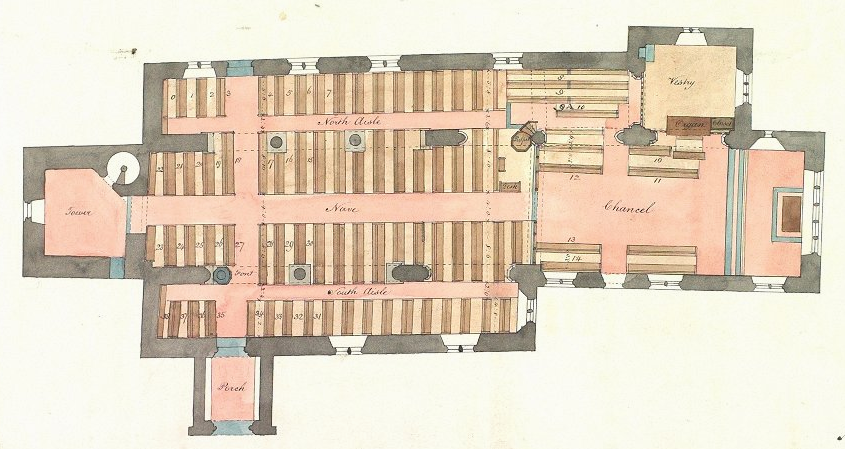
    The design drawings prepared by JH Hakewill in advance of the 1860 restoration. During this work they discovered two Anglo-Saxon grave covers which are now located near to the altar, used as a table for the sacraments.

    20230604_121858

    The entrance gate to the church from the road, with the rear of the churchyard reaching the River Witham.

    20230604_121913

    The pretty long graveyard leading to the church from the road.

    20230604_122041

    The rather blocky tower was rebuilt in 1782.

    20230604_122000

    The south porch.

    We weren’t able to visit inside the church, but the listed building record notes that there are the remains of a fifteenth century screen, the altar rail and organ are from the nineteenth century, the nineteenth century pulpit has a panel from 1674 and the alms box is from 1668. Also inside the church is the bell from the minesweeper HMS Bassingham, which was given to the community in 1999 after it was decommissioned by the Royal Navy. It was explained at the service that at the time, minesweepers were named after villages which ended in ‘ham’.

  • Carlton-le-Moorland – St. Mary’s Church

    Carlton-le-Moorland – St. Mary’s Church

    20230603_173953

    This Grade I listed church in the Lincolnshire village of Carlton-le-Moorland has elements dating from as early as the eleventh century and reference was made to it in the Domesday Book. The bulk of the structure today is from the sixteenth century rebuild and the 1890 reconstruction overseen by C Hodgson Fowler.

    20230603_173803

    Being very different in design, the chancel’s roof dates from the sixteenth century and the nave’s roof dates from the nineteenth century. The church wasn’t open when we visited, but the listed building record notes that screen is from the the fifteenth century, the wooden pulpit from the eighteenth century and the pews are from the nineteenth century. There are tablets inside the church which are memorials to the Disney family, dated 1595 and 1611.

    20230603_173621

    20230603_173617

    Some of the church graffiti.

    20230603_173424

    The church’s lychgate was unveiled in October 1920, built at a cost of £174 to commemorate those villagers who had lost their life during the First World War.

    20230603_173447

    Located outside of the church, this is one of the fountains which were placed around the local area.

  • Stapleford – Church of All Saints

    Stapleford – Church of All Saints

    20230603_143852

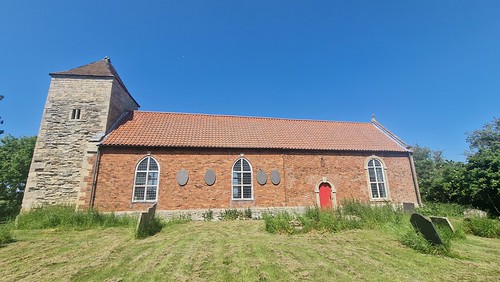
    Located down a track this pretty church was built to serve a village which has long since gone. The settlement that was once here was prone to flooding from the River Witham, meaning that this is the only building surviving. It’s also not the only medieval village to have been lost, just to the south was Stapleford Parva, with nothing now remaining of that settlement.

    20230603_143907

    Although most of the structure is from a later period, there are elements from the eleventh century in the building and the church was referred to in the Domesday Book. The belfry had to be reconstructed in around 1300 as the local parishioners had become a little bit careless and it fell down.

    20230603_144054

    There was an extensive rebuilding effort in 1770 with the mostly new structure being built on top of the earlier church, using brick rather than stone. In 1903, a restoration took place and the Cambridge Independent Press reported:

    “The parish church was re-opened for Divine service on Sunday, after being closed for a fortnight. A great improvement has been effected by re-arranging the choir seats, pulpit and reading desk. In addition the chancel arch has been beautified, and two hagioscopes opened between the chancel and the nave.” 

    20230603_143944

    Unfortunately the church was closed, but it was possible to see through one of the windows. I’m not sure where they are now, but in July 1935, the owners of the neighbouring Stapleford Hall donated to the church a number of items from the Civil War period including a helmet and bottle found in the hall’s priest hole.

    The listed building record notes that there is an eleventh century pillar piscina, eighteenth century altar rails, nineteenth century pews and twentieth century choir stalls, reredos and wooden screen.

    20230603_144011

    The pretty graveyard, with Liam’s bike hiding the sign noting that dogs shouldn’t foul the area. It is a constant mystery to me that they need signs like this as one would hope it was obvious, but there we go…..

    20230603_144117

    Charles Tonge who died in 1809 at the age of just 34, with this memorial noting “the time is short”.

    20230603_144123

    Elizabeth Tonge who died in 1826 at the age of 48, alongside her son Joseph, who died at the age of just 14.

    20230603_144155

    Edward and Ann Tonge, further dominating the side of the church wall.

  • Bassingham – Bugle Horn

    Bassingham – Bugle Horn

    I suspect some local wags and pesky kids might well have been having a go at the pub signage of the Bugle Horn, a Good Beer Guide listed pub in the Lincolnshire of Bassingham. The pub has been serving alcohol to customers since the seventeenth century, it’s a sizeable building and there’s also a large beer garden. I’ve tried to work out the reasons for the pub’s name, but I can’t see any local military connection and the actual reason is likely lost to history.

    20230603_192834

    Here it’s the Te Buge Horn.

    20230603_192816

    Here the Ugle Horn.

    20230603_192812

    And here the Bugle Orn. It’s like something out of Fawlty Towers and the kids changing the letters on the sign. But, I won’t linger any further on the external signage.

    20230603_184622

    This wasn’t what I expected to see from a Good Beer Guide listed pub if I’m being honest, especially as this appears to be a free house which isn’t manacled to a pubco or brewer. As there was another bar where more exciting options might be available, I asked if there were any other ales to choose from.

    20230603_184626

    The friendly staff member, who I assume to be the landlady, politely pointed me straight towards the keg options from Beavertown. I’m not averse to these, although I’ve obviously worked through them all before, so I was hoping for a local beer that I might not get anywhere else. Prices of these were towards the higher end of the scale, but I liked the inviting nature of the pub so I felt it was a price worth paying to not have to drink Greene King IPA.

    20230603_185202

    I went for the Bloody ‘Ell from Beavertown, an entirely agreeable blood orange keg IPA. It’s a nod towards craft beer, I approve of the pub’s attempts to widen their beer range.

    20230603_192748

    There are two separate bar areas, the one in which we seated was comfortable enough but they do perhaps need a refurbishment as some of the seating is heavily stained and things are a bit wobbly in places.

    20230603_185159

    Having said that, the pub still felt traditional and if there is a refurbishment, I hope that it doesn’t change the layout and separate areas of the interior that currently exist.

    20230603_190502

    Liam’s gammon (that’s a description of the food he ordered, not his politics which are far more reasonable), delivered just seconds after he had gone off to explore the toilet facilities in the pub.

    20230603_190506

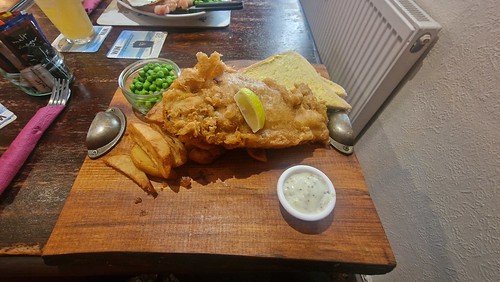
    Although the Beavertown beers might have been just a little decadently priced, the meals certainly weren’t, this fish and chips was at the very agreeable price of £10. The home cut chips are mostly hidden here by the fish, but there were more than I could eat and so I let Liam finish them up. For the perfect arrangement, the fish could have been drained better and the oil could do with changing, but the batter had a decent depth of flavour and the fish flaked away. I think they’re using some form of margarine on the bread, that wasn’t a highlight if I’m being honest. But, for the price, this was a satisfying and filling meal, if I was a local I’m fairly sure I’d eat here on a regular basis.

    The pub is well reviewed on-line, with the staff member giving the atmosphere a family friendly atmosphere where customers feel welcome being there. They’ve built up a reputation for large portions of home-cooked food at reasonable prices, which is quite a selling point as far as I’m concerned. Although I can’t say that I was surprised and delighted by the range of real ales, they’ve made an effort with offering Beavertown beers as an additional option. Definitely recommended, although some form of minor renovation might improve the ambience, as it’s an element customers have mentioned on-line for a few years. But, times are hard for pubs, and at least they’re keeping the food prices down. It felt like a proper pub to me, a phrase that’s over-used I admit, but some things are timeless and too much change here would be a bad thing.