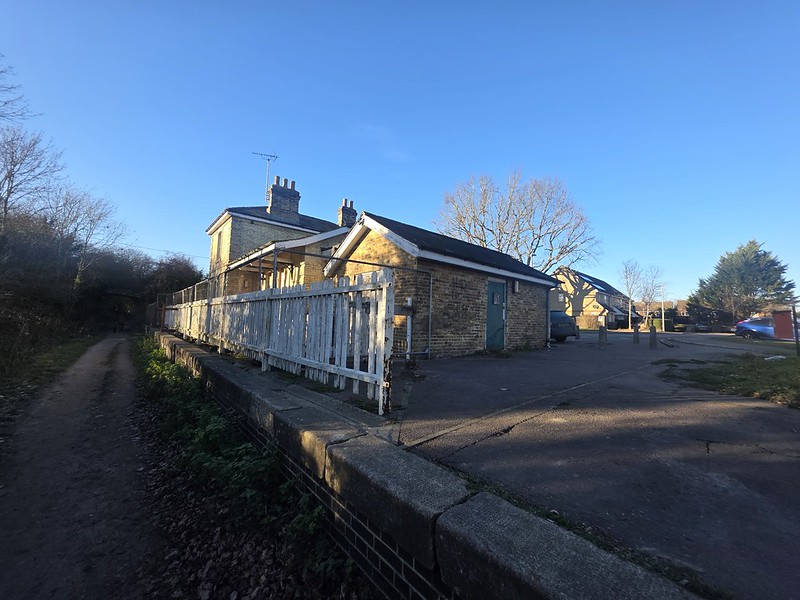
Located near to Stane Street Halt, this is the former Takeley railway station. The railway station first opened its doors on 22 February 1869, part of the Bishop’s Stortford, Dunmow and Braintree Railway.
The railway station welcomed royalty going to Easton Hall, including when the Prince of Wales visited in 1889. They would have likely been greeted by Henry Farnham, the station master, who had been at the station since the mid 1870s. Farnham died in 1893 at the age of just 43, leaving a wife, Mary Jane, and five children. There’s an image of Mary Jane’s grave at https://www.findagrave.com/memorial/178342244/mary-jane-farnham.
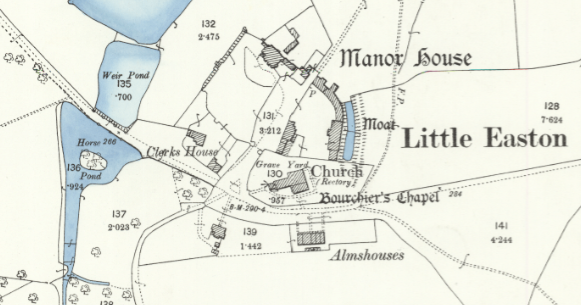
As I mentioned on my Stane Street Halt post, this line never really had enough passengers and so it closed to passenger traffic in the early 1950s. It’s evident from this map from the 1890s that there simply weren’t really enough residents in the local area to support this.
Takeley now has the advantage of having Stansted Airport within its boundaries and so this railway station would have likely been quite useful had it stayed in operation. The station buildings are now used for residential purposes after many decades of being left empty.
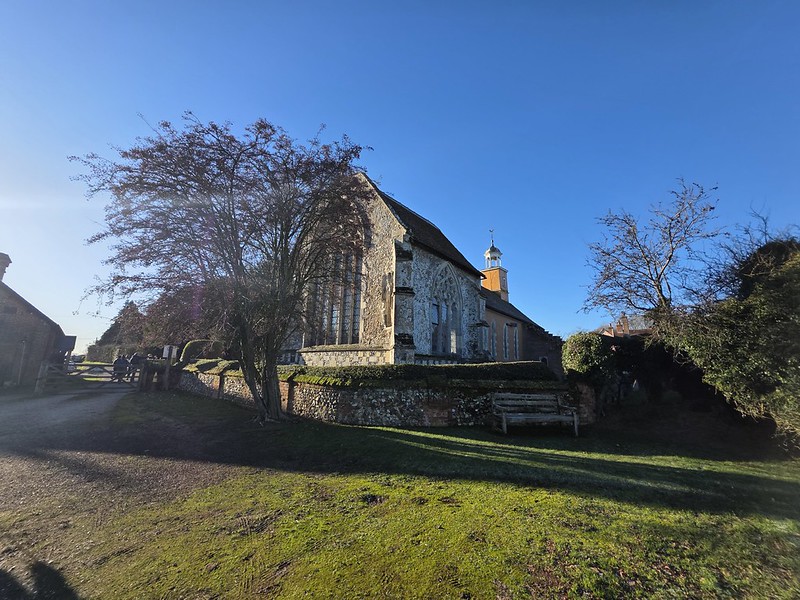
I didn’t have the chance to look inside this church, despite being very tempted, as I was on the Stansted Stagger walk so my opportunity for history meanderings were limited. It’s the Grade I listed church which is located to where the manor house Easton Hall was located, sadly one of the country houses demolished in the early twentieth century.
It’s the manor house which is one of the reasons that the church is so decadent. But, going back, the origins of the church date from the early twelfth century and there was likely a Saxon structure here before that.
For centuries, the story of the church was inextricably linked with the Bourchier and Maynard families, the powerful owners of the manor house. The south chapel, often called the Maynard Chapel, is home to a series of magnificent monuments of which one of the most poignant is the tomb of Sir Henry Maynard and his wife, dating to 1610. Below the main statues, their children are depicted in a line; several carry small skulls, a sobering historical shorthand indicating they died before their parents. If I had known about this, I might have quickly rushed in…..
The 19th and early 20th centuries brought a different kind of glamour and social change to the parish, largely driven by Frances Evelyn Maynard, better known as “Darling Daisy” who was the Countess of Warwick. A celebrated Victorian socialite and mistress (one of many) to the future King Edward VII, Daisy was a frequent presence at the church. One more thing that I would have looked out for if I’d have known is that the comedian and actor Mike Reid is buried in the church’s graveyard.
This is the intriguing bit that we noticed when walking by, there’s clearly been some wealth here to end up with so many chapels attached to the church. The central one here is the chancel, with the North and South chapels on either side.
The South Chapel, largely established in the 14th century and later embellished by the Maynard family, is something of a grand ancestral mausoleum filled with elaborate monuments. It houses the stunning 1610 tomb of Sir Henry Maynard and his wife, marking the long-standing influence of the Easton Lodge estate on the parish.
The North Chapel dates back to the 13th century but gained its most modern significance when it was dedicated as a memorial in 1945. It stands as a solemn tribute to the USAAF 386th Bombardment Group, featuring poignant stained-glass windows that commemorate the airmen stationed nearby during the war.
For over a decade, it’s been a tradition now for my friend Liam and myself to take part in the Stansted Stagger, a 26 mile challenge event put on by the Essex & Herts LDWA group. A walk at this time of the year is always a bit of excitement as there is the potential for a lot of mud, a lot of ice, a lot of rain and a lot of complaining from me. The drive there was marked by a series of Greggs being shut when they weren’t meant to be, so that was sub-optimal but I was too tired to be be pre-annoyed.
Liam got us safely to Stansted Mountfitchet where the walk starts. There were around 180 people taking part and there was a positive atmosphere whilst I focused on how many biscuits I could eat without looking greedy.
It was time for the walk to start and Liam and I seemed to be at the back, which is where we kept ourselves for much of the day. Some of the Norfolk & Suffolk contingent rushed off, but someone mentioned that it was probably just Simon H showing off. Someone in our group also mentioned that they were hungry, but fortunately, this event has 2.5 checkpoints so there was certainly lots to look forwards to.
We strolled past St. Mary the Virgin’s Church which is located just outside of Stansted Mountfitchet.
This is Arthur Findlay College, located at Stansted Hall, which is managed by the Spiritualists’ National Union. Arthur Findlay (1883-1964) was a stockbroker who became very involved with the spiritualist movement and he was one of the founders of the Psychic News. Stansted Hall, which is mostly from the late seventeenth century, was purchased by Findlay in 1923 and it was left to the Spiritualist movement in 1964 following his death.
Very pretty ice formations. We were fortunate that there was no snow, unlike the Norfolk we had departed, and relatively little ice. I have near zero ability to walk on ice, so this pleased me greatly. On reflection, this was the least muddy Stansted Stagger I’ve ever taken part in and that suited me on this occasion even as an experienced mud run person.
I appeared to be the only one in shirt sleeves as I thought it was getting a bit hot. The sun was quite clearly blazing down at this point, which is a field near to the village of Pledgdon Green.
The route that the organisers chose was a new one to me and it circumnavigated Stansted Airport. This was my favourite route that the event has taken, as it changes from year to year, although I was surprised just how little of the airport we saw as it seems to be landscaped away a bit. It was harder for them to blend the aircraft into the background though, so we were able to do some plane spotting.
The tilted sign amused me. I don’t get out much.
This was Mill Race, the former water channel for powering the mill at Tilty Abbey.
We then approached the Church of St. Mary the Virgin, which is the former chapel outside the walls of the abbey. When the abbey was suppressed following the Reformation, this became the parish church. But, I’ve written about this separately as well.
Sub-optimal and a reminder of the dangers of the cold weather. The police were aware of the car, but this looks like it must have been a frightening thing to happen.
And safely into the first checkpoint at Great Easton. I was surprised and delighted to see that there were some cheese & pickle sandwiches, which are one of my favourite things, so I had several of those. There were also jelly babies, crisps, mince pies, hot cross buns, biscuits and chocolate and so that’s all my main food groups covered. There was some fruit as well I think for those that like that.
The volunteers across the whole event were brilliant, full of enthusiasm and the LDWA is very fortunate to have so many people willing to help. And, from personal experience, it’s a lot of fun volunteering at events as well.
The church of St. John & St. Giles at Great Easton. It’s not a great photo as I was balancing crisps and jelly babies in my hand whilst trying to take a photo.
Rob had dropped a bit to walk with Liam and I for the next stage, here there are waiting for me to balance my snacks whilst taking a photo of the village of Great Easton.
Horse Pond in Little Easton, located opposite from the Great Pond and the manor house.
Despite never being far away from Stansted Airport, it was rarely visible, but the control tower did appear from time to time. We certainly had no shortage of planes taking off and landing to look at during the walk.
This is All Saints Church at Canfield End with the walk going through the churchyard. It wasn’t known who the original dedication of the church was to, so in February 1900 it was dedicated to All Saints by the Bishop Suffragan of Colchester. The nave is from the twelfth century, but the chancel and most of the interior is from the nineteenth century.
The second checkpoint was located near to Great Canfield and it had plenty of seating for the weary. Obviously, as an athlete I didn’t need a seat.
Well, how lovely.
Those warm apple pies with custard towards the front were the standout food item here, and there was a lot of competition. I actually didn’t even notice the wraps until looking at this photo, such was the choice, although I think I was focused on the crisps.
The checkpoint menu. Bear in mind this entire event costs £15 or so for members, we get that much value from the food alone. Well, I do.
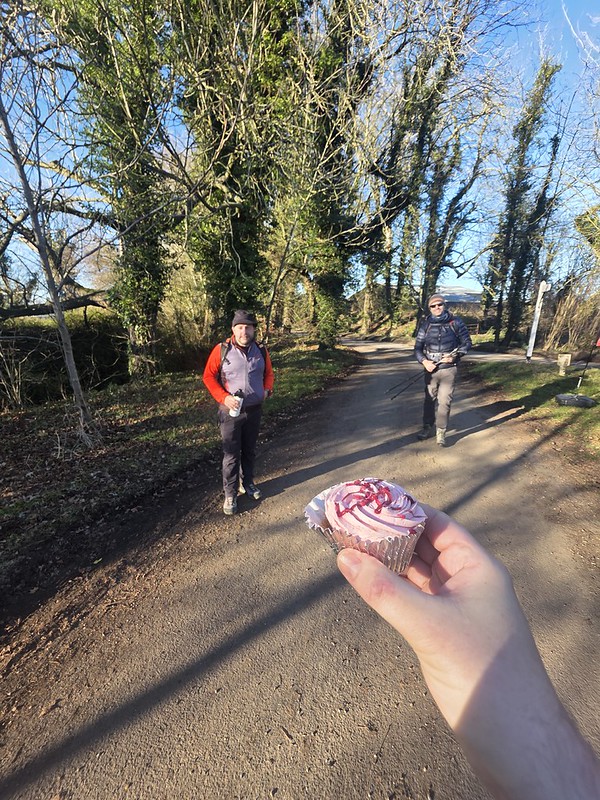
I took a cake to help sustain me for the next part of the walk.
An interesting tree near Great Canfield.
I can think of a few people who could go in these at Hellmans Cross.
The former railway station at Takeley, I’ll write about this separately and drop the link in here later.
The bridge underneath the appropriately named Station Road, this is the stretch on the former railway line from Braintree to Bishops Stortford which is now known as the Flitch Way.
Rob decided he would rush off at this point, but Liam and I decided we would just amble along. We rushed the Capital Challenge last year and sometimes it’s best to just take it easy.
The final checkpoint by the Dunmow Road which was advertised as a water stop but actually had some snacks as well, which pleased me. But my two loyal blog readers would have guessed that.
Then it was a series of bridge and tunnel crossings to get over the M11.
The bendy signage at Birchanger.
And back to the start at Stansted Mountfitchet….
Julian “I’m not very hungry, I likely won’t have anything at the end” White….. That carrot cake was delicious.
I accept that this wasn’t our fastest time, but it’s not a race and we had a really rather lovely day. For anyone tempted to take part, absolutely do, it’s a manageable distance with plenty of food, drink and encouragement at the checkpoints. The volunteers were all wonderful and so many thanks for all the time they put in to planning this event, which really is great value. We’ll be back next year!
St. Mary the Virgin church in Tilty, a rather fine Grade I religious building that we walked by on the Stansted Stagger. It was once the ‘chapel outside the gates’ that belonged to Tilty Abbey, being used by the locals or travellers who didn’t have permission to worship in the abbey itself. When the Reformation saw the end of the main abbey building and its stone was carted away, this chapel was turned into the village’s new parish church.
The stone section is the former abbey church from the 1220s, the section on the right is from the 1340s. It’s fair to see that they didn’t try and blend the two parts of the buildings together for consistency. Some of the beams supporting the chancel roof still date from the thirteenth century, making them some of the oldest in the country.
The downside of being on the walk was not being able to have time to go inside, but I’ll remember that this is here to try and visit another time.
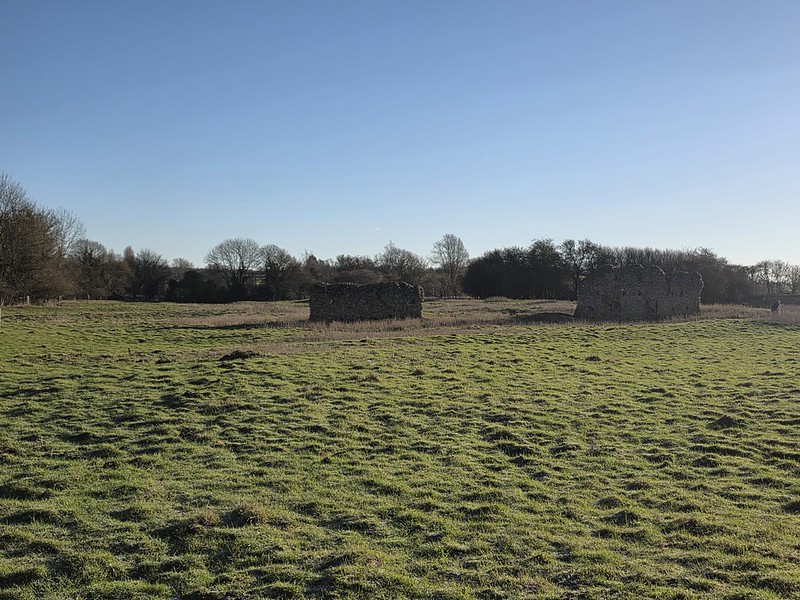
It was an unexpected surprise to walk into a field on the Stansted Stagger and see the remains of a former Cistercian abbey.
To be fair, there isn’t much of this abbey left, but at least there’s something. The bits that remain here are two fragments of the west range of the abbey. I would have explored them more thoroughly but I didn’t want to faff about looking at bits of old stone when I was meant to be on a 26 mile walk. Although I did think about it.
The abbey was founded in 1153 having been established by Maurice fitz Geoffrey and his overlord, Robert de Ferrers, who was the Earl of Derby. The first monks to populate the abbey came from Warden Abbey in Bedfordshire.
The abbey was situated on a tributary of the River Chelmer in north-west Essex and its dedication is believed to have taken place on 22 September 1153, which corresponds with St Maurice’s feast day, chosen in honour of the founder. While founded in the middle of the 12th century, the construction of the entire monastery complex is often credited to the second abbot, Simon, who served from approximately 1188 to 1214.
The site experienced significant hardship on Christmas Day 1215 when it was pillaged by the army of King John. Soldiers reportedly broke into the church during mass, ransacking chests and carrying off valuables, an event that required the monks to spend the next five years reconstructing the church. It’s fair to say that they probably considered this as completely sub-optimal.
The abbey functioned as a Cistercian community until its dissolution on 28 February 1536 under the religious reforms of King Henry VIII. Today, very little of the original monastic buildings remain, except for some stone wall fragments in the above photo and the chapel by the gate. This chapel, known as the capella extra portas, was built around 1220 for the use of visitors and now serves as the Tilty parish church, but a little more about that in the next post.
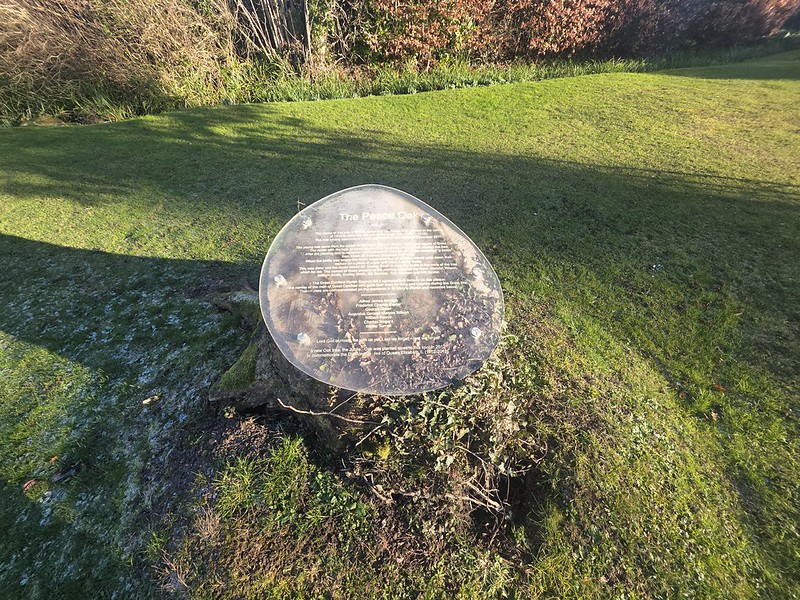
This is a rather lovely touch of history in the hamlet of Hellmans Cross, near to the village of Great Canfield. It’s the remains of the peace tree that was planted in 1919 to mark those who lost their lives in the First World War.
The local village website notes:
“The young oak came from the estate of the Revd. Maryon Wilson, rector and squire of Great Canfield. The rector with the help of some seven other residents of the parish planted the tree. After the planting and to replenish their exhausted strength, the rector produced “a bottle” from which all involved assuaged their thirst. When the bottle was empty the rector suggested that all present should write down their names on a piece of paper and place it in the bottle. This was done and the rector asked Mr. Dudley Smith to bury the bottle in the roots of the tree, which he did.
The names of those present at the planting included the Revd. Maryon Wilson, William Smith, Dudley Smith, Bill Barwick, Tom Yeoman and Will Easter.”
Unfortunately, they had to cut the tree down in 2011 due to a fungus infection, but they planted the Jubilee Tree in 2012 to replace it.
It’s a little hard to read on the plastic protective screen, but the village used this opportunity to commemorate the lives of the local men who died during the conflict. They were:
One of the interesting parts of the Stansted Stagger challenge walk (a separate post is coming on that) was this former railway line from Braintree to Bishop’s Stortford. It always struggled and was closed in 1952 as the area around it was too rural to justify a service. Now, there’s a slight irony that around 500 metres to the right of this photo is Stansted Airport and this railway line would have been potentially enormously useful for that.
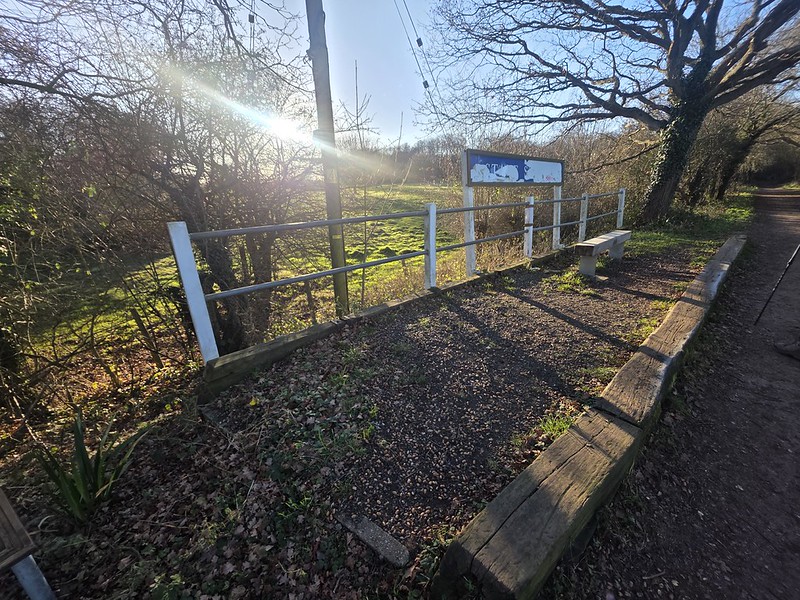
This is the site of Stane Street Halt railway station, which was added to the line in December 1922 in an attempt to boost passengers numbers. A full station couldn’t be justified here as the population was too small, but they hoped to encourage some of the Takeley residents to use it. The station was named after the nearby Stane Street Roman Road which went from Ermine Street in Hertfordshire to Colchester in Essex.
The introduction of these halts, which were by request only, meant that they had to change the rolling stock to allow passengers to disembark without a platform to disembark onto. Although all rather positive in terms of trying to increase usage, the line was closed to passengers in March 1952. It continued to be used by freight services until 1972 and then it was all ripped up and all evident of the halt removed.
There were services to Northumberland Park, where Tottenham Hotspur’s White Hart Lane football stadium was located, directly from the halt which showed some initiative in getting people straight into London. The Westminster Gazette made reference to it in 1926 noting:
“It is not more than 30 miles from London, and it has a railway station – if such a name can be applied to Stane Street Halt, whose only evidence of being a station is a little platform barely ten years long.”
The Friends of the Flitch Way helped to restore the station halt back in 2011. They also added a useful information board which gives some more details about the history of the halt, which is a really helpful thing to add.
As Liam and I were coming back from London we did our usual thing of visiting a pub from the JD Wetherspoon chain which I haven’t visited before. The Rose and Crown, located on the town’s main road of the High Street has the bonus of being a Good Beer Guide listed pub to add to my little collection.
The pub was operated by Punch Taverns until 2013, but was taken over by JD Wetherspoon in 2014 (opening in June 2015 after they had spent £1.6 million on the redevelopment) and they did an extensive amount of archaeological work and they’ve put a lot of that on-line, once again one of the few pub companies that takes the heritage of their venues very seriously. The structural heart of the building is from the sixteenth century, but it was extensively remodelled in the eighteenth and nineteenth centuries. It has been a licensed premises since around the 1780s, although there’s not a vast amount of information I can find about its history over recent decades.
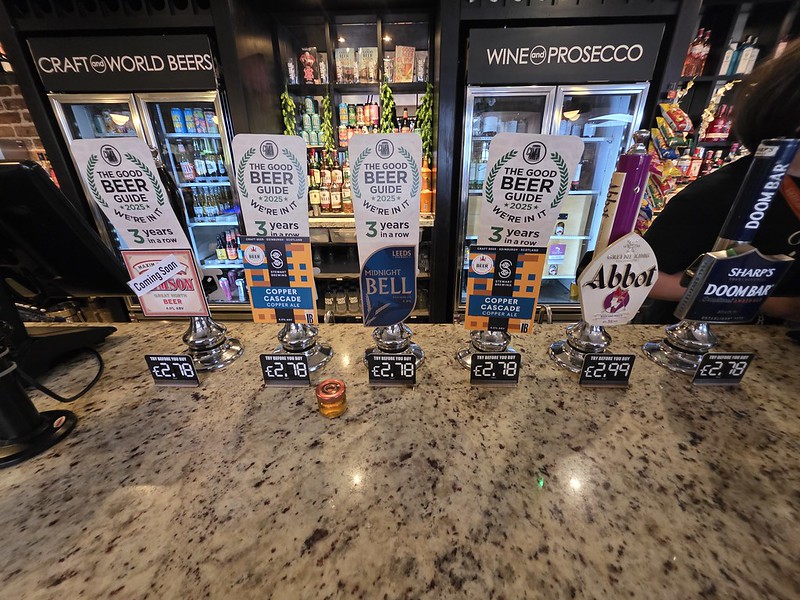
Part of the beer selection, there were a choice of six different ales when I visited, although there were no darker beers. I liked they must have got bored when putting the little jars with colour samples of the beer in front of the taps.
The rest of the bar and advertising that from this week they’re selling 1664 and Poretti, although it’s unlikely I could taste these riveting lagers from each other. Anyway, there’s something for everyone….
A taster of the Midnight Bell beer from Leeds Brewery which I’ve had before a few times, a dark and malty ale which is rather agreeable.
Half a pint of the Copper Cascade from Stewart Brewing, which I haven’t had before, but was clean, malty, refreshing and it had a slight taste of toffee.
The side of the pub and there’s a beer garden at the rear. The staircase to the toilets is quite narrow and relatively steep, I suspect they must have found it quite a challenge to insert that sensitively into the historic building and there are numerous low ceilings dotted around the place that taller customers need to be careful of.
Since this is a JD Wetherspoon venue, I thought I’d see if there were any reviews that would surprise and delight me. The pub is rated towards the higher end of the spectrum for pubs in the chain and I got a positive vibe about the arrangements. It wasn’t spotlessly clean, but the team members were friendly and engaging.
“Used to be good, I do believe it’s a case of which manager is on, my order was taken correctly then on two occasions it’s came out wrong , had to watch my friends eat , 25 mins later mine comes out. I didn’t eat it as i felt awkward and stressed because of service. No refund given, shame”
I wouldn’t have felt awkward….
“the pub not very comfortable Atmospheric should really be sold on to a freeholders that runs a grate pub with brilliant food and can attract the best out of people not the worst catal grid experience roll on new owners good bye nice but dim tim the present owner”
Hmmmm.
“Staff are dreadful. One of them is a complete liar & behaves inappropiateley. Dreadful place.”
I wish people would give more information when they post reviews like this, a bit of drama is always exciting.
“Rubbish beer, rubbish service by surly children. There are far better pubs in Maldon, spend a bit more and enjoy those instead of this place.”
Rubbish beer? Hmmmm.
“I had to take the seal of the source”
I don’t know how some people manage to be so brave.
“Full of men”
Occasionally this happens in any pub….
“Didn’t go there”
Very helpful.
“My partner food had aluminium foil stuck on the bottom of it, do your staff know how dangerous Ingestion of aluminium foil is !!!!!!! Perhaps Tim Martin would like to reply”
Tim Martin didn’t reply and there was a photo of the foil which was an absolutely tiny piece. And it’s not dangerous at all, it’s non-toxic.
Anyway, I digress once again. I liked this pub, it had a sense of history to it, the team members were friendly and the beers were well-kept. We didn’t have a need to eat on this occasion, but the food coming out look well presented and everything felt well managed.
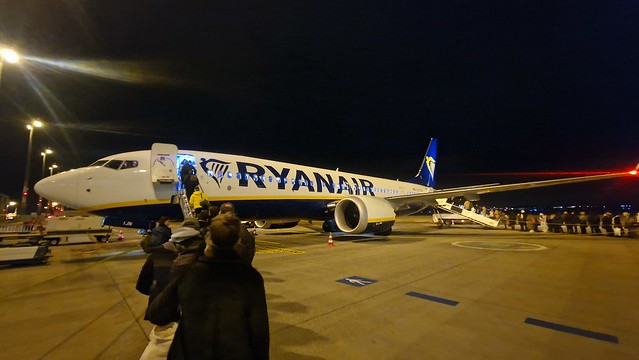
I’ve already mentioned the limited gate size at Berlin Brandenburg, but the Ryanair side of matters was efficient and timely. There was a delay on the aircraft which worried me slightly as I wanted to catch my bus to the bustling rural hotspot of Braintree, with a wait of nearly two hours if I didn’t catch it. However, that 30 minute delay was clearly communicated and the boarding process was efficient.
The aircraft is EI-IJN, I don’t think I’ve been on it before, although it’s relatively new as it was only delivered to Ryanair in January 2024. The flight was, once again, not particularly worthy of note as everything went as it should and the flight caught up a few minutes en route. The random seating Gods had given me a middle seat, but it’s a relatively short journey.
I’ve never been so pleased to see a bus to Braintree. I caught this with just a few minutes to spare, I was fortunate that we weren’t delivered to a gate at a satellite terminal and that the border was relatively quiet.
The fare from Stansted Airport is just £2 thanks to the ticket cap, which is unfortunately rising to £3 in January as the new Government continues its attack on public transport. To be fair, for this journey, that’s still very good value and I mustn’t get political.
We were delayed just slightly as they were putting Christmas lights up, but it livened the journey up a bit.
I seem to have had a run of Travelodge giving me rooms with extra beds. Anyway, safely at Braintree Travelodge and that’s the end of the Berlin trip…… All really rather lovely and my little birthday treat to myself.
I suspect my two loyal blog readers thought that this Tallinn series would never end. Well, whilst I was trying to be decadent in the lounge, Bev was having a lovely time judging by this photo that Steve sent. I didn’t say anything.
We were all reunited once again, at least for a short while. Bev and Susanna, who are quite upmarket, had paid for the posh bit of Ryanair and we were separated via this glass screen. I think Bev rather enjoyed being with the elite, but I’m used to being in the poor section.
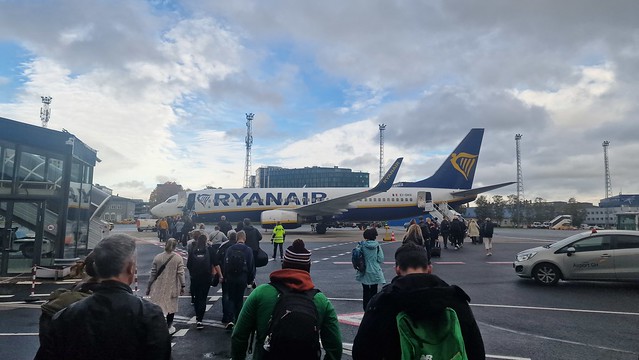
And ready to board, aircraft EI-DHX, not an aircraft that I’ve been on before (although as I’ve mentioned before, my records are a little incomplete). The aircraft is 19 years old and is a Boeing 737. Anyway, slightly geekiness aside.
The flight itself was uneventful, I was fortunate that although the flight was busy I had no-one next to me so the whole arrangement was suitably comfortable. I’ve had plenty of trips with Ryanair recently, but although their reputation isn’t always great, I’ve found no issues with them. We got delivered back in the satellite terminal which delayed matters somewhat and because Susanna and Bev dithered we had to wait for them after the border. Ross rushed off to get his train, we didn’t see him again…. I sat at the back of the shuttle and it’s mildly entertaining to watch it go along, like a DLR in reverse.
And to my great delight: luxury of luxury, Susanna had parked her car in the posh part of the airport so we could just walk there. I had tried to take us to the shuttle bus just assuming we were in some cheap car park. I was fortunate that everything went to time as I had only three hours before I got back to work, but Susanna dropped me off with at least a little time remaining. All told, this was another quite marvellous trip and I’m pleased to report that the group is next year going to what is likely Ljubljana and Slovenia, so I’d better start planning that. And thanks to Susanna, Bev, Steve and Ross for their company, I have many happy memories of Tallinn and look forwards to returning. I’m also pleased to report that the whole adventure went very well as Bev managed to catch the plane this time and there were no issues at the end like in Gdansk when Susanna and Bev slept in after their wild night out. Once again, Steve and I were inspirational, but we don’t like to go on about it.
There were numerous things that I still wanted to post about, I might get around to adding them in some sort of special feature, but now it’s time to start another exciting series of posts 🙂