
Category: Ashley

  • Ashley – St. Mary’s Church (the old one)

    Ashley – St. Mary’s Church (the old one)

    20240326_114022

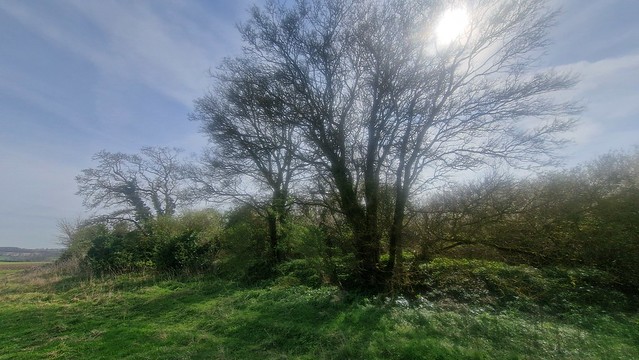
    There’s not really anything to see of the former St. Mary’s Church in Ashley, the low walls that apparently still survive have been taken over by foliage over the last few decades. Ashley, and its neighbour Silverley which it had been merged with, lost both their churches to dereliction and a new one was constructed in Ashley in the 1870s to service the religious needs of the local denizens. More on that in a later post though.

    As an aside, I wondered why on the modern landscape there’s a patch of trees near to the church, but the map solves the query, it’s because it was once a chalk pit. It’s possible to walk on a footpath around the church, but there are signs saying to keep out and it didn’t look easy to battle a way in. It all means that the ghosts of the people buried here remain safe from being disturbed. The former church of St. Mary’s isn’t in the village itself, it lies on the Dalham Road around a kilometre to the west. The churches here and in Silverley were made redundant in the middle of the sixteenth century and there were accounts of some laxness with regards to the parishioners attending a church at all. It’s not really a great surprise, but the residents of Ashley were left without a church for 200 years. In the early nineteenth century, the local village schoolroom was pressed into action for the residents, but it was thought that a grand new church was needed and that’s what was delivered in 1872.

    The church that now can’t be seen was constructed in the thirteenth century, built with flint rubble and there was a rood loft in the structure. Money was given to save the church in the 1550s and 1560s, but its time was up and it was entirely derelict by the seventeenth century. I would have liked to have seen some evidence of it, as I was able to with Silverley Church, but I’m a few hundred years too late. Sometimes nature just wins on matters such as this, I can’t imagine many people will be able to penetrate the centre of this site to find any walls and leaving it undisturbed seems the most appropriate choice.
  • Ashley – All Saints Church (Silverley)

    Ashley – All Saints Church (Silverley)

    20240319_101606

    There’s something quite meaningful about visiting a church which is effectively slowly falling down. Long gone are the sounds of people getting married, the sadness of funerals and the joy (well, generally) of a baby being Christened. This church is near to the village of Ashley, but it’s actually the former parish church of the long gone village of Silverley.

    20240319_101536

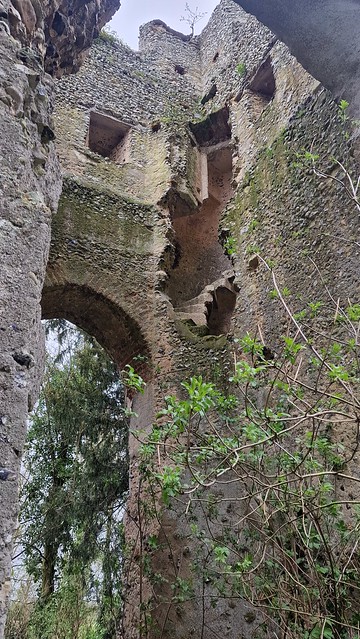
    Only the tower remains and that’s in a sub-optimal condition to say the least. The nave, the churchyard and any other remnants of the building’s history have long since gone.

    20240319_101752

    The former church is especially intriguing as the former staircase to the higher levels of the tower is still visible.

    20240319_101705

    I wonder who the last person was to successfully walk up these stairs and whether they had any indication that they would be the last to do so. It’s sealed at the bottom now to prevents any local pesky kids (or adults) from trying to climb up and promptly falling down or something similar.

    20240319_101724

    It has been solidly built to ensure that it stays in even this condition.

    20240319_102345

    It’s partly hidden from the road and I only knew that it was there because of Google Maps indicating that it was there.

    There are obviously a whole heap of stories about a church in this condition and it relates to the whole situation with Ashley and Silverley being joint parishes. Silverley was once the larger of the two settlements, but the two villages merged and the last burial at All Saints was in 1564 with nearly nothing of Silverley left today. Not that this helped Ashley, as both churches closed in the sixteenth century and the present church in the village is Victorian. But, once again, I digress and I’ll jump forwards a bit in the story.

    There was considerable anger in 1971 when some of the remaining part of the church was demolished. H.E. Thistle of Ousden wrote to the Newmarket Journal noting:

    “I was appalled to read in the Journal of the partial destruction of Silverley church tower. It would be bad enough if those responsible for this act of vandalism were under-privileged louts who knew no better, but it seems from the report that those who decided to destroy the tower were people who were in a position to know exactly what they were doing and yet went ahead in cold blood to demolish a very beautiful and ancient landmark.”

    The correspondent was rightly angry, the church’s destruction was backed by Bidwells and with the accidental approval of the Department of the Environment who it seems got a bit muddled up. That means it’s perhaps possible to partly blame Peter Walker, the then Secretary of State, but it appears to have been something of an administrative error that five tonnes of stone was carted away. The land agents locally claimed that the building was structurally unsafe, but this was proven to be something of an untruth when the demolition team struggled to demolish the structure. All very much sub-optimal and an unnecessary destruction of an historic building. It’s fair to say that the actions of Bidwells were a disgrace and showed huge contempt to the local population and the heritage of the building. Even after the controversy, Bidwells said “it’s all really a question of economics”. Twas ever thus……

    The church had been listed in August 1959 and so should have been protected, although there’s not a vast amount known about its history. It’s thought to have been constructed primarily in the fourteenth century (although it’s likely that there was a religious building on the site before this) and was in use until the sixteenth century when the village faded away, with the building used for a period as a barn. It was though derelict by the seventeenth century, with likely the tower being the only part used. And thank goodness that villagers in 1971 were able to interrupt the demolition to save at least some of the structure. Unfortunately, today the church is I think on private land and there are no interpretation signs or information about the history of the building and bit by bit the structure is likely to slowly fall apart.