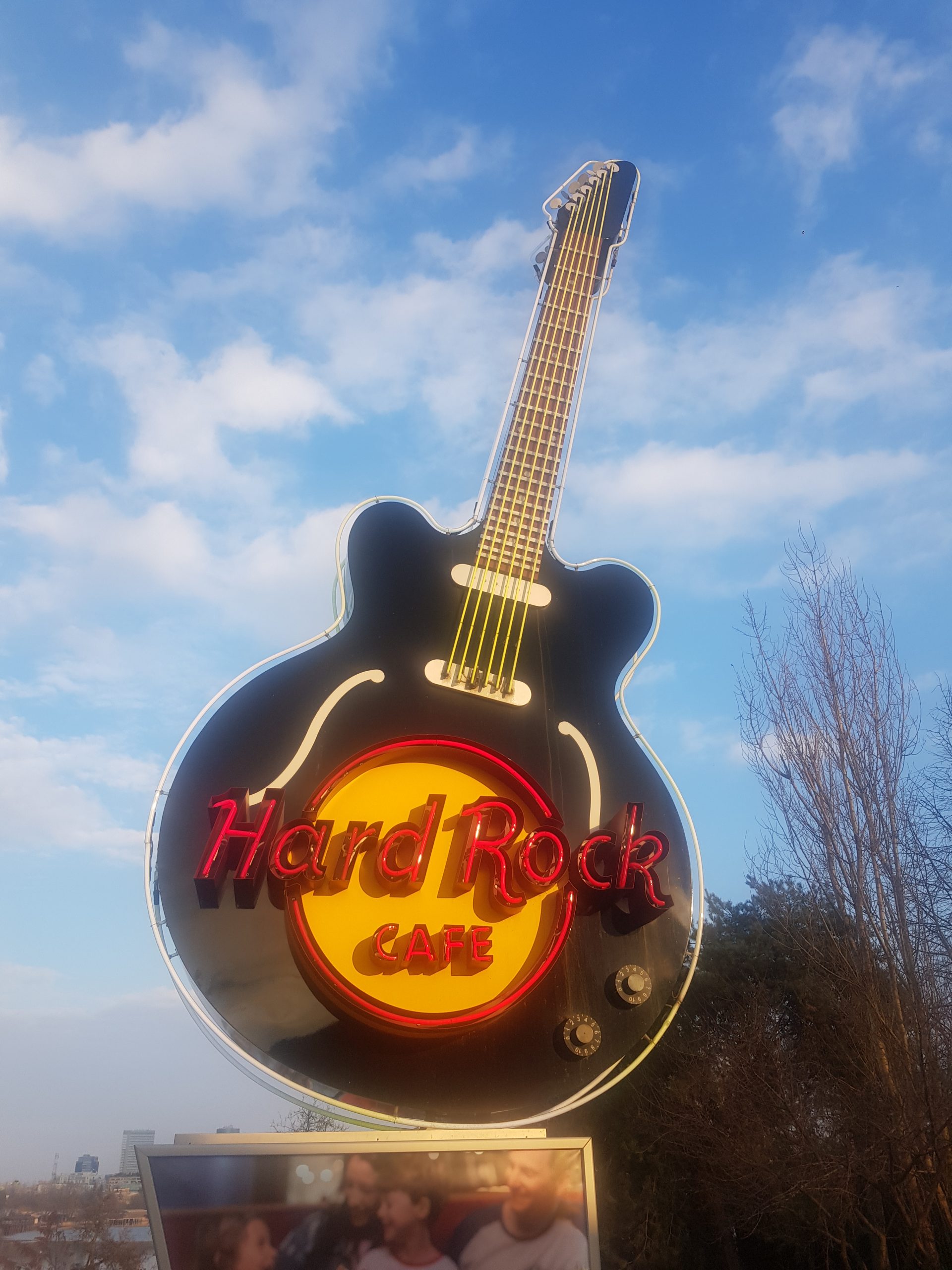
I accept that the Hard Rock Cafe isn’t much of a local culinary experience, indeed it’s not very local at all, but nonetheless I haven’t visited one in a while and so I went anyway. Travel is very empowering.

As part of the chain’s theme, there is music memorabilia throughout the restaurant, including a guitar owned by Rhonda Smith who worked with Prince (I had to Google that).

A stage, which was fortunately left unused during my visit.

It was busy for a Saturday afternoon, although I was seated immediately. Actually, on that point, I hovered awkwardly for thirty seconds at the door waiting for the staff member to look up, then she sort of giggled. I dread to think why, although I suspect it was nervousness as she didn’t seem to speak much English. But, she probably thought I was an idiot, but either way, I was taken to a table and given the menus that I needed.

Tuborg, which isn’t very Romanian since, well, it’s Danish. It tasted like every other lager I get, which was adequate and unexceptional. They need better beer options. I had thought of getting a soft drink if they did free refills, but it was clear from the menu that they didn’t, so I didn’t order one… On that point, the restaurant has picked up a few negative complaints about this, as I thought that it was brand standard to give free refills and so clearly did some other people. The restaurant management replied in reviews that not all Hard Rock cafes offer free refills, and although I’m sure that’s true, I’ve never encountered one which didn’t. It’s not clear why they can’t offer this, it’s more in keeping with the brand.

I mention that Hard Rock Cafe wasn’t ever going to offer local food, although they did have some localisation on their menu. Although quite why the “local offering” in Bucharest is a Guinness & Jameson bacon cheeseburger, I have no idea.

The food arrived quickly, and I had gone for the medium cooked Guinness & Jameson cheeseburger, since it was local…. Before I started to eat it though, I decided on just a little salt for the fries, which went slightly wrong as the dispenser was broken. I thought I’d be helpful and fix it, which is when I discovered that it didn’t work as they’d over-filled it. However, by taking the top of the salt off, quite a lot fell out. Fortunately, mostly on their table, but some was on the edge of the plate, which I brushed off onto the floor. I hoped it would disperse, but it was quite a pile of salt I had to hope no-one noticed…. Anyway.
The burger was cooked appropriately and to the medium that I requested, although the exposed section was quite cold. I don’t know how they’d done that, especially since the plate was as hot as the outer portion of the sun. It had a meaty taste (the burger, not the plate) and was tender and moist though, so I forgave them. On reflection, I’m not sure that any bacon actually appeared in this burger, but that saved me from trying to cut the fat off. It came with quite a spicy sauce on the side, which was decent, with the burger itself topped with Guinness cheese sauce, but there was no taste of the delicious stout. There was a hint of whiskey flavour from the Jameson’s, with the tomato adding a bit of flavour. The fries were fine, nothing exceptional, firm on the exterior and fluffy on the interior.
All told, it was all quite average, but the burger itself was actually very good. But, it sufficed my needs, although I noted the lack of check-back. The plate was clearly promptly though.

Google Maps had an offer on so that when I ordered a main course, I was able to get a free dessert. I didn’t really want a dessert, but I wasn’t going to turn that offer down. So I ordered a cheesecake and the waiter told me that the apple cobbler was better, so I had that instead since I’m easy to persuade. It was very good, there wasn’t too much apple and what there was under the cobble (I don’t know if that’s the technical word to use here) was sweet and had a pleasant taste. The ice cream was vanilla and had that flavour running through it, with walnuts on top adding some extra texture. The sauce was also sweet and it was served warm, all rather lovely.
This wasn’t the cheapest meal, it came to around £14 for two courses (one of which was free) and a beer. I was trying to use a 100 lei note that I’ve had since I went to Oradea, so that got rid of that nicely. The server incidentally was friendly and helpful throughout, I rather liked his engagement of service and he made the transaction simple and free from confusion. So, all rather lovely, and no-one ever did notice the little mountain of salt.