
Category: Random Posts

  • Dictionary of the Vulgar Tongue – Day Fourteen

    Dictionary of the Vulgar Tongue – Day Fourteen

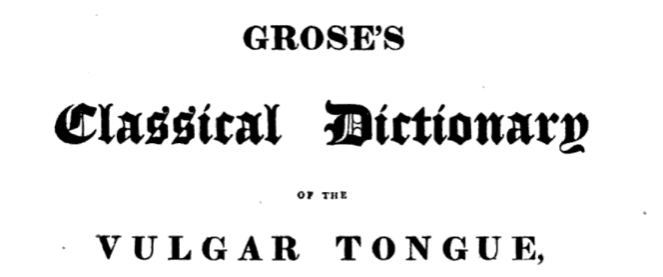
    The Dictionary of the Vulgar Tongue was first published at the end of the eighteenth century, and given that the Coronavirus crisis is giving too much time to read books, I thought I’d pick a daily word from it until I got bored…..

    Banyan Day

    The dictionary defines this as “a sea term for those days on which no meat is allowed to the sailors. The term is borrowed from the Banyans in the East Indies, a cast that eat nothing that had life”. I’ve never heard of this phrase, but it was in common usage in the nineteenth century, and no doubt in the eighteenth century, and was sometimes used not just in naval terms but also for anyone not eating meat on a certain day. And apparently it’s still a phrase used today on ships, but it just refers to a general picnic.

    An alternative usage of the phrase developed when sailors referred to meals being a Banyan Day when they were eating leftovers, as there was no meat left. That, in turn, led to the phrase being used to mean straitened times.

  • Dictionary of the Vulgar Tongue – Day Thirteen

    Dictionary of the Vulgar Tongue – Day Thirteen

    The Dictionary of the Vulgar Tongue was first published at the end of the eighteenth century, and given that the Coronavirus crisis is giving too much time to read books, I thought I’d pick a daily word from it until I got bored…..

    Bantling

    The dictionary defines this as a “young child”, a word that it seems is still in usage today to at least a small degree.

    The word has steadily fallen out of use over the last century, but it’s quite an affectionate term in many ways, although it hasn’t always been used like that and was sometimes defined more as a brat.

  • Dictionary of the Vulgar Tongue – Day Twelve

    Dictionary of the Vulgar Tongue – Day Twelve

    The Dictionary of the Vulgar Tongue was first published at the end of the eighteenth century, and given that the Coronavirus crisis is giving too much time to read books, I thought I’d pick a daily word from it until I got bored…..

    Bang Up

    This phrase is defined by the dictionary as meaning “Quite the thing, hellish fine. Well done. Compleat. Dashing”, which is interesting perhaps as it’s almost the sort of term that could be used today in modern slang. Indeed, there are still references made to “bang up good”, although I’m not sure whether that’s a continuation of the older term or by chance it has been reintroduced. I like the idea that it’s a phrase that has been in use for centuries though.

  • Dictionary of the Vulgar Tongue – Day Eleven

    Dictionary of the Vulgar Tongue – Day Eleven

    The Dictionary of the Vulgar Tongue was first published at the end of the eighteenth century, and given that the Coronavirus crisis is giving too much time to read books, I thought I’d pick a daily word from it until I got bored…..

    Baker-Kneed

    This is a phrase that seems relatively common during the seventeenth and early eighteenth century and it appears frequently in newspapers and books. The dictionary gives the definition as “one whose knees knock together in walking, as if kneading dough”, in what today would I guess more commonly be referred to at knock-kneed. The knock-kneed term seems to date only from the late eighteenth century so this is perhaps when the two phrases switched in common usage.

  • Dictionary of the Vulgar Tongue – Day Ten

    Dictionary of the Vulgar Tongue – Day Ten

    The Dictionary of the Vulgar Tongue was first published at the end of the eighteenth century, and given that the Coronavirus crisis is giving too much time to read books, I thought I’d pick a daily word from it until I got bored…..

    Baker’s Dozen

    The book defines this as “fourteen, that number of rolls being allowed to the purchasers of a dozen”. This is instantly intriguing because of the fourteen rather than thirteen and usually I’ll tell myself that I need to get out more, but under the current climate, that isn’t happening.

    The meaning of the phrase dates back to when bakers were under a legal duty, and wanted to avoid local humiliation of being put in the stocks or worse, to ensure that they sold the right weight of bread. So, it was easier to add something extra to ensure compliance, so when selling in a larger volume to wholesalers they’d put extra bread or rolls in. Buyers of something smaller would usually be given an extra piece of bread as well, along the same principle.

    So the thirteen and fourteen are both logical, bakers would put one or two extra loaves in depending on their experience at ensuring that they were compliant. It appears that during the nineteenth century the Baker’s Dozen started to be defined more as thirteen rather than fourteen, perhaps for reasons of economy. But, it’s an interesting evolution of the phrase and how meaning can shift over time.

  • Dictionary of the Vulgar Tongue – Day Nine

    Dictionary of the Vulgar Tongue – Day Nine

    The Dictionary of the Vulgar Tongue was first published at the end of the eighteenth century, and given that the Coronavirus crisis is giving too much time to read books, I thought I’d pick a daily word from it until I got bored…..

    Badgers

    The dictionary defines this as “a crew of desperate villains who robbed near rivers, into which they threw the bodies of those they murdered”. Used as slang in the criminal fraternity, I can’t imagine that this was ever very common. It’s perhaps something which used to keep communities in fear as the books I’ve looked at suggest that the murder rate was relatively low in the eighteenth century. It’s an intriguing phrase though….

  • Dictionary of the Vulgar Tongue – Day Eight

    Dictionary of the Vulgar Tongue – Day Eight

    The Dictionary of the Vulgar Tongue was first published at the end of the eighteenth century, and given that the Coronavirus crisis is giving too much time to read books, I thought I’d pick a daily word from it until I got bored…..

    Autem

    Not particularly a vulgar word, but this word was used between the sixteenth and eighteenth centuries as a slang word, and rather informally and negatively, for a church. It’s not known, but the word may have been derived from Yiddish and the phrase ‘autem bawler’ is another word for a parson.

  • Dictionary of the Vulgar Tongue – Day Seven

    Dictionary of the Vulgar Tongue – Day Seven

    The Dictionary of the Vulgar Tongue was first published at the end of the eighteenth century, and given that the Coronavirus crisis is giving too much time to read books, I thought I’d pick a daily word from it until I got bored…..

    Avoir du Pois Lay

    This is a pretty niche phrase, meaning “the stealing of brass weights off the counter of shops”. It’s so niche, it’s another phrase that must have been incredibly localised, as I can’t find any mention of this term in old newspapers or books, nor any logic to how it evolved. But I like that there’s a specific phrase for it, perhaps there should be one for stealing beer glasses from pubs…..

  • Dictionary of the Vulgar Tongue – Day Six

    Dictionary of the Vulgar Tongue – Day Six

    The Dictionary of the Vulgar Tongue was first published at the end of the eighteenth century, and given that the Coronavirus crisis is giving too much time to read books, I thought I’d pick a daily word from it until I got bored…..

    Arsy Yarsey

    This rather lovely little term used in the seventeenth and eighteenth centuries simply means to fall head over heels, deriving from arsy-versy used from as early as the sixteenth century which had a wider meaning of topsy turvy or back to front. I’m not sure that this term ever appeared much in print, I’m guessing that it was used more in the vernacular.

  • Dictionary of the Vulgar Tongue – Day Five

    Dictionary of the Vulgar Tongue – Day Five

    The Dictionary of the Vulgar Tongue was first published at the end of the eighteenth century, and given that the Coronavirus crisis is giving too much time to read books, I thought I’d pick a daily word from it until I got bored…..

    Ark Ruffians

    The dictionary defines this as “rogues who, in conjunction with watermen, robbed, and sometimes murdered, on the water, by picking a quarrel with the passengers in a boat, boarding it, plundering, stripping, and throwing them overboard.”

    I’m unsure whether the author simply made this up, as there is no mention of this in any UK or US newspaper that I can find. Nearly every Internet search of the term just brings up the dictionary itself, so if this was a phrase then it wasn’t very widespread. It would be interesting though if this practice did take place, something akin to highwaymen on the rivers.