Category: Books

  • Dictionary of the Vulgar Tongue – Day Twenty-Two

    Dictionary of the Vulgar Tongue – Day Twenty-Two

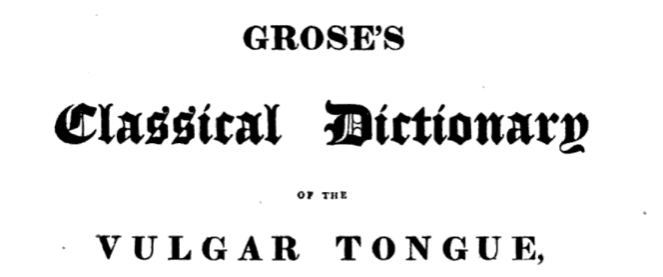
    The Dictionary of the Vulgar Tongue was first published at the end of the eighteenth century, and given that the Coronavirus crisis is giving too much time to read books, I thought I’d pick a daily word from it until I got bored…..

    Beggar Maker

    A short and sweet definition from the dictionary, this is “a publican”. This doesn’t appear to have ever been a widely used phrase, although the sentiment behind it is rather more timeless.

  • Dictionary of the Vulgar Tongue – Day Twenty-One

    Dictionary of the Vulgar Tongue – Day Twenty-One

    The Dictionary of the Vulgar Tongue was first published at the end of the eighteenth century, and given that the Coronavirus crisis is giving too much time to read books, I thought I’d pick a daily word from it until I got bored…..

    Beau Trap

    The dictionary defines this as “a loose stone in a pavement, under which water lodges, and on being trod upon, squirts it up, to the great damage of white stockings”. Since the word ‘beau’ was used to mean a foppish man, I assume this was a problem for men and women alike. I can’t imagine that the the phrase was ever much used, I can’t find much evidence of it being in common usage. It’s a nice phrase to use though, if anyone writes to their local council to complain about a damaged pavement, they should certainly include it.

  • Dictionary of the Vulgar Tongue – Day Twenty

    Dictionary of the Vulgar Tongue – Day Twenty

    The Dictionary of the Vulgar Tongue was first published at the end of the eighteenth century, and given that the Coronavirus crisis is giving too much time to read books, I thought I’d pick a daily word from it until I got bored…..

    Bayard of Ten Toes

    The dictionary defines this as “to walk on foot, Bayard was a horse famous in old romances”. To be more precise, Bayard was a magical horse as it had the ability to change its size to suit the number of riders who mounted it. Bayard dates back to at least the twelfth century and Chaucer also made reference to it in the Canterbury Tales in 1286. This is another one of these phrases which seems to have been rarely used, but I like the Bayard of Ten Toes, it’s something which deserves to be brought back into usage….

  • Dictionary of the Vulgar Tongue – Day Nineteen

    Dictionary of the Vulgar Tongue – Day Nineteen

    The Dictionary of the Vulgar Tongue was first published at the end of the eighteenth century, and given that the Coronavirus crisis is giving too much time to read books, I thought I’d pick a daily word from it until I got bored…..

    Bay Fever

    Defined by the dictionary as “a term of ridicule applied to convicts who sham illness, to avoid being sent to Botany Bay”. I’m impressed by just how many people the British Government shipped out to Australia for breaking various laws, it totalled 162,000 convicts between 1788 and 1868. I’m moderately surprised that being able to fake an illness was a reason to avoid transportation, as ships at this time were riven with people who had cholera and typhoid.

    Incidentally, the journey to Australia took four months and I can’t begin to imagine what a bloody hassle that must have been, sailing along with hundreds of seasick convicts who had cholera or typhoid. The rate of death on the transportation ships was usually relatively low, but in around 1800 the system changed to pay more to crews and masters who got convicts safely (well, alive) to Australia. Which means I imagine that they didn’t want ill convicts on board, and perhaps that’s why bay fever became a thing. Another nice phrase though.

  • Dictionary of the Vulgar Tongue – Day Eighteen

    Dictionary of the Vulgar Tongue – Day Eighteen

    The Dictionary of the Vulgar Tongue was first published at the end of the eighteenth century, and given that the Coronavirus crisis is giving too much time to read books, I thought I’d pick a daily word from it until I got bored…..

    Bawdy Basket

    The dictionary defines this as “the twenty-third rank of canters, who carry pins, tape, ballads and obscene books to sell, but live mostly by stealing”. Canter seems to be a miscreant of various types, and the 23rd rank refers to a 1698 dictionary which tried to place the criminal fraternity in 27 different ranks, with the most important ranked highly.

    The original meaning of a bawdry basket was someone (nearly always female) who carried a basket of clothes and then stole more clothing that they found, claiming to anyone asking that it was their own. Over time, this got corrupted in criminal slang to meaning someone carrying a basket of stolen goods.

  • Dictionary of the Vulgar Tongue – Day Seventeen

    Dictionary of the Vulgar Tongue – Day Seventeen

    The Dictionary of the Vulgar Tongue was first published at the end of the eighteenth century, and given that the Coronavirus crisis is giving too much time to read books, I thought I’d pick a daily word from it until I got bored…..

    Bartholomew Baby

    Apparently, and going by the dictionary’s definition, this is “a person dressed up in a tawdry manner, like the dolls or babies sold at Bartholomew fair”. As a side issue, I’m still retelling people (I heard this on a guided walk, although I can’t remember which one) the origins of the word tawdry, which comes from St Audrey’s lace, which was often sold as a cheap copy and became unfashionable.

    Anyway, I hadn’t heard of Bartholomew Fair, but this was a major annual event which was held in London from 1133 until 1855, with the authorities finding it had got debauched by inappropriate people and their behaviour, so they scrapped it. The phrase Bartholomew Baby is still in use occasionally today as a description of small wooden dolls, but the reference to people being dressed in a tawdry manner seems to have been lost.

  • Dictionary of the Vulgar Tongue – Day Sixteen

    Dictionary of the Vulgar Tongue – Day Sixteen

    The Dictionary of the Vulgar Tongue was first published at the end of the eighteenth century, and given that the Coronavirus crisis is giving too much time to read books, I thought I’d pick a daily word from it until I got bored…..

    Barrow Man

    The dictionary defines this as “a man under sentence of transportation; alluding to the convicts at Woolwich, who are principally employed in wheeling barrows full of brick or dirt”. Another dictionary from the period defines this, as well as a wheelbarrow man, as being anyone sentenced to work maintaining the roads. I’m not sure why the definition seems limited to Woolwich, although there were prison ships, or hulks, that were moored there during the late eighteenth and early nineteenth century, so I imagine it’s that.

    The surname Barrowman during the middle of the nineteenth century was nearly entirely limited to London and Essex (with the one exception being the Newcastle area), which might also explain the limited usage of the phrase outside of the capital.

  • Dictionary of the Vulgar Tongue – Day Fifteen

    Dictionary of the Vulgar Tongue – Day Fifteen

    The Dictionary of the Vulgar Tongue was first published at the end of the eighteenth century, and given that the Coronavirus crisis is giving too much time to read books, I thought I’d pick a daily word from it until I got bored…..

    Barker

    The dictionary defines this word as “the shopman of a bow-wow shop, or dealer in second hand clothes, particularly about Monmouth Street, who walks before his master’s door, and deafens every passenger with his cries of ‘clothes, coats or gowns – what d’ye want gemmen? what d’ye buy?”.

    The bow-wow shop is, according to the dictionary, a shop where the servant bites and the master barks, an interesting thought….

    Monmouth Street in the eighteenth century was known for its clothes shops, later being lost and becoming Shaftesbury Avenue when that street was expanded. In a bid to bring back the name, Great St. Andrew Street was renamed as Monmouth Street in the 1930s.

  • Dictionary of the Vulgar Tongue – Day Fourteen

    Dictionary of the Vulgar Tongue – Day Fourteen

    The Dictionary of the Vulgar Tongue was first published at the end of the eighteenth century, and given that the Coronavirus crisis is giving too much time to read books, I thought I’d pick a daily word from it until I got bored…..

    Banyan Day

    The dictionary defines this as “a sea term for those days on which no meat is allowed to the sailors. The term is borrowed from the Banyans in the East Indies, a cast that eat nothing that had life”. I’ve never heard of this phrase, but it was in common usage in the nineteenth century, and no doubt in the eighteenth century, and was sometimes used not just in naval terms but also for anyone not eating meat on a certain day. And apparently it’s still a phrase used today on ships, but it just refers to a general picnic.

    An alternative usage of the phrase developed when sailors referred to meals being a Banyan Day when they were eating leftovers, as there was no meat left. That, in turn, led to the phrase being used to mean straitened times.

  • Dictionary of the Vulgar Tongue – Day Thirteen

    Dictionary of the Vulgar Tongue – Day Thirteen

    The Dictionary of the Vulgar Tongue was first published at the end of the eighteenth century, and given that the Coronavirus crisis is giving too much time to read books, I thought I’d pick a daily word from it until I got bored…..

    Bantling

    The dictionary defines this as a “young child”, a word that it seems is still in usage today to at least a small degree.

    The word has steadily fallen out of use over the last century, but it’s quite an affectionate term in many ways, although it hasn’t always been used like that and was sometimes defined more as a brat.