
Category: Books

  • Dictionary of the Vulgar Tongue – Day Forty-Two

    Dictionary of the Vulgar Tongue – Day Forty-Two

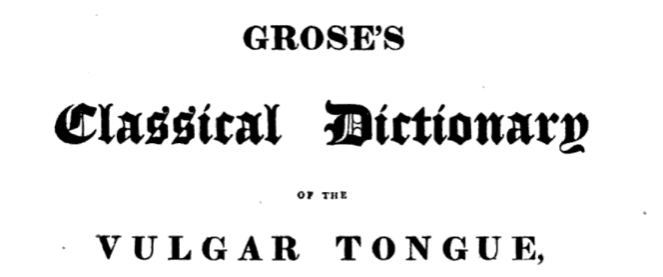
    The Dictionary of the Vulgar Tongue was first published at the end of the eighteenth century, and given that the Coronavirus crisis is giving too much time to read books, I thought I’d pick a daily word from it until I got bored…..

    Breeches Bible

    The dictionary defines this as “an edition of the BIble printed in 1598, wherein it is said that Adam and Eve sewed figleaves together, and made themselves breeches”. The first edition of this bible actually appeared in 1560, with the appropriate passage in Genesis reading:

    “Then the eies of them both were opened, and they knew that they were naked, and they sewed figge tree leaves together, and made themselves breeches”.

    Today, this instead reads:

    “Then the eyes of both of them were opened, and they realised they were naked; so they sewed fig leaves together and made coverings for themselves.”

    Certainly a strange turn of phrase even for the late sixteenth century.

  • Dictionary of the Vulgar Tongue – Day Forty-One

    Dictionary of the Vulgar Tongue – Day Forty-One

    The Dictionary of the Vulgar Tongue was first published at the end of the eighteenth century, and given that the Coronavirus crisis is giving too much time to read books, I thought I’d pick a daily word from it until I got bored…..

    Break-Teeth Words

    This is a humorous little phrase, meaning “hard words, difficult to pronounce”. Unfortunately, I can’t find much evidence in books or papers that this was ever in common usage, but I still like it…..

  • Dictionary of the Vulgar Tongue – Day Forty

    Dictionary of the Vulgar Tongue – Day Forty

    The Dictionary of the Vulgar Tongue was first published at the end of the eighteenth century, and given that the Coronavirus crisis is giving too much time to read books, I thought I’d pick a daily word from it until I got bored…..

    Bray

    The dictionary defines this as “a vicar of Bray; one who frequently changes his principles, always siding with the strongest party: an allusion to a vicar of Bray, in Berkshire, commemorated in a well-known ballad for the pliability of his conscience”.

    I hadn’t heard of this phrase, although a film was made with the title of ‘Vicar of Bray’ in the 1930s, telling the story. Like most of these things, there are differing tales from other the centuries, it likely refers to Simon Aleyn who served as the Canon of Windsor between 1559 and 1563. He managed to shift from being a Catholic to a Protestant and then back to a Catholic, before finally changing back to Protestantism. I can think of some politicians like him….

    The text of the ballad is at https://en.wikipedia.org/wiki/The_Vicar_of_Bray_(song).


  • Dictionary of the Vulgar Tongue – Day Thirty-Nine

    Dictionary of the Vulgar Tongue – Day Thirty-Nine

    The Dictionary of the Vulgar Tongue was first published at the end of the eighteenth century, and given that the Coronavirus crisis is giving too much time to read books, I thought I’d pick a daily word from it until I got bored…..

    Bran-faced

    Not the most politically correct of terms, although to be fair, this dictionary is over 200 years old, this is defined as “freckled, he was Christened by a baker, he carries the bran in his face”. I can’t find much mention of this term being used in print, so I’m guessing that it wasn’t particularly widespread. Probably not one that needs to be brought back into usage…

  • Dictionary of the Vulgar Tongue – Day Thirty-Eight

    Dictionary of the Vulgar Tongue – Day Thirty-Eight

    The Dictionary of the Vulgar Tongue was first published at the end of the eighteenth century, and given that the Coronavirus crisis is giving too much time to read books, I thought I’d pick a daily word from it until I got bored…..

    Bragget

    The dictionary defines this as “mead and ale sweetened with honey”, which seems to have been a common word at the time, derived from the medieval word ‘brag’ meaning malt. The drink was sweet, and often had spices added to it, with the word also being spelt ‘braggot’ or ‘braket’.

    Chaucer used the word as early as the fourteenth century, but it has pretty much fallen out of use now.

  • Dictionary of the Vulgar Tongue – Day Thirty-Seven

    Dictionary of the Vulgar Tongue – Day Thirty-Seven

    The Dictionary of the Vulgar Tongue was first published at the end of the eighteenth century, and given that the Coronavirus crisis is giving too much time to read books, I thought I’d pick a daily word from it until I got bored…..

    Bowsprit

    The dictionary defines this as “the nose, from its being the most projecting part of the human face, as the bowsprit is of a ship”.

    Another one of those words which is slowly going out of use. However, the word ‘bow’ is still listed as another word for noise, so perhaps this is the same derivative.

  • Dictionary of the Vulgar Tongue – Day Thirty-Six

    Dictionary of the Vulgar Tongue – Day Thirty-Six

    The Dictionary of the Vulgar Tongue was first published at the end of the eighteenth century, and given that the Coronavirus crisis is giving too much time to read books, I thought I’d pick a daily word from it until I got bored…..

    Bouncer

    The dictionary defines this as “a large man or woman”, which is interesting insomuch as that using the word bouncer as a slang for door staff is thought to originate from a novel by Horatio Alger called The Young Outlaw. I was hoping that instead the word evolved from inns and pubs using large men to ensure order at their establishments, but unfortunately I can’t find any evidence of that…..

  • Dictionary of the Vulgar Tongue – Day Thirty-Five

    Dictionary of the Vulgar Tongue – Day Thirty-Five

    The Dictionary of the Vulgar Tongue was first published at the end of the eighteenth century, and given that the Coronavirus crisis is giving too much time to read books, I thought I’d pick a daily word from it until I got bored…..

    Book-Keeper

    I really like the definition of this term, not anything about accountants, but “one who never returns borrowed books”. As a side issue, there’s a small debate about why book-keeper is hyphenated, with a few people suggesting that in this case it would really be bookskeeper, which is a clunky term, hence why a hyphen developed. This interested me, and going back to the late seventeenth century, the word is usually spelt book-keeper. There must be a whole field of study about the evolution of the hyphen, which I suspect is more intriguing than it might at first sound. I do need to get out more…..

  • Dictionary of the Vulgar Tongue – Day Thirty-Three

    Dictionary of the Vulgar Tongue – Day Thirty-Three

    The Dictionary of the Vulgar Tongue was first published at the end of the eighteenth century, and given that the Coronavirus crisis is giving too much time to read books, I thought I’d pick a daily word from it until I got bored…..

    Blue Pigeons

    The dictionary defines this as criminal slang for “thieves who steal lead off houses and churches”, or to “fly a blue pigeon” means committing the same crime. An irritating and heinous crime which has unfortunately taken place over the last few centuries, although I’ve found some references to this phrase in the late eighteenth century which refers to “fly a blue pigeon” as meaning deceitful behaviour. The blue refers to the old nickname for lead and although I can’t find much evidence of this phrase in literature or the media, if it was a criminal phrase then I assume it would have mostly been spoken.

  • Dictionary of the Vulgar Tongue – Day Thirty-Two

    Dictionary of the Vulgar Tongue – Day Thirty-Two

    The Dictionary of the Vulgar Tongue was first published at the end of the eighteenth century, and given that the Coronavirus crisis is giving too much time to read books, I thought I’d pick a daily word from it until I got bored…..

    Blue Flag

    I’ve never heard of this phrase, but the dictionary defines it as “he has hoisted the blue flag; he has commenced publican, or taken a public house, an allusion to the blue aprons worn by publicans”. Other dictionaries at the time also referred to it as being a name for those becoming fishmongers, for the same reason of the blue aprons. The term now is better known for representing clean beaches, but I like the phrase, which was used between the mid-eighteenth and mid-nineteenth centuries.