
Category: Books

  • Dictionary of the Vulgar Tongue – Day Sixty-One

    Dictionary of the Vulgar Tongue – Day Sixty-One

    The Dictionary of the Vulgar Tongue was first published at the end of the eighteenth century, and given that the Coronavirus crisis is giving too much time to read books, I thought I’d pick a daily word from it until I got bored…..

    Captain Lieutenant

    Quite a long definition, the dictionary notes that this is defined as “meat between veal and beef, the flesh of an old calf; a military simile, drawn from the officer of that denomination, who has only the pay of lieutenant, with the rank of captain; but so is not entirely one or the other, but between both”.

    It seems a rather long phrase to describe meat, a bit clunky for a butcher to have to write out on their display or for a customer to ask for. And on that basis, I also can’t find much evidence that this phrase was much used, but there’s something very precise about the term that I like. It’s perhaps a shame that Morrison’s to this day doesn’t use the phrase in their market street butchers…..
  • Dictionary of the Vulgar Tongue – Day Sixty

    Dictionary of the Vulgar Tongue – Day Sixty

    The Dictionary of the Vulgar Tongue was first published at the end of the eighteenth century, and given that the Coronavirus crisis is giving too much time to read books, I thought I’d pick a daily word from it until I got bored…..

    Canterbury Story

    Defined as “a long round-about tale”, this has an obvious source which is from the long, tedious and winding stories of the fourteenth-century Canterbury Tales. I’ve just denigrated what is perhaps one of the most important medieval books, but they are a bit long…. There’s a possibility that it didn’t derive from Chaucer’s book, but instead from pilgrims on their way to Canterbury on a pilgrimage when they told elaborate and excessively long stories. But, that’s an excusable thing to do to pass the time.

  • What’s My Line and Colonel Sanders

    What’s My Line and Colonel Sanders

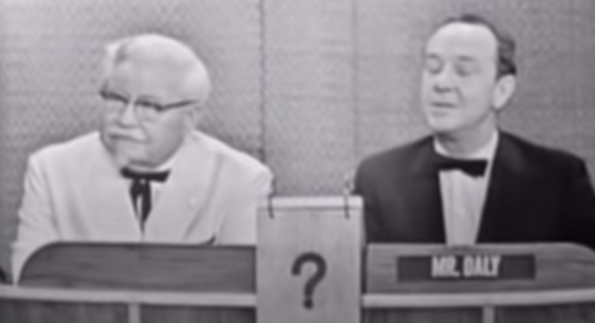
    I’ve been watching some of the old US episodes of What’s My Line, and this is certainly my favourite so far…. Filmed in 1963, Sanders became much better known just a couple of years later.


  • Dictionary of the Vulgar Tongue – Day Fifty-Nine

    Dictionary of the Vulgar Tongue – Day Fifty-Nine

    The Dictionary of the Vulgar Tongue was first published at the end of the eighteenth century, and given that the Coronavirus crisis is giving too much time to read books, I thought I’d pick a daily word from it until I got bored…..

    Cannikin

    This word is described by the dictionary as a “small can”, and in the criminal fraternity, it means the plague. The word comes from the sixteenth century Dutch word ‘kanneken’ which now means cannon, but I think had a different meaning back then that was something like ‘can’ or ‘bucket’.

    The above image shows in red the capitalised version of Cannikin, the blue its lower case. And, there was a surge in usage of the word in the early 1970s. This was because Project Cannikin was a large underground nuclear weapons test, given the fluffy name of Cannikin, but it was something much more explosive than a small can, quite literally. Rather than it being a little can, the test involved 400 tonnes of equipment and a shaft that was nearly 2,000 metres deep. The test was controversial because there were fears of earthquakes and tsunamis, and the concern generated by this is what led to the creation of the Greenpeace pressure group.

  • Dictionary of the Vulgar Tongue – Day Fifty-Eight

    Dictionary of the Vulgar Tongue – Day Fifty-Eight

    The Dictionary of the Vulgar Tongue was first published at the end of the eighteenth century, and given that the Coronavirus crisis is giving too much time to read books, I thought I’d pick a daily word from it until I got bored…..

    Calibogus

    A slightly strange name for a drink, this word is defined by the dictionary as a “rum and spruce beer, an American beverage”. The word dates to the seventeenth century and it usually also contains molasses and it was also common in parts of Canada, where it was known as Callibogus.

    For anyone who wants to make it, and I don’t think that I’ll be rushing out to get the ingredients (and where on earth would I get Zirbenz Stone Pine Liqueur or spruce beer from anyway?), here’s a recipe from https://kindredcocktails.com/cocktail/calibogus-smugglers-cove.

    1 1⁄4 oz Añejo rum (blend of column and pot still)
    3⁄4 oz Zirbenz Stone Pine Liqueur
    3⁄4 oz Molasses syrup
    1⁄4 oz Lime juice
    1 dr Spruce Beer (extract)
    3 oz Seltzer water

    I wouldn’t say that the words are much used, but they haven’t gone out of usage entirely.

    As for how the word evolved, none of the three dictionaries I looked at had any idea at all……

  • Dictionary of the Vulgar Tongue – Day Fifty-Seven

    Dictionary of the Vulgar Tongue – Day Fifty-Seven

    The Dictionary of the Vulgar Tongue was first published at the end of the eighteenth century, and given that the Coronavirus crisis is giving too much time to read books, I thought I’d pick a daily word from it until I got bored…..

    Calves Head Club

    I’m not sure this is much of a definition as it’s more of an historic tale, but the dictionary notes this is “a club instituted by the Independents and Presbyterians, to commemorate the decapitation of King Charles I. Their chief fare was calves heads; and they drank their wine and ale out of calves skulls”.

    The club allegedly met every 30 January, the date of the execution of the King, becoming something of a Bullingdon Club arrangement. This kept going until 1734, when they went too far at an event at the Golden Eagle pub, on Suffolk Street in London, with an account reporting:

    “Thursday in the evening a disorder of a very particular nature happened in Suffolk-street: ’Tis said that several young gentlemen of distinction having met at a house there, call’d themselves the Calf’s-Head Club; and about seven o’clock a bonfire being lit up before the door, just when it was in the height, they brought a calf’s-head to the window dress’d in a napkin-cap, and after some Huzza’s, threw it into the fire: The mob were entertained with strong-beer, and for some time halloo’d as well as the best; but taking a disgust at some healths which were proposed, grew so outrageous, that they broke all the windows, forc’d themselves into the house, and would probably have pull’d it down, had not the Guards been sent for to prevent further mischief. The damage done within and without the house, is computed at some hundred pounds. The Guards were posted all night in the street, for the security of the neighbourhood.”

    A little too raucous for me.

  • Dictionary of the Vulgar Tongue – Day Fifty-Six

    Dictionary of the Vulgar Tongue – Day Fifty-Six

    The Dictionary of the Vulgar Tongue was first published at the end of the eighteenth century, and given that the Coronavirus crisis is giving too much time to read books, I thought I’d pick a daily word from it until I got bored…..

    Cagg Maggs

    Defined by the dictionary as “Old Lincolnshire geese, which having been plucked ten or twelve years, are sent up to London to feast the cockneys”. There’s not much to add to this precisely worded definition, but I like the slight north-south divide being hinted at here, send the old and scraggy meat down to London rather than keep it up north…. That assumes that Lincolnshire is in the north, which is perhaps pushing it though.

  • Dictionary of the Vulgar Tongue – Day Fifty-Five

    Dictionary of the Vulgar Tongue – Day Fifty-Five

    The Dictionary of the Vulgar Tongue was first published at the end of the eighteenth century, and given that the Coronavirus crisis is giving too much time to read books, I thought I’d pick a daily word from it until I got bored…..

    Buzman

    The dictionary defines this as a criminal’s word for a pickpocket. The interesting element about this is that some people think that this is the origin of the phrase “busman’s holiday”, which dates back to at least the 1880s. It would be that the pickpocket was always working even when they’re on holiday, such would be the nature of their ‘trade’. I’m not sure that this is the actual origin, but I do prefer this version.

  • Dictionary of the Vulgar Tongue – Day Fifty-Four

    Dictionary of the Vulgar Tongue – Day Fifty-Four

    The Dictionary of the Vulgar Tongue was first published at the end of the eighteenth century, and given that the Coronavirus crisis is giving too much time to read books, I thought I’d pick a daily word from it until I got bored…..

    Butter Box

    This phrase is defined by the dictionary as “a Dutchman, from the great quantity of butter eaten by the people of that country”. I’m not quite sure if this is offensive or not, but I guess there could be worse, although I don’t think I’ll use the phrase the next time that I’m in the Netherlands. It was certainly initially meant to be offensive, it dates to the mid-seventeenth century when sailors used it in a derogatory manner during the Anglo-Dutch Wars.

    It has also been suggested that the phrase derives from when the Dutch flag looked like this, which was in the seventeenth century, as apparently it looks like a butter box. I must admit, it doesn’t look at all like a butter box to me, so I’m going with the Dutch people binge eating butter.

  • Dictionary of the Vulgar Tongue – Day Fifty-Three

    Dictionary of the Vulgar Tongue – Day Fifty-Three

    The Dictionary of the Vulgar Tongue was first published at the end of the eighteenth century, and given that the Coronavirus crisis is giving too much time to read books, I thought I’d pick a daily word from it until I got bored…..

    Bundling

    There’s quite a long definition for this in the dictionary, which is:

    “A man and woman sleeping in the same bed, he with his small clothes, and she with her petticoats on; an expedient practised in America on a scarcity of beds, where, on such an occasion, husbands and parents frequently permitted travellers to bundle with their wives and daughters. This custom is now abolished. See Duke of Rochefoucalt’s Travels in America”.

    Theodore Zeldin wrote about this in An Intimate History Of Humanity, noting that it was actually a more common practice than the dictionary suggested, as it was practised in England, Wales, the Netherlands (where it was known as kweesten) and even Afghanistan. There’s a Wikipedia page on the subject, and a book entitled Little Known Facts about Bundling in the New World was published in the United States.