
Category: Books

  • Dictionary of the Vulgar Tongue – Day 119

    Dictionary of the Vulgar Tongue – Day 119

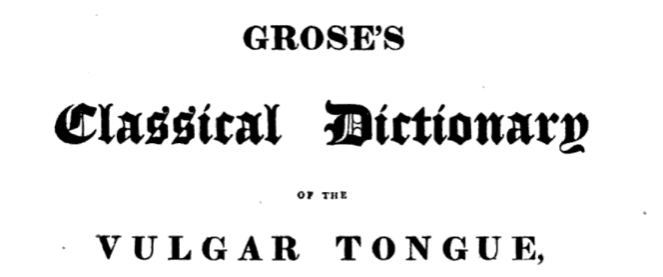
    The Dictionary of the Vulgar Tongue was first published at the end of the eighteenth century, and given that the current health crisis is giving too much time to read books, I thought I’d pick a daily word from it until I got bored….

    Field Lane Duck

    This sounds delicious, it’s defined by the dictionary as “a baked sheep’s head”. Field Lane was a street in London, near to where Saffron Hill is today near to Holborn, where stolen goods were commonly sold. That area gained a reputation for deceit, thieves and stolen products, so anything related to Field Lane would be known as something just a little fraudulent. The phrase was primarily a late eighteenth century and early nineteenth century one, becoming less commonly used when Field Lane disappeared in the mid-nineteenth century. So anyone buying meat that they thought was something a little decadent might well have been considerably disappointed.

  • Dictionary of the Vulgar Tongue – Day 118

    Dictionary of the Vulgar Tongue – Day 118

    The Dictionary of the Vulgar Tongue was first published at the end of the eighteenth century, and given that the current health crisis is giving too much time to read books, I thought I’d pick a daily word from it until I got bored….

    Feague

    Not the most elegant of things to think about, the dictionary defines this as “to feague a horse; to put ginger up a horse’s fundament, and formerly, as it is said, a live eel, to make him lively and carry his tail well; it is said, a forfeit is incurred by any horse-dealer’s servant, who shall shew a horse without first feaguing him. Feague is used, figuratively, for encouraging or spirting one up”.

    I’m not entirely sure of the practicalities about achieving this aim with a live eel, but the ginger solution remains a problem today for those buying horses. Today, the phrase is better known as gingering, as this is now the most common usage, and is of course seen as an animal rights abuse.

  • Dictionary of the Vulgar Tongue – Day 117

    Dictionary of the Vulgar Tongue – Day 117

    The Dictionary of the Vulgar Tongue was first published at the end of the eighteenth century, and given that the current health crisis is giving too much time to read books, I thought I’d pick a daily word from it until I got bored….

    Fam Lay

    Apparently (it says on Google), in 2020, Fam Lay is a famous rapper, but over 200 years ago, the dictionary defined this as “going into a goldsmith’s shop, under pretence of buying a wedding ring, and palming one or two, by daubing the hand with some viscous matter”. The term was used by the criminal fraternity and it seems quite a precise definition, probably never in common usage. The word ‘fam’ could mean the hand, and ‘lay’ in this instance is just a shortened version of layer, so it’s effectively a sleight of hand.

  • Dictionary of the Vulgar Tongue – Day 116

    Dictionary of the Vulgar Tongue – Day 116

    The Dictionary of the Vulgar Tongue was first published at the end of the eighteenth century, and given that the current health crisis is giving too much time to read books, I thought I’d pick a daily word from it until I got bored….

    Fakement

    This word is defined by the dictionary as “a counterfeit signature. A forgery. Tell the macers to mind their fakements; desire the swindlers to be careful not to forget another person’s signature”. It’s a word that sounds like it should exist in English (adding ‘ment’ usually means to action the first part of the word), but it also sounds as though it has been recently been made up. It actually though dates back to at least the sixteenth century, although was more commonly used in the nineteenth century.

  • Dictionary of the Vulgar Tongue – Day 115

    Dictionary of the Vulgar Tongue – Day 115

    The Dictionary of the Vulgar Tongue was first published at the end of the eighteenth century, and given that the current health crisis is giving too much time to read books, I thought I’d pick a daily word from it until I got bored….

    Elbow Grease

    Some of the phrases in this dictionary remain in common usage today, but I would have otherwise assumed that they perhaps had a more recent origin. This phrase is defined in the dictionary in the same way as it would be today, “labour, elbow grease will make an oak table shine”. Indeed, the phrase is much older even than the late eighteenth century when this dictionary was published, it was being used as early as the sixteenth century and likely before then. There is a direct French equivalent, “huile de coude” which means the same.


  • Dictionary of the Vulgar Tongue – Day 114

    Dictionary of the Vulgar Tongue – Day 114

    The Dictionary of the Vulgar Tongue was first published at the end of the eighteenth century, and given that the current health crisis is giving too much time to read books, I thought I’d pick a daily word from it until I got bored….

    Earth Bath

    Short and simple, this is defined by the dictionary as “a grave”.

    The phrase is also very much a nineteenth-century one, it fell out of usage after that. More recent usages tend to be with reference to the treatment of being buried to one’s neck in soil for medical purposes, rather to the original rather more morbid meaning.

  • Dictionary of the Vulgar Tongue – Day 113

    Dictionary of the Vulgar Tongue – Day 113

    The Dictionary of the Vulgar Tongue was first published at the end of the eighteenth century, and given that the current health crisis is giving too much time to read books, I thought I’d pick a daily word from it until I got bored…. Incidentally, this word is out of alphabetical order compared to the previous days as that’s where it’s located in the dictionary.

    Die Hard

    Although I’ve heard this phrase often, primarily due to the film name, I’ve never known what it really means. But, the Grose’s dictionary has the answer, it’s defined as “to show no signs of fear or contrition at the gallows; not to whiddle or squeak. This advice is frequently given to felons going to suffer the law, by their old comrades anxious for the honour of the gang”.

    Over time, the word meaning has shifted away from death at the gallows, to mean instead remaining fixed on a viewpoint and not changing. Word origin for this meaning is from the mid-nineteenth century, which flows nicely from the original meaning of the phrase in the eighteenth century.

    The Wikipedia article at https://en.wikipedia.org/wiki/Die_hard_(phrase) is thus partly nonsense, they’ve got the first usage of this word as being after the publication of Grose’s dictionary.

  • Dictionary of the Vulgar Tongue – Day 112

    Dictionary of the Vulgar Tongue – Day 112

    The Dictionary of the Vulgar Tongue was first published at the end of the eighteenth century, and given that the current health crisis is giving too much time to read books, I thought I’d pick a daily word from it until I got bored….

    Dutch Feast

    Another in the series of phrases, such as Dutch Concert, which were meant as insults against the Dutch, the dictionary defines this as “where the entertainer gets drunk before his guest”. Underlying the phrase was the typecasting of the Dutch as bad drunks, whereas perhaps the British at the time considered themselves as rather well-behaved drunks. The phrase was used from the late seventeenth century, but then had pretty much died out by the mid-nineteenth century.

  • Dictionary of the Vulgar Tongue – Day 111

    Dictionary of the Vulgar Tongue – Day 111

    The Dictionary of the Vulgar Tongue was first published at the end of the eighteenth century, and given that the current health crisis is giving too much time to read books, I thought I’d pick a daily word from it until I got bored….

    Dutch Concert

    This is another charming little phrase, defined as “where every one plays or signs a different tune”. I’m not sure if the dictionary meant signed as a conductor or meant to say ‘I, but the effect is still the same. The phrase is probably from the late seventeenth century, as worsening relations between Britain and the Netherlands led to some new derogatory language about the country. So, it likely started as an insult about the ability of Dutch musicians, but the phrase is still used today about a performance that goes a bit wrong and isn’t in harmony. There seems to be more harmony, if I can be excused for using that word again, between the British and the Dutch today though, such is progress,

  • Dictionary of the Vulgar Tongue – Day 110

    Dictionary of the Vulgar Tongue – Day 110

    The Dictionary of the Vulgar Tongue was first published at the end of the eighteenth century, and given that the current health crisis is giving too much time to read books, I thought I’d pick a daily word from it until I got bored….

    Dumplin

    Ah, at least, a Norfolk themed word in the dictionary, defined as “a short thick man or woman. Norfolk dumpling; a jeering appellation of a Norfolk man, dumplins being a favourite kind of food in that county”. This also ties in with an image I posted last week entitled ‘Norfolk Dumplin’. The word origin here is from ‘dump’, which means the consistency of dough. The word is still used in a negative manner, someone seen as a stupid country person, although it has evolved into almost an affectionate meaning today. Incidentally, apparently the recipe for dumplings in Norfolk don’t call for fat, but instead flour and a raising agent, but I have no idea….