
Category: Books

  • Dictionary of the Vulgar Tongue – Day 169

    Dictionary of the Vulgar Tongue – Day 169

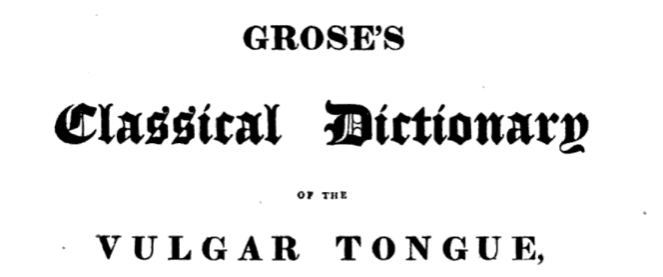
    The Dictionary of the Vulgar Tongue was first published at the end of the eighteenth century, and given that the current health crisis is giving too much time to read books, I thought I’d pick a daily word from it until I got bored….

    Irish Apricots

    This is defined by Grose as “Potatoes. It is a common joke against the Irish vessels, to say they are loaded with fruit and timber, that is, potatoes and broomsticks”. There was no end of similar phrases, with Irish apples, Irish footballs, Irish grapes and Irish lemons all meaning the same thing, ie, potatoes.

    The Irish Apricots phrase wasn’t recorded before the end of the eighteenth century, so it was perhaps quite a new reference when Grose wrote about it. It was used more commonly in the early nineteenth century, but has since fallen out of use.

  • Dictionary of the Vulgar Tongue – Day 168

    Dictionary of the Vulgar Tongue – Day 168

    The Dictionary of the Vulgar Tongue was first published at the end of the eighteenth century, and given that the current health crisis is giving too much time to read books, I thought I’d pick a daily word from it until I got bored….

    Jerrycummumble

    This bizarre word is defined by Grose as “to shake, towzle or tumble about”. It’s likely Cockney Rhyming Slang for tumble, although quite how this established itself I have no idea, although it has also been recorded as being ‘jerry mumble’ which is at least easier to say. It was first recorded in the early eighteenth century, but was rarely used in written English. Unfortunately, the word has now fallen out of usage, likely never to return…..

  • Dictionary of the Vulgar Tongue – Day 167

    Dictionary of the Vulgar Tongue – Day 167

    The Dictionary of the Vulgar Tongue was first published at the end of the eighteenth century, and given that the current health crisis is giving too much time to read books, I thought I’d pick a daily word from it until I got bored….

    Jark

    Another one of Grose’s simple definitions, he simply writes that this is “a seal”, which is meant in the impression or stamps sense, not the thing that lives in the sea. Someone who forged documents was also sometimes referred to as a “jarkman”, as was someone who wrote begging letters. The word dates back to at least the sixteenth century, but the word origin is unknown.

    And another word that has mostly gone out of usage….

  • Dictionary of the Vulgar Tongue – Day 166

    Dictionary of the Vulgar Tongue – Day 166

    The Dictionary of the Vulgar Tongue was first published at the end of the eighteenth century, and given that the current health crisis is giving too much time to read books, I thought I’d pick a daily word from it until I got bored….

    Japanned

    This is another of Grose’s religious definitions, which he refers to as “ordained. To be japanned; to enter into holy orders, to become a clergyman, to put on the black cloth: from the colour of the japan ware, which is black”. Wikipedia has an article on Japanning, which it seems is a lacquerwork that was initially used on furniture and then on porcelain. Much of this wasn’t particularly authentic Japanese, but the designs were repurposed and changed for the European market. The process was very popular in the nineteenth century, but less so from the early twentieth century onwards.

    I’m not sure that the way the word was defined by Grose was particularly common, but it’s a logical way to refer to someone who has become ordained.

    The word, with all its meaning, declined in usage, just as the design did.

  • Dictionary of the Vulgar Tongue – Day 165

    Dictionary of the Vulgar Tongue – Day 165

    The Dictionary of the Vulgar Tongue was first published at the end of the eighteenth century, and given that the current health crisis is giving too much time to read books, I thought I’d pick a daily word from it until I got bored….

    Jack Tar

    Grose didn’t exert himself with his definition of this phrase, noting solely that it was “a sailor”. As this is a common phrase even now, a fair bit of work has been done by others in trying to work out where the term originally derives from. It’s likely that the ‘Jack’ was just a colloquial word for a man, but the ‘tar’ bit is more unknown. Sailors would sometimes put tar on clothing to make it waterproof, but ships were also known for their ropes covered in tar, so either route might have led to the origins of the phrase.

    It’s thought that the term would have been relatively new by the time that Grose wrote about it, probably dating to around the mid to late eighteenth century by the time it was in more common usage. There are though some references to it at the beginning of the eighteenth century, but it became much more frequently used in the early nineteenth century.

    By the late nineteenth century, the term was used less frequently, although it’s yet to entirely die out.

  • Dictionary of the Vulgar Tongue – Day 164

    Dictionary of the Vulgar Tongue – Day 164

    The Dictionary of the Vulgar Tongue was first published at the end of the eighteenth century, and given that the current health crisis is giving too much time to read books, I thought I’d pick a daily word from it until I got bored….

    Hush Money

    Little has changed with the meaning of this phrase, defined by Grose as “money given to hush up or conceal a robbery, theft, or any other offence, or to take off the evidence from appearing against a criminal”. This does perhaps feel like a more modern construction, but it dates back to at least the beginning of the eighteenth century.

    ‘Hush’ comes from ‘huisht’, meaning to be quiet or still, with the ‘t’ at the end likely going missing over time as people mis-took it for being in the past tense.

    The phrase has remained in common usage over the last three centuries, becoming more frequently used over the last few decades.

  • Dictionary of the Vulgar Tongue – Day 163

    Dictionary of the Vulgar Tongue – Day 163

    The Dictionary of the Vulgar Tongue was first published at the end of the eighteenth century, and given that the current health crisis is giving too much time to read books, I thought I’d pick a daily word from it until I got bored….

    Hulver-Headed

    Grose goes back to Norfolk with this definition, which is “having a hard impenetrable head; hulver, in the Norfolk dialect, signifying holly, a hard and solid wood”. The word ‘hulver’ did indeed mean holly, although also an evergreen shrub or tree and it’s likely how Hulver in Suffolk got its name. So, the term ‘hulver-headed’ is quite a beautiful one in many ways, meaning muddled or having an addled brain. The phrase was in use from at least the seventeenth century, but started to fall out of usage by the middle of the nineteenth century.

  • Dictionary of the Vulgar Tongue – Day 162

    Dictionary of the Vulgar Tongue – Day 162

    The Dictionary of the Vulgar Tongue was first published at the end of the eighteenth century, and given that the current health crisis is giving too much time to read books, I thought I’d pick a daily word from it until I got bored….

    Huckle My Buff

    This not very delicious sounding drink is defined by Grose as “beer, egg and brandy, made hot”. And it has come back into existence over recent years thanks to Jamie Oliver who made a modern version of the cocktail. It’s thought to have originated in Sussex in the eighteenth century, although it lingered on until at least the nineteenth century.

    The standard way, or at least one way, of making this concoction is to pour a pint of beer into a saucepan, chuck three eggs in, a big dash of brandy, 1oz of sugar and 1 teaspoon of nutmeg. I’m not sure I’ll be rushing to make it, although I’d be willing to prepare it if I can find some idiot willing to try it. It’s probably a good way to get rid of a beer that Greene King make to be fair…

    The Argus have a story about the modern preparation of this drink as well when it was part of an event held by Harveys of Lewes.

  • Dictionary of the Vulgar Tongue – Day 161

    Dictionary of the Vulgar Tongue – Day 161

    The Dictionary of the Vulgar Tongue was first published at the end of the eighteenth century, and given that the current health crisis is giving too much time to read books, I thought I’d pick a daily word from it until I got bored….

    Hot Pot

    This isn’t the definition that I expected from Grose, which is “ale and brandy made hot”. Grose didn’t mention this in the dictionary, but it’s likely a phrase used in Norfolk and Suffolk in the eighteenth century, simply meaning a warm ale or a warm brandy. This is a literal definition, as ‘pot’ used to mean a drinking vessel, and a few real ale drinkers still use that word.

    Incidentally, and as an aside, the English dish of hot pot likely has a different meaning, from ‘hodge podge’, or a random collection of ingredients.

  • Dictionary of the Vulgar Tongue – Day 160

    Dictionary of the Vulgar Tongue – Day 160

    The Dictionary of the Vulgar Tongue was first published at the end of the eighteenth century, and given that the current health crisis is giving too much time to read books, I thought I’d pick a daily word from it until I got bored….

    Horse Ladder

    There’s something quite brilliant about any dictionary definition which starts “a piece of Wiltshire wit”. It carries on to define the ‘wit’ as “this consists of sending some raw lad, or simpleton, to a neighbouring farm house, to borrow a horse ladder, in order to get up the horses, to finish a hay mow“. No doubt much hilarity ensued….

    Ironically, a horse ladder is very much a thing now, although the rugged types of Wiltshire would have course never needed anything like that. I’m not sure that the term was ever much in common usage, but it’s a lovely little phrase in any event.