
Category: Books

  • Dictionary of the Vulgar Tongue – Day 179

    Dictionary of the Vulgar Tongue – Day 179

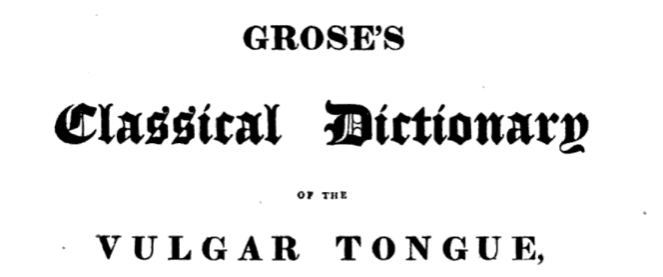
    The Dictionary of the Vulgar Tongue was first published at the end of the eighteenth century, and given that the current health crisis is giving too much time to read books, I thought I’d pick a daily word from it until I got bored….

    Knight and Barrow Pig

    This is another beautiful phrase, defined by Grose as “more hog than gentleman. A saying of any low pretender to precedence”. A barrow pig is one which has been castrated and so the meaning of the phrase becomes quite self-evident, but it’s perhaps unfortunate that it didn’t seem to be widely used and it’s really only through Grose that it has been recorded. It would be quite a sophisticated insult to use today though…..

  • Dictionary of the Vulgar Tongue – Day 178

    Dictionary of the Vulgar Tongue – Day 178

    The Dictionary of the Vulgar Tongue was first published at the end of the eighteenth century, and given that the current health crisis is giving too much time to read books, I thought I’d pick a daily word from it until I got bored….

    Knight of the Post

    This is defined by Grose as “a false evidence, one that is ready to swear any thing for hire”. So, effectively, someone who is willing to perjure themselves for money, which isn’t an ideal state of affairs for the judicial system. The phrase dates back to the late sixteenth century, although had fallen out of usage by the middle of the nineteenth century. In England and Wales, perjury only became an offence in common law in 1613, following a series of rather unfortunate cases.

    Back in the Tudor and Stuart periods, and indeed later, it was possible to find people around the Inns of Court and Westminster Hall who were willing to lie and produce false documents for a suitable fee. The origins of the term are unknown, but it’s thought it likely relates to where the individual would stand, by a certain post where legal announcements were placed, waiting for their next commission.

  • Dictionary of the Vulgar Tongue – Day 177

    Dictionary of the Vulgar Tongue – Day 177

    The Dictionary of the Vulgar Tongue was first published at the end of the eighteenth century, and given that the current health crisis is giving too much time to read books, I thought I’d pick a daily word from it until I got bored….

    Kissing Crust

    Sometimes Grose gets a bit obsessed with murder, crime and fornication, but with this definition it’s more playful, it’s “the part where the loaves have touched the oven”. There’s some debate, and there are probably more important things to talk about, about whether this is correct, as others have defined it as “the part where the loaves have touched each other”. This sort of makes a difference, at in Grose’s definition it would be a hard bit of bread, whereas with the second definition, it would be a soft piece of the bread.

    I don’t think I’ll over-worry about who is correct (although I’m not sure it’s Grose), but it’s a quite warming little term and a few bakeries around the world have used it as their name.

  • Dictionary of the Vulgar Tongue – Day 176

    Dictionary of the Vulgar Tongue – Day 176

    The Dictionary of the Vulgar Tongue was first published at the end of the eighteenth century, and given that the current health crisis is giving too much time to read books, I thought I’d pick a daily word from it until I got bored….

    Kingdom Come

    Another cheery little definition from Grose, he defines this as “he is gone to kingdom come, he is dead”. It’s better known now as a computer game franchise and also as a phrase in the Lord’s Prayer, although there it’s a reference to the Kingdom of God that will come in the future. This future state of glory is also relevant to the meaning of the phrase, it just means the next phase and in human terms that means being dead.

    The phrase had fallen out of favour, but its new meaning has seen a recent rise in usage.

  • Dictionary of the Vulgar Tongue – Day 175

    Dictionary of the Vulgar Tongue – Day 175

    The Dictionary of the Vulgar Tongue was first published at the end of the eighteenth century, and given that the current health crisis is giving too much time to read books, I thought I’d pick a daily word from it until I got bored….

    Kill Care Club

    This is defined by Grose as “the members of this club, styled also the Sons of Sound Sense and Satisfaction, met at their fortress, the Castle Tavern, in Paternoster Row”. There’s some good timing with my working through the dictionary as, by chance, I walked through Paternoster Square today in London, which is the remnants of what was a badly damaged area during the Second World War.

    Paternoster Row was until the Second World War a home of book publishing, with millions of books destroyed during the Blitz. The Castle Tavern had long since closed by then, but it was located on the north side of Paternoster Row, between Eagle and Child Court and Lovels Alley. As for the club, I have no idea, it’s something that Grose must have been intrigued by and there’s little else that has been written about them.

  • Dictionary of the Vulgar Tongue – Day 174

    Dictionary of the Vulgar Tongue – Day 174

    The Dictionary of the Vulgar Tongue was first published at the end of the eighteenth century, and given that the current health crisis is giving too much time to read books, I thought I’d pick a daily word from it until I got bored….

    Kent-Street Ejectment

    This term is defined by Grose as “to take away the street door: a method practised by the landlords in Kent Street, Southwark, when their tenants are above a fortnight’s rent in arrear”. Kent Street is now better known as Tabard Street, which had its fair share of slum housing and where the poorest were taken advantage of, something which has perhaps not changed much over the centuries. Anyway, I suppose taking the door off is a pretty effective way of making someone feel unsafe and uncomfortable, but things must have got pretty bad given that the area became known for it.

  • Dictionary of the Vulgar Tongue – Day 173

    Dictionary of the Vulgar Tongue – Day 173

    The Dictionary of the Vulgar Tongue was first published at the end of the eighteenth century, and given that the current health crisis is giving too much time to read books, I thought I’d pick a daily word from it until I got bored….

    Keelhauling

    This is defined by Grose as “a punishment in use among the Dutch seaman, in which, for certain offences, the delinquent is drawn once, or oftener, under the ship’s keel: ludicrously defined, undergoing a great hard-ship”. As an aside, it’s interesting to see the word ‘oftener’ used here, which is still valid, although rarely used.

    It wasn’t the kindest punishment it has to be said, although it was an official sanction that could be used in the Dutch navy, known as ‘Kielhalen’. The word ‘keelhauled’ still exists in English in a more generic sense of being punished, but the naval version could be fatal. The sailor could hit the barnacles under the ship, which risked head wounds, as well as just hitting the vessel itself with some force.

    So, a punishment in the Dutch navy has managed to enter the English vernacular…..

  • Dictionary of the Vulgar Tongue – Day 172

    Dictionary of the Vulgar Tongue – Day 172

    The Dictionary of the Vulgar Tongue was first published at the end of the eighteenth century, and given that the current health crisis is giving too much time to read books, I thought I’d pick a daily word from it until I got bored….

    Jumblegut Lane

    This is quite beautiful, and how has this fallen out of usage? It’s defined by Grose as “a rough road or lane” and it conjures up wonderful images of rickety stagecoaches and the like flying over bumpy roads. It’s the sort of phrase that could perhaps be used again for those areas of the country where there seem to be more pot-holes than road……

  • Dictionary of the Vulgar Tongue – Day 171

    Dictionary of the Vulgar Tongue – Day 171

    The Dictionary of the Vulgar Tongue was first published at the end of the eighteenth century, and given that the current health crisis is giving too much time to read books, I thought I’d pick a daily word from it until I got bored….

    Island

    I have absolutely nothing to add to this, but it’s a charming definition, “he drank out of the bottle till he saw the island; the island is the rising bottom of a wine bottle, which appears like an island in the centre, before the bottle is quite empty”. The only comment about this is that I wondered why they have these indentations, and apparently it’s historic and no longer necessary. It was just easier for glass blowers to ensure that bottles stayed upright if they could fold the bottom of the bottle in. Or at least that’s what I found on-line, so it must be true…..

  • Dictionary of the Vulgar Tongue – Day 170

    Dictionary of the Vulgar Tongue – Day 170

    The Dictionary of the Vulgar Tongue was first published at the end of the eighteenth century, and given that the current health crisis is giving too much time to read books, I thought I’d pick a daily word from it until I got bored….

    Itchland

    Grose’s definition of this word, which is simply “Scotland”, doesn’t actually hint at how negative and offensive it was meant. For a period in the eighteenth century and into the nineteenth century, the Scots were referred to this in this way by the English, suggesting that they had lice and were infested. And, this was nothing new in terms of insults, the same word had been used against the Welsh in the seventeenth century.

    It seems that English-Scottish relations improved by the 1820s or so, as the word went out of usage. Quite why it has made something of a return in the twentieth century, I’m not sure, perhaps it’s just in articles about the past….