Category: Rimini

  • Rimini – Bologna Rail Journey

    Rimini – Bologna Rail Journey

    20251119_104556

    After a few hours in Rimini, which I decided wasn’t really enough and so I’ll have to come back, it was time for the next part of my rail journey which was to Bologna. I was changing trains there, so I only had a short period there, although I did spend a week in Bologna a few years ago. I remember lots of tall towers….

    20251119_104618

    Mine was the 12:43 train and I was pleased that everything was on time. My plan was to travel to Bologna and then from there, I’d go to Venice.

    20251119_104843

    The railway station opened in 1861 and it has survived, albeit damaged, bombings from the Austro-Hungarian Navy during the First World War and from allied aircraft during the Second World War. There aren’t many facilities at the railway station, there’s a bar, shop and paid for toilets. This is something that annoys me about most railway stations in Italy, they don’t have the UK approach to matters that they really should be free of charge. Well, in my view anyway.

    20251119_115202

    My Hitachi Rock train gliding into the platform.

    20251119_115341

    It was a little busy, but there were still plenty of seats. As I’ve mentioned numerous times on this blog recently, I like these clean, open and modern double-decker trains. I’ve yet to have a problem getting a seat on one of these trains and the prices are towards the lower end of the scale.

    20251119_132442

    And safely into Bologna railway station.
  • Rimini – Chiesa di Sant’Agostino (Frescoes)

    Rimini – Chiesa di Sant’Agostino (Frescoes)

    20251119_101703

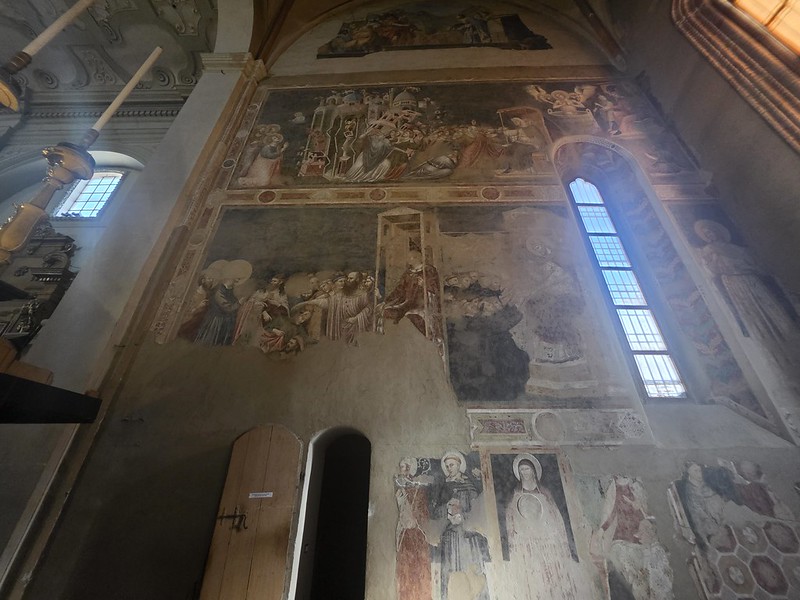
    I was rather pleased to be shown to where some historic frescoes are located in this beautiful church. The frescoes were painted in the second half of the fourteenth century, but they had become forgotten following a Baroque restoration, an earthquake and numerous other little renovations about the place. They were rediscovered in the early twentieth century, following the 1916 earthquake. They’re located in the apse of the church, but visitors have to walk around to see them as they’re separated off from the altar and the main part of the church.

    They’re painted by what is referred to as the Rimini School of Painting, which is in the style of early Gothic art. The frescoes have been stabilised now as part of a restoration, but there are quite big gaps in the whole arrangement thanks to the passage of time. Much of this damage was done between 1580 and 1585 when an Episcopal decree stated that the walls needed to be whitewashed.

    20251119_101654
    20251119_101737
    20251119_101742
    20251119_101751
    20251119_101802
  • Rimini – Other Photos

    Rimini – Other Photos

    20251119_104538

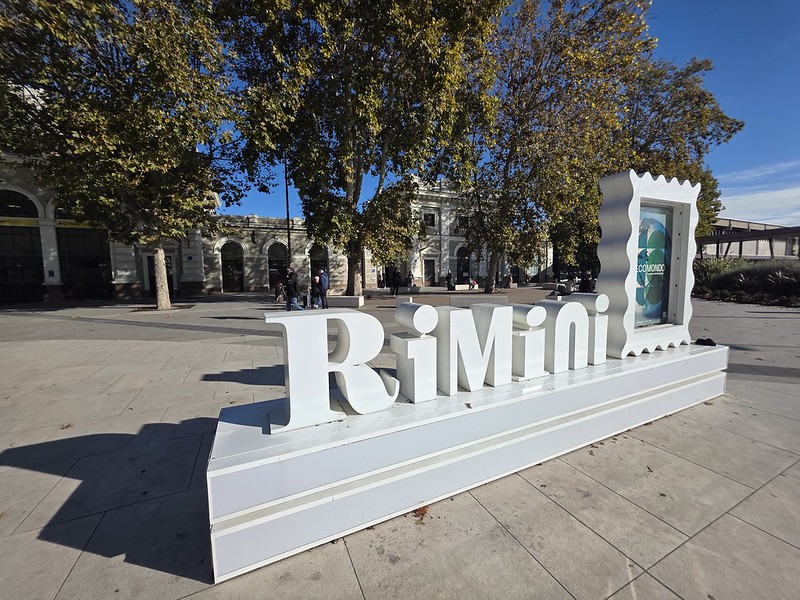
    And some other photos that I took during my rather brief stay in Rimini.

    20251119_104452

    Approaching the railway station.

    20251119_104157

    As a general comment, the provision for cyclists seems to be ever improving across Italy.

    20251119_103823

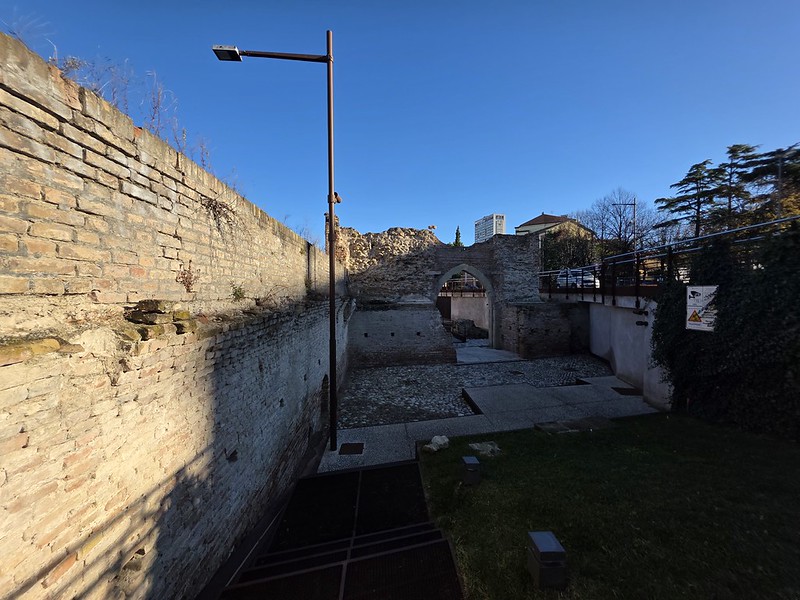
    I accept that this might not look like the most exciting of photos, but the significance is that this is where the first British bombing of Rimini took place. It occurred on All Saints’ Day, 1 November 1943, at 11:50 and 68 people died with 69 people injured.

    20251119_103503

    I didn’t have time to go in, but this museum, Domus del Chirurgo, has one of the mosaic floors that has been discovered in the city.

    20251119_103408

    A sculpture of Count Luigi Ferrari Banditi (1849-1895) who was a local politician from the noble Rasponi family of Ravenna.

    20251119_103248

    A monument to Francisco Busignani (1913-1936), an Italian engineer and army officer who lost his life in the Second Italo-Ethiopian War. This was added to Piazza Ferrari in 1939, designed by Elio Morri.

    20251119_102738

    The Torre dell’Orologio which is where the names of the fallen from the area are listed. This was constructed in 1547 and rebuilt in 1759, before being refocused as a war memorial in the twentieth century.

    20251119_102637

    A bronze statue of the great Roman emperor, Julius Caesar. This dates to 1933 and was cast by the foundry Fonderia Laganà. The statue was removed during the Second World War for political reasons and to prevent it from being damaged, before then being put in a military store before being put back here.

    20251119_102552

    This might look like a random hole, but this is Piazza Tre Martiri and those are the original Roman paving stones. There’s some archaeological work planned here with the intention of making more of this history open to the public.

    20251119_102503

    Christmas is coming……

    20251119_092426

    One of the harbours for those who can afford a yacht, located on the Marecchia River.

  • Rimini – Chiesa di Sant’Agostino

    Rimini – Chiesa di Sant’Agostino

    20251119_102213

    The outside of this church which was first mentioned in 1069. By the middle of the thirteenth century, it was handed to the newly formed Order of the Hermits of St Augustine, who transformed the modest parish into a major Gothic-style monastic church arrangement, featuring a large nave and a red-brick bell tower that became one of the tallest structures in Rimini. That bell tower, rising over 55 metres, was for centuries a navigational landmark which was handy for sailors in the Adriatic.

    20251119_102041

    The unfinished brick facade.

    20251119_102054

    A funerary monument from the 1630s.

    20251119_100532

    The church is the burial location of Alberto Marvelli (1918-1946) who has now been beatified for his actions during the Second World War. Known as a campaigner for social justice, he saved many lives during the war but was killed in a car accident in 1946. In 2004, Pope John Paul II declared him Blessed, and his tomb inside this church has become a place of quiet pilgrimage.

    20251119_100421

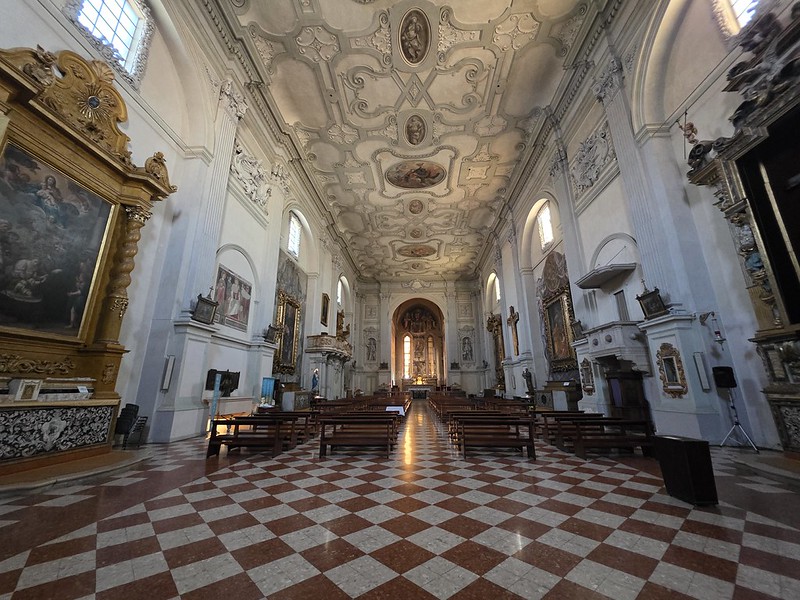
    The church has a beautiful interior, spacious and dignified. There are some fourteenth century frescoes from artists involved with the Rimini School of Painting, but more of that in another post as they surprised and delighted me when I found them.

    20251119_100432

    The decorated ceiling and apparently (well, I’m not going to know either way) there are some stuccoes by Ferdinando Galli-Bibiena (1647-1743).

    20251119_101957

    I thought that this was rather realistic.

    Anyway, a really rather lovely church, but one of the staff mentioned to me that there were some frescoes and this was my favourite thing about the building, so much so they can get their own post.

  • Rimini – Chiesa dei Servi 

    Rimini – Chiesa dei Servi 

    20251119_094507

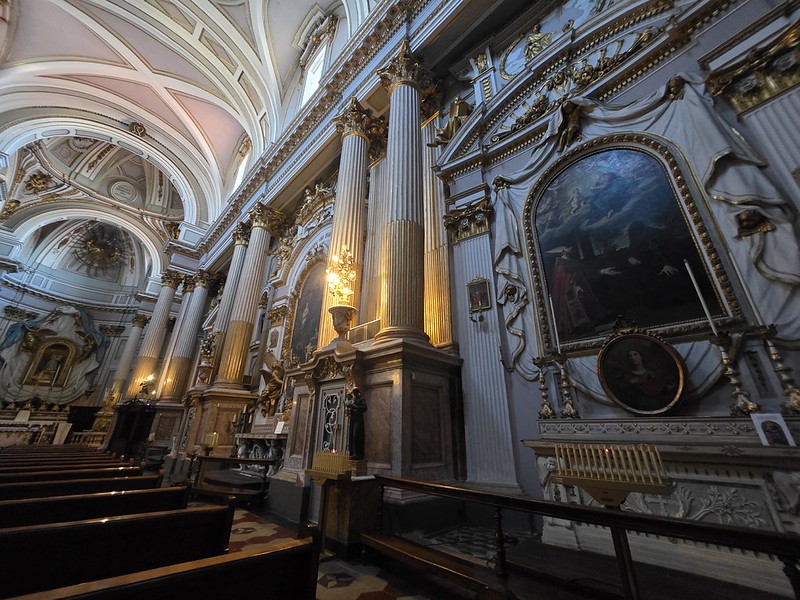
    This rather glorious single-nave church was built in 1317, funded by the wealthy Malatesta family and it was operated (I’m not sure whether that’s the right word, but I’ve decided that I like it) by the Order of the Servants of Mary, a Catholic order established in Florence in 1233.

    20251119_094246

    It’s very much a Baroque affair and that’s down to the work of Gaetano Stegani who modernised the whole design of the church between 1774 and 1777. However, the Servants of Mary didn’t get long to enjoy their newly designed church, they were kicked out in 1798 when their order was suppressed. The Dominicans replaced them, but they lasted for just a year.

    20251119_094218
    20251119_094322
    20251119_094221

    There isn’t much subtlety to the Baroque period….

    After religious matters settled down somewhat in the nineteenth century, the building was used as a parish church. In 1894, the façade which had remained relatively modest, was rebuilt under the supervision of Giuseppe Urbani. As if the Baroque styling wasn’t enough, the artist Luigi Samoggia added more gilding to the internal stuccoes.

    It was a peaceful church with the smell of incense running through it. It’s perhaps a little too ornate for my own tastes, but it’s beautiful and I suspect that the Malatesta family would have been pleased with it.

  • Rimini – 1613 Statue of Pope Paul V and the Time of Catholic Nepotism

    Rimini – 1613 Statue of Pope Paul V and the Time of Catholic Nepotism

    20251119_094957

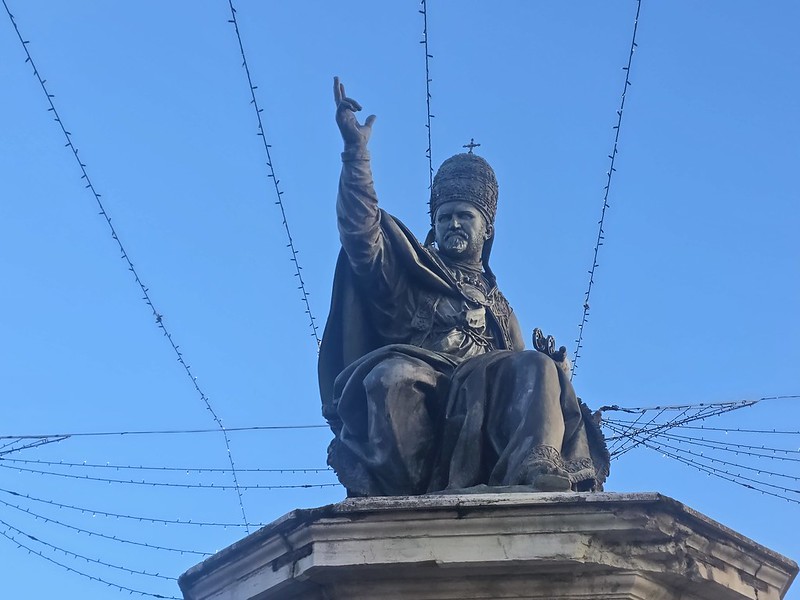
    Located at Piazza Cavour, in the heart of Rimini, is this statue of Pope Paul V (1550-1621) who held his Papal role from 1605 until 1621. This statue was designed by Nicola Cordier and cast by Sebastiano Sebastian in 1613.

    20251119_095009

    I don’t know how long the marble base has been here, but some subtle repair work can be noted by the trained eye.

    20251119_095002

    When Napoleon’s forces began making their enthusiastically unwelcome way through Italy, the denizens of Rimini took one look at their proudly papal statue and thought, perhaps quite reasonably, that it might not be the wisest thing to leave on public display. In an act of civic self preservation, they quietly removed Pope Paul V’s papal insignia and replaced it with more neutral decorations, effectively giving him a little political makeover in the hope that French troops wouldn’t take offence and reduce him to rubble. It was a cunning plan which worked well and the statue is still here today.

    But, back to Pope Paul V, this great man of peace was merrily ordering assassinations on his opponents and also handing out key roles to his family members. Like many other Popes, he made his nephew a cardinal and the Italian word for nephew is ‘nepos’. And, that’s where the word nepotism comes from, the Popes handing out trophies to their family members, although it’s thought that a good number of Popes actually pretended their sons were their nephews (to get around that celibacy thing they demanded of others). It took until Pope Innocent XII (1615-1700) thought that this power grab by families was a little, well, sub-optimal and he started the fightback against nepotism.

  • Rimini – Ponte di Tiberio (The Bridge of St. Julian)

    Rimini – Ponte di Tiberio (The Bridge of St. Julian)

    20251119_093539

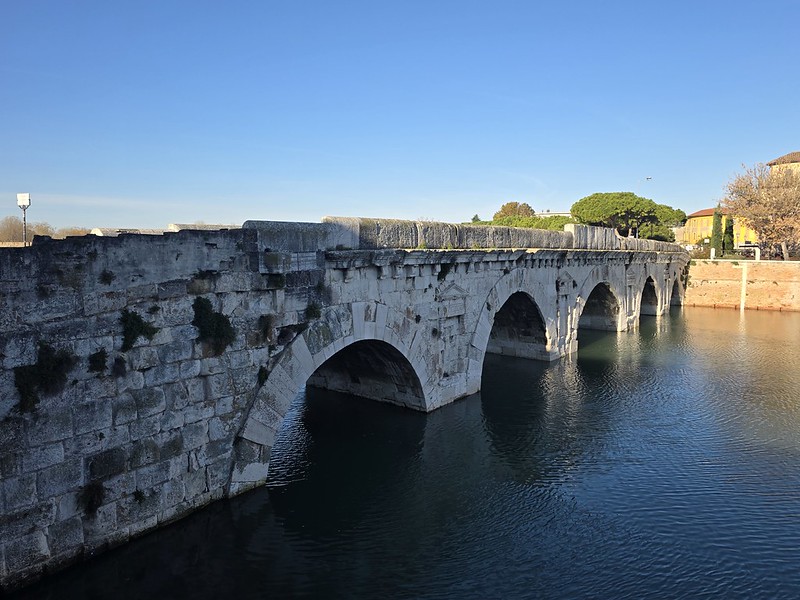
    Now this is exciting, known as one of the more important Roman bridges still standing. It is known today as the Bridge of Tiberius, but it is also known as the Bridge of Augustus and the Bridge of St. Julian. I’ve decided that I like the latter one the best, so that’s what I’m calling it.
    20251119_093652

    The construction of this bridge began in 14 AD under Emperor Augustus and it’s evident that he likes things that were built to last. Emperor Tiberius finished the job off and it’s his name that seems to be the most commonly used now which probably would have annoyed Augustus.

    This was an important structure, it carried the Via Aemilia and the Via Popilia, which in Roman times were major roads connecting Rimini to the rest of the Roman Empire. Architecturally, I think that this is rather beautiful with its five arches constructed out of Istrian stone, that sturdy pale rock that the Romans adored for its durability. It was also properly built with foundations that goes right into the riverbed, with some clever load distribution systems going on which even my civil engineer friend Liam would have likely been surprised and delighted by.

    20251119_093720

    The bridge has had some challenging times, although that’s not entirely surprising given that it’s 2,000 years old. In 552, the bridge was deliberately damaged by a Gothic military commander and it was damaged again in 1528 when Pandolfo (a name which sounds like a magician) retreated from Rimini. The Spanish knocked it about a bit during the War of the Austrian Succession and it was ordered to be demolished by the Germans in 1944. However, the local commander seemingly deliberately did a bad job of that, so, fortunately, it was saved and it was the only bridge along the River Marecchia that did survive.

    In May 2020, after some considerable years of debate, argument and planning, the sensible decision was finally made to pedestrianise it. That has now helped protect it for future generations and has made it much easier for pedestrians and cyclists to actually use without the fear of cars hitting them.

    20251119_093743

    I had a little walk along the bridge, which is one of the oldest surviving in the world, and it is hard not to be impressed by the heritage of this. The stonework glistened and it looked sturdy and robust, I’m very much impressed at the Roman engineers who managed to put this together. The Istrian stone that was used wasn’t local and it would have been a faff to get here, but the Romans wanted something that wouldn’t promptly fall down and I’d say that it was worth the effort.

  • Rimini – Porta Galliana

    Rimini – Porta Galliana

    20251119_093126

    I like an old gate, imagining the heritage of this. Porta Galliana, which takes its name from the local Galli family, is the last surviving medieval gate of Rimini and it was originally constructed in the thirteenth century. It’s been knocked about over the years and remodelled plenty of times, but it’s still standing here. It is located by the Marecchia river and was part of the defensive structure of Rimini, with this being the water gate arrangement that gave access to the harbour.

    20251119_093114

    The gate area was redeveloped recently to allow it to become more accessible and I think that they’ve done a really decent job of it. They’ve been hampered a little by it being 3.25 metres below the current street line. It was partly demolished in the nineteenth century and has been incorporated into other structures as the city changed around it.

    20251119_093132

    The gate was restored by Sigismondo Pandolfo Malatesta, the Lord of Rimini, between 1417 and 1468. This was a time when Rimini was dealing with its medieval priorities of not being attacked by neighbouring cities, but also wanting to ensure its maritime trade continued. There were also some water management elements introduced to the gate, primarily to avoid flooding to the city.

  • Rimini – Mercure Rimini Lungomare

    Rimini – Mercure Rimini Lungomare

    20251118_154231

    My night’s accommodation in Rimini was in the Accor operated Mercure Rimini Lungomare (lungomare is Italian for seafront). I suspect that this is quite a busy hotel during the summer months, although I can’t imagine that the demand is quite as high in November. I noticed several hotels along the seafront just close up for the winter months.

    20251118_154816

    My room was upgraded and I had a rather nice balcony.

    20251118_155032

    After I had worked out how to open the door (I suspect it was a child lock, so that will of course defeat me for some time) this was the view from my balcony. I always think this is lovely, but then promptly never go back out onto the balcony.

    20251118_155043

    My very nice private balcony, which I didn’t go back out onto after looking out here.

    20251118_155636

    Very lovely.

    20251118_155651

    I’m not sure exactly what they are, but they were very nice.

    20251118_190646

    The staff member at reception was particularly friendly and personable when I checked-in, so I felt very welcome. He mentioned that I could have a free drink between 19:00 and 21:00 which I privately thought seemed a bit limited for the bar opening. He then explained that this was extra to my welcome drink, which I could have at any time, and it was a hotel’s way of welcoming guests with snacks and a drink. I very much liked this arrangement.

    20251118_190906

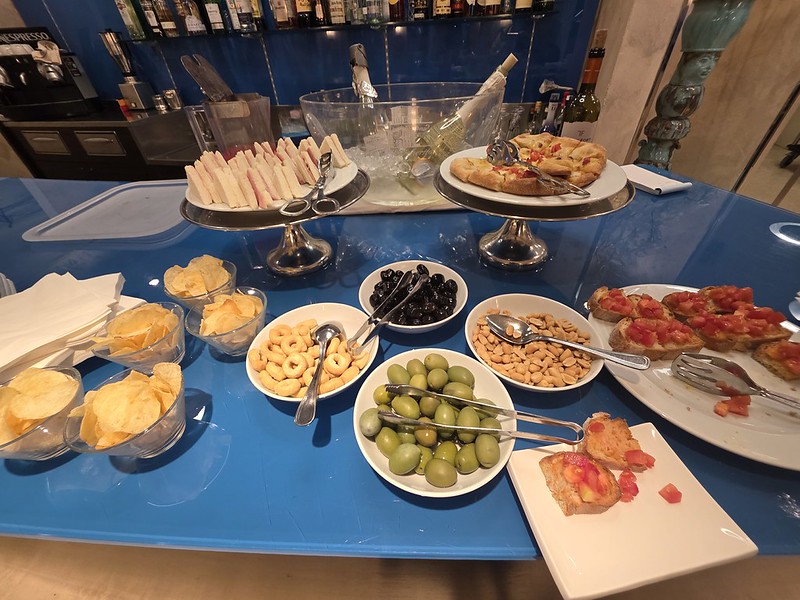
    These were the free snacks offered in the evening and this is something I’d like to see in many other locations.

    20251118_190954

    I went for white wine, which I thought was very Italian.

    20251118_201405

    I then went off for my two hour long walk and decided to switch back to beer. Well, Peroni, which is similar. And some more snacks. I sat outside to be continental although I think it was about minus three.

    20251119_070234

    Breakfast the next morning, which had a fine selection of meats, cheeses, breads and the like.

    20251119_070548

    Delicious.

    20251119_070717

    There was no shortage of Nutella.

    20251119_070756

    My first course.

    20251119_072925

    I liked my first croissant, so I had another one. This pistachio tart thing was also very delicious.

    20251119_071536

    Richard would have liked this, make your own orange juice from, well, oranges. I had quite a few glasses of this.

    Anyway, I really liked this hotel, with no noise disturbances either internally or externally. I liked the welcome gift, the welcome beer, the welcome wine and the welcome food, so I definitely felt welcome. The hotel was spotless, the staff were friendly and the nightly rate was very reasonable. The breakfast was delicious and this Accor Hotel certainly surprised and delighted me.

  • Rimini – Evening Photos by the Sea

    Rimini – Evening Photos by the Sea

    20251118_200137

    After a long day of travelling, my evening plan was simply to get to the hotel and then have a little meander around the coastal part of Rimini. The hotel had a pleasant balcony arrangement looking out over the coast and Rimini felt like a slightly upmarket Great Yarmouth.

    There’s a long promenade which has plenty of seating, along with restaurants and bars along the side although most of these seemed closed for the winter. There are then some paths to the sand and the Adriatic where I could have gone and sun bathed if I was interested in that. Well, moon bathed anyway.

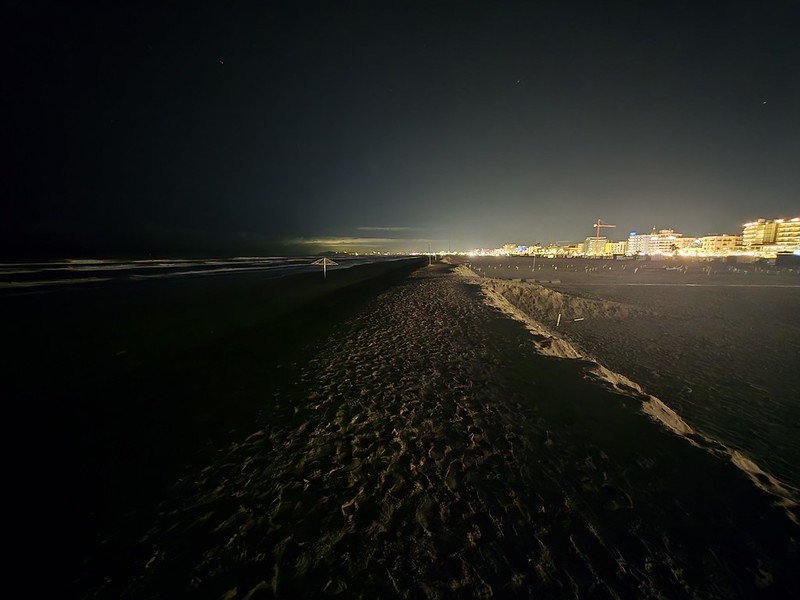
    So, below are just some random photos of my evening meander and apologies that some of them aren’t what might be called shining examples of photography. I’d note though that I was standing in what was pretty much entire darkness for some of the photos, so my phone did well to capture anything.

    20251118_192241
    20251118_192301
    20251118_192700
    20251118_192704
    20251118_192709
    20251118_192851
    20251118_192906
    20251118_193345(0)
    20251118_193618
    20251118_194646
    20251118_194504
    20251118_200927
    20251118_200228