Category: Athens

  • Athens – ibis Styles Athens Routes (Visit 1)

    Athens – ibis Styles Athens Routes (Visit 1)

    20250227_100613

    The outside of the Ibis Styles in Athens where I was staying for one night, although I stayed there again for my last night in Athens. The staff member at reception was exceptionally friendly, explaining about the hotel and offering a positive first impression. It’s relatively centrally located and not far to walk for the Acropolis and other city centre delights.

    20250226_150604

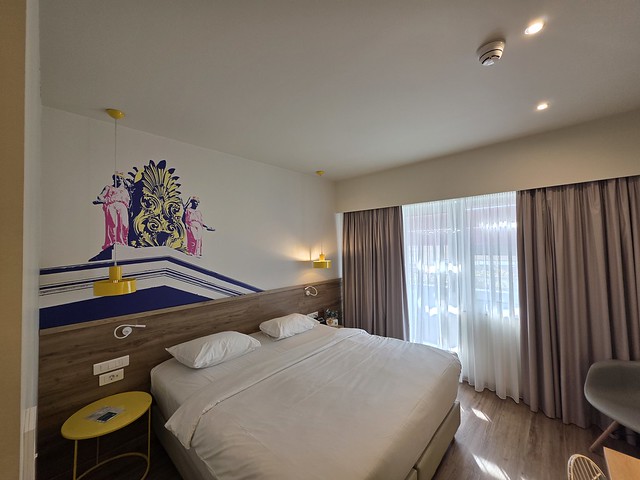
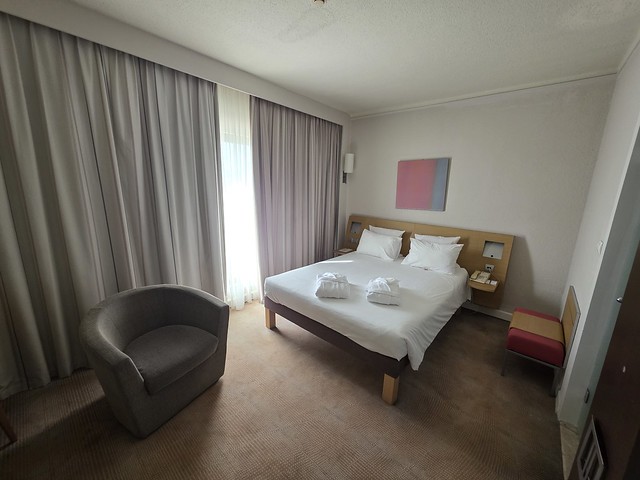
    The room which was an upgrade to the one that I booked. Spacious, cool, clean and with a desk.

    20250226_150648

    It also had the benefit of having a balcony which brought about a rather pleasant breeze and I’m also one of those people who likes road noise.

    20250226_192839

    The welcome drink and I was offered a choice of three beers, although they’re effectively all lagers. I went for the Mamos from the Athenian Brewery,  a generic but not unpleasant clean and light beer. I also like the free snacks that are provided with drinks in most locations in Athens, this is one of the little policies that I wish was followed in the UK.

    The on-line reviews are very positive and not many customers seem annoyed with them. The area is agreeable and doesn’t feel like you need a stab jacket, with the design feeling modern and on-trend. Their restaurant isn’t open at the moment other than for breakfast, although the bar is trading as usual. I didn’t have breakfast, as unfortunately the days of free breakfasts at Ibis Styles have long gone and the cost of over £12 seemed a bit high. I enjoyed the stay so much I booked to return for my final night, although matters weren’t quite as decadent on that one. But more about that another time…..

  • Athens – Hadrian’s Arch

    Athens – Hadrian’s Arch

    20250226_141548

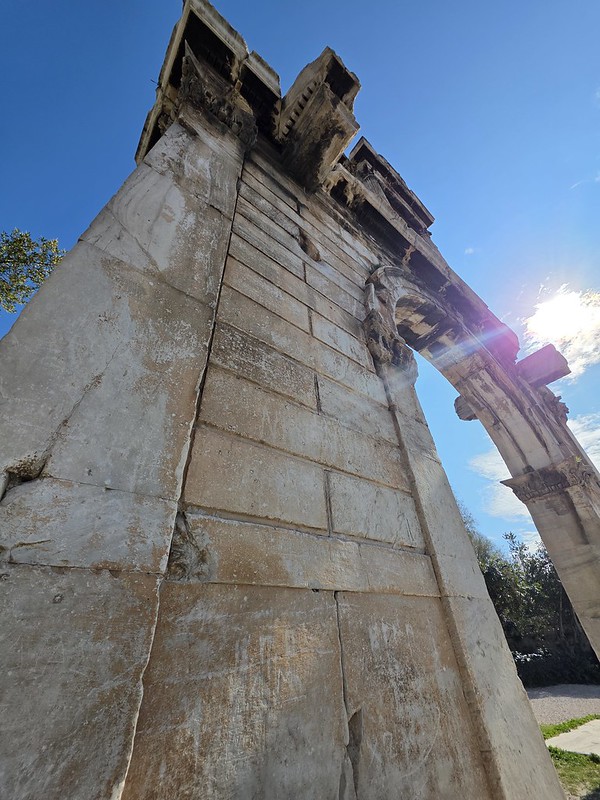
    I like an old gateway and this arch dates to 131AD or 132AD, so it’s done well not to fall down in the intervening period or to be used to make lime. It’s made of Pentelic marble, which is the same stone that was used to build the Parthenon. It stands 18 metres tall and it apparently, so the signage says, is a blend of Greek and Roman architectural styles. There are inscriptions which mark something of a divide between the classical Greek City founded by Theseus and the newer Roman area influenced by Hadrian. It’s not known whether it’s meant to be a rigid boundary or a symbol of the integration of Greek and Roman cultures under Hadrian’s rule. It was likely funded by the Athenians to thank Emperor Hadrian for his benefactions to the city and he’s a very lucky man to have a wall in northern England and a gate in Athens after him.

    20250226_141520

    The side of the arch, the origins of which are inevitably a little lost to history and it’s not known who the architect was of the whole arrangement. The Wall of Haseki was built in 1778 when Athens was run by Hadji Ali Haseki and this was a wall around the city which incorporated Hadrian’s Arch. The wall was reduced to ruins during the 1826 Ottoman Siege of Athens and was promptly demolished, although the historic arch was kept.

    20250226_141629

    It’s located next to a busy road and that’s inevitably having something of an impact on it and its colour is a little murky in places. In November 1935 it was reported that:

    “Extraordinary tumultuous scenes broke out as King George of the Hellenes, to-day, again set foot in his capital, after his long exile. Wearing evening dress, and with a monocle in his right eye, the King, his face twitching with restrained emotion, had listened at Hadrian’s Arch, on the boundary of Athens, to an address of welcome by the Mayor of Athens. He then received the keys of the city and started to walk under the arch into the capital. Immediately there was a forward rush by the crowd, who seized the King and bore him shoulder high, cheering frantically and shouting “Long live the King.”

    The cavalry were forced to clear the King’s route with drawn sabres. One man received a wound on the head from which blood streamed, and others were also hurt. Rescued from the ebullient loyalty of the crowd, the King regained his car and continued the drive to the cathedral. Strict precautions against an attack on the returning monarch had been taken at all stages in the route of the Royal drive. Hadrian’s Arch was especially strongly guarded, in view of the long wait while the Mayor of Athens and the provincial Mayors welcomed the King.

    Here, a guard of troops was drawn up and many spectators were stopped and searched for arms. Even girls in national costume were not spared. In his message to the Greek people on the occasion of his return, King George expresses deep emotion and infinite gratitude. He says he is ready to devote all his strength, his experience, and his life to the material and moral betterment of the whole people without exception. He promises absolute equality and justice for all.”

    There had been an 11 year period with no Monarch, with King George II having served just 1 year and 160 days in his role, before he was reinstated in 1935. He held the role until 1 April 1947, although he was in exile between 1941 and 1946 due to the Second World War. But, it shows the importance of Hadrian’s Arch in the national pride of the country.

  • Wizz Air (Budapest to Athens)

    Wizz Air (Budapest to Athens)

    20250226_050434

    Getting from my hotel in Budapest required a 45 minute walk from my hotel at 04:00 in the morning and then a 40 minute journey on a bus to the airport. Due to my cutting the walk down to under 30 minutes, the immediate presence of the airport bus at its stop and the aforementioned vehicle making up time en route, I arrived at the airport around three hours before my flight which was much better going that I had expected. Indeed I was so early that my flight to Athens wasn’t on the screen…. Given the efficient nature of security I was able to have two hours in the lounge, but more of that in another post.

    20250226_071416

    There’s the 08:20 flight visible as I was going to Athens for a five day trip. Budapest is the home of Wizz Air and it’s been a few years since I went to the Hungarian capital. But that will have to come in another riveting episode of this blog as Richard is expecting a swift write-up of Athens and I can’t be dawdling writing about Budapest.

    20250226_071443

    I really liked Budapest Ferenc Liszt Airport, or as much as you can realistically like an airport. There was plenty of seating, plenty of power points, plenty of space and clear signage. It’s a shame that the designers of Berlin Brandenburg hadn’t had a little day trip out here, although I won’t start going on about that again. Well, other than that mention.

    20250226_072021

    The boarding started forty minutes before the flight and the division between priority and non-priority is clear.

    20250226_080450

    Yet again, the boarding process was efficient. I joined the boarding queue a little earlier than normal as I was in a window seat and I didn’t want to make people move after they’d just sat down. There was a Wizz Air staff member checking a lot of customer bags for size, although mine wasn’t checked. There was then a bus transfer to the aircraft and the process did annoy a few customers as they kept packing more passengers on. The bored and worn out looking driver shouted “I know there’s space, this seats 100”, although I think they’ve done the sizing in the same way that they do in lifts. The amount of times I’ve seen a small lift and it says that the maximum number of people is 6, but they must be rather thin shall we say. Anyway, I digress, the aircraft is HA-LZI, an A321 which was brought into use in late 2021 and I don’t think I’ve been on it before.

    20250226_101126

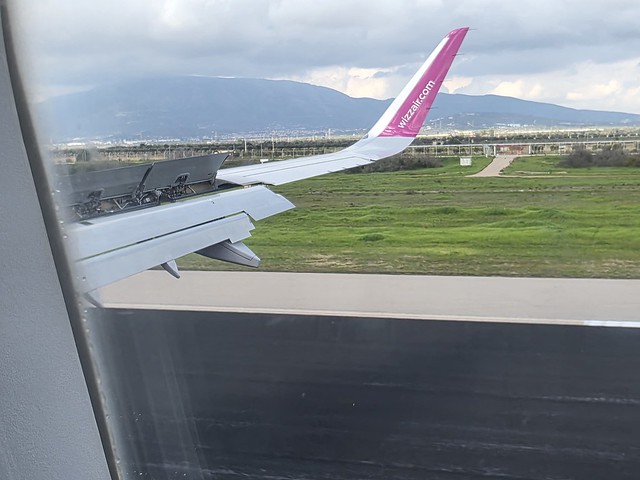
    And safely landing in Athens. I had been randomly assigned a window seat and there was also no-one next to me, so it felt as if there was plenty of room and the aircraft was likely only 70% full. The crew were friendly and polite throughout, with the entire flight feeling calm. I bought the ticket as part of the Wizz Air All You Can Fly subscription service, so it came in at just under £9. The flight arrived 11 minutes early and as this was a Schengen to Schengen flight I didn’t have much of a wait at the airport. That meant I was safely in Athens, with Richard arriving the following day on his executive aircraft. Once again, I was suitably impressed by Wizz Air, their pricing and general efficiency.

  • Athens – National Archaeological Museum (Folding Mirrors)

    Two more items from the National Archaeological Museum in Athens and I wouldn’t have actually guessed what these were if it wasn’t for the descriptions next to them.

    So, this item is a folding mirror, and it shows the female Goddess Nike, which represents victory, killing a bull. Not the most pleasant item perhaps, but it has some age, it dates to around 290BC to 300BC.

    And another folding mirror which was found in Demetrias, which is now in Greece, and shows a female with an earring. It dates back to the third century BC and was likely owned by a wealthy individual.

  • Athens – National Archaeological Museum (Doves)

    I thought initially that these were pigeons, which struck me as a strange thing to make a figurine of. They’ve actually doves, not that there’s much difference between them and pigeons, and they were found in the sanctuary of Aphrodite at Daphni and they date to the fourth century BC.

    As another of my little asides, near to where these were found, and also in Daphni, is a monastery on the outskirts of Athens which was built on the former site of the sanctuary of Apollo. Some of the remains were taken by Lord Elgin and sold to the British Museum where they are still located today. However, the British Museum doesn’t display them, so it’s questionable to me why they’re holding them, surely a provincial museum somewhere would be better to have them where they could be seen. Having said that, the British Museum apparently don’t display 99% of their items, so this isn’t an unusual situation and perhaps it really is the case that no museum wants them on a long-term loan.

  • Athens – National Archaeological Museum (Hippo)

    I might well be posting photos of random artefacts from the National Archaeological Museum in Athens for many more days yet, there was much to see.

    Anyway, this is a hippo dating back to 3,000BC, made from granite and found in a temple at Abydos in Egypt. It’s apparently a particularly rare find given the large size of the hippo. I imagine that creating this would have taken many hours of chipping away at granite, but it still seems to be in reasonable condition even given its great age.

  • Athens – National Archaeological Museum (Jockey of Artemision)

    This large sculpture, located in the National Archaeological Museum, of a horse and young jockey is made from bronze and dates to around 140BC. Strangely, the statue likely only survived as it was on board a ship that went aground off Cape Artemision in Greece, otherwise it might have been melted down. It’s not known who the creator was, but it’s thought it might have been dedicated to the Gods as thanks for the horse winning a race.

    Known as the Jockey of Artemision, the sculpture is carefully crafted and has plenty of detail, particularly on the faces of the jockey. The sculpture wasn’t found in one piece and was instead brought up from the sea floor over a period of 11 years. Only in 1972, nearly fifty years after the sculpture was initially discovered, were the pieces all put back together again.

  • Athens – National Archaeological Museum (Egyptian Funerary Stela)

    Located in the National Archaeological Museum, this is the funerary stela (or tablet) of Amenemhet.

    And this one, which is more colourful than the photo suggests, is a funerary stela with a representation of Khenit and her son, Kai.

    Neither of these are dated, but both are likely from the Middle Kingdom, so at some point between 1975 BC and 1640 BC.

  • Athens – National Archaeological Museum (Egyptian Funerary Model)

    Located in the National Archaeological Museum, this is a wooden funerary model of a ship and its crew. It dates to somewhere between 2040BC and 1640BC and was a grave good to help ensure that the soul was able to travel on a pilgrimage to the city of Abydos.

  • Athens – Airport Museum

    This museum within Athens airport was a useful distraction whilst trying to kill time and it’s open for nearly all of the day, is unstaffed and is free of charge to enter.

    It’s a well-laid out museum and it contains items found when the airport was being constructed. There’s also some background provided about the local area and how it has developed over the centuries.

    A bread stamp, used to imprint designs into bread, from the mid-Byzantine period.

    A sphinx from Spata.

    Dating from the early Byzantine period, this is part of a beehive. However, it was later repurposed to be used as a cover for a child’s grave.

    This marble decorative piece would have been used at a grave and it dates from around the end of the fifth century BC.

    A small marble gravestone marker, dating to the Roman period.

    Intriguing, this is a landmark from a mortgaged field which gives the name of its owner and also its value. It dates to the fourth century BC.

    I know that a few airports in the United States have small museums such as this, and a few others around the world, but it’s a shame that more don’t have something similar. British Airways have a wonderful museum at Waterside, which is only semi-open to the general public, but I’m not sure that there’s anything at nearby Heathrow Airport.