Category: Leipzig

  • Leipzig – Stadtgeschichtliches Museum (Be a Good German)

    Leipzig – Stadtgeschichtliches Museum (Be a Good German)

    20250725_113715

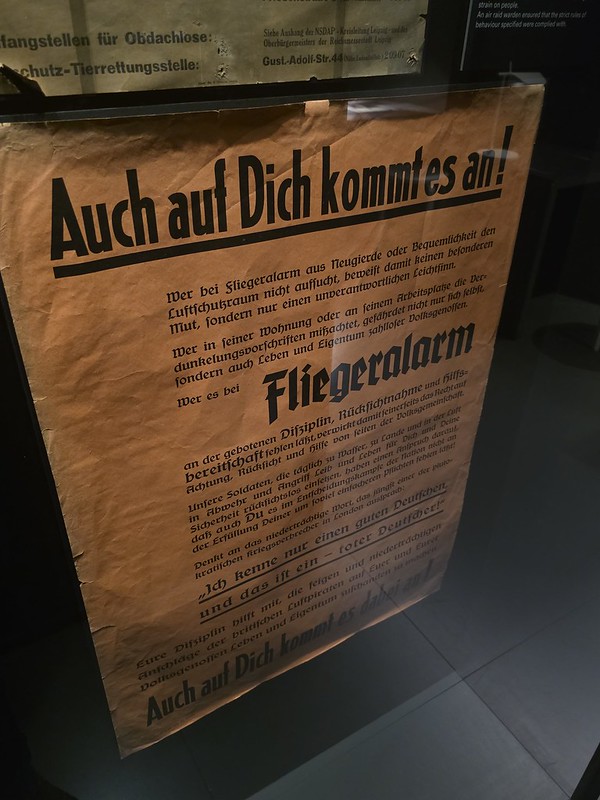
    This war poster uses a combination of guilt and nationalism to get citizens to go to the air raid shelter. It translates something like:

    “It depends on you too!

    Anyone who, out of curiosity or laziness, fails to go to the air raid shelter during an air raid alarm shows not courage, but reckless irresponsibility.

    Anyone who disregards blackout regulations at home or at work endangers their fellow citizens and puts lives and property at risk.

    Anyone who, during an Air Raid Alarm, lacks the required discipline, consideration, and willingness to help, shows that the fate of others means nothing to them.

    Everyone must follow the command of the hour: maintain calm and order! Only in this way can the valuable assets of the German people be protected.

    Every act of negligence endangers the community!

    I know only one good German, and that is a disciplined German!

    Every violation of air raid regulations is a betrayal of the community.

    It depends on you too!”

    The large black text at the top bellows “Auch auf Dich kommt es an!”, which translates to “It depends on you too!” which is a phrase that sounds almost encouraging until you realise it’s really saying “If something goes wrong, we’ll be blaming you.” The message beneath is something of a masterclass in guilt-laden discipline as if you don’t go to the air raid shelter, it’s not bravery but some sort of sub-optimal “irresponsible recklessness”. Forgetting to close your blackout curtains? That’s not carelessness, it’s practically sabotage. In the world of wartime Leipzig, leaving a lamp on made you not just a bad neighbour but a potential traitor to the Nazi regime.

    I’m not suggesting that British posters were always cuddly and friendly on this matter, but this one (Image: Imperial War Museum Art.IWM PST 13891) seems typical of a rather softer style than the German shouty style.
  • Leipzig – Stadtgeschichtliches Museum (Hedwig Burgheim)

    Leipzig – Stadtgeschichtliches Museum (Hedwig Burgheim)

    20250725_113447

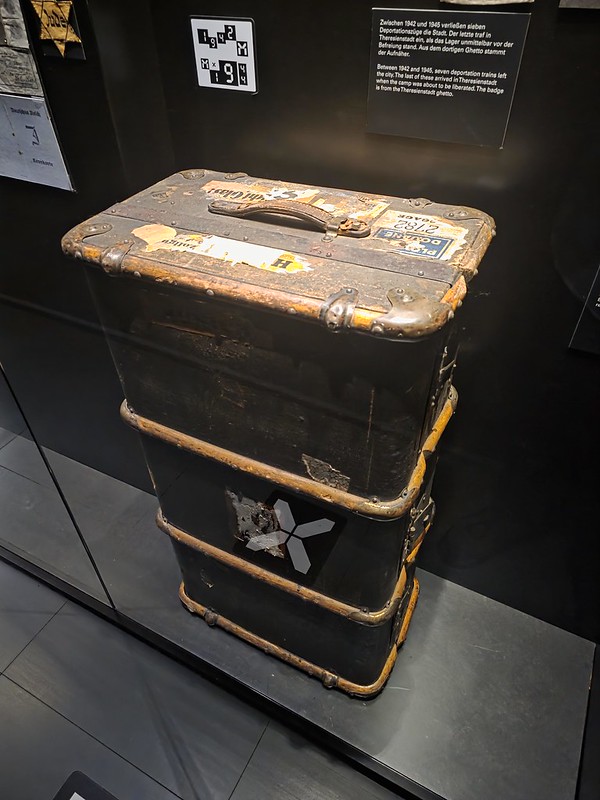
    This exhibit relates to Hedwig Burgheim, an educationalist who, in the 1930s, founded a Jewish school in Leipzig focusing on home economics and training kindergarten teachers. Her work was likely as an act of hope and purpose in a time when the future for Germany’s Jewish population was rapidly being stripped away by the Nazis. There’s a lot more information about her on the German Wikipedia page, but one tragedy is that her attempts to move to the United States were thwarted.

    By 1943, Hedwig was forced to move into one of Leipzig’s so-called “Judenhäuser”, the designated houses where Jewish families were crowded together before deportation. Aware of the horrors that were coming, she entrusted a suitcase which was filled with her personal belongings to a family she had befriended, a small act of faith that some part of her life might survive this horrendous war.

    She was deported to Auschwitz and murdered on 27 February 1943. Her nephew Ralf Kralowitz returned to Leipzig from Buchenwald concentration camp, but it was returned to him empty. The contents had vanished, the museum doesn’t note whether they were likely stolen, lost or simply scattered.

    The Nazis took away everything that Hedwig had built, whether that be her school, the Jewish community she was a part of, her possessions and ultimately her life. It’s a powerful exhibit sitting here in the museum and at least this exists to tell her story. Her memory certainly hasn’t been forgotten, there are numerous memorials to her and there’s also the Hedwig-Burgheim-Straße road in the city which has been named after her.

  • Leipzig – Stadtgeschichtliches Museum (Theresienstadt Ghetto Badge)

    Leipzig – Stadtgeschichtliches Museum (Theresienstadt Ghetto Badge)

    20250725_113514

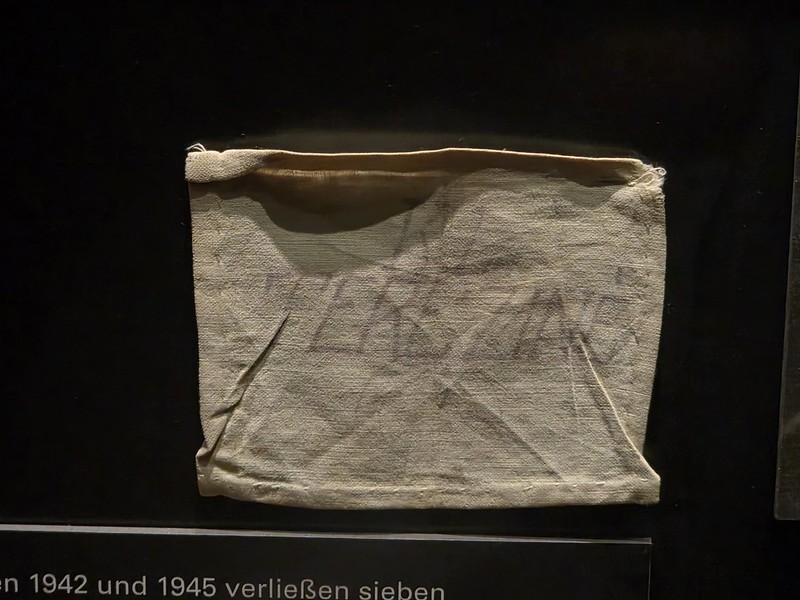
    Back to Leipzig and this is a badge from the Theresienstadt Ghetto (a town in the Czech Republic, now known as Terezín), where I went a couple of years ago but that’s something else I’ve just realised that I haven’t written up.

    Between 1942 and 1945, seven deportation trains departed from Leipzig, carrying hundreds of Jewish residents who had been stripped of their rights, property and dignity. The final transport, which left in early 1945, reached Theresienstadt just weeks before the camp was liberated by Soviet forces in May.

    Not much more is known about this little piece of cloth, but the fragment remaining deserves at least some attention for what it now commemorates.

  • Leipzig – Stadtgeschichtliches Museum (Paintings of Catharina Margarethe and Amy Dumont)

    Leipzig – Stadtgeschichtliches Museum (Paintings of Catharina Margarethe and Amy Dumont)

    20250725_105446

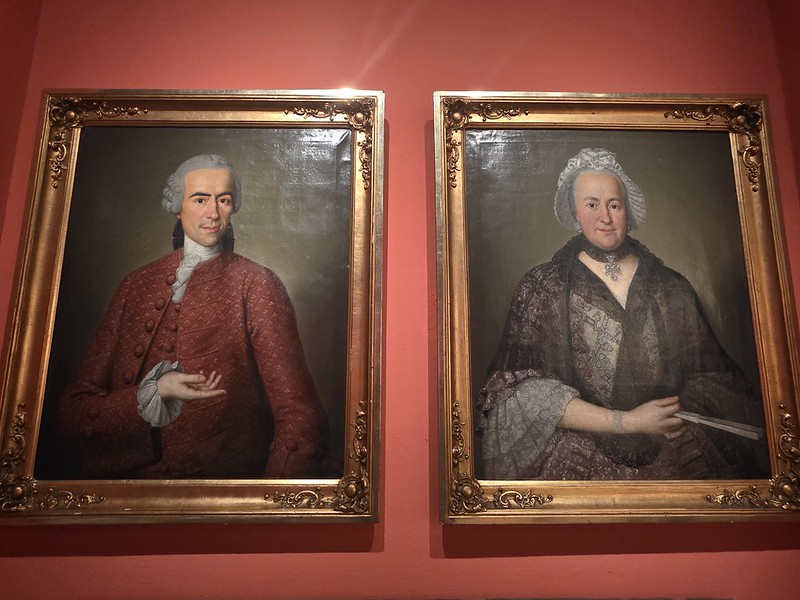
    These two splendid individuals are Any Dumont and Catharina Margarethe, painted by Samuel Beck (1715-1778) in 1767. Amy Dumont, on the left, was a banker and iron wholesaler who evidently did well for himself financially. His ancestor Philippe Dumont was a founding member of Leipzig’s Reformed congregation in 1700, the family having settled in Leipzig as Huguenot refugees where they had been made welcome by the Germans who rather appreciated their skills. Catharina Margarethe, on the right, appears to be holding either a fan or an aggressively bound opera programme, either of which I could have done with in the city as it was far too hot. Her outfit is all muted finery and cautious lace, the clothing which must have been a nightmare to paint.

    The paintings were donated to the museum in 2017 by members of the family who later became to be important figures in Leipzig in the nineteenth century, the couple’s daughters having married into the Melly and Thieriot families. The element that intrigued me the most here is just how welcome the Huguenot families were made, they were given special privileges because of their skills which were thought to bring an economic boost to the region. The same happened in Norwich, where large numbers came, with the city again offering a friendly welcome. I think it’s fair to say that migrants aren’t always treated with such reverence….

  • Leipzig – Stadtgeschichtliches Museum (Transporting Books in Barrels)

    Leipzig – Stadtgeschichtliches Museum (Transporting Books in Barrels)

    20250725_105653

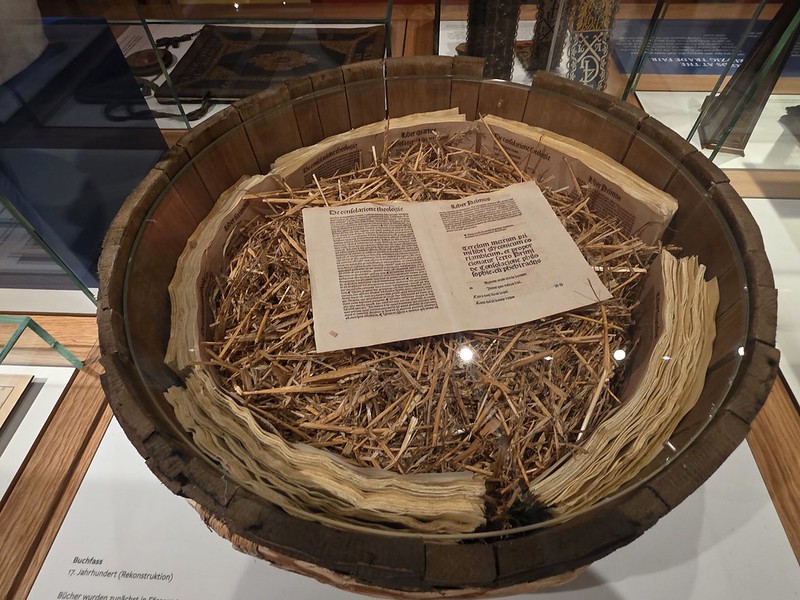
    I’ve never really given much thought to this, but apparently this was once the way that books were transported about the place before thousands of Amazon Prime vans scuttled around the country. The printed sheets would be placed in barrels which would be filled with dry straw to prevent moisture getting in. Then, the lucky book buyer could get the book bound themselves in the style which they liked. The museum notes that the city was the main centre of German book trading in the eighteenth century, surpassing even Frankfurt. I can only imagine the competitive fury that must have ignited between the printers, each trying to out-barrel the other.

  • Leipzig – Stadtgeschichtliches Museum (Swearing Oath on a Bible)

    Leipzig – Stadtgeschichtliches Museum (Swearing Oath on a Bible)

    20250725_102549

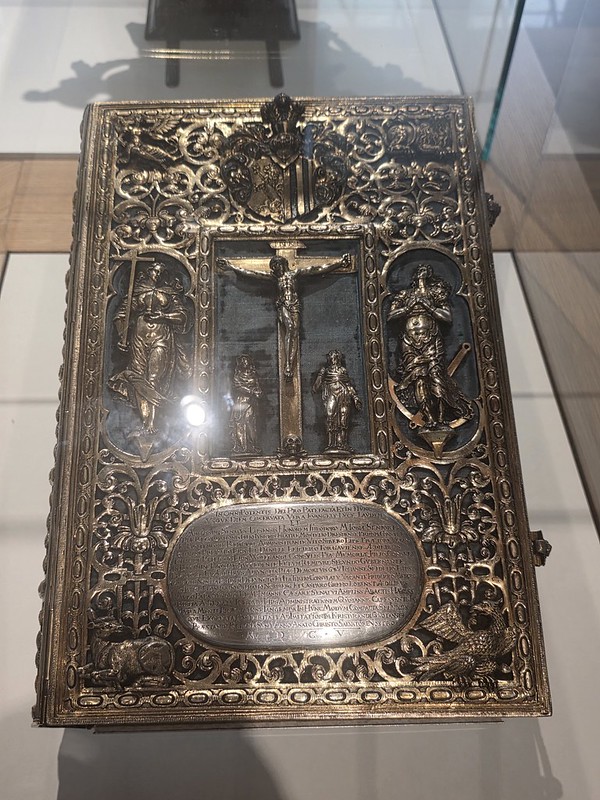
    This Bible was printed in Leipzig in 1605 and there’s some impressive gold-working (or whatever the technical term is) undertaken here by the city’s goldsmiths. But, impressive as the Bible might be, the element that surprised and delighted me the most was knowing that generations of council members swore their solemn oath of office on this book, pledging to help everyone in the city regardless of whether they were rich or poor.

    There is another Bible, published in 1597, that is near identical and was by Leipzig’s two most important goldsmiths, Hans Reinhart the Younger and Elias Geyer, and an early city chronicler, Johann Jacob Vogel (1660-1729), mentioned that they were made in quick succession, one for the judges and one for the council members. Both Bibles are hugely important as previously the council members had sworn on Catholic relics, meaning that it took them half a century for them to swear on a Lutheran Bible, making this something of a public declaration of Protestantism.

  • Leipzig – Stadtgeschichtliches Museum (1571 Book – Trostbüchlein)

    Leipzig – Stadtgeschichtliches Museum (1571 Book – Trostbüchlein)

    20250725_102342

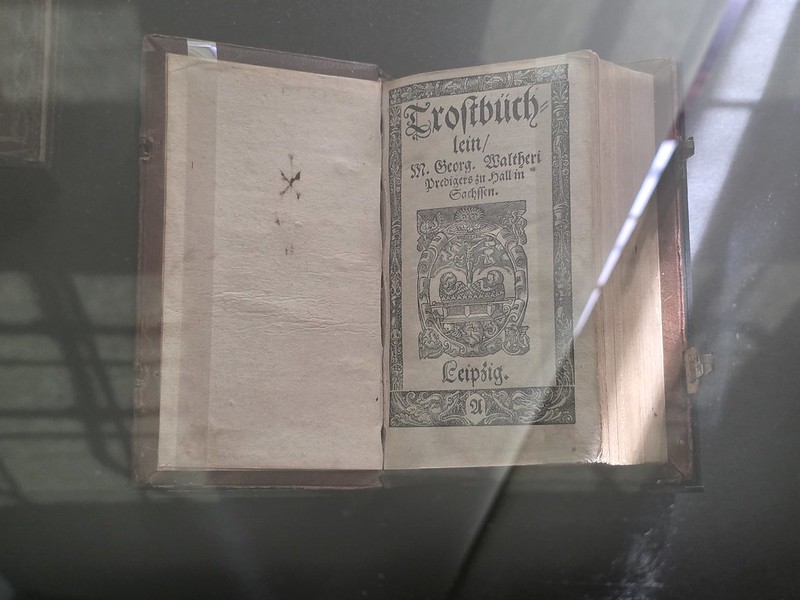
    I love an old book and this is the Trostbüchlein, loosely translated as the Little Book of Comfort, that was published in Leipzig in 1571. There’s a relevance to religious books of this period to the city, as Leipzig was a centre of printing and it’s also where Martin Luther’s controversial views had been debated in 1519. The author is listed as Georg Walther, a Lutheran pastor from Halle, which suggests the content was likely a soothing blend of theological musings and gentle chastisement.  I was probably a little over-excited to visit St. Thomas Church in the city (but more on that in another post), which is where Martin Luther preached and I wonder whether the congregation realised just how large the Protestant and Catholic schism would become.

  • Wizz Air (Tirana to Leipzig)

    Wizz Air (Tirana to Leipzig)

    20250724_094439

    To avoid any card based dramas on the bus journey back to the airport, I prepaid for my ticket online and I was transported smoothly to the rather decadent frontage of the building.

    20250724_113531

    I did have a relaxing lounge visit at this point, but to surprise and delight my two loyal blog readers, I’ll post about that separately as it’s sensible to ration excitement.

    20250724_113532

    It’s a large, clean and organised terminal. The security process took under three minutes and the border control was once again automated, as I didn’t need stamps, so I was through to airside within five minutes. All very efficient.

    20250724_114114

    There were a lot of size checks on bags at the airport and some people got caught out. I’m afraid I’m on the side of Wizz Air here, they’re not stopping marginal bags, but they are stopping bags which are nowhere near the size limit. They must have taken around £250 or so in extra charges which is no doubt annoying for the passenger, but they probably need to try and at least be near to the official limit to have some sort of chance of getting away with it.

    20250724_120820

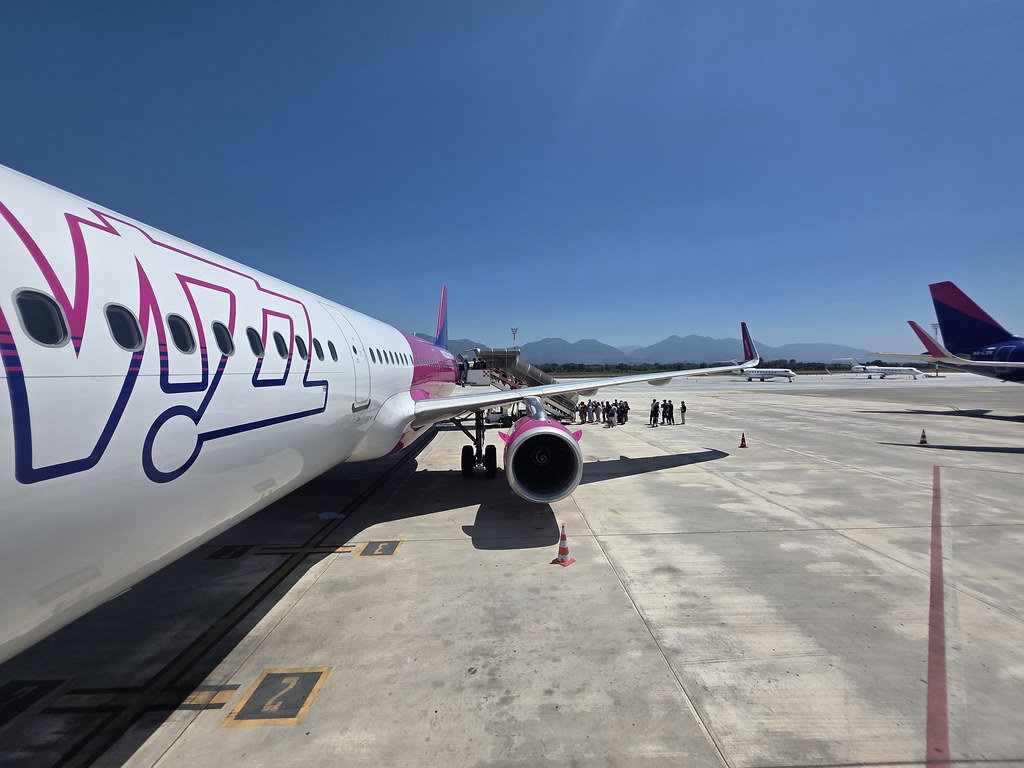
    The aircraft registration was HA-LXB, not one that I’ve been on before. There were three buses to the aircraft and the doors of all three opened immediately, creating something of a huddle from those who felt the need to rush aboard. I just stay out of it and let the chaos play out.

    20250724_121121

    Goodbye to the hills of Albania…. The journey was uneventful, the crew were once again friendly and efficient, although I couldn’t hear the announcements from the pilot. The seating Gods had given me a middle seat, but it was a relatively short flight and I kept myself amused watching YouTube videos.

    20250724_151958

    And safely in Leipzig, fully ready for me to complain about Deutsche Bahn.