Blog

  • Frettenham – Saint Swithin’s Church

    Frettenham – Saint Swithin’s Church

    20250608_134106

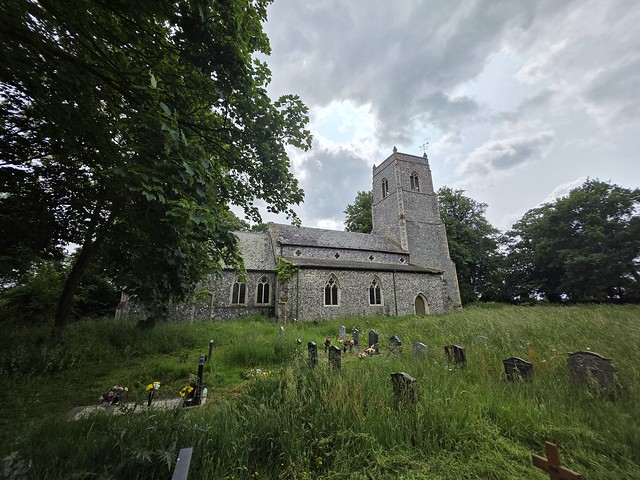
    This was the first of the weekend’s churches that Richard and I visited, Saint Swithin’s Church in the North Norfolk village of Frettenham. This is another village that I’ve been near on tens of occasions, but I can’t say that I’ve ever heard of it. This either means that I have a poor memory or the history of Norfolk has so many more pages for me to turn.

    20250608_133550

    The current structure dates primarily to the fourteenth century, with fifteenth and sixteenth additions and then some Victorian rebuildings. There was though a church here before this, likely early Norman although this is an Anglo-Saxon settlement and so there might have been something from then. In 1906, the Bishop of Norwich to dedicate the new pulpit, but there had been a fair amount of other work doing including the reroofing and releading of the south aisle and the plastering of the walls, all under the supervision of the architect HJ Green. There was another fund started shortly afterwards to pay for repairs that were needed on the tower.

    20250608_133158

    The porch, although the church was unfortunately locked.

    20250608_133241

    There was a scratch dial visible on the porch.

    20250608_133936

    The tower, likely from around 1460, which looks like quite an expensive structure from when the village was perhaps a little more prosperous.

    20250608_133438

    An old door from the chancel and I mentioned at the time to Richard that this part of the church looked like it had been hacked about by the Victorians. That was true, since it has transpired that they entirely rebuilt it in 1869, a project undertaken by the Rector in memory of his deceased wife. It was at this time that they discovered some Roman activity on the site, although this wasn’t religious in nature, it was in the form of evidence of a Roman road under the aisle.

    20250608_133401

    Stained glass from the end of the chancel and it looks particularly impressive. It is also recent, having been created by Paul Greener who was a 24 year old working on a project in the 1980s. It was around this time that they discovered that the medieval tiling from around 1400 on the floor was still present.

    20250608_134017

    The war memorial which was unveiled in 1921 to commemorate the lives of the ten villagers who had died, with three more names added after the Second World War. The Imperial War Museum lists them as:

    Bloom, P
    Buck, C
    Buck, T
    Cannell, Cecil George
    Cousins, A
    Foster, W
    Garrett, R
    Money, L
    Muskett, C
    Norgate, W
    Revett, A
    Stoliday, F
    Wymer, Sydney George

    20250608_133904

    They’re gone for what they refer to a wildlife graveyard. This is ridiculous though as far as I’m concerned, there are people engaged and interested in the gravestones here who are entirely unable to see anything. There was a military gravestone that I wanted to look at, but that obviously wasn’t happening.

    20250608_133313

    One tomb is visible in the foliage. But they likely had money, so their gravestone is allowed to be seen.

    20250608_133102

    I’m not sure this is going to do much good for the gravestones and this is in an area which has plenty of space for wildlife, so I’m not entirely sure I understand the logic here. This is a relatively remote building, but there was little to engage us here, they’d locked the church, given no history about it and made the churchyard impenetrable. It risks looking like a church for the few (if any), not the many and it’s no great surprise that the Church of England has reported that they have been unable to get enough people together to hold services since Covid, but to be fair to them, this is a church that is a little distant geographically from the village that it once served. It’s also an active benefice, this must be one of their more challenging churches. There seems to be a fair amount of interest inside, so hopefully I’ll get to visit the interior in the future.
  • Warsaw – Thai Me Up

    Warsaw – Thai Me Up

    20250611_204935

    It’s an interesting name for a Thai restaurant, but I needed somewhere suitably exotic to celebrate the end of this wave of dental treatment and I also hadn’t been here before so that seemed reason enough to visit.

    20250611_194446

    The food menu and for those from the UK, divide by five to get the equivalent amount in pounds.

    20250611_194451

    The drinks menu which seemed suitably broad in size.

    20250611_194948

    I was greeted promptly at the door and offered a choice of seats, but I liked the window seat as it meant I had a view over the restaurant and also the kitchen. I could see from my viewpoint that everything was being cooked fresh in the kitchen, it certainly seemed authentic with the woks being flung about excitedly and flames coming from pans. The aroma of the restaurant was also enticing, the open kitchen meant that the Thai flavours lingered across the interior.

    20250611_195746

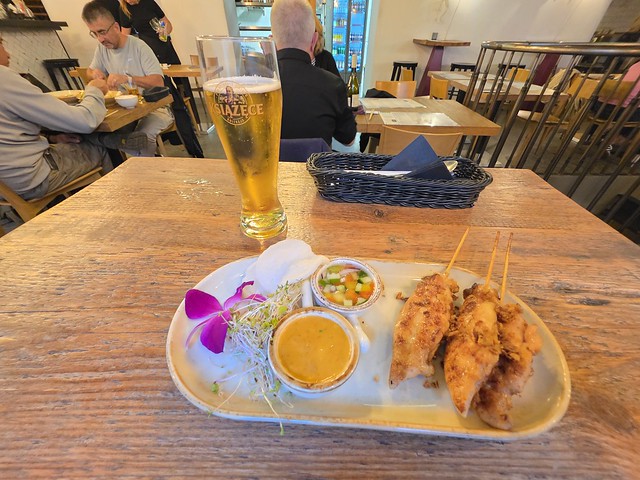
    The starter was the chicken satay and this is the best presented version of that meal that I’ve ever seen. The chicken was tender and generous in portion size, with what I think is called Achar which is a diced fruit and vegetable arrangement, alongside prawn crackers, the satay sauce, along with what might be mung bean sprouts but I’m unsure. I haven’t been to Thailand, but I will work out a trip there at some point.

    They had some Polish beers, but adding to the Thai authenticity I went for a Singha beer. It’s a pale lager, but it seemed light and appropriate for the meal, although I suppose in that sense it’s both exotic and banal. It came in a bottle, but the team member poured it into the glass and took the bottle, which doesn’t help for Untappd photos if I’m being honest but I was there for the food rather than my Untappd feed.

    20250611_200806

    The main was the chicken green curry with rice, which was mentioned to be spicy hot. It was hot in terms of the spice, although not overly so, but was certainly piping hot in the temperature sense. The chicken was tender, the curry was rich in flavour and it had all those vegetable things that I think are meant to be good for you. The jasmine rice was light, although in an ideal world I would have rather have had a bit more of that because of how large the green curry sauce portion was.

    The atmosphere in the restaurant was laid-back and informal with an authentic feel only diminished slightly by the customer with a loud Glaswegian accent. It does get rather confusing at times, planning a trip to another country whilst being Poland, eating a Thai cuisine and listening to customers speaking in English (well, Glaswegian, but they have similar roots). They had a side room and downstairs area, so they could cope with very large numbers here, but it was still moderately busy for a Wednesday evening.

    The pricing was reasonable, especially for an on-trend city centre restaurant in the capital, with the service being polite and attentive. The food and drink all met or exceeded my expectations in terms of the taste, temperature and presentation, with the portion size being larger than I had expected. At the end of the meal, it wasn’t quite as easy as I would have liked to get the bill, but I wasn’t in a rush and I could have forced the issue if I had wanted with my passive aggressive look. And it just gave more time for people watching, so I remained happy and would merrily recommend this restaurant to others.

  • Wizz Air (London Luton to Warsaw Chopin)

    Wizz Air (London Luton to Warsaw Chopin)

    20250609_121021

    And a flight to Warsaw for my last week of dental work and I’ve been very brave by all accounts. For completeness, I thought I’d include the photos of the lounge visits from my Priority Pass card before the flight, as I’m like that….. I received a notification that the aircraft was running around thirty minutes late, which allowed a little extra time for these visits. This is Big Smoke and the chicken tenders and Electric Eye beer which was hazy, hoppy and a bit tropical.

    20250609_133735

    The Calamari and pineapple juice at Nolito, primarily as they’d run out of orange juice.

    20250609_135429

    And the My Lounge, which was full when I first went but I joined the on-line queue and headed to Nolito instead. Thirty minutes later I received a message saying that I could check-in. The cutlery here was filthy as usual, but everything else felt clean and organised. The staff were friendly and the beer, Birra Moretti, was generic and dull.

    Anyway, I digress.

    20250609_150947

    This is the first Wizz Air flight that I can remember where the boarding process was unclear. The priority (not me) and non-priority (me) queues weren’t very clear and a staff member came down after some time to try and resolve the confusion. The gates are poorly marked here rather than it being a Wizz Air issue, but fortunately I arrived early enough to work the whole arrangement out, but I noticed some stressed customers after me.

    20250609_150952

    There we go, confirmation that I was in the right queue…..

    20250609_153657

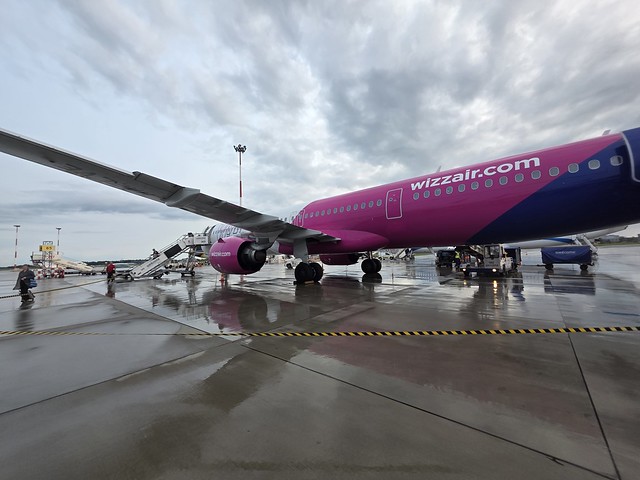
    It felt a longer wait than usual to board the aircraft, but nothing unreasonable, and all of the staff seemed helpful if not one that seemed a little frazzled by customers. The aircraft was HA-LVE, which I don’t think that I’ve been on before, an Airbus A321 which has been in the Wizz Air fleet since July 2019.

    20250609_153712

    The seating Gods had given me an aisle seat towards the rear of the aircraft, which I felt was very agreeable. Two other customers had been barging past other customers and I just let them past me, they seemed to have an issue with personal space and numerous other customers just let them go by. It transpired that they were sitting next to me on the aircraft, so it was efficient that they had gone ahead of me given that I had the aisle seat. The flight was without issue once again, with the pilot making regular announcements. I think I was asleep for most of the flight, I get easily tired now that I’m 30.

    20250609_194107

    And safely into a rainy Warsaw around an hour after the original expected arrival time. As the flight had cost me under £9 with Multi Pass, I was happy with the whole arrangement. The border control was efficient and more personable than I’ve experienced recently, some others ahead me in the queue were being asked the purpose of their visit, but I just got “welcome back to Poland” so perhaps they’ve got fed up with asking.

  • Derby Museum and Art Gallery – Hanson Log Boat

    Derby Museum and Art Gallery – Hanson Log Boat

    20250606_122723

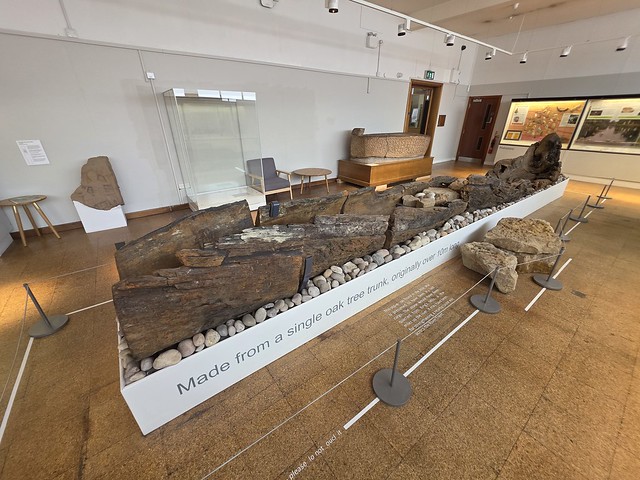
    This is what has become known as the Hanson Log Boat, a Bronze Age long boat which was found at the Hanson gravel pit in Shardlow, near to Derby. It was discovered during an archaeological watching brief and they had the problem of transporting it so that it could be preserved. Given the huge weight due mostly to it being waterlogged, they came up with the idea of sawing it into smaller bits, which doesn’t feel entirely optimal but I’m not an archaeologist. They found another log boat at the site a few years later but didn’t want to move another one, so they left it for future generations to resolve the logistical arrangements.

    20250606_122731

    As the signage suggests, it’s around 3,400 years old. It’s made out of one large oak tree which would have originally been over ten metres in height.

    20250606_122708

    This is the boat’s final cargo, a heap of rock. More precisely, it was Bromsgrove sandstone which was likely being used to strengthen a causeway across the River Trent. Having this cargo still intact does add somewhat to the general intrigue about this boat.

  • Food from Every Stall on Norwich Market (2025 Edition) – Week 16 and Italian Street Food

    Food from Every Stall on Norwich Market (2025 Edition) – Week 16 and Italian Street Food

    20250528_131428

    This week’s episode of eating at every food stall at Norwich Market was Italian Street Food, which I rather enjoyed when we last did this in 2023. We battled to the market, fending off everyone who wanted to talk to James which is reaching a ridiculous level now, excited by the thought of something substantial. I think that it’s one of the more filling of the options that are available from the market stalls, although it’s the one that could perhaps do with its own seating area.

    20250528_131304

    The menu and there have been relatively small price increases over the last two years, each pizza is now around 50p more expensive. I noted a couple of years ago that it was a busy stall and that was the case again, with numerous delivery orders being sent out as well. I was tempted by the calzones (or whatever the plural of calzone is), maybe next time.

    20250528_132036

    The food ordering area and I did get slightly confused where we were supposed to order, but the team member had noticed that and helpfully called over. This is also where the burgers are put together, something else that I really should try in the future. I accept that James and I haven’t been great this year at varying our orders from when we did it before.

    20250528_131444

    The pizza oven and the food collection area. There was a wait of around ten minutes for the pizza, but that felt reasonable given it was relatively busy when we were there. The aroma from the pizza felt rather Italian and it was certainly hot enough given that it had just come from the oven.

    20250528_132818

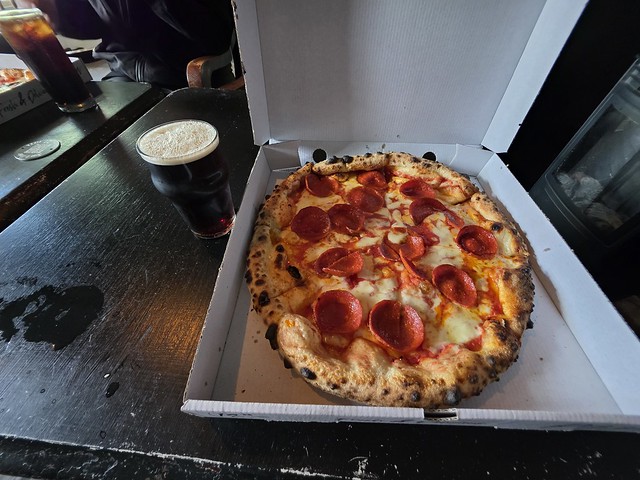
    My pepperoni pizza and note that we have moved to the Garnet pub to eat these as I didn’t want any seagull based incidents with an entire pizza. I mentioned to James that I thought that the cheese was just very slightly rubbery and a change from when we last visited, but it’s transpired I noted that last time, so it must just be the cheese mix that they’re happiest with. The pepperoni was decent, although I’ve had ones which are more punchy in flavour, but I liked the leopard spotting on the pizza edges. James mentioned that he thought that there should have been black pepper provided, but it’s transpired he said that last time. We are nothing if not predictable….

    IMG-20250528-WA0008

    James went for a margarita pizza as he is on a diet, here’s his artistic looking photo. He liked it, although he didn’t think that the dough was as good as the pizzas that he makes at home. I must admit, he is quite decent at making pizzas, they’re certainly as good as those from Dr Oetker.

    Overall, I was sufficiently surprised and delighted at this, because the prices felt reasonable for the quality and the service was friendly. I’m not going to say that it’s the best pizza that I’ve ever had, but for a lunchtime treat at less than £10, I think it’s entirely agreeable and it’s a hearty option.

  • Derby Museum and Art Gallery – Memorial Plaque of Lieutenant Charles William North Garstin

    Derby Museum and Art Gallery – Memorial Plaque of Lieutenant Charles William North Garstin

    20250606_124630

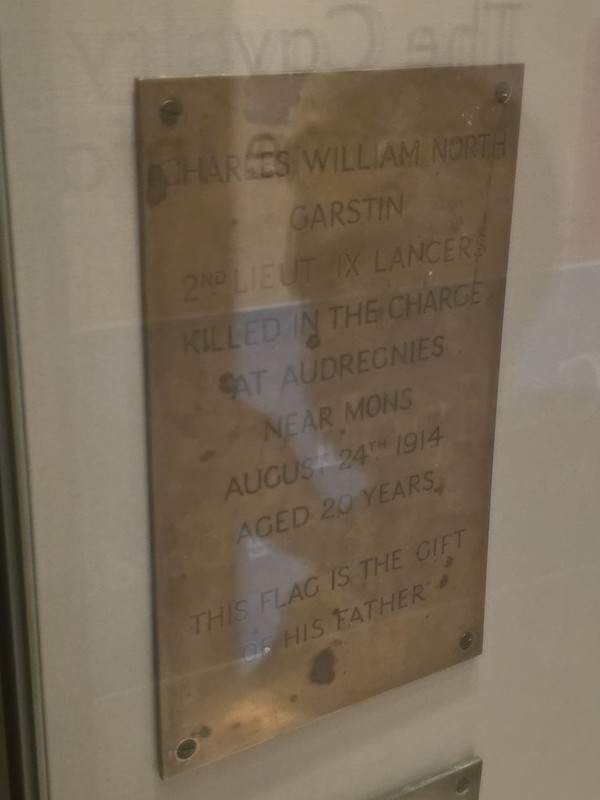
    This is the brass memorial plaque commemorating the life of Charles William North Garstin, 9th Lancers who died on 24 August 1914. The plaque was funded by his father, who had to deal with losing his little boy, and only son, who was aged just 20. There’s more about Charles at https://livesofthefirstworldwar.iwm.org.uk/lifestory/1313008, so I won’t repeat that, but instead I looked up his father, Sir William Garstin.

    Sir William Edmund Garstin, born on 29 January 1849, was a prominent British civil engineer whose work primarily related to public infrastructure in Egypt. He was educated at Cheltenham College and King’s College in London where he specialised in engineering. He started his career in 1872 with the Public Works Department of India, focusing on irrigation projects. In 1885, his expertise led him to Egypt, where he first served as Inspector-General of Irrigation before being promoted to Under Secretary of State for Public Works in 1892. In this role, he was instrumental in overhauling Egypt’s irrigation systems, playing a key part in the design and construction of the Aswan Low Dam which was built between 1898 and 1902. His work also extended to the barrages at Asyut and Esna. Furthermore, Garstin authored significant reports on the hydrography of the Upper Nile and initiated Egypt’s geological survey in 1896.

    After his retirement in 1907, Garstin continued to contribute by serving as a British Government director of the Suez Canal Company. He died on 8 January 1925, and was cremated in London. In recognition of his work, the extinct giant snake, Gigantophis garstini, was named in his honour, which I assume he would have been pleased with unless he really didn’t like snakes. I read numerous obituaries of William, but none of them mention the death of his son in the First World War, although some made reference to his Red Cross efforts. It rather means that I’m left to ponder the quiet, profound sorrow that must have underscored his later years after such a successful career.

  • Derby Museum and Art Gallery – Ukrainian Military Display

    Derby Museum and Art Gallery – Ukrainian Military Display

    20250606_125343

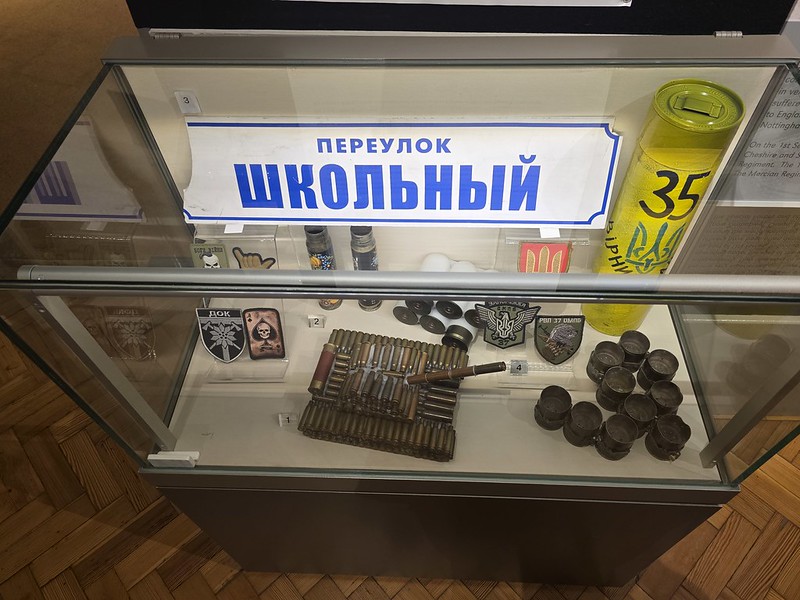
    The museum has a display in their military section about the invasion of Ukraine by Russia in 2022 and there’s a note on the display which mentions that “the items on display have been collected by a humanitarian voluntary aid group from England which supports Ukraine.”

    In the photo are:

    (i) A model tank made by Ukrainian service personnel from spent small arms

    (ii) Decorated spent artillery shells

    (iii) A traffic sign from Sudzha, a town in Russia, which Ukrainian forces seized in 15 August 2004, although the Russians took it back on 12 March 2025.

    (iv) Badges worn by Ukrainian armed forces.

    A rather interesting arrangement which is up-to-date and relevant, a reminder of the illegal occupation of the great country of Ukraine that I’m looking forward to being able to return to.

  • Derby Museum and Art Gallery – Fragment of Hog Back Tombstone

    Derby Museum and Art Gallery – Fragment of Hog Back Tombstone

    20250606_123325

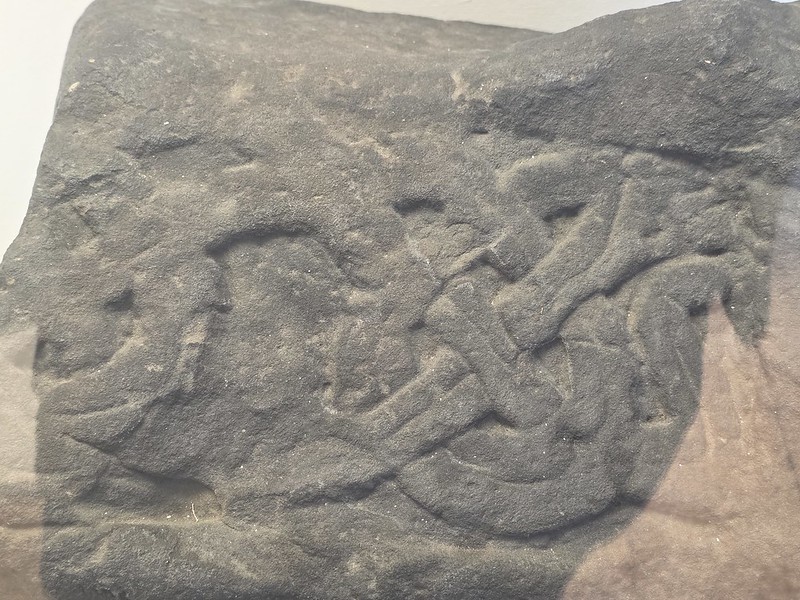
    This is the fragment of a Viking Hog Back tombstone which dates to around the tenth century. The information panel reads:

    “When complete this was in the shape of a house, with a bear-like beast gripping each end. This type of tomb was the fashion of Norwegian settlers in Yorkshire and Cumbria, but is unusual in the Midlands.”

    They’re quite intriguing things as although they were created by Vikings, they don’t appear in Scandinavia, so they’re Anglo-Scandinavian in origin. It’s made from the local Derbyshire gritstone and it seems quite tough.

    20250606_123331

    It was found at St. Alkmund’s Church in Derby in 1844 when they were building a new church. There had though been a religious building on the site since the ninth century, but some bloody idiot decided to pull the church down in the 1960s. Now, this meant that numerous other historic artefacts were discovered which is fascinating from a different viewpoint, but the demolition seems a little odd to me. I’ve followed the arguments that took place in the press in the 1960s and it appears that the sheer incompetence comes down to Geoffrey Allen, the Bishop of Derby. I say this because the congregation, parochial council members and local residents seemed bloody furious and the church had to respond saying that, yes, the Church of England had agreed the demolition at meetings that Allen was present at. They struggled to provide any defence of what Allen had been doing and I’m struggling to understand why they were so willing to lose a location that had been home to a church for over 1,000 years, even conceding that the steeple was falling down. Anyway, I digress here.

  • Derby Museum and Art Gallery – It’s Just a Brick

    Derby Museum and Art Gallery – It’s Just a Brick

    20250606_122628

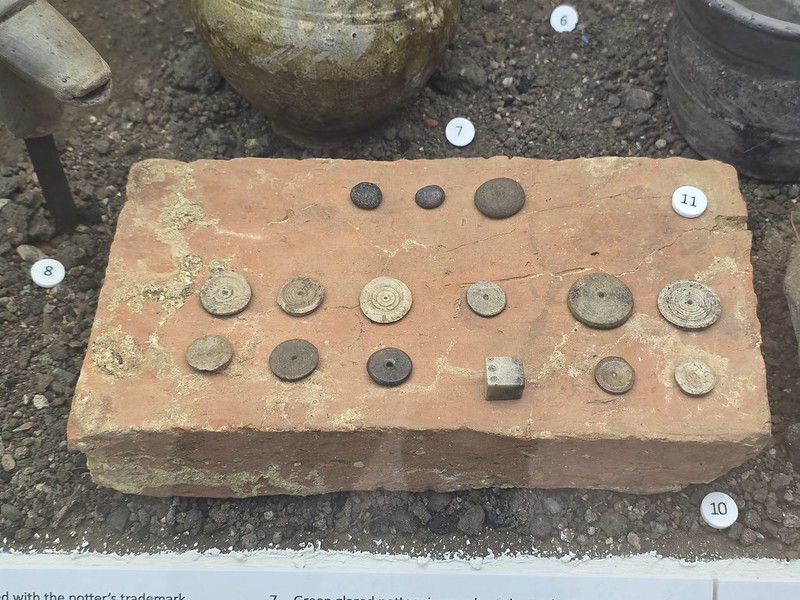
    I accept that this is just a brick and I really need to get out more, but this is not just a brick, it’s a Roman brick. Ignore the stuff placed on the brick, more on that later, but the Romans were the pioneers of mass production of bricks and they did it in some style. As for what the Romans did for the people of Derby, well, they built them a lovely fort in AD50 although they then decided to move their operations north and so they demolished it. However, by that point they had already built another fort at Little Chester and they didn’t demolish that one. Having noted all that, this brick is apparently from Tripontium which is about 40 miles away, but it’s a little bit of Romano-British culture. I find it intriguing to see bits of Roman brick when they appear in other buildings as the stuff seems to have lasted longer than great chunks of what they built in the 1970s. I won’t mention Anglia Square in Norwich….
  • Derby Museum and Art Gallery – Hippo in Derby

    Derby Museum and Art Gallery – Hippo in Derby

    20250606_123724

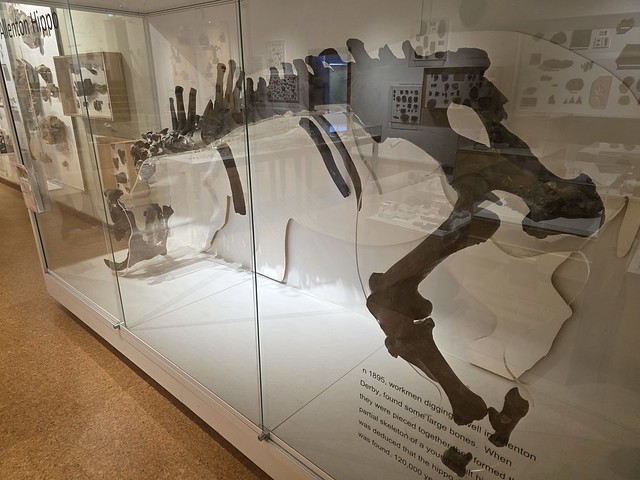
    I’ve never really given thought about whether hippos used to roam about Derby, but I’m not sure that I would have guessed that this was their hunting ground once. Workmen discovered these bones in Allerton in March 1895, now a suburb of Derby, when they were digging a new well at the Crown Inn. Private investors funded something of a dig and when this was completed the skeleton was given to the museum, where it remains proudly on display. 127 bones were discovered in the dig, although some of these were from another hippo and some from a passing elephant, and the hippo was thought to be around three metres in length.

    The discovery proved important as it showed that there must have been a land bridge at some point between Britain and mainland Europe as it was unlikely that a hippo would have swum several miles since they can’t actually swim at all. It was later reported that when the pub had been constructed in 1878 that other bones had been discovered, but the builders threw them away not realising what they’d found. To be fair, they probably weren’t really expecting to discover the ancient remains of a river beast, perhaps more hoping to find a lost coin or two. It’s not thought that there were any humans in Britain at this time, around 120,000 years ago, so they wouldn’t have had any little territorial disputes. The hippo that was found is the same species of the hippo that live in sub-Saharan Africa today. I left the museum rather pleased that I know the answer in case anyone asks me if there used to be hippos in Derby.