
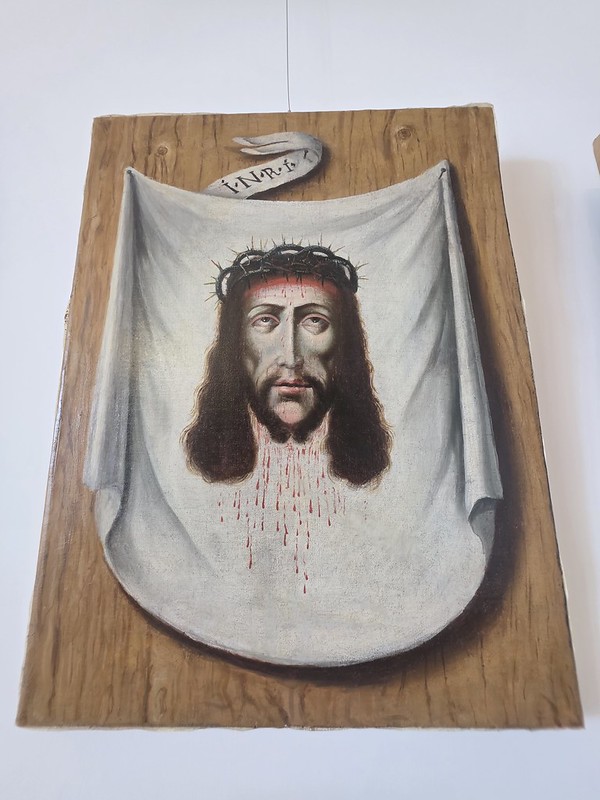

This rather striking bit of religious art is a depiction of the Veil of Veronica, an image that hovers somewhere between theology, relic culture and the sort of iconography that would have deeply unsettled 17th-century Protestants. And quite honestly, it’s a bit intense for me, it’s not something I’d want adorning the wall of my Norwich abode. The basic idea behind this depiction is rooted in a popular medieval legend, that as Christ carried the cross to Golgotha, a woman named Veronica stepped forward and compassionately wiped his face with her veil. In return, the image of his face was miraculously imprinted on the cloth.
The piece here is especially gory, there’s no romanticising the crown of thorns, and the blood flows freely in a way that can only be considered sub-optimal. Above Christ’s head is the abbreviation “I.N.R.I.” — Iesus Nazarenus, Rex Iudaeorum — which translates as “Jesus of Nazareth, King of the Jews.” This was the inscription placed above his head on the cross, and it’s become the go-to Latin tag for anyone wishing to subtly indicate their religious art credentials. The gallery doesn’t know who painted it, but states that it’s from the eighteenth century.
I suppose that art like this wasn’t created just to sit on a wall and collect polite admiration, it was meant to surprise and delight, or indeed in this case, shock. It’s something of a spiritual call to arms, but that’s why I rather liked this. I’m not sure whether a painting of a man dripping blood is ever going to be something that delights, but it certainly stood out in the gallery and I thought it looked quite modern when I first saw it.