Author: admin

  • Warsaw – Warsaw Ghetto (Leszno Street and Żelazna Street)

    Warsaw – Warsaw Ghetto (Leszno Street and Żelazna Street)

    20250419_112511

    I’ve tracked a lot of the Warsaw ghetto wall, but I can’t remember seeing this specific signage before and as the sign says, this is where the Leszno Street entrance to the ghetto was located. The Warsaw Ghetto was established by by the Nazis following German occupation and the area was formally sealed on 16 November 16 1940. There were initially 350,000 Jews walled into the ghetto, but that number soon increased to 460,000 as deportees from other areas arrived in the city.

    20250419_112509

    These maps are located in numerous places across the city, over-laying the location of the ghetto onto the current street plan. Leszno Street was one of the major pre-war streets enclosed within the initial ghetto boundaries established in November 1940. When the ghetto was effectively split into two sections (the “Small Ghetto” south of Chłodna Street and the “Large Ghetto” to the north) following boundary adjustments in late 1941 and early 1942, notably the exclusion of a section west of Żelazna Street between Leszno and Grzybowska Streets, Leszno Street remained a key east-west axis within the Large Ghetto.
    The incredible web-site at https://getto.pl/en gives a clear indication of what is happening here.

    20250419_112545

    What the area looks like today, with the line of the ghetto wall visible on the pavement of Żelazna Street.

    20250419_112527

    There’s the line of the former ghetto.

    20250419_112518

    The crossing today and, as ever, it’s very hard to try and envision what this area looked like in the early 1940s.

  • Warsaw – Potential Arson at the Wooden Bell Tower at the Cathedral of Our Lady of Victory

    Warsaw – Potential Arson at the Wooden Bell Tower at the Cathedral of Our Lady of Victory

    20250419_110209

    I frequently go on about the quality of life in Warsaw, the low crime, the low level of anti-social behaviour, the strong policing, the low litter and all manner of other positive attributes about the city. However, one of the historic buildings in Warsaw was lost a few days ago and arson has yet to be ruled out from the investigation.

    20250419_110306

    This bell tower is located next to the Cathedral of Our Lady of Victory and the wooden construction dated to around 1817. For reasons relating to German and Russian occupation, there’s not a huge amount that is old in Warsaw, so the loss of this is highly sub-optimal. It took fire fighters around two hours to put out and they have been able to save around 25% of the wooden structure and the bells in their steel frame also held up.

    20250419_110300

    The two bells, one of which dated to 1772, did quite well not to fall down and so it seems that they can be repaired and there is some excellent documentation of the structure from a few years ago. I don’t know the official titles, but the heritage people have already been on site to work out how to fix the situation. Knowing Poland, it’ll be fixed the next time that I go by and I rather hope that it transpires not to be arson.

    20250419_110310

    And a couple of graves located near to the bell tower.

  • Wizz Air (London Luton to Warsaw Chopin)

    Wizz Air (London Luton to Warsaw Chopin)

    20250417_141629

    I usually don’t write anything about the flights I take, but a change is as good as a rest and all that. I’m not sure that Luton Airport has really mastered the art of returning flights efficiently, but the security process is now quite efficient. I have to confess to pure idiocy during security when I managed to leave my belt on during the security scan. I blame the confusion on their policy of leaving liquids and laptops in the bag which throws my system. The member of security staff was though not deterred and, thankfully, my brief masterclass in how not to do security seemed to escape wider notice, preserving my fragile dignity in aviation matters.

    They announced the gate quite early, an hour before the flight, the delights of Gate 32 beckoned. Having endured the boarding methodologies back in my BA days, which often resembled a polite but ultimately confusing game of human Tetris, Wizz Air’s approach felt refreshingly straightforward. Every passenger knows, or should know, where to go from signage and they didn’t take long to board everyone. Admittedly, that leads to a lot of waiting on the stairs in the airport terminal to board, but at least it feels efficient although it’s less ideal for people who prefer to have a little sit down rather than balance themselves and their luggage on steps.

    20250417_143213

    The aircraft was ready and for the sake of completion, the registration is 9H-wNE, the same aircraft I went from Gdansk to London Luton on a few months ago. It’s hard not to make that sound quite geekish, but as a reminder, for my two loyal blog readers who can’t remember, it’s an Airbus A321 which was delivered to Wizz Air in March 2024. Feel free to use that aviation nugget of information at your next dinner party, instant social success guaranteed…..

    20250417_144703

    I’ve had a long series of good fortune from the seating Gods where I’ve been aisle or window seats, but that luck had run out for this flight when I was randomly given a middle seat. I always vaguely hope that one of the passengers doesn’t turn up, but they both did. Both were Polish, the one by the aisle fell asleep for most of the flight and the other managed to consume several Polish beers and then needed me to wake up the aisle guy from his hibernation for obvious reasons. I’m not sure that they entirely managed to follow my rule of letting the middle seat passenger have the arm rests, but since that’s a rule I’ve created it’s one that’s hard to enforce. Fortunately, this isn’t a long flight and two hours later we were landing into Warsaw.

    The crew on the flight were well presented, engaging and efficient, although that’s the normality for Wizz Air flights I’ve found. Announcements from the pilots were in Polish with a shorter English version following soon after and the safety briefing was completely in a way that the CAA would be pleased by.

    The delights of Warsaw always excite me, so I didn’t even mind that it was a bus that took us to border control. Most passengers on the flight were Polish or had EU passports, so the queue for my passport to be stamped was relatively short. The border agent was friendly and for this visit didn’t require a detailed explanation of my life before letting me into Poland. The flight is with my Multi Pass, which I’m still moderately obsessed with, so it cost just £8.99. Armrest battles aside, Wizz Air delivered the goods once again as far as I was concerned.

  • Warsaw – Reason Behind Hotel Bristol Name

    Warsaw – Reason Behind Hotel Bristol Name

    20250417_204633

    This is an aside, just because it loops back to a post I wrote a few days ago about Frederick Hervey, the 4th Earl of Bristol (1730–1803). This rather decadent hotel in Warsaw was constructed between 1899 and 1901 on the site of the former Tarnowski Palace, opening to the public on 19 November 1901. Unusually for central Warsaw, some of the structure remained standing after the Second World War as the Germans had been using it themselves, meaning that it could be re-opened relatively quickly at the end of the conflict. It was taken over by Orbis, who today are known for running all Accor hotels in Poland amongst numerous other things, with plans to demolish it in the 1970s fortunately disregarded. It’s now part of the Marriott chain, but I rather like the link to Ickworth House with the hotel name, which has remained unchanged since 1901.

  • Food from Every Stall on Norwich Market (2025 Edition) – Week 6 and Coral Bay

    Food from Every Stall on Norwich Market (2025 Edition) – Week 6 and Coral Bay

    20250416_132639

    Next up in our second round of visiting every food stall at Norwich Market took James and I to Coral Bay. Here’s when we visited in 2023 and we took advantage of the two meals offer, with both of us being suitably impressed by the quality of the food. This time the service was once again friendly and efficient, with the stall taking cards and cash. Ainsley Harriott has visited this stall and been surprised and delighted by the quality of the food, fine praise indeed. There’s a vegetarian curry available, a vegan patty and the ackee and salt fish curry sounded delicious, I’ll likely try that if we do a third round of visiting every stall in a future year (although I think we’ve identified some other things to aim for first).

    20250416_131008

    The menu this time, with prices going up around £1.50 per dish and there’s also now the appearance of large meals to offer more selection. The Jamaican patties are still available and there are a variety of fillings, with this being the lower priced point selection. There is a small seating area at the stall, but it was quite quiet and we wanted to gossip about the food, so we went to the area near city hall whilst trying to avoid the ever increasing number of pigeons and seagulls.

    20250416_131127

    I had jerk chicken last time, so this time I went for curried chicken and that included salad and rice, with the Encona hot pepper sauce being free of charge. The portion size was generous and the quality of the food was high, with the slow cooked chicken being tender and having a richness of flavour. The hot sauce was very useful and mixed in well with the rice, with the salad adding some firmness of texture.

    IMG-20250416-WA0003

    This time, I trusted James to take a photo of his food so that my two loyal blog readers could get an indication of everything we ordered. Unfortunately, he forgot until he had nearly finished the food, but I obviously didn’t say anything… But, luckily, he has been able to recreate in almost snapshot imagery what he was served with. I asked James what he thought of the food and he said something like:

    “Upon perusal of the menu’s manifold offerings, my selection gravitated towards the establishment’s interpretation of brown stew chicken, a Caribbean culinary staple. The presentation, upon arrival, was characterised by a substantial apportionment of the principal gallinaceous component, veritably luxuriating in a deep, mahogany-hued sauce redolent with aromatic allusions. The chicken itself, subjected to what must have been a significantly protracted and punctilious simmering process, exhibited an extraordinary degree of tenderness; the flesh, utterly succulent, providing a most gratifying and unctuous mouthfeel indicative of superlative preparation techniques. The sheer quantitative generosity of the serving was noteworthy, promising thorough satiation for even the most prodigious of appetites.

    Accompanying this delectable centrepiece was a commensurate portion of traditional rice and peas, the grains perfectly distinct and imbued with the subtle, saccharine perfume of coconut milk, punctuated by the earthy depth of the leguminous inclusions. Furthermore, a colourful mélange of crisp, horticultural elements constituted a refreshing salad, providing a counterpoint of chromatic vibrancy and textural variation to the richer constituents of the plate. This tripartite arrangement – the profoundly flavourful and tender chicken, the gratifyingly substantial rice and peas, and the invigorating salad – represented a commendable and thoroughly well-executed example of gastronomic synergy, leaving this particular gourmand unequivocally contented with the entire gustatory experience.”

    Overall, the food here was excellent and filling, possibly one of the best that we’ve experienced this year. It is though still expensive, a challenge which is obviously not easily resolved given food and wage inflation at the moment. However, sometimes it’s worth paying for quality and I liked the whole arrangement. And I’ll remind James to take a photo next time, but we both left agreeing that this was an enjoyable meal.

  • Warsaw – Metro System : C4 Bemowo (Visiting Every Station)

    Warsaw – Metro System : C4 Bemowo (Visiting Every Station)

    20250418_113542

    Next on my expedition to visit every metro station in Warsaw was Bemowo, at the western end of the M2 line. Construction of the station started in 2019 and it opened for passenger usage on 30 June 2022, with the station name being simply the name of the district that it’s located in, although during planning it was named after the street it’s on, ‘Powstańców Śląskich’. It’s a residential area of the city and something of a transportation hub, so the extension out here seems rather sensible.

    20250418_113630

    The Church of the Roman Catholic Parish of St. Luke the Evangelist which was constructed in 2001, with the parish having been established in December 1992 by Cardinal Józef Glemp. The first Holy Mass had been celebrated on May 31, 1990, at the site of the future church.

    20250418_113657

    It might have my initials, but I can’t imagine me starting a construction company on the grounds I’m not keen on changing light bulbs.

    20250418_113822

    The sculpture of General Józef Zachariasz Bem (1794–1850) who was a Polish military leader and national hero of both Poland and Hungary. He began his career in the Napoleonic Wars and rose to prominence during the 1830–1831 November Uprising in Poland, where he earned a reputation as a skilled artillery commander. Later, he played a key role in the Hungarian Revolution of 1848, leading forces in Transylvania to several significant victories against Austrian and Russian troops. His leadership, courage and tactical brilliance made him something of a beloved figure in both nations given how much he had surprised and delighted the populations. Following the collapse of the revolutions, Bem sought refuge in the Ottoman Empire, where he converted to Islam and continued his military career under the name Murad Pasha. He died in exile in Aleppo in 1850, although his remains were later brought back to Poland. Despite his exile, Bem’s legacy endured as he is remembered as a symbol of cross-national solidarity and the shared fight for independence, with statues and memorials honouring him in both Poland and Hungary.

    20250418_114802

    Looks a bit industrial. This was on my way to look at the nearby Górczewska Park.

    20250418_115328

    This text reads “SÁNDOR PETŐFI 1823 – 1849, Outstanding Hungarian poet Adjutant to Gen. J. Bem, Fell for freedom”. Unless my two loyal blog readers have already forgotten from two paragraphs ago, they already know about General Bem. Sándor Petőfi was a legendary Hungarian poet, revolutionary and something of a national hero. He is widely regarded as Hungary’s national poet and was one of the key figures of the Hungarian Revolution of 1848. Petőfi’s poetry, full of passionate calls for liberty and national pride, inspired revolutionary fervour among Hungarians. His most famous poem, “Nemzeti dal” (“National Song”), played a central role in igniting the revolution.

    20250418_115354

    The park’s amphitheatre which was opened in 2008 and which can seat up to 1,000 spectators. From 2009, it was named the Michael Jackson Amphitheatre, which didn’t delight everyone and they took the name away in 2019 as it became too controversial. It was originally given this name because he did some sort of musical event at the nearby airport, Warsaw-Babice Airport.

    20250418_115503

    Some trees and a park seems a sensible place to put them.

    20250418_115506

    A hill in the park with a playground on it.

    20250418_121325

    It started raining so I thought that I’d better get back.

    20250418_121546

    Going down the steps.

    20250418_121609

    The station design which seems less decadent than they could have made it given that it’s a new station and the ones before looked, well, more jazzy. The plan was to use weathering steel, or Corten Steel, as apparently this rustiness looks interesting. I’m not entirely convinced, but there we go.

    20250418_121623

    The ever useful metro map. The task of constructing the C4 Bemowo station, along with the preceding C5 Ulrychów station and connecting tunnels, was awarded to a consortium comprising the Turkish company Gülermak Ağır Sanayi İnşaat ve Taahhüt A.Ş. as the leader, and the Italian company Astaldi S.p.A., both of whom had experience in building other bits of the network in the city. While the station box itself was constructed using the cut-and-cover method, typical for Warsaw Metro stations, the connecting tunnels were bored using Tunnel Boring Machines (TBMs), which were named “Krystyna” and “Elisabetta”.

  • 2025 LDWA Capital Challenge

    2025 LDWA Capital Challenge

    20250412_063036

    Someone, which I accept was likely me, thought that it would be a great idea to complete the LDWA Capital Challenge event again. So, after getting up way too early, here’s Liam on the train all excited for the day of traipsing around London. The event has three different routes, although we happened to be doing the same route that we had completed before.

    20250412_065029

    An early morning Tower of London.

    20250412_065150

    The Tower of London with a pond in the moat.

    20250412_070050

    Old and new, it looks a little AI created, but is authentic.

    20250412_070128

    Walking over Tower Bridge to the start of the event, which this time was at a community centre. The first London LDWA marshal we saw was Pete C and it’s always a delight to catch up with him.

    20250412_070318

    The fog on the Tyne is all mine all mine…. It’s the Thames, I accept, but I don’t know any songs about the foggy Thames.

    20250412_084143

    Liam at Canary Wharf.

    20250412_084145

    Some decorative elements at Canary Wharf.

    20250412_090242

    One of the two city farms that we walked by.

    20250412_090359

    Some pigs.

    20250412_090924

    Looking back to the city.

    20250412_091410

    Liam in the Greenwich foot tunnel. I would say that there’s a fun fact that the tunnel was bombed during the war and the heavily patched up area in the middle is testament to that, but I’m not sure that is quite a “fun” thing… Incidentally, we had to walk up and down the stairs as the lifts were broken. However, as Liam and I are just natural and accidental Olympian types, we would have walked up and down anyway.

    20250412_091912

    The Cutty Sark, a majestic clipper ship launched in 1869, embodies the romance of the high seas and the fierce competition of the 19th-century tea trade. Built for speed, with the odd name “short shirt” (Scots for a short undergarment, the name of a witch in Robert Burns’ poem) was designed to be the fastest vessel on the China tea route. Though she never quite clinched the title, her sleek lines and impressive sail area allowed her to achieve remarkable speeds, later dominating the Australian wool trade. It became a training ship used by the Royal Navy and it then became a museum ship before a sub-optimal situation when it caught fire a few years ago. There’s a bit of the Ship of Theseus about all this, I wonder how much is actually original….

    20250412_092126

    The first snack of the day, from the Tesco Meal Deal we had obtained earlier in the day.

    20250412_093651

    The River Thames and my fun fact about this is that the river has its very own species of seahorse, which is a short-snouted seahorse that has been found living in the tidal parts of the river, particularly in the area around Greenwich.

    20250412_093652

    Looking back on where we’d walked earlier in the day.

    20250412_095357

    Clever, if you walk in that direction for 24,859 miles then you end up back in the same place. There are some technical reasons why that might be quite challenging, but I like the theory.

    20250412_100507

    This is the ‘Demon with Bowl’ sculpture by Damian Hurst located on Edmund Halley Way and designed to look like a Ancient Mesopotamian demon.

    20250412_102522

    I used to live over there…….

    20250412_102524

    Liam enjoying the exciting view. We were making a good pace at this point, trying to keep other walkers in sight to help with the navigation. As a little treat for him, I let Liam do all the navigation on this event. Actually, I’ve let him do that for the last 23 events, which is a reminder of how we work so well together.

    20250412_102803

    Approaching the Thames Barrier. As today’s fun fact, the design of the Thames Barrier’s rising sector gates was actually inspired by the humble taps on a gas cooker. Reginald Charles Draper, who conceived the idea, based the rotating cylinders on the way gas cooker taps work.

    20250412_103103

    A close-up of the barrier and Liam studied its engineering. I wondered if there were any nineteenth century clay pipes in that beach area.

    20250412_105942

    Volunteers at the second checkpoint which was the first one with some little snacks to keep us going. As usual, thanks so much to all the volunteers who make events such as this possible.

    20250412_105950

    My delicious lunch from the Tesco meal deal, fortunately not heated up too much in the blazing sun. I haven’t yet mentioned, but it was too hot.

    20250412_114615

    Some fields. If I’m being honest, I’m more of an urban walker.

    20250412_124902

    A bridge at Eltham Palace, once a favoured palace of kings, including Henry VIII who spent his childhood there, it fell into disrepair which wasn’t entirely ideal. In the 1930s, eccentric millionaires Stephen and Virginia Courtauld built a stunning modern home onto the existing Great Hall, creating a unique architectural hybrid.

    20250412_124904

    Anyone looking closely will see Dave M filming one of his videos. Dave started later than Liam and I, catching us up just before we reached the Palace. We walked together until the next checkpoint ensuring lots of gossip, but then he had to have a long rest at that checkpoint so Liam and I bravely walked on our own. I initially assumed that he just couldn’t keep up with the pace of us athletes, but it transpired he was waiting for his wife…. I wondered how much attention Dave actually pays though, we walked up about 12 enormous hills near Charlton and he didn’t even notice them. Actually, Dave was also reading from the route description, something which is completely beyond me, I’m more of a GPX person. But, I sometimes think I’m not a natural navigator….

    20250412_144431

    Beckenham Place Mansion and time for another fun fact…. Despite its rather grand appearance as a Grade II* listed Georgian building, the impressive portico on the north-west side wasn’t originally part of the mansion. It was added later, around 1806-1812, and was actually salvaged from another demolished house in Blackheath called Wricklemarsh House showing that they had a desire for recyling.

    Not that I’m one gossip, but it was evident to me that Liam was limping slightly, but he denied it. We are very different, at the first sign of pain or discomfort with me, then absolutely everyone knows about it, including members of the public who happen to be walking by. Liam is braver and doesn’t like to make a fuss, whereas I rather like a dramatic monologue, why be subtle when there’s an opportunity for a theatrical production?

    20250412_152230

    Some street art somewhere near Crystal Palace. Liam’s foot wasn’t in the best of states by this time, but I rushed ahead to inspire him to walk quicker. As they always say, “the sooner you’re finished, the less time you’re stuck out there”. I accept I’m not sure who actually says that, but there’s some truth to it and tough love is important. I did say we could slow down if he wanted, but we both knew that I didn’t really want him to.

    20250412_154003

    I did wonder about visiting a pub at the end of the walk, but the one near to the end point is operated by Sam Smiths and I can’t be navigating their odd rules and regulations.

    20250412_154451

    The end of the walk and I think we were very brave. It was good to see Gavin at the finish with a smiling face and I announced that Liam was suffering a little in the hope that we might both get extra cake although that didn’t work. Although, and unusually, I thought Liam should win the ‘bravest walker’ out of the two of us as he had been a bit limpy but kept going. For anyone interested, the results are here and that was over twenty minutes faster than when we did it before. We never really worry about times, but we were surprised at how fast we got round, we must be getting fitter and healthier.

    20250412_154753

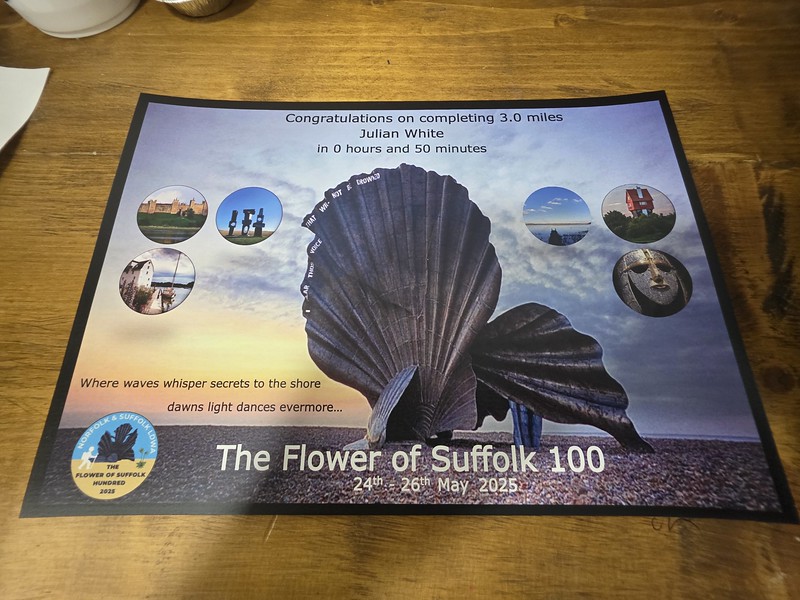
    My certificate and my third pack of Mini Cheddars as I can’t be near them without eating them and I also needed sustenance after the long walk.

    IMG-20250412-WA0003

    Liam and I at the end, with Sarah who trod on my shoelace but I was too polite to say. We then walked back to the nearby Overground station and then nearly boarded the train before I remembered we hadn’t touched in, so that would have been sub-optimal to have been fined. Luckily I remembered, we boarded and Liam soon recovered and didn’t collapse. As one of the finest athletes in the LDWA, I was uninjured. This tends to happen on urban walks, I like firm and flat surfaces, which isn’t the usual terrain of a challenge event. I should say we didn’t see much of the other walkers from Norfolk, but it was good to catch up with Andy and others at the end.

    It was another lovely day out and marvellously organised. There is less food and drink than other challenge events, but the theory is that entrants walk by hundreds of food and drink options, so the need is a little different to a rural walk. I’ve now put my certificate on the wall at home, I’ve once again gone for blu-tac rather than a frame as that’s just, well, within my DIY skills.

  • Ickworth House – Below Stairs

    Ickworth House – Below Stairs

    20250413_133559

    One of the volunteer guides at Ickworth House told me that this favourite area of the property was the below stairs tunnels and rooms. These comments transpired to be very understandable having seen the whole building, there’s an element of rawness down here.

    20250413_133658

    Located on the lower floor under the Rotunda, the opportunity to explore this hidden world is largely thanks to a significant initiative by the National Trust: the “Ickworth Lives” project. Launched in 2011, this project meticulously researched and restored the basement quarters to reflect their appearance and function during the 1930s.

    20250413_133609

    The wine and craft beer storage area. I accept it was mostly the former.

    20250413_133633

    Keeping track of who was staying in the rooms.

    20250413_134059

    A lovely view of a brick wall, although at least there was some sun shining in. Anyway, I think it’s time for a table:

    Role Key Responsibilities Mentioned/Implied at Ickworth References
    Butler Supervise male staff, manage wine cellar, oversee dining service, potentially valet duties Yes (Mr. Dunning)
    Housekeeper Supervise female staff, manage linens & stores, oversee house cleaning Yes (Mrs. Seddons)
    Cook/Head Cook Plan menus, order food, manage kitchen staff, prepare meals Yes
    Valet Gentleman’s personal servant: dressing, clothes care, shaving, boot polishing Implied/General
    Lady’s Maid Lady’s personal servant: dressing, hair, cosmetics, clothes care Implied/General
    Footman Assist butler, serve meals, answer door, run errands, polish silver Yes (Laurence)
    Housemaid Clean rooms, make beds, clean fires, dust, general household duties Yes (Rose, Lily, Florence)
    Parlour Maid Serve meals (often breakfast/lunch), clean reception rooms, answer door Yes (Mary Brunning)
    Kitchen Maid Assist cook with food preparation, kitchen cleaning Yes (Ruth Mizen, Maggie)
    Scullery Maid Wash dishes/pots/pans, heavy cleaning in kitchen/scullery, prepare vegetables, light fires Yes (Arianna, Harriet Flack)
    Hall Boy General errands, heavy lifting (coal/wood), cleaning boots, assisting footmen/butler Yes (John Mayhew)

    That’s quite a selection of staff who were working in the warren of rooms downstairs. The job wasn’t the worst going, but it would require an early rise and shifts tended to be up to 16 hours a day, with minimal days off. Lady Theodora Hervey, the 4th Marchioness, had at least improved matters somewhat in her 1910 investment in the facilities which reduced the need to walk so far to serve food and it also introduced electric lighting and hot water boilers.

    20250413_134104

    It seems that rather than the servants being housed in the attic of the building,some of their sleeping quarters were located in the maze of downstairs rooms.

    20250413_134155

    I’ve seen far worse in terms of accommodation.

    20250413_134129

    I can only imagine this was one of the rooms for a butler or valet, it’s quite decadent. It also has half a set of encyclopaedias.

    20250413_134230

    Some of the industrial equipment in the cellars. Liam was more excited about all this engineering than I was. How someone can get excited by a piling rig is beyond me, but I don’t judge.

    20250413_134400

    The finishing kitchen and this was installed after the dining room debacle meant the food was getting cold by the time it arrived.

    20250413_134414

    I did note that the kitchen was bigger than my entire flat….

    20250413_134639

    More engineering.

    20250413_134647

    Liam understood this.

    20250413_134707

    The pipes continue.

    20250413_134722

    One of the toilets that the servants could use.

    20250413_134754

    And, for the sake of completeness, the other one.

    There’s been an increase in interest in this whole sort of thing since Downton Abbey, although I’ve personally always been more engaged with You Rang, M’Lord?, although I must admit to having never watched Downton Abbey…. It’s definitely an intriguing area of the house and they’ve restored this really to quite a high standard of authenticity which has humanised the rooms.

  • Ickworth House – William Hogarth’s ‘The Hervey Conversation Piece’

    Ickworth House – William Hogarth’s ‘The Hervey Conversation Piece’

    20250413_131837

    As I’m not observant, I hadn’t realised at the time that this painting at Ickworth House was by William Hogarth (1697-1764) who must rank as one of the most influential British artists. The work was commissioned by John, Lord Hervey, and also has the title of ‘The Holland House Group’ which seems to me to be a more grown-up sounding name than ‘the Hervey Conversation Piece’. This secondary title points towards the significant presence of Henry and Stephen Fox, whose family later held the title Baron Holland and resided at Holland House. I had to look it up, but the ‘conversation piece’ style of artwork was a thing in the eighteenth century, a way of the middle classes to show off their status.

    It was painted between 1738 and 1740, with this being time for another table…

    Sitter Key Title/Role Depicted Action/Pose Relationship to Hervey/Group
    John Hervey, 2nd Baron Hervey (1696–1743) Vice-Chamberlain to Royal Household Standing centrally, wearing gold key, gesturing at plan Commissioner; Central figure; Political leader/Courtier
    Henry Fox, 1st Baron Holland (1705–1774) Surveyor-General of the King’s Works Standing, holding up architectural plan Political ally (Whig); Colleague (related interests in architecture/works)
    Stephen Fox, 1st Earl of Ilchester (1704–1776) Later Joint Secretary to the Treasury Seated at table with wine/fruit, dog at feet; stick upsets Desaguliers’ chair Brother of Henry Fox; Political ally (Whig); Social connection
    Charles Spencer, 3rd Duke of Marlborough (1706–1758) Gentleman of the King’s Bedchamber (from 1738) Seated left of Hervey, leaning in, gesturing Colleague in Royal Household; Political ally (Whig); Social connection
    Thomas Winnington (1696–1746) Whig Politician Standing beside Marlborough, foot on garden roller Political ally (Whig); Social connection
    Rev. John Theophilus Desaguliers (1683–1744) Natural Philosopher, Clergyman, Engineer, Freemason Peering through telescope, teetering on upset chair near river Intellectual figure; Represents scientific/Enlightenment interests within Hervey’s circle

    I love a political artwork (I don’t get out much) as they’re statements of intent and political alliances rather than anything else. Hervey had reached the giddy heights of Vice-Chamberlain to Royal Household which was a rather more powerful role than it is today. I note that because I would bet that the majority of people don’t know that Samantha Dixon currently holds the role, although I sometimes fear that the majority of people don’t know who the Home Secretary is.

    There is some background information here, which is that John Hervey and Stephen Fox were in a relationship, although initially John has pursued Henry Fox until he rejected the advances and he went for his older brother instead. For extra excitement, Winnington had an affair, likely more than one, and managed to get himself involved in a duel.

    The artwork has never left the property and was owned by the Hervey family until 1956 when it was accepted by HM Treasury in lieu of death duties and then given to the National Trust. There’s also a copy of the artwork at Redlynch Park in Wiltshire, which was the country seat of the Fox family.

  • Ickworth House – Painting of Constantine Phipps Greeting Augustus Hervey

    Ickworth House – Painting of Constantine Phipps Greeting Augustus Hervey

    20250413_131925

    This painting at Ickworth House shows the meeting of the Hon. Mrs Constantine Phipps being led to greet her brother, Captain the Hon Augustus Hervey, later 3rd Earl of Bristol. The artwork was commissioned in 1750 by the matriarch Mary, Lady Hervey, but it was a rather more complex affair than she might have first intended. The six individuals posed, or whatever it is people do when sitting for a painting, in Paris in October 1750 and much of the whole thing was a show of her social status. Anyway, there’s more about Mary at https://en.wikipedia.org/wiki/Mary_Hervey and more about Augustus at https://en.wikipedia.org/wiki/Augustus_Hervey,_3rd_Earl_of_Bristol.

    The artist was Hubert-François Bourguignon (1699-1773), known as Gravelot, who was something of an active participant in London’s burgeoning art scene, frequenting Slaughter’s Coffee House and teaching at the St. Martin’s Lane Academy, an important precursor to the Royal Academy, alongside figures like William Hogarth and Francis Hayman. His pupils included the young Thomas Gainsborough, who reportedly even painted backgrounds for Gravelot in the mid-1740s. In the Ickworth painting, commissioned five years after his return to Paris, Gravelot appears to have been the primary architect and instigator of the whole arrangement. He is credited with painting the bodies of the figures and, significantly, the heads of Mary, Lady Hervey, and the Fitzgerald couple.

    But then we move onto Jean-Étienne Liotard (1702–1789), a portrait painter born in Geneva to French Huguenot parents. For the Ickworth commission, Liotard was specifically engaged to paint the heads of the Honourable Mrs Constantine Phipps and her husband. But then it seems that Lady Hervey became a bit impatient with the speed of everything and she commissioned Francis Hayman (1708-1776) to finish everything off, although his exact contribution is unclear so there are some figures that have likely been painted by three different people.

    Which gives us (as everyone loves a handy table):

    Figure Name & Title (at time of painting / later) Dates Relationship to Commissioner (Mary, Lady Hervey) Depicted Attire Artist of Head
    Woman being led Hon. Lepell Phipps (née Hervey) / later Lady Mulgrave 1723–1780 Daughter Pink and white dress Liotard
    Man being greeted Captain the Hon. Augustus Hervey / later 3rd Earl of Bristol 1724–1779 Son Blue naval uniform, gold braid Gravelot
    Woman seated (right) Mary ‘Molly’ Lepel, Lady Hervey c. 1700–1768 Commissioner (Self) Pink dress, black shawl Gravelot
    Man leading woman Constantine Phipps / later 1st Baron Mulgrave 1722–1775 Son-in-law Blue attire Liotard
    Second woman standing Lady Mary Fitzgerald (née Hervey) 1726–1815 Daughter Green dress Gravelot
    Second man standing George Fitzgerald, MP (dates N/A) Son-in-law Murrey-brown coat, blue waistcoat Gravelot

    What a faff. This painting was one of the relatively few at Ickworth House that just stayed at the property, perhaps because no-one else would want it, rather than being one that the National Trust had to work out how to reacquire later on. The whole thing feels like the eighteenth century equivalent of a modern-day photo of a family on a first class flight somewhere cultural, showing happy families, a slight air of superiority and a hint of cultural aspirations. Well, something rather more than a hint. The painting is all very country house aristocracy, although to be fair, that’s exactly what it is and I’m rather pleased (as much as anyone can be in the circumstances) that the painting has continued to be kept at the house.