Seen in Las Vegas back in 2015, certainly noticeable and controversial….
The United Church of Bacon is a parody church, a group set up to promote atheism which Wikipedia tells me was established in Penn Jillette’s house (from Penn and Teller).

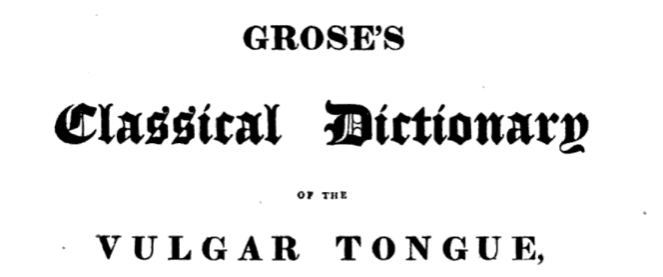
The Dictionary of the Vulgar Tongue was first published at the end of the eighteenth century, and given that the Coronavirus crisis is giving too much time to read books, I thought I’d pick a daily word from it until I got bored…..
Calibogus
A slightly strange name for a drink, this word is defined by the dictionary as a “rum and spruce beer, an American beverage”. The word dates to the seventeenth century and it usually also contains molasses and it was also common in parts of Canada, where it was known as Callibogus.
For anyone who wants to make it, and I don’t think that I’ll be rushing out to get the ingredients (and where on earth would I get Zirbenz Stone Pine Liqueur or spruce beer from anyway?), here’s a recipe from https://kindredcocktails.com/cocktail/calibogus-smugglers-cove.
1 1⁄4 oz Añejo rum (blend of column and pot still)
3⁄4 oz Zirbenz Stone Pine Liqueur
3⁄4 oz Molasses syrup
1⁄4 oz Lime juice
1 dr Spruce Beer (extract)
3 oz Seltzer water
I wouldn’t say that the words are much used, but they haven’t gone out of usage entirely.
As for how the word evolved, none of the three dictionaries I looked at had any idea at all……

Part of my Streets of Norwich project….
There’s not much to write about St. John’s Street, which is located off of Mountergate. The current St. John’s Street used to be called Orchard Street (named after the Orchard Tavern pub), and the rest of it has since been lost to development.
The buildings that were either side of what was Orchard Street have also gone, with car parking on the right-hand side and Parmentergate Court housing project on the left-hand side.

Part of my Streets of Norwich project….
I’ve realised today how little bloody attention I pay to things, given that I’ve been calling a road I thought that I knew by the wrong name. It’s only a marginal error, but I’m moderately irritated that I hadn’t realised, Bishopgate ends earlier than I thought and becomes St. Martin at Palace Plain. Now, this is hardly of much relevance to anything of global importance, but the quirky layout is due to how things have shifted over the last century.
In the above map, St. Martin at Palace Plain covers part of the square, then the road down to where it looks like there is a pub in the middle of the road, before going up to another pub. Today, that is the entrance to the courts and the road and Worldsend Lane have all gone, so St. Martin at Palace Plain is effectively just the stump of road between the church and the entrance to the Bishop’s Great Gate and not that much further. Indeed, I’ve noticed that some properties have been moved out of St. Martin at Palace Plain on the listed buildings register and placed under other streets.
But, despite this street now just being a bit of a stump, it has a tremendous amount of history packed into it.
This is the view from the end of St. Martin at Palace Plain, looking down towards Bishopgate.
The sun gave me problems taking this photo, but this is the Bishop’s Gate, a structure constructed in 1436 to give access to the Bishop’s Palace. I’ve been in the chapels at the top of the Erpingham Gate and the Ethelbert Gate, but I don’t know what the set-up is with this one. The old Bishop’s Palace is now used by Norwich School, but there’s a new palace used by the bishop which is just the other side of this gate.
This is St. Martin’s Church, which has spent its lifetime literally overshadowed by the cathedral. No longer really having any congregation of its own as the nearby housing had gone, the church stopped being used for services in 1971. Since then it has been used to store church furniture, as offices for the Probation Service and is now used by the Norwich Historic Churches Trust. More on this in another post as I’ve been on a guided tour of this church, and it’s one of my favourites in the city.
This was once the wall of the Bishop’s Palace, although there has been some building just inside of it over the last century.
On the wall in the previous photo is this plaque, which marks where Lord Sheffield was killed during Kett’s Rebellion in August 1549.
The Kett’s Rebellion was started by the desire of some landowners to enclose land for their own financial benefit. That’s a slightly shortened version of the enclosure process, but that’s the upshot of it. The locals didn’t like that, so on 8 July 1549 some denizens at Wymondham ripped up the landowners’ lovely new fences. The owner of the manor of Wymondham was Robert Kett, who should have been most aggrieved at the damage done to property. But, he decided to back the rebels and he became their leader.
Kett decided that he would march on Norwich to show the authorities that the locals weren’t happy and that it was the poorest who would suffer the most. Perhaps unfortunately for him, he had thousands of people with him, turning a little local dispute into one of the largest protest marches that East Anglia had ever seen. He reached Bowthorpe, a suburb of Norwich today, on 9 July 1549 and Sir Edmund Wyndham, the Sheriff of Norwich, popped out to tell Kett that he should perhaps go home. Kett ignored that.
Instead of going home, Kett led his men to set up camp at Mousehold Heath, on the edges of the city centre, on 12 July 1549. Although this location was outside of the city walls, it offered views into Norwich and this is where they established their camp for six weeks whilst issuing their demands for a fairer society. By now, there were 16,000 people at this camp, which was presenting a problem for Norwich, as although it was the second-largest city in the country at the time, it still only had a population of 12,000.
The authorities agreed to listen to the demands that Kett had, which took some time, as there were 29 grievances that Kett wanted dealing with. Some of these were fiercely ambitious and only one related to the enclosure process, which is what had started this all off. During this time, the city hadn’t closed off its gates, so the people at the camp could enter Norwich to buy food and supplies, with something of a party atmosphere going on at Mousehold Heath by all accounts.
On 21 July 1549, the city authorities got fed up with this and they shut the gates. Faced with the camp having to break up due to a lack of supplies, Kett led an attack on the city. Despite having a strong artillery and city defences, Kett’s rebel forces won and took control of the city. This was a serious threat to King Edward VI now, so he ordered 1,500 troops led by the Marquess of Northampton to retake Norwich.
The relevance of this story to the street I’m writing about is that one of the military leaders was Lord Sheffield. He had had what I assume was a lovely breakfast at the Maid’s Head, a hotel which is still trading today, and led a mounted attack on rebels to force them back along St. Martin’s at Palace Plain to Bishopgate and then back out of the city. Unfortunately, he fell off his horse into a ditch. The rules of engagement at the time said that in such circumstances, the fallen man should be taken and held for ransom. Unfortunately for Lord Sheffield, a butcher decided to hit him on the head and kill him. And, today the location of Lord Sheffield’s death is marked by the plaque on the wall.
Just to finish the tale, the rebels could never win this, the Monarch was too strong. He despatched the Earl of Warwick and 14,000 men, including some rather rough mercenaries, to take back control (there’s a phrase….) and after a series of battles, the rebels lost. Although the Earl of Warwick’s army lost 250 men, there were over 3,000 rebels killed during the fighting. Many surviving rebels were promptly executed and Robert Kett and his brother William were taken to the Tower of London to face trial. They were, unsurprisingly really, found guilty and Robert Kett was sent back to Norwich to be hanged on the walls of Norwich Castle, whilst his brother was hanged on the west tower of Wymondham Abbey.
Was the rebel sacrifice worthwhile? Probably not. Little changed, other than the city announced it would mark a day of celebration every year on 27 August to celebrate the defeat of the rebels, with this party carrying on for well over a century.
Anyway, after that story, back to St. Martin’s at Palace Plain. The other building that is now situated off this road is the modern court complex, which has one of the city’s oldest buildings in its cellar, the Norman House. But more of this when I find those photos….

The Dictionary of the Vulgar Tongue was first published at the end of the eighteenth century, and given that the Coronavirus crisis is giving too much time to read books, I thought I’d pick a daily word from it until I got bored…..
Calves Head Club
I’m not sure this is much of a definition as it’s more of an historic tale, but the dictionary notes this is “a club instituted by the Independents and Presbyterians, to commemorate the decapitation of King Charles I. Their chief fare was calves heads; and they drank their wine and ale out of calves skulls”.
The club allegedly met every 30 January, the date of the execution of the King, becoming something of a Bullingdon Club arrangement. This kept going until 1734, when they went too far at an event at the Golden Eagle pub, on Suffolk Street in London, with an account reporting:
“Thursday in the evening a disorder of a very particular nature happened in Suffolk-street: ’Tis said that several young gentlemen of distinction having met at a house there, call’d themselves the Calf’s-Head Club; and about seven o’clock a bonfire being lit up before the door, just when it was in the height, they brought a calf’s-head to the window dress’d in a napkin-cap, and after some Huzza’s, threw it into the fire: The mob were entertained with strong-beer, and for some time halloo’d as well as the best; but taking a disgust at some healths which were proposed, grew so outrageous, that they broke all the windows, forc’d themselves into the house, and would probably have pull’d it down, had not the Guards been sent for to prevent further mischief. The damage done within and without the house, is computed at some hundred pounds. The Guards were posted all night in the street, for the security of the neighbourhood.”
A little too raucous for me.

As I bored everyone with here, my travel has meant that I’ve managed to visit a lot of JD Wetherspoons over the years. So in an attempt to remember them all, I’ve decided to try and write about them. As explained elsewhere, other perfectly good pubs are also available and of course should be visited 🙂
There are 111 JD Wetherspoon outlets in Greater London, and I’m not typing all that up in one go. So here, for my own amusement during the Covid-19 situation, are those in towns which start with the letters A-B. So, entirely arbitrary really.
Figures: (which are more for me than to interest anyone else):
Number visited : 7/11
Favourite pub in list : Goodman’s Field
Acton (Red Lion and Pineapple) – I visited this one a few weeks ago, just before the lockdown, so this one is easy to link to. I very much like it, a quirky design and a real sense of history to it.
Aldgate (Goodman’s Field) – This pub is the easiest to get a seat in for those in the Tower of London area of the city and it has quite a cafe bar feel to it, as well as lots of power outlets. I’ve visited here plenty of times over the last decade and it’s got one of the more relaxed vibes to it and it’s well-reviewed on TripAdvisor for a Wetherspoons. Well, relatively. The pub name harks back to when the area was fields that were once owned by Roland Goodman.
Barking (Barking Dog) – I always thought that this pub name was just a wry word-play about it being located in Barking, but the actual reason according to Wetherspoons is:
“For centuries, fishing was Barking’s most important industry. Its fishermen fished the high seas off Doggerbank and the coast of Iceland. If you shorten ‘Doggerbank’ and join it to ‘Barking’, you end up with the name of this Wetherspoon pub.”
The reviews for the pub are again relatively high on TripAdvisor, although it’s a shame that the poster didn’t explain what the mistake was.
“What an awful customer service by Manager Kerry. it was meant to be the perfect Sunday where I would enjoy a meal and a drink. Not the case wrong choice. I paid around £15 for meal and drink and realised i made a mistake. Bad Customer service from a poorly trained duck.”
But referring to a female staff member as ‘duck’ like that is probably all I need to know. A chunk of the negative reviews of this pub have all been written by the same person, I’m not sure why anyone would rate somewhere as 1/5 and then keep going back before then leaving more 1/5 ratings…..
Anyway, the pub is hardly the prettiest from the outside, at the base of a bland and modern office block, but it’s convenient for the next door underground/railway station. The interior is relatively large and about as much character has been added in the design as is likely realistically possible in such a modern building.
Barkingside (New Fairlop Oak) – Never been here….
Battersea (Asparagus) – This memorable pub name refers back to when in the nineteenth century the area around where the pub now stands was used for growing asparagus, which became known as Battersea bundles. It’s, I think, the only pub in the country with this name, and there’s something to be said for finding a unique and memorable name. The pub opened in 1998 as part of a new commercial building, but it’s not too garish and there is a beer garden out the back for those who like wasps.
Bexleyheath (Furze Wren) – Never been here….
Bexleyheath (Wrong ‘Un) – It was a nuisance to get to Bexleyheath when I lived north of the river in the east end of London, the lack of underground meant connecting to North Greenwich (which was already a DLR journey and an underground journey from where I was) and then getting a bus which seemed to take hours. And probably did. So, I’ve only been here once and I never made it to the other Wetherspoons in Bexleyheath.
And, since my sole visit was seven years ago, I’ve mostly forgotten everything about the pub. Which is why I now write the blog primarily, to remind myself of where I’ve accidentally gone before I forget. The pub name is a bit tenuous, it’s apparently because cricket was once played in the area and a Wrong ‘Un is a difficult delivery to play for the batsman.
I like the TripAdvisor review exchange with a customer complaining that he had been told to drink up five minutes before the pub closed, which to me isn’t an unreasonable request, but there we go. The review then accuses the manager of the below.
“The manager came out and his name is terry fitzgerald. I explained to him what happen and he reply qas well you are in England you should speak English. How dare they even suggest such a thing. The was more than willing to take our money over the bar.”
But, I like very much that the manager himself has replied:
“I take great issue with your comments as this incident did not happen, I lived in Spain and Portugal for a total of fifteen years and have great memories of the countries and the people I would not say anything so ridiculous and there is no proof from our head office that you complained to them. I do not what issues you might have but if you are going to review please tell the truth. Terry Fitzgerald ( and I am sorry for the late reply)”
Each person can decide who they believe, but I know who I’m with here…. Anyway, I digress again.
Another customer complained that they had been spoken to because they kept complaining about the food, and I do wonder why people keep going to pubs if they do keep complaining about the food. And another customer who complained about a staff member’s behaviour and demanded an apology, but the customer didn’t mention themselves that they had been filming him with a phone.
I must return to this pub, I like moderate drama like this, keeps things interesting.
Brixton (Beehive) – I’ve been here three times and it’s the only Wetherspoons I’ve felt unsafe in, given that there were fights on two of those visits (not involving me) and on the third a huge argument between an aggressive staff member and a customer. The toilets were on all three visits beyond unclean, the staff had entirely clearly given up. It’s the only Wetherspoons I’ve been to as well where there were “customers only – no public use” signs on the toilets, although by the time someone has gone in and reached the toilets I can’t imagine this sign would put them off. Having written that, I haven’t gone back in years and a few reviews have mentioned new security processes, so perhaps it’s a lot better now. It is quite a small Wetherspoons though, so given its central location in Brixton and cheap prices, it gets busy quickly. Or did when I last visited.
Brockley (Brockley Barge) – The pub name here is a good one, it’s a reminder that the Croydon Canal used to pass near to where the pub stands today, although a railway line has now been laid along much of the canal’s former route. I much prefer this new pub name to the Breakspear Arms, which was the pub’s previous name, and JD Wetherspoon re-opened this location in 2000 after a few years of closure. The closure was probably inevitably as media reports noted that the pub had established itself as somewhere with a poor reputation, so it’s entirely to JD Wetherspoon’s credit that they’ve managed to turn this place around.
The interior is homely, although not particularly notable, but the atmosphere is welcoming, even though the pub has been busy in the early evening on the times that I’ve visited. Perfectly decent pub though, the staff here have always been friendly when I’ve been in as well.
Bromley (Greyhound) – Never been here….
Bromley (Richmal Crompton) – Never been here….

Further to my riveting post about Caistor St. Edmund (by riveting, I mean not especially riveting), I like that the village has retained its full name. This is primarily likely because of the other Caister in Norfolk, so although the spelling is different, differentiating the two locations has probably proved useful over the centuries, so there’s Caistor St. Edmund and Caister-by-the-sea.
Both places are named Caistor/Caister for the same reason, it’s the old English word for a Roman fort, although it might once have been spelled in different ways, such as caester or castre. The Romans themselves called it Venta Icenorum, meaning the ‘marketplace of the Iceni’.
The surname Caister, and its variants, derives from the same meaning and it’s most common in England, Canada, the United States, Italy, South Africa, New Zealand, and for reasons unknown, Ecuador. What’s even more interesting, to me anyway, is that by looking at a map of England and its surnames, there is a basic correlation between where Roman sites once were and where people live today with the surname Caister.
The St. Edmund bit is because the parish was owned by the Abbey of Bury St. Edmunds, with the village church also dedicated to St. Edmund. The village is also commonly known as St. Edmunds, although I’m not sure that anyone much minds which one is used. But, I’m sticking to St. Edmund since it seems to be the official version.

The Dictionary of the Vulgar Tongue was first published at the end of the eighteenth century, and given that the Coronavirus crisis is giving too much time to read books, I thought I’d pick a daily word from it until I got bored…..
Cagg Maggs
Defined by the dictionary as “Old Lincolnshire geese, which having been plucked ten or twelve years, are sent up to London to feast the cockneys”. There’s not much to add to this precisely worded definition, but I like the slight north-south divide being hinted at here, send the old and scraggy meat down to London rather than keep it up north…. That assumes that Lincolnshire is in the north, which is perhaps pushing it though.