Author: admin

  • Quincy – Hancock Cemetery (Ebenezer Hayden)

    Quincy – Hancock Cemetery (Ebenezer Hayden)

    Back to my visit to the Hancock Cemetery in Quincy.

    This is the grave of Ebenezer Hayden, who was the son of John and Susanna, and he was born in 1645 and died on 13 February 1717. Colonial American history doesn’t get much older than this and Ebenezer married Anna and had three children, Ebenezer jr (born 13 April 1679), Ruth (born 19 November 1681) and William (birthdate unknown, but he married Sarah Hobart on 26 December 1726). Hayden was made a freeman in Boston on 15 May 1690, but lived most of his life in Braintree (which was effectively the same place as Quincy then).

    Hayden fought in the Suffolk Troop during King Philip’s War, also known as the First Indian War, which was a conflict lasting from 1675 until 1678. It was fought between the native Americans and the colonists, and although the numbers on each side were about even, the native Americans suffered greater losses. That time in the military meant that Hayden is now seen as a veteran of the US Army, hence the circular marker by his grave.

    I do wonder what these seventeenth-century colonists would make of the Braintree and Boston areas today……

  • Dictionary of the Vulgar Tongue – Day Seventy-Two

    Dictionary of the Vulgar Tongue – Day Seventy-Two

    The Dictionary of the Vulgar Tongue was first published at the end of the eighteenth century, and given that the Coronavirus crisis is giving too much time to read books, I thought I’d pick a daily word from it until I got bored…..

    With the moving of server last week I got a bit behind on these, but I’ve caught up now and today is day 72 of this. This has lasted for considerably longer than I had anticipated.

    Cherry-Coloured Cat

    I had heard of this phrase in relation to PT Barnum, when he agreed to buy a cherry coloured cat for his circus and realised he had been fooled when he was presented with a black cat and the seller told him “you can get black cherries as well as red”. But, this dictionary pre-dates Barnum, and their definition is nearly identical, which is “a black cat, there being black cherries as well as red”.

    The phrase has also been used to describe a confidence trick or scam and there was a report in a newspaper in the 1830s fondly telling the story of how a man in Scarborough enjoyed fooling the gentry who came to the town with the same trick. This then became a common jape in the late nineteenth century, but it’s perhaps through Barnum that this lives on.

  • Atlanta – Birthplace of Martin Luther King

    Atlanta – Birthplace of Martin Luther King

    After visiting Atlanta Zoo and the Jimmy Carter Presidential Library, I didn’t have much hope of getting a ticket for the birthplace of Martin Luther King. So, my plan was just to go to the visitor centre and see that, but I thought I’d ask about a ticket anyway. And, good fortune prevailed, there was one ticket left for the last tour of the day. This isn’t always possible, many reviews state just how difficult it is to get a ticket to visit the property and it’s recommended to go early on in the day.

    It’s a short walk from the visitor centre to the birthplace home of Martin Luther King, one of the greatest of American political leaders. There were 15 people allowed on the tour and access is only granted to the house to those who have a ticket, which is issued free of charge.

    The plaque at the entrance to the property, which is at 501 Auburn Avenue in Atlanta. King was born on 15 January 1929 in what was a predominantly black area at the time, living at the house with his grandparents, parents and siblings for the next twelve years. King was assassinated in Memphis in 1968 and so he feels like a figure from history, but if events had turned out differently, he could still be alive today.

    Given how many people were living in the house, it’s not the largest, but the family were comfortable there. The tour lasts for around half an hour and it was led by an enthusiastic ranger who gave information about the building and the family who lived there. Photos inside aren’t allowed, which is probably for the best as there isn’t much time for the rangers to guide people around as it is.

    The building was owned by the Martin Luther King Jr. Center for Nonviolent Social Change after his death, but the National Park Service purchased it relatively recently for $1.9 million. It’s fortunate that the property has survived, a sweeping plan to modernise the area was proposed in 1966 which would have seen its demolition, but there was too much opposition to that.

  • Dictionary of the Vulgar Tongue – Day Seventy-One

    Dictionary of the Vulgar Tongue – Day Seventy-One

    The Dictionary of the Vulgar Tongue was first published at the end of the eighteenth century, and given that the Coronavirus crisis is giving too much time to read books, I thought I’d pick a daily word from it until I got bored…..

    Chaw Bacon

    This beautiful phrase, now more commonly just one word, is defined as “a countryman, a stupid fellow”. ‘Chaw’ is an old English variant of the word chew and the combination of the bacon element, which was traditionally seen as a poor man’s food (well, and women and children) so it’s the equivalent of a country bumpkin.

    The phrase dates back to at least the early eighteenth century, but it seemed to have a resurgence in the late nineteenth century before falling back into obscurity.

  • Bramerton – Church of St. Peter

    Bramerton – Church of St. Peter

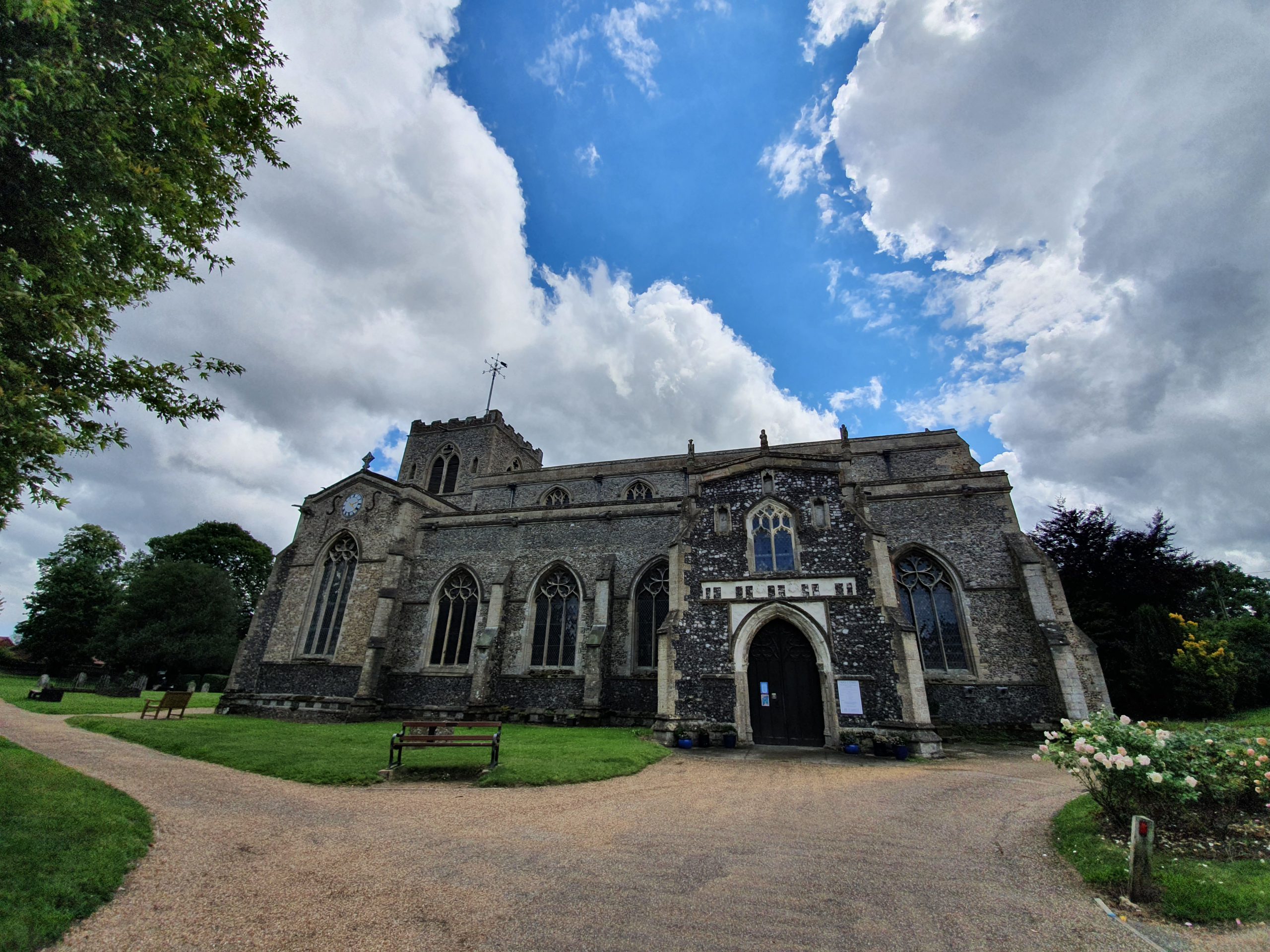
    Unfortunately, the current situation means that the interior of churches can’t be visited, so I’ll have to come back again for that. There has been a church here since around the end of the thirteenth century, but much of the current structure is from a reconstruction in the 1460s, funded by a legacy from Richard Medewe.

    The lychgate at the entrance to the Church of St. Peter in Bramerton. The gate is relatively modern and was installed at the beginning of the twentieth century.

    These quite bulky diagonal buttresses date from the 1460s reconstruction, so were part of the original design plan. The clock on the tower was installed in December 1928, designed by Smiths of Derby and this originally had to be wound up every week, but the process has since been automated.

    Aesthetically, I do wonder what they were thinking when they inserted that Priest’s Door in the early part of the seventeenth century. They had to chop the bottom half off the window to do it and it hardly fits in, but I suppose religious convention of the time demanded it.

    This is a pencil drawing of the church from the early nineteenth century,

    The porch.

    The west side of the church all looks a bit out of proportion, primarily due to the construction of a vestry in the nineteenth century. This work was undertaken in 1866 and also increased the capacity of the church to 180 people, pretty much the entire population of the village.

  • Dictionary of the Vulgar Tongue – Day Seventy

    Dictionary of the Vulgar Tongue – Day Seventy

    The Dictionary of the Vulgar Tongue was first published at the end of the eighteenth century, and given that the Coronavirus crisis is giving too much time to read books, I thought I’d pick a daily word from it until I got bored…..

    Chatter Box

    This of course remains a commonly used phrase today, but I did like the quite vivid definition given by the dictionary, which was “one whose tongue runs twelve score to the dozen, a chattering man or woman”. When the dictionary was published, this was a relatively new phrase as it had only started to be used in the 1770s. It was originally two words, but it has been corrupted down into one over the years.

    I think I prefer the dictionary definition than the word it’s describing, I will definitely attempt to get the phrase “your tongue runs twelve score to the dozen” in somewhere this year.

  • Whitlingham – Trowse Newton Hall

    Whitlingham – Trowse Newton Hall

    The former entrance to Trowse Newton Hall, it’s in a beautiful location by Whitlingham Lake today, but it was previously in a more private area of land as the lake is a more recent man-made creation.

    The current hall was constructed in the mid-fifteenth century to be used as a country house by the priors of Norwich, but this replaced an earlier building. This previous structure had been visited by Edward III and his wife Philippa in 1335 and they arrived in a grand procession along the River Yare.

    The privilege of the priors was also used by the Deans of Norwich Cathedral following the reformation, but the property was let out to tenant farmers from the seventeenth century. The building was badly damaged following the Norwich food riots of 1766, caused by an increase in bread prices and a misplaced notion that bakers were making a fortune, and it was later mostly demolished in around 1860.

  • Norwich – Meadows Near the River Yare

    Norwich – Meadows Near the River Yare

    Just photos, but this is the meadow area between Trowse and Whitlingham Lake, just by the River Yare. I’ve never walked on these meadows, although they were peaceful and there were a few small groups sitting by the river.

    Not the most welcoming of introductions though.

  • Dictionary of the Vulgar Tongue – Day Sixty-Nine

    Dictionary of the Vulgar Tongue – Day Sixty-Nine

    The Dictionary of the Vulgar Tongue was first published at the end of the eighteenth century, and given that the Coronavirus crisis is giving too much time to read books, I thought I’d pick a daily word from it until I got bored…..

    Chapt

    Defined as “dry or thirsty”, this is a now obsolete word for chapped, although I’ve seen people write about their “chapt lips” in error so it might go full circle. Or indeed, unless they were aware of its archaic roots and wanted it to be brought back in the mainstream.  Although chapped is more used as an adjective now, its origins are as a verb and in the US there are far more of these ‘-t’ endings than in the UK where it’s usually ‘-ed’. But not here, even the Americans like the idea of chapped, even though they also like words like learnt, spelt and spoilt to name just a few.

  • Norwich – Colman’s

    Norwich – Colman’s

    Last week, Unilever closed the Carrow Works factory that has been used by its Colman’s brand since 1856, marking the end of the connection with Norwich.

    I noticed that the Colman’s branding has been removed from the site now, with production mostly moving to Germany. I have no idea what they’re going to do with the huge site, although there are some listed buildings within the complex, so it’ll likely be turned into housing. Some of the site is currently available for short-term let, although I’m not sure who would want such a large site for 18 months.