Author: admin

  • Hoveton – St. Peter’s Church

    Hoveton – St. Peter’s Church

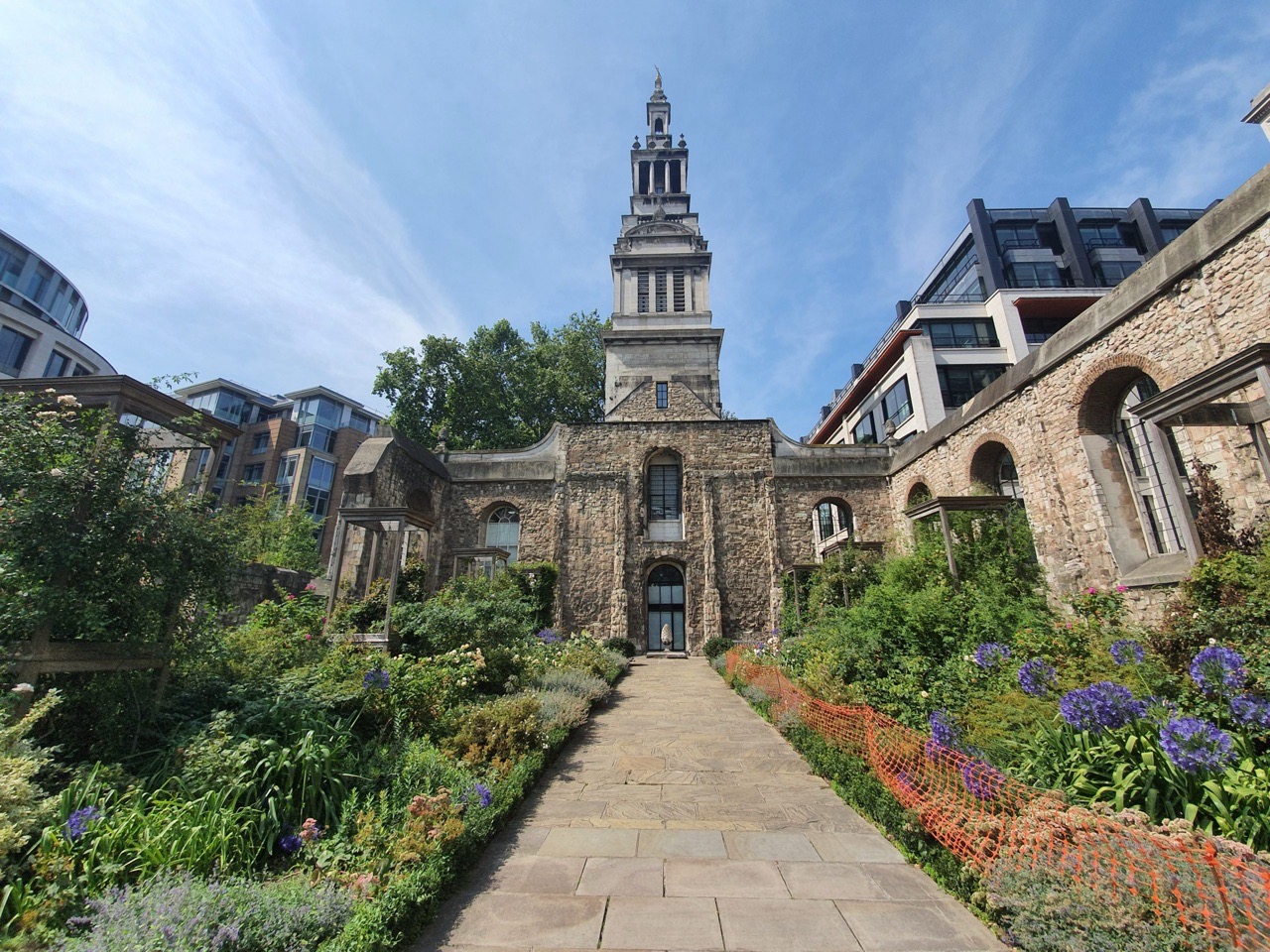
    Unusually, this church was built in the early part of the seventeenth century, in 1624. Its location, near to Hoveton Hall, seems to suggest it was more constructed for the country house rather than for the people of Hoveton. They also didn’t need a church, they already had St. John’s which was actually near to the settlement of Hoveton.

    There is the possibility that the settlement of Hoveton St. Peter might have been larger and once had a church of its own, but no-one is quite sure where this might have been located.

    The building itself was ‘modernised’ internally in the 1880s, but externally, the church is nearly entirely unchanged since it was built.

    The only change to the building is that the north door has been blocked, but the thatched roof remains and this feels like a little bit of a hidden treasure in the Norfolk countryside.

  • Norwich – Las Iguanas

    Norwich – Las Iguanas

    And that’s another restaurant in Norwich permanently closed, the Latin American themed Las Iguanas on Wherry Road. Located near to Coast to Coast, which also permanently closed a few weeks ago, Las Iguanas is closing as a result of the Casual Dining Group going into administration. A little surprisingly, both Bella Italias in Norwich are staying open, although many are closing around the rest of the country.

  • Norwich – The Chip Shop (Stafford Street)

    Norwich – The Chip Shop (Stafford Street)

    Not the most innovative of chip shop names, but I’ve heard positive things about this location and their reviews are broadly glowing in praise. Before I start, I’ll get my pet hate out of the way, which is businesses that don’t take cards. Although I have no complaint as they can run their business how they want, it means I won’t go back. The number of locations that don’t take cards is now so small that customers expect it, and in my view, local businesses need to fight back against the sea of monotony that is offered by some chains.

    Indeed, Amex is running their usual December offer early, so any customer visiting a chip shop (or any small business which accepts Amex) with that offer will get £5 for free if they spend £10. More and more market traders are accepting cards and any business which doesn’t seems destined to need a large sign visible in their window or on entrance telling customers they don’t accept cards. And, that was the case here, the first marketing message in the shop was “cash only”. Although to be fair, the shop wasn’t quiet, the trade was steady.

    The service was polite and efficient, with the social distancing system being a little unclear (over half the customers got it wrong), but the staff were verbally explaining it. The price for battered sausage and small chips was £2.60, which is below average and the portion of chips was substantial. There was a moderate customer service failing in that they wrapped the whole lot up, even though I wanted it unwrapped, and didn’t offer salt and vinegar.

    But, the chips were excellent, fluffy on the interior, slightly firm on the exterior and they had a pleasant taste. The sausage content was a little generic, but it tasted fine and the batter seemed freshly made, was golden and had a richness of flavour.

    So, I can understand why they have the reputation that they have, there’s a focus on the food and all seemed fine with perfectly good value for money. The locals are fortunate to have this chip shop here, it is clearly well respected in the area.

  • Norwich – UEA Walk

    Norwich – UEA Walk

    Just some photos in this post….. This is from our group walk which covered part of the lake at the UEA and some of their sculptures. More of these next week when we explore the rest of the lake and sculptures area.

    Incidentally, the dog was rather sweet. He just sat in the lake like that for some time, the owner said that he was wondering if his dog thought that he was a crocodile.


  • West Lynn – West Lynn War Memorial

    West Lynn – West Lynn War Memorial

    West Lynn’s war memorial is located within the churchyard of St. Peter’s church and was unveiled in 1920. It is made out of Bath Stone and there were 25 names from the First World War and 4 names from the Second World War. Over recent decades it has become harder to read the names on the memorial, so new black plaques have recently been installed to make the names clear. When these new plaques were added, historic research meant that 10 additional names were added from the First World War, bringing the total to 35.

  • Flixbus Coming to UK

    Flixbus Coming to UK

    It’s fair to say that Flixbus (above photo is of their coach which took me from Torun to Warsaw a few months ago) for some time considerably annoyed me, managing to leave from the wrong coach stop at the wrong time with coaches that rarely worked properly. Much of this is because they partnered with coach companies across Europe who were of varying quality, but my more recent trips have been much better. I now like them and feel reassured by them.

    But, anyway, the company have now announced that they’re coming to the UK and this is likely bad news for National Express and Megabus. Although it’s probably more devastating for National Express, who have been charging ridiculous fares on some routes for years because they could and stinging passengers with little extra costs all over the place.

    Anyway, Flixbus are starting from routes to and from London, but will likely expand. They are also experienced in running open access rail networks in the European Union, and they will probably make public transport better integrated. All told, it’s all good news for passengers and might kick National Express into focusing a little more on customer service.

  • King’s Lynn – The Norfolk Dumplin

    King’s Lynn – The Norfolk Dumplin

    Whilst looking at something else about King’s Lynn, I noticed this print (© The Trustees of the British Museum) in the collections of the British Museum.

    This moderately bizarre image (click on the image to make it bigger) is an attack on Robert Walpole (1676-1745), and suggests that Edward Taylor was an illegitimate child of Walpole. I’m still slightly surprised, as this trick was commonly used in electioneering at the time, that the law allowed “W-lp-le” to hide the fact that the creator of the image wanted to highlight that he was referring to “Walpole”. Walpole, effectively the country’s first Prime Minister, was known to have had other mistresses, so the allegations aren’t necessarily false. The connection to King’s Lynn is that Edward Taylor was born in the town in 1703.

    It’s not known who created the illustration, but it is dated to 1744 and the British Museum acquired it in 1868 from the estate of Edward Hawkins, a long-time curator of the museum. The term ‘Norfolk dumpling’ usually refers to someone who is a bit dense, although it’s also a culinary treat….

  • Dictionary of the Vulgar Tongue – Day 105

    Dictionary of the Vulgar Tongue – Day 105

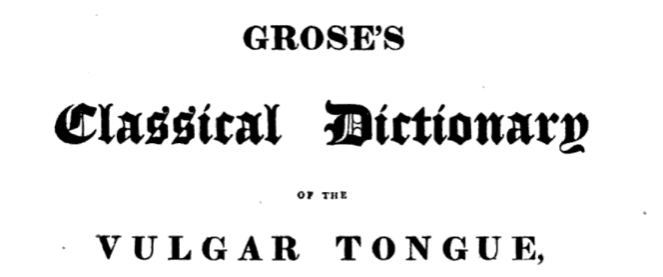
    The Dictionary of the Vulgar Tongue was first published at the end of the eighteenth century, and given that the current health crisis is giving too much time to read books, I thought I’d pick a daily word from it until I got bored….

    Dog Latin

    There’s some imagery than readers of the dictionary can probably picture here after seeing the definition, which is “barbarous Latin, such as was formerly used by the lawyers in their pleadings”. Other dictionaries also mention that this was a similar issue with some vicars in the church during their sermons mauling Latin about.

    But the legal element here continues, with what is now called Law Latin. This is where significant parts of the British law and legal opinions were written in a Latin which was partly made-up by trying to translate English back into Latin. This led to a situation where for a period in the medieval period there were court cases using French (and tens of legal words used in British courts still today have French origins), English and Latin, so it’s not entirely surprising that the results were a little mixed.

  • King’s Lynn – Etching by Henry James Stuart Brown from West Lynn

    King’s Lynn – Etching by Henry James Stuart Brown from West Lynn

    Yesterday, I posted some photos of King’s Lynn which were taken from West Lynn.

    This 1928 etching (© The Trustees of the British Museum) was drawn from along the riverbank of West Lynn and shows the main buildings in King’s Lynn. It was drawn by Henry James Stuart Brown (1871-1941) who was known for this style of drawing and although he was overlooked during his own lifetime, his works have become much more collectable in recent years. He made numerous etchings in this part of the country and the British Museum have a relatively substantial collection of his prints, with Brown donating this work to the museum in 1930.

  • King’s Lynn – Whitefriar’s Gate Etching by William Taylor and William Pickford

    King’s Lynn – Whitefriar’s Gate Etching by William Taylor and William Pickford

    I posted about the Whitefriar’s Gate, or Carmelite Gate, yesterday, and today I found this etching in the on-line collections of the British Museum (© The Trustees of the British Museum).

    Dating from 1843, it’s quite atmospheric with children playing and chickens eating, and it couldn’t be much more different than the surroundings of the gate today, which is just quite a lot of barrenness. The image was drawn by William Pickford and was etched by William Taylor, with Taylor also being the publisher of the image. The plate isn’t on display at the British Museum, but they’ve owned it since 1876 when they purchased it from the art dealer Robert Jackson.