Author: admin

  • Colchester – St. Botolph’s Priory

    Colchester – St. Botolph’s Priory

    In the tenth century, there was a church here dedicated to St. Botolph, but a Kentish priest with the name of Norman fancied setting up an Augustinian priory. So, after some research and approval, this magnificent structure was built and the religious institution was established. It was the first Augustinian priory to be constructed in the country and it also, very sensibly, honours St. Julian.

    The rather glorious remaining section of the west front of the priory.

    Much of the church has been reconstructed using Roman brick that was robbed from various walls and buildings around Colchester.

    These pillars have stood the test of time…..

    This is the nave, looking towards the west end of the priory. The priory was closed down during the Dissolution of the Monasteries, but the nave area was saved as this was used by the local population at their church. Everything that the monks used, such as the cloisters, numerous chapels and their area for prayer was all pulled down.

    The church in its new form survived until 1648, when it was destroyed during a siege that took place during the English Civil War. There were plans to rebuild the church after the Civil War, but they never came to pass, so the ruins have stood here now for over 350 years, currently under the management of English Heritage.

  • Dictionary of the Vulgar Tongue – Day 150

    Dictionary of the Vulgar Tongue – Day 150

    The Dictionary of the Vulgar Tongue was first published at the end of the eighteenth century, and given that the current health crisis is giving too much time to read books, I thought I’d pick a daily word from it until I got bored….

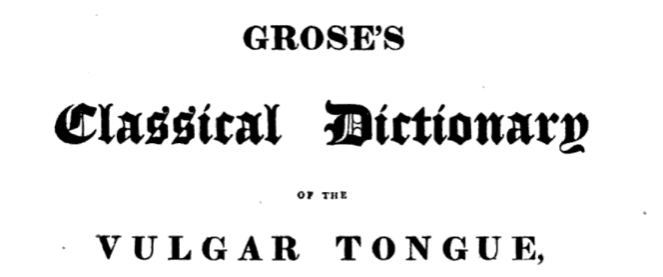
    Hedge Creeper

    I’m moderately confused by this definition from Grose, where he notes this phrase means “a robber of hedges”. I’m not convinced by this, as I’m really not sure many hedges were robbed and this phrase was more commonly used to describe someone who hid in a hedge to commit a crime, perhaps a highwayman. It is possible that Grose meant that it’s a robber who steals something from hedges, perhaps clothing left out to dry, although that’s getting a bit tenuous. So, on this, I’m unsure….

  • Colchester – Site of Shooting of Charles Lucas and George Lisle

    Colchester – Site of Shooting of Charles Lucas and George Lisle

    This memorial notes where Sir Charles Lucas (1613-1648) and Sir George Lisle (1610-1648) were shot on the orders of Sir Thomas Fairfax, the Parliamentarian General. The two men were shot in the castle yard on 28 August 1648, following the surrender of the town to Parliamentary troops during the Civil War. The men were buried at St. Giles’s Church in the town and after the restoration of the Monarchy, there was a commemoration ceremony and the actions of Fairfax were rejected by many. Lucas was given a posthumous peerage in 1666 and the decision to shoot them was seen as a miscarriage of justice, even for the period. Lisle had said to the firing squad “now rebels, do your worst” and Lucas was equally brave.

    This memorial stone was unveiled here behind Colchester Castle, where the men were killed, on 20 October 1892 at a ceremony attended by Henry Laver.

  • Dictionary of the Vulgar Tongue – Day 149

    Dictionary of the Vulgar Tongue – Day 149

    The Dictionary of the Vulgar Tongue was first published at the end of the eighteenth century, and given that the current health crisis is giving too much time to read books, I thought I’d pick a daily word from it until I got bored….

    Hedge

    This term, which is now a multi-trillion industry in the form of hedge funds, was defined by the dictionary as “to make a hedge; to secure a bet, or wager, laid on one side, by taking the odds on the other, so that, let what will happen, a certain gain secured, or hedged in, by the person who takes this precaution; who is then said to be on velvet”.

    The word hedge is from the old English ‘hegg’, similar to the Dutch word ‘heg’ and the German word ‘hecke’, with the financial version just meaning to be on both sides of a hedge.

  • Colchester – The Victoria Inn

    Colchester – The Victoria Inn

    The Victoria’s web-site has the message “we pride ourselves on being able to source many ales that you may not have tasted before, many from micro breweries who don’t usually supply nationally so we take the time to go and fetch them ourselves. Not for us the safe route of Adnams, London Pride, Doombar, etc……” which is one of the most reassuring things that a pub can say. Although I understand that many pubs are tied and don’t have this flexibility, it’s still relatively rare to get an interesting choice of beers.

    Some of the real ales and ciders, there were also pumps to the right with what might be defined as more exotic craft options, with beers from Bone Machine, Turning Point and the Cloudwater Brew Co. There was a friendly welcome from a staff member perched by the counter, giving him an ideal vantage point to get customers to sign in, seat them and engage with them as required. The staff members were helpful, friendly and there was a relaxed feel to the whole pub. All rather lovely.

    This is the two-thirds of the Mary Ann is Dead from Bone Machine, although I caused some moderate confusion by ordering a drink in this measure. The barman was immensely helpful in working out the price and finding a suitable glass, I have somewhat got in the habit of ordering in thirds without checking the pub was set-up to do that. I liked that this unintentional curveball didn’t annoy the barman though. The drink has a rich and decadent taste of mint running through it, along with the chocolate flavour, very moreish. There was a limited aftertaste though, although the initial hit was quite strong, but this is still a very beautiful drink.

    I pinched from Nathan a taster of the Multi-Dimensional Being from Cloudwater Brew Co. and I have no idea what on earth this drink was, defined loosely as a brown ale and it had a whole array of different flavours. My palate wasn’t good enough to know what these flavours were, other than slightly fruity whilst maintaining some elements of a stronger beer such as notes of chocolate. But, whatever the flavours were, this was a quite magnificent drink and I opted for one of my ever rare 4.75 out of 5 scores on Untappd. I could rightly say that no-one is really bothered about what I think of a beer, but I’m pleased that the brewery noted and acknowledged the score when they saw it.

    It was a little bit of a shame that the pub didn’t open longer into the evening, as there were numerous other drinks options that looked tempting. But, I’m sure I’ll be back in the future. And this is one of my favourite pubs of the year.

  • Hope – Name Origin

    Hope – Name Origin

    I didn’t spend long in the village of Hope, it was just sufficient time for us to visit the pub, the Cheshire Cheese Inn. The village name though is intriguing and The Concise Oxford Dictionary Of English Placenames notes:

    Hope, Derbyshire. Hope in 926, Hope in the Domesday Book. From Old English ‘hop’, meaning valley.

    I was slightly disappointed with this, I had hoped (excuse the pun) for something more inspirational. The dictionary takes some time explaining this word, it has numerous meanings, but in this part of the country, it was a relatively common Old English word to describe a valley. The village has had the same name for probably nearly 1,500 years and that’s some going, also making it one of the earlier places in Derbyshire to have been recorded.

  • Hope – The Cheshire Cheese Inn

    Hope – The Cheshire Cheese Inn

    This was our choice for food following our visit to the rather wonderful Swiss Tap in the nearby town of Edale. It’s listed in the Good Beer Guide and is a sixteenth-century building with some heritage to it. The owners of the building put stucco plaster on the frontage in 1877, but when this was removed it was evident that this was once two cottages.

    The main bar area of the pub.

    The same room, with a downstairs area visible down some steps on the right-hand side. There were people in there so I didn’t disturb them by taking a photo, but this was the second cottage that was once used to house animals downstairs whilst the owners lived in the upper part. I like that the pub has made an effort to explain its history on their web-site, noting:

    “The Inn owes its name to being an overnight stopping point on the old salt carrying route from Cheshire across the Pennines to Yorkshire. Payment for lodging at the Inn was actually made in Cheese. The original cheese hooks can still be seen in the lower room. Today it retains a relaxed unspoiled, old world atmosphere with open fires, traditionally brewed hand pulled beer and a reputation for good wholesome food.”

    There’s a small bar area to the left.

    And here it is, but customers were advised to take advantage of table service, rather than trying to order in this limited area.

    The menu, with primarily traditional British dishes, but an effort has been made to cater for vegetarians.

    I’m going to have to admit that my beer tasting ability couldn’t cope easily with this, the Daily Bread from Abbeydale Brewery. The staff member warned me that it was a very yeasty beer, hence the name, but I couldn’t work out whether it was slightly past its best or whether the yeast was meant to make it taste like that. Since I wasn’t competent enough to know which it was, I’m assuming that it was just a strong flavour and it wasn’t unpleasant, just different to what I’d usually have. Interesting though, I like that there’s something different to try.

    I had the beer-battered haddock, which was moderately expensive at £13.75. The fish was well cooked and tender, with the batter retaining some crunch and having a pleasant flavour. The mushy peas were, as they often are, pretty pointless as they were devoid of flavour, but the chips were homemade and moreish. All very acceptable though and the portion size was towards the generous side.

    Back to the price, I wasn’t entirely delighted to note at the end that, despite being listed on the Amex Shop Small site, they decided they didn’t accept Amex and that meant I couldn’t claim my £5 from the card company as part of the scheme. Anyway, that aside, the staff here really were excellent and our main server was personable and helpful. It was a comfortable location and I liked the history to the pub, with the friendly staffing all adding the atmosphere. Not a bad choice of mine at all……

  • London (Marylebone) – Metropolitan Bar

    London (Marylebone) – Metropolitan Bar

    JD Wetherspoon might not surprise and delight everyone, but they certainly do have some pubs located in beautiful and historic buildings. This is the former Chiltern Court Restaurant within Baker Street underground railway station, which has also been used by the railway network. It’s named after the Metropolitan Railway, which was the first passenger-carrying designated underground railway and it operated between 1863 and 1933.

    It wasn’t very busy and I only went in to get out of the heat. It was all clean, well presented and comfortable, with the helpful advantage of having lots of power outlets.

    The most delightful element about this pub, although there were numerous, was that it was freezing cold because of that air conditioning by the window. This was quite marvellous and I very much appreciated it, as I may have mentioned to numerous people that London at the moment is too hot. The drink was £1.10, a Dalston’s fizzy rhubarb and this apparently contains real British rhubarb. So, with my refreshing drink with ice along with the air conditioning chucking out cold air, I was quite settled.

    I didn’t see much of the staff, just the drink that I ordered on the app being dropped off. They seemed friendly enough though, it was a relaxed environment and it would have normally been much busier than this. It might take the pub many more months to return to how busy it was, the number of rail passengers and the reduced number of tourists in the capital seems to be taking its toll on many pubs.

    As an aside, and I’ll let those interested read more about a little incident (well, quite a major incident really) that the pub had in their toilets a few years ago…. https://www.thesun.co.uk/archives/news/765720/hole-in-pub-lav-was-den-for-pee-ping-tom/

  • Dictionary of the Vulgar Tongue – Day 148

    Dictionary of the Vulgar Tongue – Day 148

    The Dictionary of the Vulgar Tongue was first published at the end of the eighteenth century, and given that the current health crisis is giving too much time to read books, I thought I’d pick a daily word from it until I got bored….

    Hangman’s Wages

    Another cheery definition from Grose’s dictionary, this is explained as “thirteen pence halfpenny; which, according to the vulgar tradition, was this allotted: one shilling for the executioners, and three halfpence for the rope, – NB this refers to former times; the hangmen of the present day having, like other artificers, raised their prices. The true state of this matter is, that a Scottish mark was the fee allowed for an execution, and the value of that piece was settled by a proclamation of James I at thirteen pence halfpenny”.

    Being an executioner was not an ideal job during the late eighteenth century and early nineteenth century, when this dictionary was published. There were many people capable of performing the execution, but it wasn’t a job role which was held in respect and was sometimes performed by prisoners hoping that their own sentences might be commuted. Things were to change though and, although referring to the mid-Victorian period, the comprehensive Capital Punishment web-site mentions:

    “The post of hangman became much sought after in the mid 19th century and remained so until capital punishment was abolished in 1964 with large numbers, including women, applying for each vacancy. When William Calcraft retired, the post of hangman for London and Middlesex ceased to be a salaried position. His successors were paid a fee for each execution they carried out and these fees remained static at £10 for the hangman and 3 guineas for the assistant from the 1880’s to the late 1940’s, when the hangman’s remuneration was increased to £15. The cost of rail travel was also reimbursed. The fees were paid half at the time and the balance two weeks later. It is therefore reasonable to suppose that most of those who held the post of executioner did it not for financial gain but for other, more personal reasons.”

  • Brewdog – List of Bars

    Brewdog – List of Bars

    As my friend Des mentioned to me that I like ticking boxes on lists (I need to get out more), I thought I’d note (primarily for my own benefit, I can’t imagine more than two people in the world care) which Brewdog bars I’ve been to.

    For the UK ones, if there’s a link then I’ve been there and if there isn’t, then I haven’t…. For the rest of the world, I’ve just listed where I’ve been as I can’t be bothered to write them all up. I still have a lot of these to visit, but my favourites so far are Cambridge, London Canary Wharf, London Seven Dials and London Brixton. The only that I haven’t really liked was the Brighton outlet.

    There’s also the Brewdog Visa 2 which I got so confused about I decided not to even try and use.

    Anyway….


    UK

    Aberdeen

    Aberdeen Castlegate

    Aberdeen Union Square

    Birdcage (Columbia Road, London)

    Birmingham

    Brewdog Old Street (No Alcohol)

    Brighton

    Bristol

    Brixton

    Cambridge

    Camden

    Camden Road Arms

    Canary Wharf (2nd visit when inside open)

    Cardiff

    Carlisle

    Clapham Junction

    Clerkenwell

    Dalston [vegan]

    Dogtap Ellon

    Doghouse Manchester

    Duke of Battersea

    Duke of Hammersmith

    Dundee

    Ealing

    Edinburgh Airport

    Edinburgh Cowgate

    Edinburgh Lothian Road

    Glasgow Kelvingrove

    Glasgow Merchant City

    Hop Hub Tap Room

    Invernurie

    Leeds Headingley

    Leeds White Cloth Hall

    Leeds North Street

    Leicester

    Liverpool

    Manchester

    Manchester Outpost

    Milton Keynes

    Newcastle

    Northcote Arms

    Norwich

    Nottingham

    Old Street

    Oxford

    Paddington

    Perth

    Peterhead

    Plymouth

    Reading

    Seething Lane Tap, London

    Seven Dials

    Sheffield

    Shepherd’s Bush

    Shoreditch

    Smithfield Market Arms

    Soho

    Southampton

    St. Andrews

    Stirling

    Swansea

    Tower Hill Outpost

    York


    REST OF THE WORLD

    Firenze (Florence)

    Hamburg