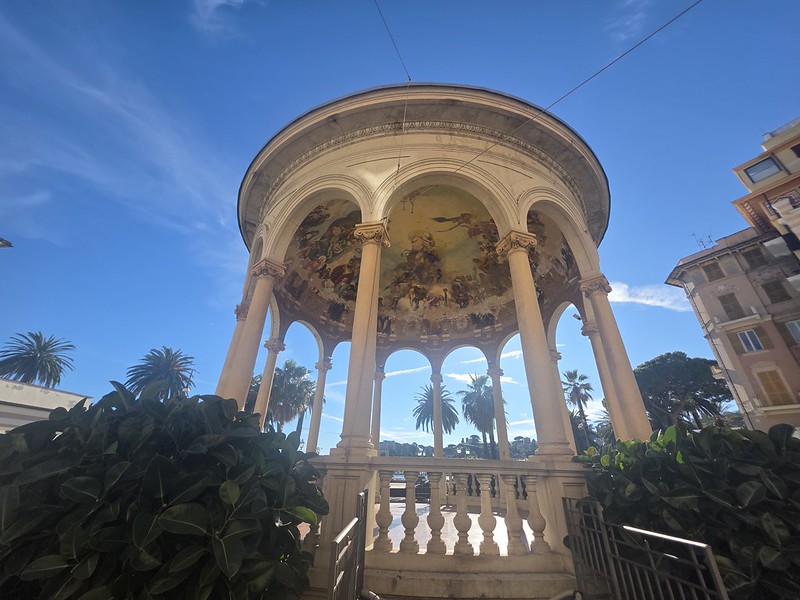
This rather attractive little music kiosk is situated near the waterfront and it was paid for by former residents who had left Rapallo. Millions of Italians left their country in the late nineteenth and early twentieth centuries to settle in South America, mostly Argentina and Brazil.
Unveiled in 1929, it was designed by the architect Luigi Devoto and painted by Giovanni Grifo.
The underneath of the kiosk and it depicts the faces of some of the great composers, including Verdi, Mozart and Beethoven. Given its coastal location, it’s had to be repaired and restored numerous times but it looks in decent shape at the moment.
It’s really quite beautiful, this is the sort of thing that somewhere like Las Vegas, Warsaw, Shenzhen or Dereham should have.
I like travelling on rail networks overseas and I haven’t been on the Italian system much, so I thought that I’d have a little day trip from Genoa to Rapallo. It probably wasn’t the best idea to be taking the train for an hour in the opposite direction to the airport where I was getting an evening flight from, but I like a bit of drama.
This is Genova Brignole, the second largest station in the city and it opened here in 1868 although the current building dates to 1905. It’s spacious, grand and functional, with a ticket office and more helpfully to me, numerous ticket kiosks.
Mine was the 11:24 train to Sestri Levante. The eagle eyed one of my two readers will note that there’s an earlier train, but long experience has cautioned me against rushing for these things and making a mistake.
I went to the platform and realised that the ticket validators were all downstairs, so if I had rushed for my train I wouldn’t have possibly realised this.
My now validated ticket.
The station sign and there was an absence of staff anywhere, the only one that I saw was in the ticket office.
It was too hot, but I don’t like to go on about these things.
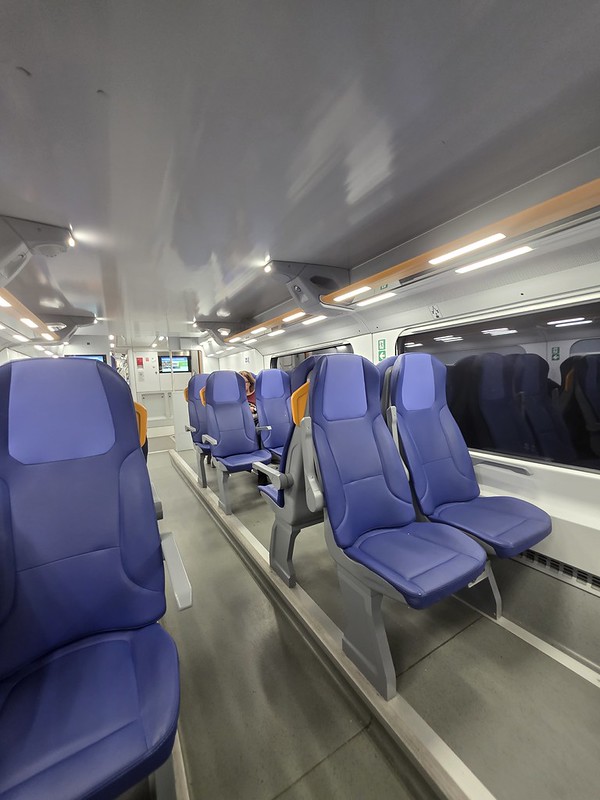
And here comes the Caravaggio train built by Hitachi, but better known as the Rock. They’re two tier trains and they look shiny and exciting.
Most of the power sockets were broken, but fortunately I found a working one so that I was charged up for the day. The train was clean, there were no visible guards, but the information screens were clear and informative. There were also some pleasant views along the coast as we swept along what is apparently known as the Italian Riviera.
And safely into Rapallo railway station, with the ticket costing around £4. I thought that this was reasonable and the train was on time, with the whole arrangement being easy and efficient. The return journey wasn’t, but more on that later.
My second night in Genoa was at the keenly priced and centrally located Hotel Acquario. It wasn’t very well reviewed, but the problems seemed to relate to a previous owner, so it seemed a reasonable place to book. After I had worked out how to open the door to reception, there was a prompt and personable welcome.
There are steps to get to the lift, so accessibility options aren’t really great here. The lift also stopped working overnight, but I bravely managed to walk up a few flights of stairs.
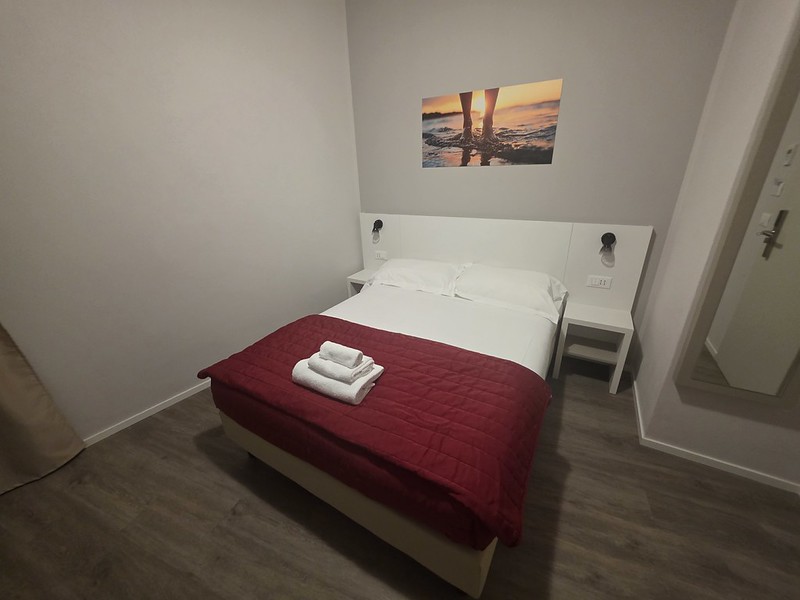
The room was clean, functional and the air conditioning worked. I didn’t hear any guests during my stay, so I’m not sure that it was very busy. Given that there were no guests evident, there were also no internal noise issues.
The bathroom with shower was also clean, functional and everything worked as expected. There has been something of a renovation earlier this year, so everything feels modern and well looked after.
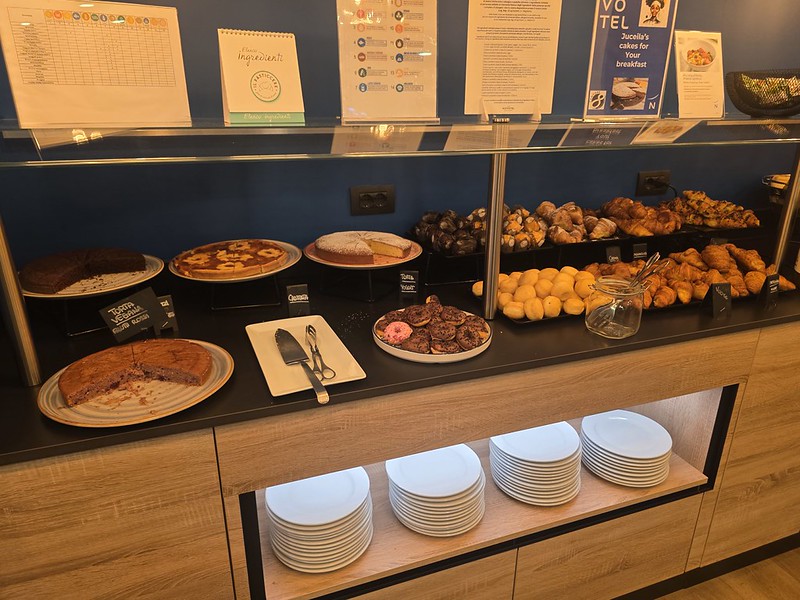
I did debate having the very cheap breakfast, but it required pre-booking and so I decided against it as I couldn’t be making big decisions like that so early on the day before. But, there is a small breakfast room and a basic breakfast provided for a charge of around £5.
I left the window open as I like street noise, although there was excellent double glazing so if anyone wanted it closed they probably wouldn’t hear anything. I was careful taking the photo out of the window in case I plummeted out or dropped my phone…..
Overall, I was pleased with the stay, I thought it represented value for money and is one of those occasions where online reviews aren’t always what they might appear at first sight.
My first night in Genoa was at the keenly priced Novotel, around a twenty minute bus journey away from the airport (well, after a twenty minute walk as well).
I popped to the bar to get my welcome drink.
And after eight minutes I went back to reception as there were no bar staff. Incidentally, the reception desk were friendly and engaging, it was a very welcoming hotel.
The matter was promptly addressed and I got my Peroni, which tasted of metal and disappointment.
The bedroom. I didn’t turn either of them on, but this is the smaller of the two televisions in the apartment.
And the lounge area as well as the hotel had kindly upgraded me to their apartment suite. I did like having that desk and I had more than enough power points to plug devices into.
I didn’t really need a kitchen as well. The free welcome drinks were handy though.
Nor two huge drawers of plates, glasses and other assorted items.
The Nespresso machine with a kettle for teas.
And a microwave.
I had an entire room for a closet as well, I nearly put my one shirt up in the wardrobe to make the most of it.
The view from the room. The air conditioning in the rooms worked well, but I like having a bit of city noise and the windows opened wide which also helped fresh air get in as well.
Breakfast was suitably quiet at 07:15.
Croissants.
I usually skip hot items at breakfast, but the bacon was suitably burnt for my tastes and so I had some of that.
Hams and other items. Unfortunately, the allergens situation here was poorly handled, they were using shared tongs for cheeses, meats and olives. That meant that they had meat, dairy and all other allergens on numerous items, so I’m not sure that anyone with dietary issues would be entirely content here.
Very lovely.
And cake for breakfast is always lovely.
The online reviews for the hotel aren’t entirely positive, but I was pleased with everything. I think the car park charges are a bit high, but that’s hardly something that I need to bother myself with. I suspect that some elements of the hotel are due a refurbishment judging from the reviews, although the public areas looked shiny.
This hotel was very cheap as I was using rewards night, with the size of the upgrade being something of a pleasant surprise. There were a few minor cleanliness issues, but nothing of any concern, with the staff members always being friendly and helpful. I would stay here again if I was visiting Genoa again (well, obviously I won’t stay here if I don’t visit the city, but I digress).
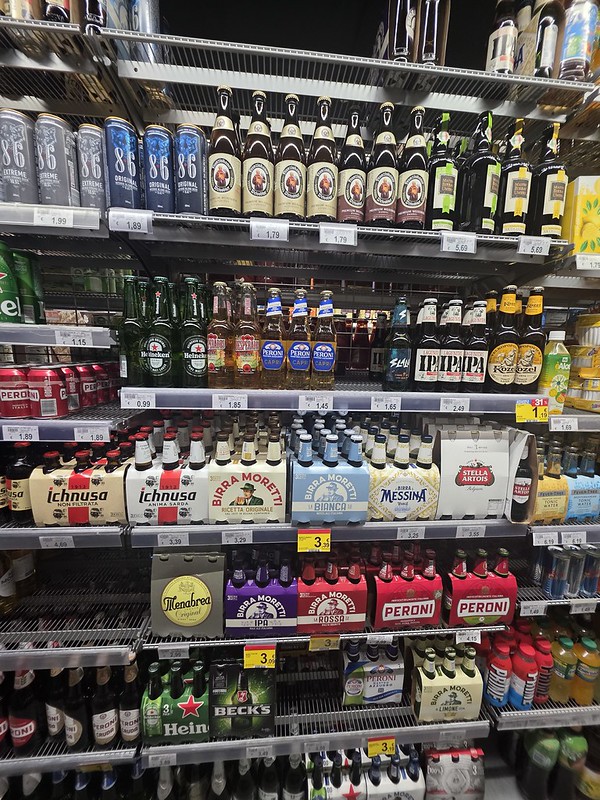
Just as a slightly random post, I had a little meander around one of the Carrefour Express supermarkets in the centre of Genoa. And meander is the appropriate word, they struggle for space and so the selection was wrapped around inside looking more like a miniature Ikea, there’s no Tesco Express blandness here.
Anyway, here’s the beer range which felt reasonable for a little city centre shop as there’s quite a broad selection of styles. There are some strong beers and in the top right of the photo below, a couple of slightly more decadent beers from the Mastri Birrai Umbri brewery in Perugia. That the first Italian city that I visited and that was over fifteen years ago, so I must pop back there.
The prices didn’t seem bad either.
Alongside the Nutella, strawberry yoghurt and liquer chocolates, I went for the Raffo Lavorazione Grezza. It’s quite a malty lager and I must admit that I didn’t hate it, especially at the low price that they were charging.
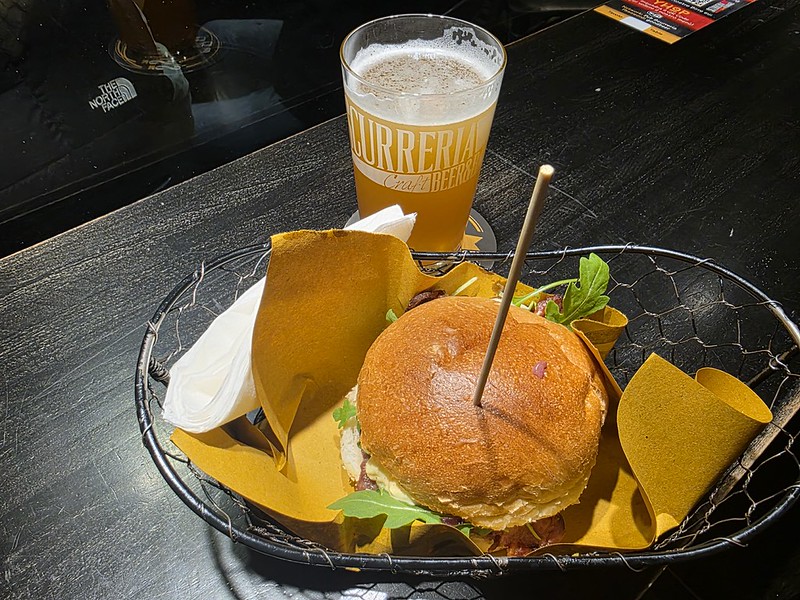
As I was still surprised and delighted by the number of craft beer locations in Genoa, I decided to visit Scurreria Beer and Bagel. I timed my visit well as it was packed by the time I left, which was still early evening.
Staff welcome customers at the door and then seat them, with a QR code on the table giving access to the drinks and food menu. The beers are ever changing, hence why providing a printed menu would be challenging. Table service is then offered and I found the whole arrangement well managed and organised. It all had a vibrant and personal charm, this isn’t a large venue by any means.
The online reviews are very positive for this venue and it felt like mostly locals rather than tourists. That certainly bodes well for the future of craft beer and hopefully more similar venues to this will open up.
For the second time in one day I accidentally ordered a burger, but I don’t mind a bit of duplication. This one was the spicy beef burger and the meat was juicy with the spicy mayo adding flavour, along with the rather lovely caramelised onions.
The beer is the Heavy Punch from the Bonavena Brewing Company, a punchy, hoppy and citrusy beer which was rounded and complemented the burger nicely.
I found the venue friendly, welcoming and the beer range was nicely curated with a selection of different styles. The prices were reasonable and the background music was at an appropriate level for the day. The food menu is primarily bagels and burgers, although there are some other options to surprise and delight customers. All really rather lovely.
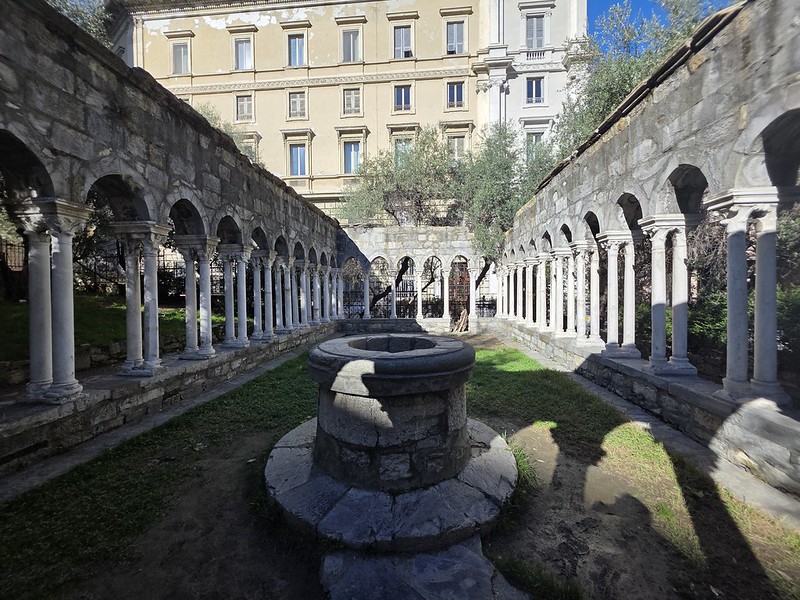
Located next to the former home of Christopher Columbus are these medieval cloisters which feel slightly out of place. That’s primarily as they are out of place, they’ve knocked the nearby church down but thought they’d like to keep these cloisters and so they moved them.
They were attached to the twelfth century Benedictine Monastery, but progress was progress and in the early twentieth century the city authorities wanted modernity and a better infrastructure, so the demolition took place in 1905.
They’re quite understated here, even though they’re next to a busy historic attraction. Which has the advantage that there’s no people, tourist shops or anything else cluttering the arrangement up.
The monastery’s existence had really ended in 1799 when the religious community was shut down by Napoleon. The monastery then became a college, then a prison and so the religious links had long since gone when they decided that the entire area needed clearing.
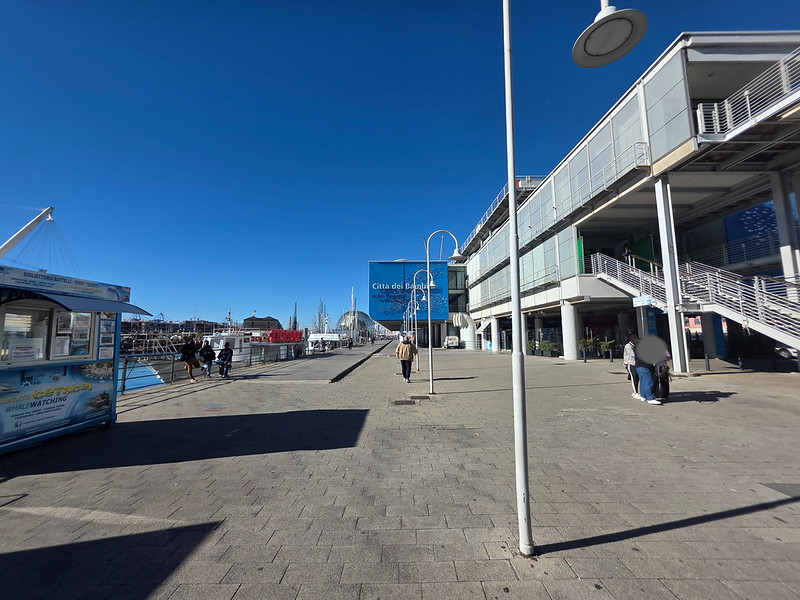
I’m aware that this scam is hardly the preserve of Genoa, I’ve seen it in Rome, Florence, Athens and Milan, but it still feels sub-optimal. I’ve blurred out the two ‘victims’ in this photo but I saw numerous people being upset by this and so it appears they weren’t aware of how it worked despite it being such a common scam.
But, in short, they offer to put a free bracelet or some other rubbish on the wrist whilst trying to be engaging and welcoming. The aim is that the tourists, who are looking to enjoy their day, are pleased to be offered something for free and they make conversation. They are then asked for a donation and it’s hard to remove the bracelet now it’s firmly attached to the wrist of the victim.
I did ignore four different people trying it on me, although it’s never going to work on me as I don’t want a free bracelet. Indeed, I don’t want any adornments of any kind even if they were complimentary. Now, if they tried giving me a decadent can of craft beer, then they might be in business.
The whole arrangement here saddens me as it causes distress, from minor annoyance to general upset, to those targeted, brings the area into disrepute and I can see a relatively large number of negative online reviews about the area because of it. Although this certainly isn’t a new thing, there’s a review from 15 years from someone who felt intimidated by it happening in the Genoa Waterfront Marina area.
I’m not sure if it’s a criminal offence or not, but some of the behaviour I saw today from victims who pushed back was certainly verging on harassment and threats of violence. There were a fair few Carabinieri nearby, so perhaps those involved know just how far to push their little scam without getting into trouble.
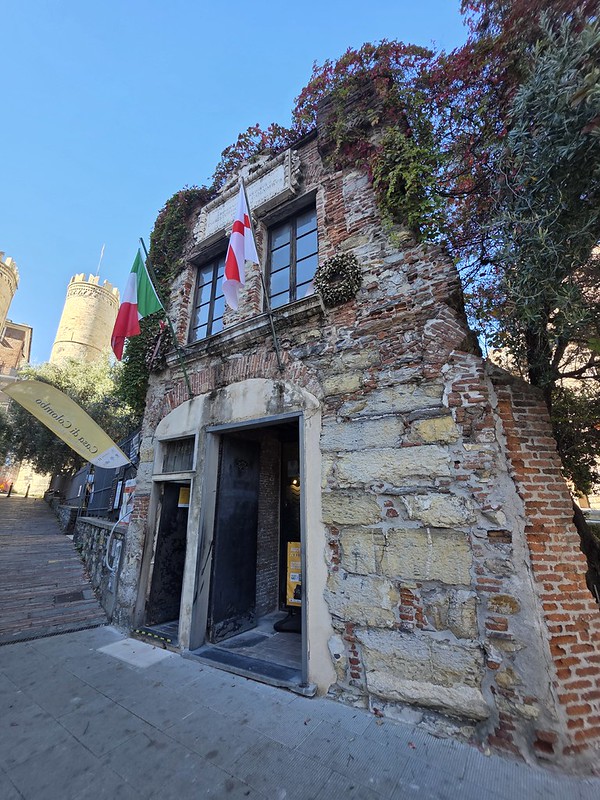
This accumulation of bricks is known as the house of Christopher Columbus (1451-1506) and it is the location of where it’s thought he lived between 1455 and 1470. The actual building is later, built in the early eighteenth century, and a relatively early attempt to try and preserve history. It’s thought that the original structure was destroyed during the 1684 Bombardment of Genoa by the French.
The property is now just two stories in height, but the reconstructed one was across five stories. However, when they knocked the neighbouring buildings down, which had shared beams, they lopped off the top half of this structure. That seems a slightly less inspired attempt to maintain history, but at least something is here.
It’s now a museum, but I didn’t pop in as the reviews weren’t that positive and I can’t say I’m entirely engaged with reconstructed buildings or extensions that are turned into ballrooms. It’s said that the building was lower in height in around 1900, but I can’t find any photos of how it might have looked before that.
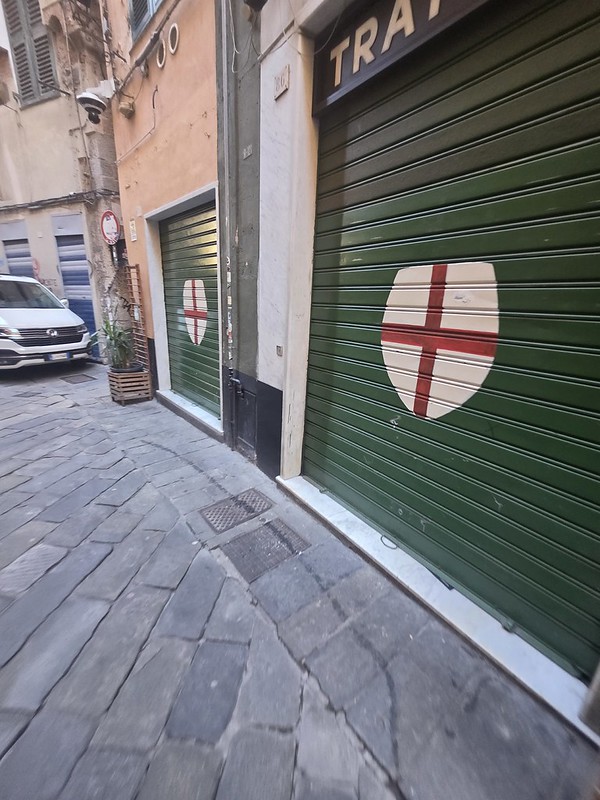
It’s not Essex, but this is Genoa who share the same flag of St. George. Indeed, there’s a strong line of argument that the English took this flag from Genoa and the Duke of Kent said in a speech in the city in 1992 that:
“The St. George’s flag, a red cross on a white field, was adopted by England and the City of London in 1190 for their ships entering the Mediterranean to benefit from the protection of the Genoese fleet. The English Monarch paid an annual tribute to the Doge of Genoa for this privilege”.
The history for all of this is a little disputed and quite controversial, but there is certainly a shared lineage of sorts.