I’m very jealous of the offer on German rail that passengers can get unlimited regional travel by trains for around £60 a month. The German rail system is routinely dreadful, but this is a scheme that I would very much like in the UK. At the moment, £60 feels like it would get me a seat at 23:07 to get from London Liverpool Street to Norwich, there’s so much more that we can do.
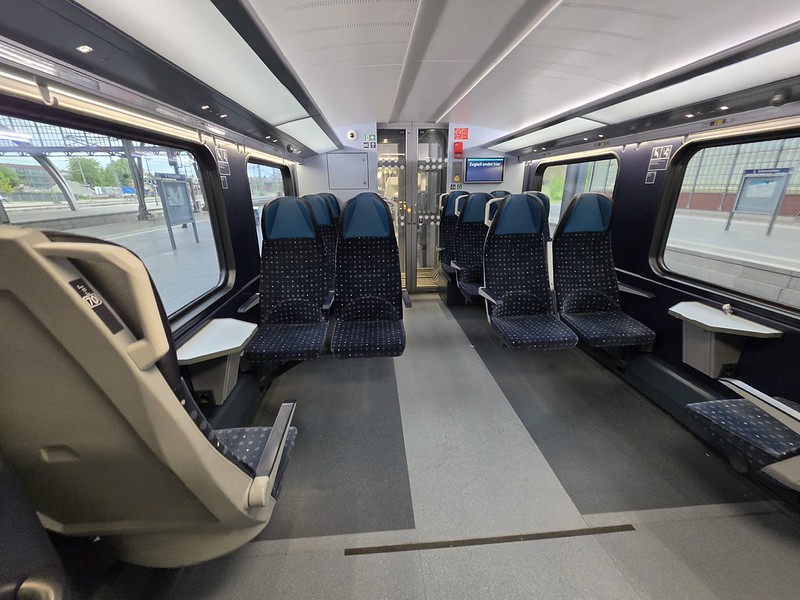
It’s a rather lovely looking train, it’s operated as Deutsche Bahn Regio Schleswig-Holstein.
This is the same, or similar, to the regional trains in Italy and I was thinking that I would be making a rare very positive post about German rail. At this point a conductor came on and threw everyone off with some considerable rudeness, so he was having an altercation with another passenger. I wonder sometimes whether Deutsche Bahn has some sort of commitment to making passengers suffer to some degree, but perhaps that’s being unfair.
They decided to half the length of the train and although I’m sure that they didn’t do that to annoy me although it did show impressive dedication to that principle. It also made the service rather cramped, but here’s the confirmation that we were off to Hamburg though.
There was no seating available, other than in the empty First class section, so people made themselves comfortable on the steps. On a different matter, I found a seat and had access to a power point, so my nerves were calm.
This is the First section that remained empty during the journey, theoretical comfort in action…
Unfortunately, a large number of football fans from FC Hansa Rostock boarded and put hundreds of stickers up around the train. But, they also abused women who took refuge upstairs where I was. Other passengers consoled them, because there were no staff to be seen anywhere, which is always reassuring when the train has developed the atmosphere of a lightly mobile police incident. The fans’ game was also to try and shake the train so it was hardly the most comfortable of journeys for many passengers.
Anyway, this wasn’t a long journey and it was only just over an hour to get to Hamburg. I suspect that if I had selected the train before then the whole experience would have been very different, but this felt like a typical train journey on Deutsche Bahn. I’m pleased to say that the next leg of my journey on Flix Train was considerably better. I’ll just have to go back to Germany and take more rail journeys and I’m sleflessly very willing to do that for this blog.
In a new and ‘riveting’ series of posts that will amuse me and likely no-one else, I’ve been looking at the reviews of Wizz Air on Trustpilot. As a website, Trustpilot seems fundamentally flawed that companies that pay them nearly always have very good reviews, but there we go.
There are plenty of entirely valid reasons to criticise Wizz Air, and nobody who has ever willingly sat at Luton Airport departure lounge at 04:40 should perhaps pretend otherwise. But some of the reviews are also a useful reminder that budget airlines operate on a fairly brutal bargain which is that the fare is low because almost everything else is governed by rules, fees and small print. That does not mean passengers deserve poor service, delays or confusion, but it does mean there is a certain amount of personal responsibility involved in reading what has been booked, checking baggage allowances, understanding airport check-in requirements and not assuming that a £19 flight comes with the emotional warmth of the sort of country house hotel that my friend Richard would book.
“I would leave no star, but doesn’t allow me. I travel with a suitcase that has official size. Not for wizzair. Paid a premium seat that included the carry-on bag. Then my bag was measured by the rudest staff at Barajas in Madrid. They must recruit on level of bitterness and rudeness. My god they nail it. So my bag stuck out 2 cm. And soft. So if you squeeze it may be is fine. HAs been fine everywhere. another 75 euros later… I was charged because it was not supposed to fit. Clearly custom airbus with special bag specifications for wizzair. On board staff allowed it on as i went in overhead compartment no problem. They came after me to take bag down. And plane is half empty. Not surprised. Between delays and rudeness don’t fly wizzair!!!!”
So the bag was two centimetres too big. The personal bag maximum is 40 * 30 * 20 with Wizz Air which is the same as Ryanair and incidentally, with BA it’s 40 * 30 * 15. Top tip here, don’t bring a bag more than 40 * 30 * 20 and Wizz Air doesn’t charge which seems like a fair deal…. And I’d be surprised at a half empty plane, Wizz Air has 93% occupancy and Ryanair is 94%.
“The worst airline I have ever been. I always travel all around the world with my backpack that fits in the cabin. The only place where they forced me to get my backpack out and pay for it was wizz air. I will never travel with them again”
I’d worry less about it fitting in the cabin and more about the bag sizer….
“The worst airlines servicein the world, it should be closed ASAP, so my issue: I bought 23 kg check-in bag for my short flight (1.5h), I came there without 23 kg baggage, but I came with 8 kg small cabin bag, they said I should buy a cabin bag extra, I said them that I don’t have any check in bags, what isthe problem, I’m doing it for you so not overloading the plane with actually weight. They asked me to pay 75€ euro extra or it would be not possible me to go to the plane. That’s so unprofessional and so disrespectful for people who is buying this fckng tickets to travel”
So they booked a checked-in bag, didn’t check it in and then get to the plane with it and wonder why they’re charged….
“I was charged €73 euros per 10kg case as we were told at the boarding gate we should have checked it in to go in the hold! Nowhere did we see that when you check-in on line you should then leave your 10kg (cabin bag) at check in when you arrive at the airport for it to go in the hold!!”
It’s on the website and when checking in, where else are they supposed to put this information?
“Normally, if you don’t choose seats, airlines still put you and your partner together, if there is space. Wizzair separates everyone out of spite.”
Welcome to the world of budget airlines.
“Robbed! I have travelled for 39 countries. Couple of hundred cities. Countless flights and I had NEVER been robbed like I was by WIZZ. They charged us 106€ for not making an online checkin. I’ll repeat 106€ for making our checkin at the airport counter. THIEVES!! Don’t ever fly with WIZZ”
Budget airlines in the US, Asia and Europe all charge for boarding passes at the airport, this customer has done well to somehow avoid them and somehow miss the heap of warnings during the Wizz Air booking process.
“I arrived at the airport 2 hours before my flight. I checked my luggage without any hassle and went through security to get to the gate to board the plane. The lines were endless but I managed to get out of security and into the gate before the plane 20minutes before departure. I ran to where I was stopped and was told by an employee in stuttering English that the gate was already closed and I could not board 20 minutes before the plane was due to depart. I was not explained why or given any real reason.”
The reason is that the gate closes thirty minutes before the flight. I’ve been on Wizz Air flights where the aircraft doors are closed and the flight fully boarded twenty minutes before departure.
“Absolutely terrible experience with Wizz Air. On the outbound flight, the exact same hand luggage was accepted without any issue. On the return flight from Nuremberg to Skopje, I suddenly had to pay €70 extra for the very same bag.
This feels like pure rip-off and completely arbitrary. Either the rules apply consistently, or they don’t. Letting customers fly one way with the same hand luggage and then charging them heavily on the return flight is unacceptable.”
Unsurprisingly, it is possible to board with a bag that’s too big and if they checked every bag every time I can imagine the surprised and delighted customers.
“This is a scam airlines! Never use this for your travel as they actually show a cheap ticket which people buy it but at the end of the travel with all the extras they are the expensive ones.”
Don’t buy the bloody extras then.
“During the flight, two flight attendants seated at the front were speaking extremely loudly for an extended period, which made it difficult to relax. I politely approached them and kindly asked if they could lower their voices a bit, as it was quite disturbing. Unfortunately, their response was very unprofessional and rude. One of them replied dismissively, saying, “this is my working space,” without showing any consideration or basic customer service. Both of them had an unfriendly attitude and made me feel uncomfortable for simply making a reasonable request.”
Fair ply to the customer for telling the crew that, I’m not sure that I would have dared done that.
This is not about sneering at unhappy customers, this is more about the strange little gap between what people buy and what they appear to think they have bought. Those that want decadence really should fly with a full service airline or at least read the rules…..
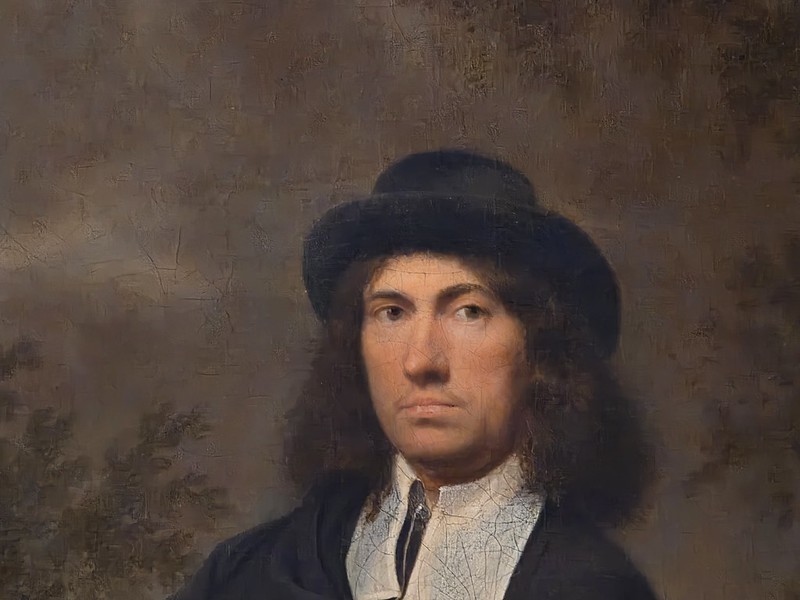
In a world far too full of frivolity, noise and people making unnecessary gestures, Barend Graat (1628–1709) offers this little arrangement. It’s a man in black, seated with all the visible delight of someone preparing to audit a village. There is no dramatic flourish, no satin explosion, no imported parrot or mythological excuse for expensive legs. Just black clothing, a sober hat, a white collar and a face which suggests that merriment has been considered and found wanting. This is just as I would want it to be.
The sitter, who is unknown, may be dressed against frivolity, but the portrait itself is full of social performance. He is not simply wearing black, he is wearing seriousness. In an age when everyone else might be tempted towards velvet, feathers and decorative nonsense, here is a man who has chosen dignity, shadow and the mild suspicion that someone nearby is enjoying themselves too much. I like it and I would put this sort of thing on my wall. Well, I wouldn’t, my friend Liam would as otherwise it’d fall off if I did it.
This old mural is now at the bottom of a staircase, but it was originally at the end of a small chapel. I’m struggling to make this out, but the museum notes that it shows St. Anne, the patron saint of the convent, with her daughter Mary and her grandson Jesus. There seems to be some religious debate about whether Anne actually existed, but it feels inappropriate to think about that in this former convent that was named after her. There are apparently two standing figures at the side, but no-one is sure who they are and I’m not sure that I can even see them.
I asked AI what it could see without mentioning what was in the image, this is what ChatGPT decided it could see.
This is Gemini’s best guess. I’m not sure how close either of these are, but I like their creativity and am reassured that it wasn’t something obvious that I could have seen in the original photo.
I haven’t wittered on about JD Wetherspoon venues for a couple of weeks, so it feels about time to post something. This is the Thomas Waghorn in Chatham which I visited on the first May Bank Holiday.
It’s a grand building which is located in the town’s former main Post Office.
The information panel outside the pub and the chain adds on their website:
“The well-known statue (erected in 1888) by the bridge over Railway Street commemorates the ‘postal pioneer’ Thomas Fletcher Waghorn – the Chatham-born naval officer and merchant seaman who developed a new postal route from Great Britain to India. His 6,000-mile overland route replaced the 16,000-mile sea journey, reducing the time taken from around three months to just 35–40 days.”
As mentioned, JD Wetherspoon opened it in 2016 and they spent £2.2 million on the building and the conversion, so a fair commitment.
It’s a large venue inside with this space in front of the bar and they’ve also got an open kitchen. There is an upstairs area and a garden with a choice of around seven real ales and numerous craft beer options.
My obligatory carpet photo and it was all a bit grimy.
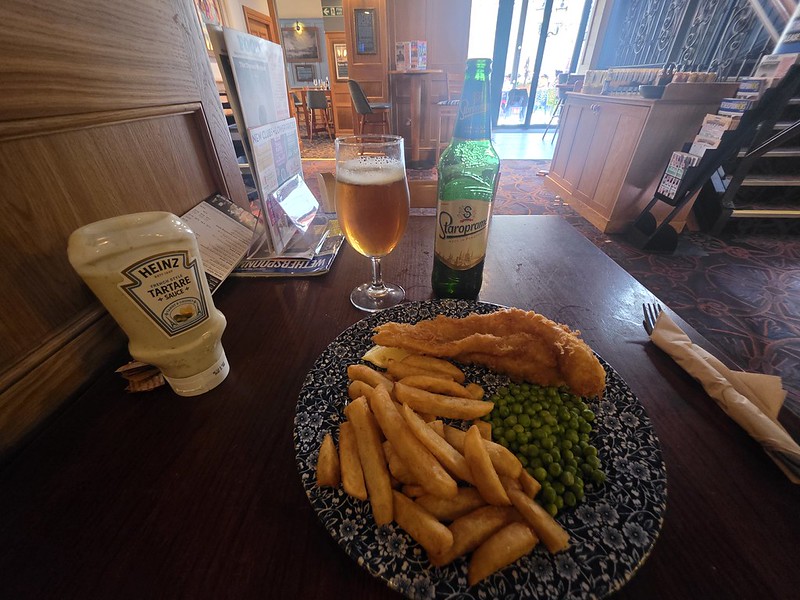
This was around £9 which really is decent value for fish & chips and a bottle of Staropramen. All tasted as expected, was at the appropriate temperature and was served promptly. The Staropramen was agreeable and actually served in a clean glass, those larger ones are often not particularly well presented.
It’s fairly well reviewed online for a JD Wetherspoon venue, but I felt the need to check as usual.
“I am not happy with the way my son and his friends were treated by the staff at The Thomas Waghorn, my son bought an alcoholic drink Mango loco that cost him over £9 & his friend only had a drop of it(only put a tiny drop of it on her finger, she didn’t have a sip of the drink at all) & my son & his friends were kicked out of the place. My son is 18 & a half & I am not impressed with how the situation was dealt with by the staff, I certainly will not be going there ever again as my son has come home in tears as has my niece(who was with my son). This situation should have been dealt with more understanding rather than with rudeness”
Or just don’t let children have any alcohol in a pub maybe…..
“Me (17) and my partner (18) came here for their birthday and they ordered two drinks, both for them. The waiter took the drinks away and offered us juice instead. He then told me with a very smug look on his face that he couldn’t give me a refund as it says in ‘small print’ on the website. This has never been a problem anywhere else.”
I can’t imagine what the problem was here given one was 17….
“WARNING: Filled with old racist men waiting for death. Hateful 20 IQ door staff discriminate at random. Miserable bar staff who cant pour pints they’re so overworked. Reheated freezer food. Literally every surrounding bar in the area is better.”
I don’t think this customer likes the pub…..
“I was simply kicked out because staff did not like my children around”
I would be interested to know what these children were doing….
“Atmosphere of a wake.”
Good, venues can have too much frivolity sometimes….
“Found a 5p in the salt that we sprinkled on our food”
I’m not sure that I’ve seen a review mentioning something like that before….
“The young male server in his 20s who I’ve been told is possibly called Robin ( not sure how accurate that is and dude was also probably autistic) that seemed to really struggle with understanding humour and very obvious good humoured sarcasm had genuinely ruined my evening out with my friend and partner. He was so patronisingly rude and unpleasant that I eventually stopped ordering through the app and went straight to the bar just so he would stop serving my table. He very clearly had a huge attitude problem with power tripping from his server position as he continued to be rude and in a poor rendition of what he thought was an Essex accent said to me “I didn’t see your drink at the end of the bar lovey” in a mocking tone and in reference to myself making a joke about wanting a beer like my friend. Also he asked my partner “If things go down the wrong holes often” when she was choking on her food. Weird to make a sexual innuendo at a person who’s actively choking. For the first time in my life I wanted to talk to the on shift manager as the server was actually bordering on hostile after our 4th encounter which was extremely strange. This is the first time he’s done this as he in a poor attempt at humour called my friends partner fat on another occasion and once couldn’t wrap his head around the fact that someone at our table didn’t want ice cream with their brownie so he legitimately stood there staring in confusion and contempt for 2 minutes I’m silence whist our table watched him in confusion”
Well, I like a bit of drama…..
“Manager refused to deal with my issue after being presented with a side dish that was included on my main plate and so tiny it was like a the kitchen staff had been dared to do it. He wanted more money to rectify it and refused to give me his name when I asked for it, stating I could describe him on the complaints form instead. He was a child but had no self awareness and shouldn’t have been in a management position. Harry Potter specs, curly black hair and an attempt at a man’s stubble? I think? He was very forgettable?”
Those last couple of lines are hideous, how customers think it’s somehow acceptable to talk about team members like that…. Anyway, I digress.
The pub did though hit the newspapers a couple of years ago when two elderly customers were confronted by a duty manager and thrown out for using drugs. Anyway, JD Wetherspoon formally issued an apology and said that the duty manager had made a mistake. However, one of the two had phoned the pub manager up and was rude, and so JD Wetherspoon said he was permanently barred for that instead.
The venue could do with a bit of a deep clean, but it was cheap, welcoming and everything seemed to be served efficiently. It’s a decent venue as well and I’m not sure that many other operators could have made this work.
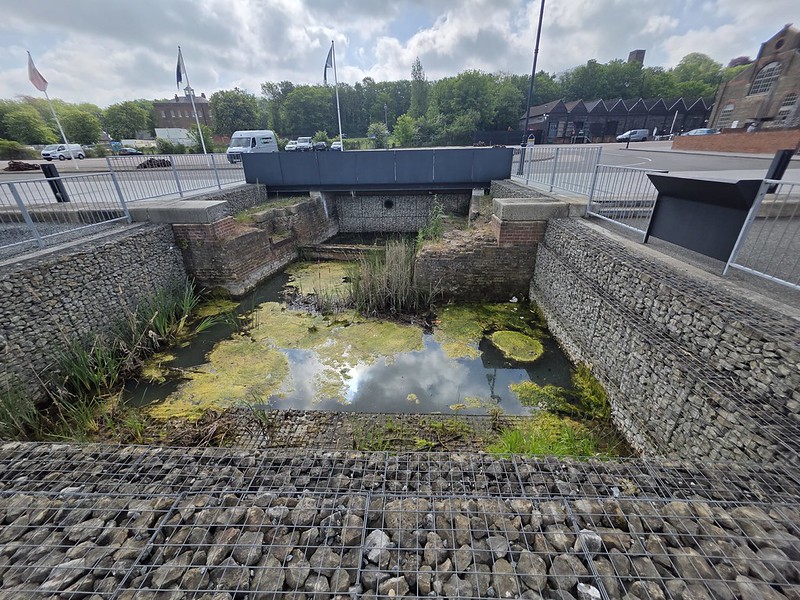
I thought this was some sort of pond and although that’s technically correct, it’s a piece of engineering by Marc Isambard Brunel (1769-1849). In short, the Navy needed vast quantities of timber for ships, repairs and maintenance, and the old hand-sawing methods were slow, exhausting and inefficient. Brunel’s answer was not just to introduce steam-powered sawing, but to think about the whole process. Timber could be floated from the South Mast Pond into the canal system, through the lock and onwards towards the sawmill. This is pretty much all that is left of the arrangement and it was discovered in 2008 by archaeologists and uncovered in 2018.
My point of interest though was finding out more about Brunel, who I hadn’t realised was French. He fled to the United States due to the little problem of the French Revolution and it seems that he was lucky to escape with his life as he was a Royalist. Not that any of his work survives from there, but he was the Chief City Engineer for New York and then came to the UK where he promptly lost all his money and ended up in a debtors’ prison. Fearing that he might go and work for Tsar Alexander in Russia, the British Government bailed him out and he was engaged with numerous construction projects.
That’s certainly some biography to have, although he is perhaps now best known for his son, Isambard Kingdom Brunel who did much for Great Western Railway, designed the Clifton Suspension Bridge, the Thames Tunnel (which he worked on alongside Marc) and designed the SS Great Britain. I’d say that this was quite a talented family…. And he made a nice pond.
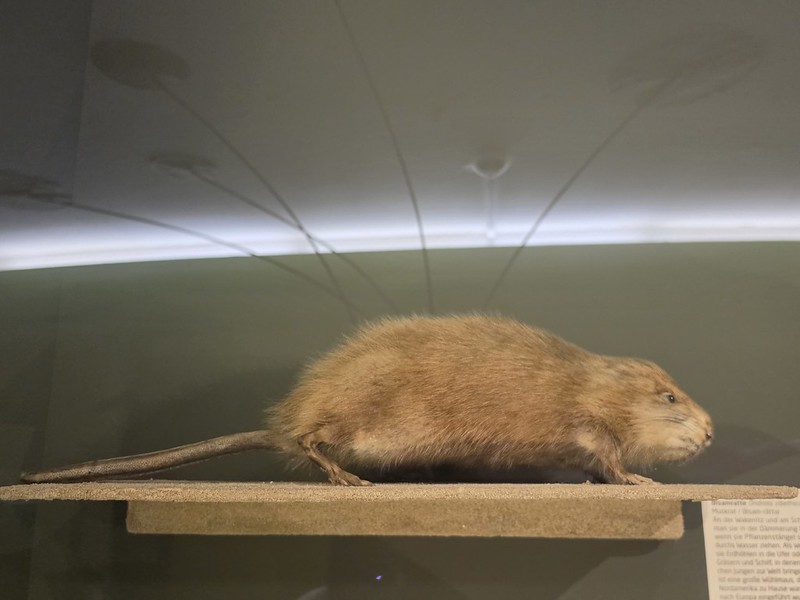
This is a muskrat, but this was one moment in life where I was less excited about seeing a stuffed rodent and more intrigued about the word origin. I’m frequently taken by some flight of fancy, or a linguistic holiday in this case, but in German this is a ‘bisamratte’ which also means muskrat. As an aside, I wouldn’t say that I think this is revolutionary knowledge but I didn’t know that muskrats could stay underwater for twenty minutes before coming to this museum.
It is a semi-aquatic rodent, originally from North America, and belongs closer to the voles than to the proper rats. But humans being human saw it being damp and furry and called it a rat. That all aligns with both the German and English definitions of the word. Anyway, this is where my little flight of fancy begins, because Bisam also means musk. The German word has a long journey behind it, travelling indirectly through older German forms and Latin to the word ‘balsamum’ meaning fragrant and that has Greek origins as well. I was distracted with that word also being where balsamic vinegar got its name, it was just a fragrant liquid.
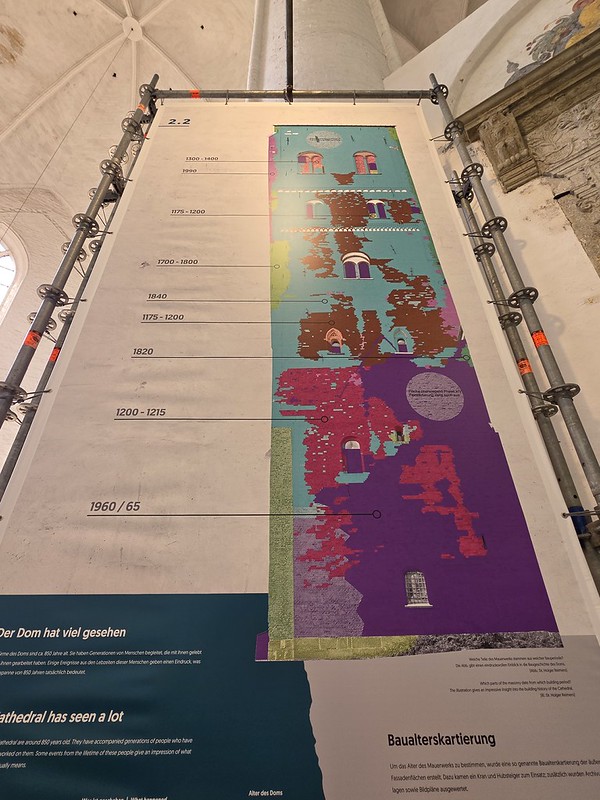
I’m not sure that I’ve seen an image like this before, but it’s a snapshot of how much stonework has been replaced at Lübeck Cathedral over the years. I’ve written about the four construction and engineering problems of the cathedral which has caused this situation, but there has been plenty of stone replacement over the centuries.
In the above image, the various colours show how old the stonework is. There’s not a huge amount of the original late twelfth century stone and what survives is mostly in the middle. I’ve often wondered just how old some buildings actually are because of all the restorations that take place and this gives about a precise answer to that as possible.
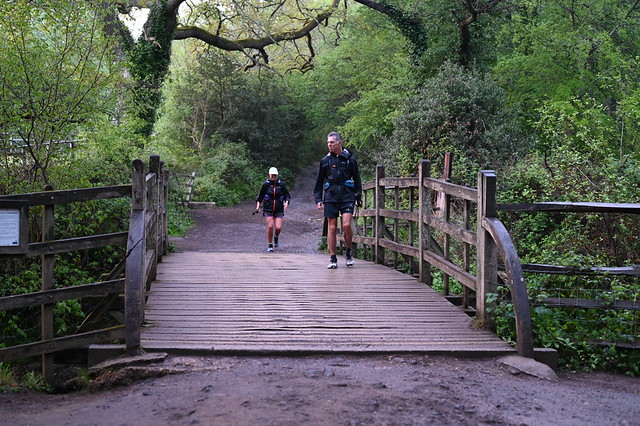
This interview is with Anne, the 100s Coordinator, and she completed the marshals’ event in early May with her husband Vaughan. Here they are in the photo on Pooh Sticks Bridge which is on the route of the 100. There’s some great advice here!
Q. Could you briefly introduce yourself, your role as the national 100 organiser and how many LDWA 100s have you entered?
A. Hello. I’m Anne Wade. LDWA 100s Coordinator on the NEC. This means that I support and help future 100 organising committees to organise our annual flagship 100-mile events. Since these take place all over the country, the role involves a lot of travelling, a lot of sharing of documents and information, and responding to lots of requests for advice and to carry out specific tasks. I have now completed 22 100s and they have all been very different in terms of location, ascent, terrain and weather. What remains steadfast is the warm, friendly welcome at checkpoints and the delicious food.
Q. From your perspective, what are the biggest challenges for a local group in putting on an event of this size?
A. Finding a suitable HQ with adequate spaces, parking, catering facilities and changing rooms. Finding able and enthusiastic volunteers for the various committee roles and the long lead-in time.
Q. What do you think makes a really good LDWA 100, both for entrants and for the volunteers who make it happen?
A. As an entrant, the 2 most important things are the route and the food:
Route – well-thought-out and designed to be scenic and to visit places of interest. Not too many steep hills or stiles, especially in the last quarter. Nice clear footpaths and tracks.
Food – range of plentiful and good quality food. Sweet and savoury at every checkpoint. Variety of hot meals.
As a volunteer, it’s so rewarding to see entrants achieve their goals. Smiling, jolly and grateful entrants make volunteering worthwhile. There are so many roles to be filled in organising a 100-mile event and over both weekends, there is certainly a job for you! Why not be an entrant on one weekend and be a volunteer on the other? Best of both worlds!
Q. You completed the marshals’ event with Vaughan. How did you find the route, and did anything particularly stand out from walking it together?
A. Yes. We always walk together. Now that the trees and bushes are in leaf, the route was even more beautiful than on our recce in March. There were plenty of bluebells, wild garlic and birdsong to keep our senses busy. Walking the route together gives us another shared experience for our life-long memories and reminiscences.
Q. What do you think entrants should most look forward to on this year’s route?
A. Views and variety. The views from the tops of the hills and variety (fields, forest, heath and down). The warm encouraging welcome and amazing food at checkpoints.
Q. Was there a particular stretch that felt mentally tougher than expected, even if it was not necessarily the hardest on paper?
A. When it rained and was foggy during the night. Makes route-finding more tricky and being outside less pleasurable. The descent from the Downs to Kemsing (CP12) immediately followed by the ascent back up to the Downs felt particularly challenging.
Q. How do you get through moments where things feel tough, tiredness creeps in and you start to question your sanity on why you entered?
A. You don’t question it, you just keep going. Surely you know that LDWA walkers are powered by tea and fuelled by cake!
Q. Food becomes rather important on a 100 and is the highlight of the event for many. Are there any particular checkpoint foods or walking snacks that you find especially helpful on a long event?
A. Vaughan eats constantly throughout the event. He takes stashes of food from every checkpoint, munches his way along and is starving again by the time we get to the next one. I tend to eat lots at the checkpoints and that lasts until the next one. Initially, I like sweet foods and coca cola. Then I prefer savoury foods and anything dairy-based. I like to drink milk or weak tea. I especially like the hot meals.
Q. What advice would you give to someone taking on their first LDWA 100 this year?
A. Footcare is going to be the most important factor in completing the event with some degree of comfort. The Weald clay has dried into lumps, which are not kind to 100-mile feet. Top tip – stick sanitary towels to the insoles of your shoes – the extra padding works wonders!
Do not go out too fast. Save some energy for the relentless steep hills in the last quarter.
Eat plenty right from the first checkpoint. You will burn around 10,000 calories and you cannot run on empty.
Q. Finally, when you look at the amount of work that goes into each 100, what do you hope entrants remember about the people behind the event whether it be the organisers or the marshals at the checkpoints?
A. Smiling and encouraging from the start all the way through to the finish, even though they will be just as tired and will have had very little sleep.
Walking and eating are the easy parts. While rewarding, marshalling at HQ and the CPs is really difficult at times and there are always crises to deal with, of which entrants will be blissfully unaware. Then there are the unseen heroes, like the control team, media team, transport team, baggage team, sweepers, as well as the caterers and cleaners.
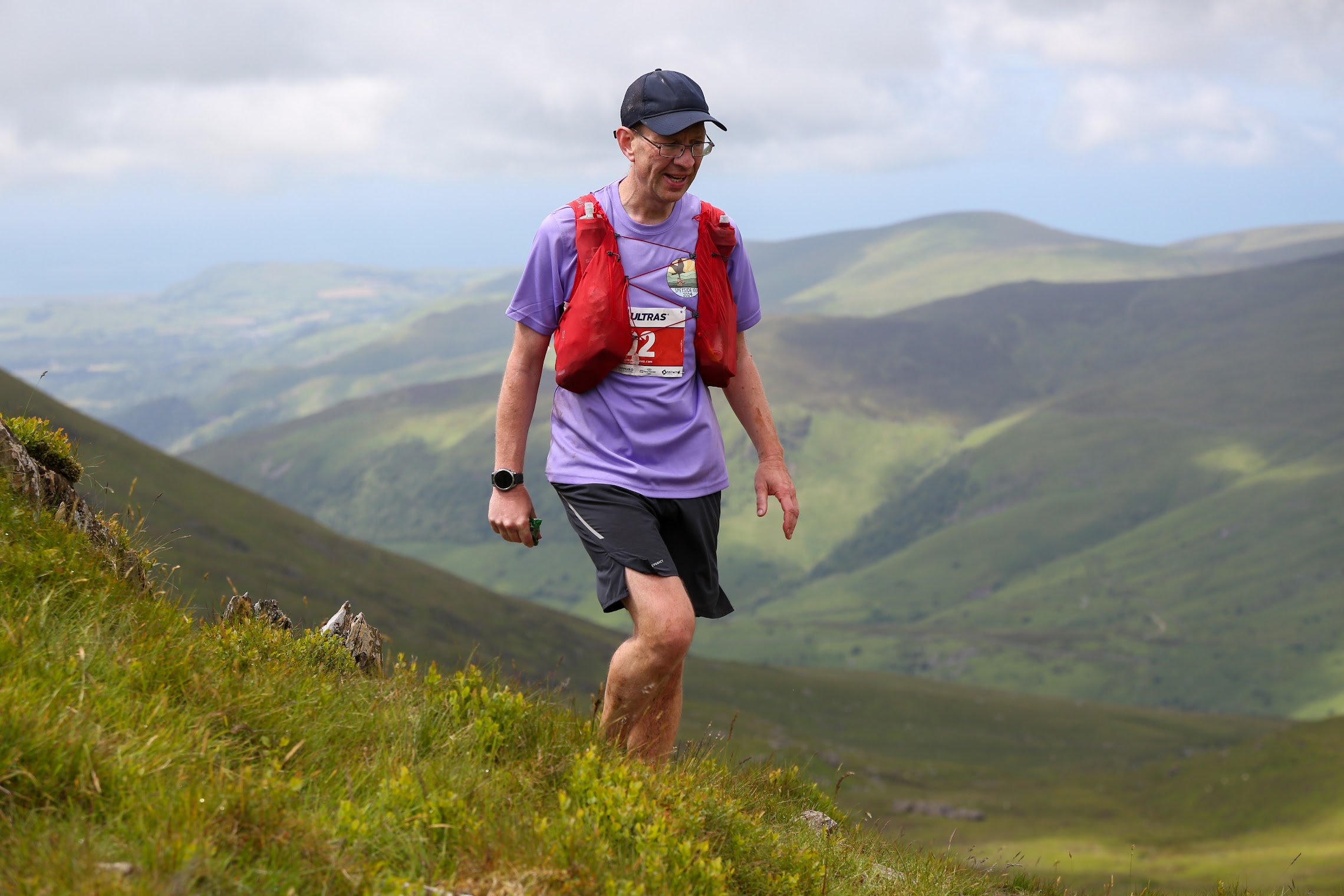
This interview is with Guy Evans and I like who inspired him during Covid! And there’s some great advice here.
Q. Could you briefly introduce yourself and say how you first became involved with long-distance walking?
A. I’m a long-time walker, more recently turned into a sometime runner. I’m an addict. A long distance addict. It started with family walks, then one thing led to another and I entered my first long distance event, the Bath Beat organised by a certain David Morgan at the time. But after a while that wasn’t enough and I stepped up to 50s. I still have the mug from my first ever 50, the Poppyline 50 back when it was held in the summer. Fortunately, the appalling blisters that I also acquired eventually healed! It took me a long time to get my head around doing a 100 miles and I was partially inspired by Julian’s blog posts during Covid to take the plunge. “I’ll just do the one then I know I can do it. Only mad people walk a 100 miles.” Now I’m at the point where I’m wondering if a 100 is enough. So I’m an addict. But I figure there are worst things to be addicted to!
Q. You’ve completed four LDWA 100s already. What keeps bringing you back to the event?
A. It’s iconic. Above all, I love the understated, unpretentious, laid-back, friendly atmosphere. It has a very different feel than other ultra events. As it’s in a different part of the country each year the route and scenery is always new. Finally, I don’t currently need to worry about cut-offs. I plan to do them as long as I am able.
Q. What did you learn from your first 100 that still feels useful now?
A. Not to think about the overall distance. Just think how far it is to the next checkpoint. A very large part of finishing is mental not physical.
Q. How does your approach to a 100 change with experience? Are you calmer now, better prepared, or just more aware of the various little indignities waiting along the way?
A. For sure, I’m more relaxed. There is confidence in knowing I can do the distance and in knowing my kit, what to put in the drop bag etc. But there are always doubts, a 100 miles is a long way. I’m better mentally prepared but due to injury less physically prepared.
Q. What are you most looking forward to about this year’s Hunnypot 100 in Kent?
A. Catching up with people who I haven’t seen for a while, a number of them since last year’s 100. I’ve heard the scenery in the last quarter is good, so I hope I’m not too tired to enjoy that. And of course dodging the heffalump trap.
Q. Are there particular parts of a 100 that you especially enjoy, whether that is the early miles, the night section, the checkpoints or the final stretch?
A. I love the absurdity of the breakfast stop and in particular the full English. That and the beer at the last checkpoint 🙂 A wonderful juxtaposition that somehow sums up the LDWA so well!
I’ve always had a second wind after the breakfast stop that carries me through for a bit, then there is “just” a good day’s walk to the finish. Night sections I used to despise, but I’m beginning to appreciate the stillness more.
Q. What do you find hardest about the later stages of a 100, and how do you keep yourself moving when tiredness starts to take over?
A. The general fatigue. However long the event it’s about 70%-80% of the way through that I often find hard, you’re tired but the end isn’t yet in sight. As to how to cope, I saw a sign on an ultra that really resonated with me: “You didn’t come this far to come this far”. That’s so true. Determination keeps me going, my wife would say stubbornness. In some perverse way, I’m looking forward to that feeling of fatigue. I feel I may regret saying this.
Q. Food can become rather central on an event like this, sometimes alarmingly so. Are there any checkpoint foods or walking snacks that you particularly hope to find on a long event?
A. I’m lucky in that I can usually eat anything. Hot cross buns are a favourite but tend to be seasonal!
Q. What advice would you give to someone taking on their first LDWA 100 this year?
A. 0. You’re amazing for getting to the start line. It’s too easy to get into a bubble and forget that we are all ordinary people doing extraordinary things.
Don’t overthink it. Just concentrate on getting to the next checkpoint.
Know your “why”, that could be something worthy, such as setting an example to your young kids or raising money, something personal, such as I want to prove to myself that I can, or something intrinsic, such as I’ll feel so proud on Monday, or whatever. But know your why. Your head is much more likely to give up before your body does.
There will be lows but remember, it doesn’t always get worst.
Smile, especially when you don’t feel like it.
Q. Finally, when you look back on the 100s you’ve completed, what moments tend to stay with you most?
A. Great question. It seems somewhat random. Being alone on the Great Ridge in the dark and wind, chatting with someone on the canals going into Stratford, in Scotland summiting a hill at sunset well past 10pm, a pretty river section. Those and the moment around mile 90 where you know, really know, that you’re going to finish and you just need to walk it in. I remember ringing my wife nearly in tears on my first 100 at that point.