For anyone trying to follow this blog, my apologies for all of the jumping around (not literally, I’m too old for frivolity like that). I had a couple of weeks away to celebrate my birthday and then went back to the UK and thought I needed another little trip away. The one I decided on was to Italy and Venice, and I have already written about the movingseatgate flight…..
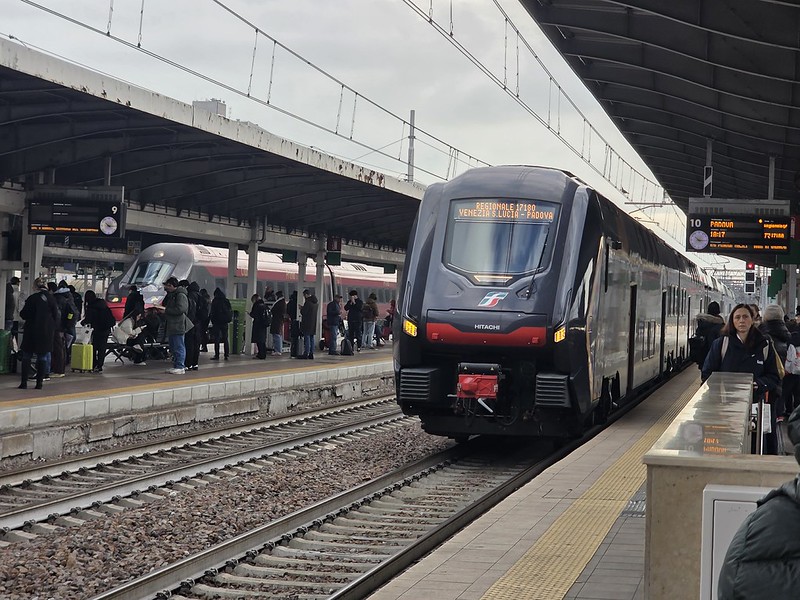
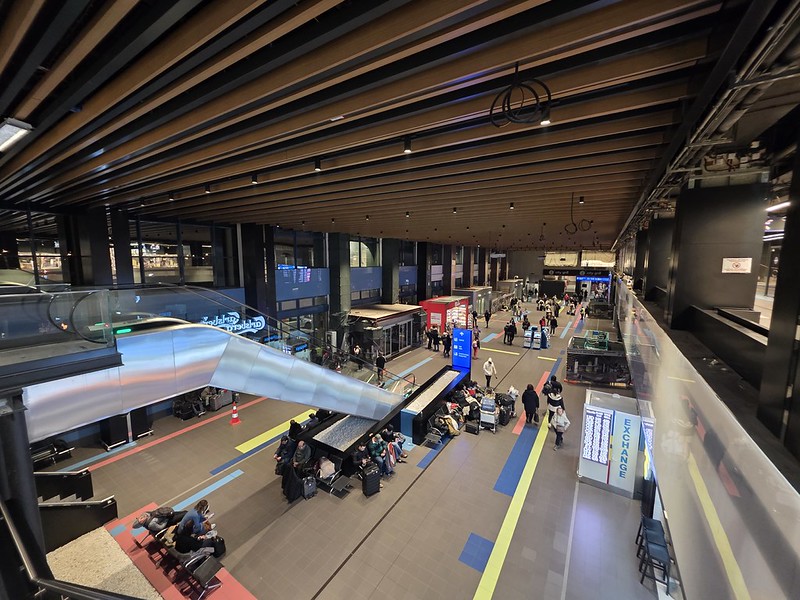
This means, here I am at Venice Mestre railway station as I fancied going to Padua. The station first opened in 1842, although the current and rather cramped station building opened in 1963.
The train journey cost me around £4.50 and I used the app to purchase the ticket. I deliberately boarded a regional train, even though there were quicker ones, as I like these double-decker trains and I don’t have to faff about with seat reservations.
I’m getting very used to these trains now, lots of space and power outlets are readily accessible.
And safely in Padua.
One of the Frecciarossa 1000 high-speed Italian trains which are in operation. These trains can fly around Europe at 400 km an hour, although the speed restrictions in Italy slow them down a bit.
After a peaceful night at the Ibis Styles Bucharest Airport, I decided to walk to the airport which is about a fifteen minute walk. Not all of the pavement was like this shall we say, but it was an easy walk and for those without baggage it’s not worth using a shuttle. Although I might not be the best touchpoint on this as I think that anything involving under one hour of walking isn’t worth getting transport for.
The Gendarme Heroes Monument at the entrance to the airport.
I had some minor issues finding my way into the airport terminal, which is evidently not designed for people walking there, but here’s the main entrance. It transpired that this was the arrivals terminal, but there is a connection via an internal corridor to the departures terminal.
As I had departed too early for the hotel’s free breakfast, they had instead given me a drink, yoghurt, croissant and I saved the banana and yoghurt drink for the airport. There’s no lounge here, so this just had to suffice.
I’m sure that the airport will look lovely when the work is finished, but it feels a bit like a building site at the moment.
The departures terminal.
There’s my flight, the 07:10 to London Luton.
There wasn’t much of a check of my passport at the airport, but the security there were all friendly and I was able to find a quiet spot to wait for my flight. There isn’t a great deal of space here, but the gate staff did their best to ensure that passengers weren’t left waiting.
This photo is from the arrival at Luton Airport, as there was an air bridge so I couldn’t get an external photo. The seating Gods had put me in 34F, which is a window seat, so that worked nicely for me. The aircraft is 9H-WNP and for about the tenth flight in a row, I have to report that I haven’t been on this one before either.
I was asleep for most of the flight, but everything I saw was well managed, professional and efficient. I really don’t understand how people have issues with Wizz Air on such a regular basis, as I find their cabin crew and pilots to be as good as on any other airline.
And that was the end of this trip, which started on my first birthday weekend with Liam, Ross, Richard and I going to Cardiff. After travelling to Italy, Slovenia, Albania, Greece and Romania (albeit the last three quite quickly) I had a train back to Norwich and some happy memories of a very lovely trip, with thanks to Steve, Bev and Susanna joining me in Italy and Slovenia.
I accept that this isn’t a perfect photo, but I had taken two flights and a rather packed bus from Bucharest Băneasa airport to get here. This is the Accor operated Ibis Styles hotel, which is where I was spending my final night of my near two week trip around various bits of Europe.
There was a very friendly welcome from the team member at reception and he mentioned about the free breakfast. When I said that I’d be leaving too early, he said that the hotel can arrange something in these circumstances, which was much appreciated. He also mentioned that they had upgraded my room and I very much liked this as well.
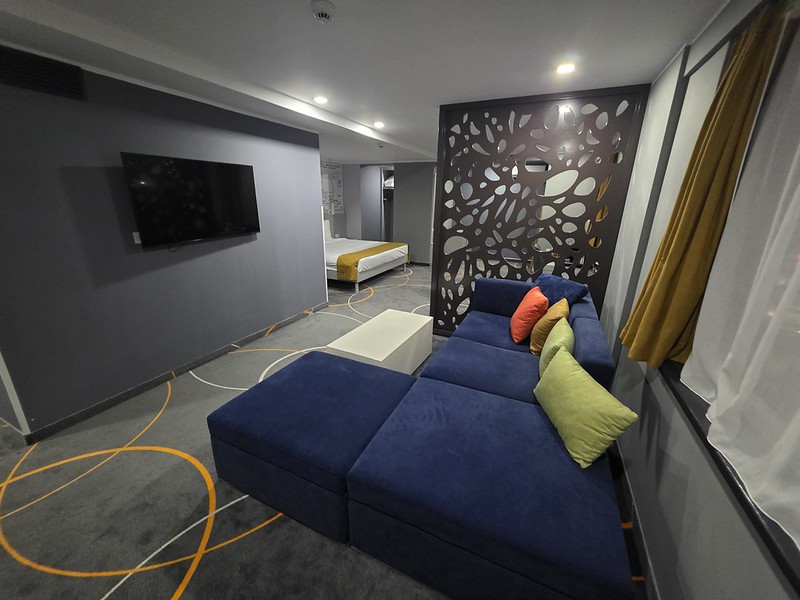
Very comfortable. The design felt both a bit 1980s and also modern, it had a homely feel that I liked. Ibis Styles are known for their slight quirkiness and they brand their hotels around a theme, with this one being air travel which feels appropriate.
My welcome drink of beer and also my welcome gift of fruit. I’ll be honest and say that I prefer chocolates, crisps, beer or random souvenirs, but a gift is a gift and was much appreciated. I also love seeing a Nespresso machine in a room, so I indulged in coffees.
Some of the room decoration.
I like traffic noise, so I opened the window happily, although the double glazing is very effective at keeping the noise out, including from the next door airport.
With my breakfast collected, it was time for the early morning walk to the airport. And more on both of those in the next post….
But, overall, this was an excellent hotel, with friendly service, clean rooms and no noise issues. I felt very welcome and after two flights in one day, with another one early the following morning, I felt entirely rested by the time I woke up. This is a hotel that I’d certainly be happy to book again when I’m next in the Bucharest area.
My Wizz Air flight had arrived into Bucharest Băneasa airport from Athens, which is the smaller of the two international airports in the city and one that I’ve never visited before.
I think it’s beautiful and it was immediately evident that this is an airport from the early days of international passenger travel. These are usually demolished or refurbished beyond recognition, so it was a delight to see that much of this one felt original.
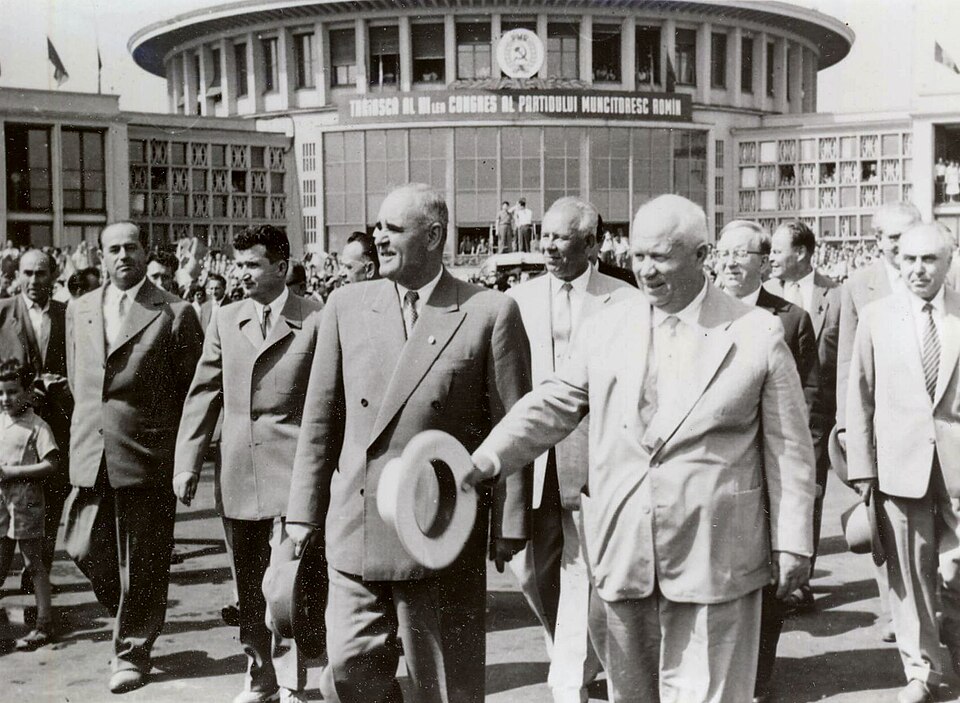
This photo was taken in 1960 not too far away from where my previous one was taken. In the middle is Gheorghe Gheorghiu-Dej, the then Leader of Romania, with Nikita Khrushchev, the President of the USSR, with his hat. And there to the left of Gheorghe Gheorghiu-Dej is a younger, and at the time less powerful, Nicolae Ceaușescu.
The departure hall of the airport. As a quick history of this airport, it was opened to passengers in 1920 and that makes it one of the oldest airports still in use in Europe. The current terminal building dates to the late 1940s, although it didn’t open until 1952. It was the country’s main international airport until Bucharest Henri Coandă International Airport opened in 1969.
In 2012, it was decided to close this airport to passengers and concentrate just on business traffic, primarily as Bucharest Henri Coandă had taken all of the trade. However, this period was a time of a surge in budget airlines, more interest in visiting Romania as a country and growing business needs, so, in 2022 it reopened as a passenger airport.
And the approach road to the airport. I hadn’t realised when I landed here just how beautiful the airport was, so I’ll have to try and ensure that I fly from, or to, this airport again so that I can explore it a little more.
Having safely arrived in Athens from Tirana, I had a wait of just over three hours for my next flight. As Albania isn’t in Schengen, that meant I’d have to reclear security in Athens ready for my flight at 14:10 to Bucharest.
Wizz Air flights depart from the Satellite Terminal, which feels around eight miles away and it’s a compact area which really struggles with the number of passengers using it. Fortunately, the lounge in this terminal is much quieter and was a peaceful place to wait for my next flight.
Their hot food selection might have gone entirely untouched as I didn’t see anyone have anything from there and it was swept away at lunchtime.
My more basic breakfast snack.I realised that I had gone for a beer at around 11:00 in the morning, but I think the rules of alcohol don’t apply at airports. Also, as I’d been up since around 03:00, it felt like lunchtime.
The lunchtime cold food came out and this was what I was hoping for, Greek salad, chicken wraps and dolmadakia.
Lovely.
There are some decent views of the runways and also the actual airport for those passengers flying with airlines who didn’t have to use the Satellite Terminal.
I had a very peaceful couple of hours here, before going back out into the rather more bustling gate area.
There was some strict enforcement of bag size at the gate which led to the normal complaints of “it’s ridiculous, it’s only just too big” from some passengers after they’d be charged £80 or something. Far be it for me to judge, but if the bag is too big, then it’s too big, but most people caught out tend to have bags which hardly fit through the aircraft door, let alone the bag sizer.
My aircraft awaits.
Unusually for Wizz Air, we boarded via an air bridge, which meant I had to make efforts to work out the aircraft’s registration which was HA-LXH, yet another aircraft that I haven’t been on. I should probably find a new hobby to be fair than working out which aircraft I’ve sat in.
The seating Gods had given me a window seat near to the rear, so I waited for about a month for passengers to work out where they were sitting and then faff about for three hours putting their bag in the overhead lockers. I very much like the Wizz Air crew, as they get passive aggressive annoyed at passengers faffing about, which reassures me as flights need a small amount of panic about an on-time departure.
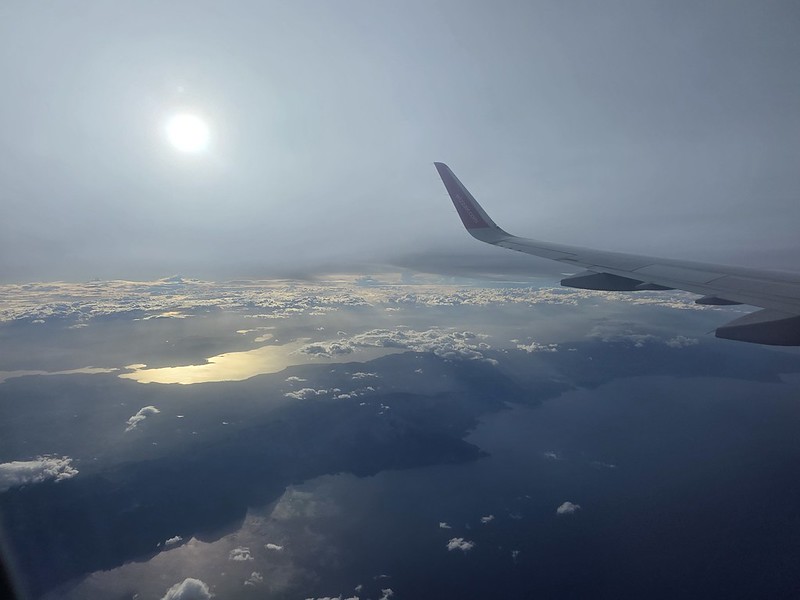
And we’re off.
It was a peaceful flight, no-one annoyed me and the announcements were clear and appropriate from the pilots. The cabin crew were friendly and efficient, so this is yet another post of delight about Wizz Air. For £8.99, I was very pleased with this flight, but I’m conscious that I’m noting that quite a lot.
Safely in Bucharest Băneasa airport, which I’ll post about separately as I really enjoyed flying into this location for the first time, being more used to the larger Bucharest airport which is nearby.
Tirana Airport at some early hour of the day, this was the first of my two flights of the day, this one to Athens and then one from there to Bucharest.
The airport wasn’t very busy yet, I had arrived at something like 04:30 for my flight 06:50 flight.
Very pretty, the view after I got through security, which was prompt and efficient. The queueing arrangement was a little erratic, but I’m too broad-shouldered for the woman trying to push past me in the queue to have any chance of success. This enabled the queueing system to work in the way that I expected it to.
Which meant that I had clear access to the food and drink…
Ajvar, tomatoes, olives, gherkins, this is what I call a breakfast…
And that’s burek on the left, this surprised and delighted me. They did have some other hot food elements for breakfast, but I didn’t engage with those.
After a few coffees, orange juices, breads, muffins and a heap of ajvar, it was time to leave the lounge, slightly unwillingly to be honest.
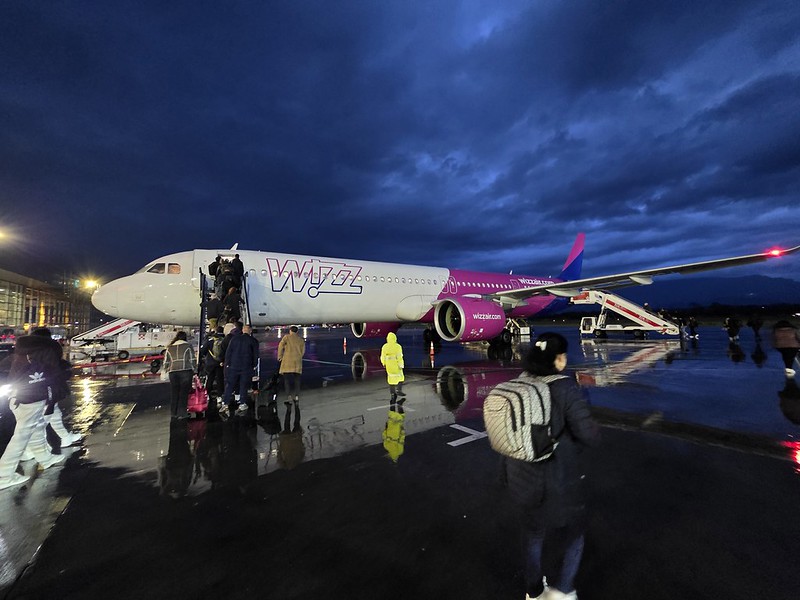
Ready to board, the aircraft is HA-LVP which isn’t an aircraft I’ve been on even though it’s usually used on Warsaw routes.
The big hills in the background…..
Wizz Air crew are routinely brilliant, but they couldn’t do anything about the passengers on board if I’m being honest. Some passengers decided that they didn’t like Wizz Air’s seating system, so they decided that they’d sit where they liked. The passengers were rearranged back to how Wizz Air liked it, so we were ready to take off.
At the end of the flight, the crew tried initially to stop several passengers standing up as the aircraft was landing, but after temporary success, several passengers ignored them and meandered around the aircraft whilst it was still taxiing. The aircraft then stopped quite abruptly and an elderly passenger promptly fell over and another passenger opened the overhead locker and a bag fell on his head.
Oh good, a bus to the terminal.
Nice views. Well, relatively, I’m standing on the tarmac of an airport.
I’ve only just got a new passport and all the other countries have carefully stamped it in order near the front. But, not Athens, they shoved their stamp on page 28 and it was so heavy in ink it promptly covered the opposite page. Sub-optimal.
Some of the new machines that will be brought into action soon. The queueing system at Athens Airport was chaotic and the staff weren’t really sure what to do, it felt a disorganised mess. Being British, I like a system where people queue in order, this system was widely rejected by other passengers on the flight. Fortunately, I didn’t care, I was in no rush as I was staying at the airport for another flight around three and a half hours later.
But, back to Wizz Air, this was a £9 flight and I was once again delighted at their operational efficiencies. Organised, efficient and their systems only became derailed because passengers did whatever they wanted and that included far too much applause on landing which I felt was far too raucous.
As I had an early morning flight, I didn’t really have the opportunity to go back into central Tirana again, so I went to stay at the Side Airport Hotel. This was only around a ten minute walk from the airport of which half of that was working out how to get around the security gates.
Walking past the cargo centre. Does travel get any more exciting than this?
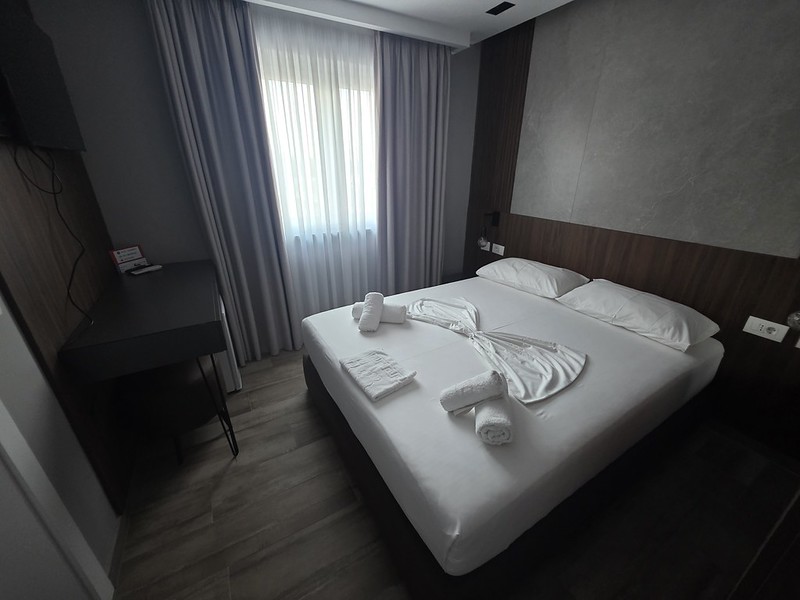
There was an upbeat welcome at the reception desk and I was told that I could have a free lift to the airport in the morning. I did mention that I had an early flight, but they were determined to be helpful. The room was clean, functional and they had made an effort with the towel presentation. I’m not too concerned if a hotel puts the towels in a pile, but I suppose it shows attention to detail.
The bathroom was clean and tidy, it all felt decent value for money. There were also no noise issues, either internally or externally. I could hear the airport, since it was around 50 metres away, but I like background noise like that.
The view from the room. Although I couldn’t see anything priced, there’s a shop and bar in the hotel, both of a reasonable size.
I would have been happy walking to the airport at 03:00 given that it was so close, but they wanted to drive me as part of the hotel’s offering, so I accepted.
Two minutes later I was safely at the airport and I realised that there is another way in, so the hotel was actually nearer than I thought. I’d certainly return to this hotel if I needed to stay near to the hotel overnight, I thought it was very reasonably priced, it was clean and modern.
After leaving the airport lounge in Trieste, it was time to go through to passport control. This was very much a positioning journey to get me back to the UK, I spent some time in Tirana earlier in the year and I would only be there overnight.
After getting through into the gate area, it was apparent that the airport authorities had forgotten to put many seats in there. As this was a non-Schengen flight, it meant we had to be segregated, so annoyingly there were lots of seats the other side of that glass wall.
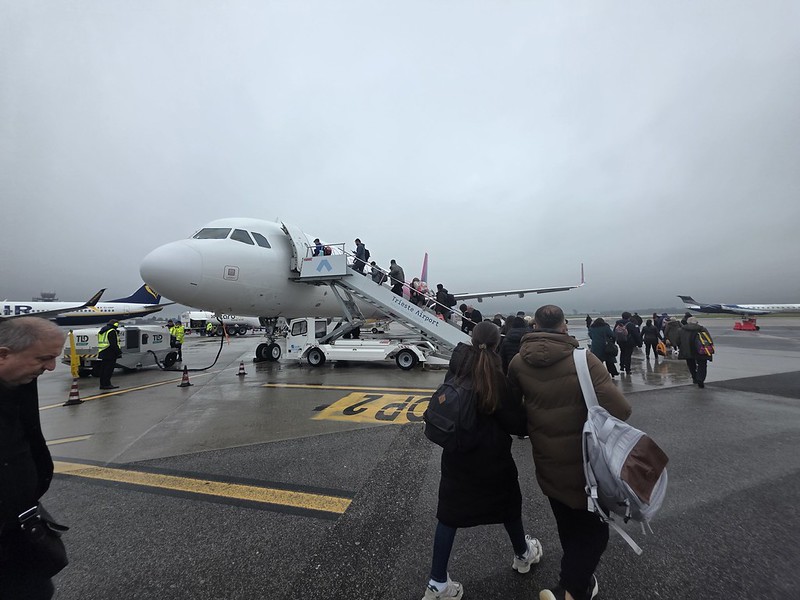
Walking outside to the aircraft, the whole process was ordered as usual.
The aircraft was HA-LTB, seemingly another aircraft that I haven’t been on before. I think I might need to get on more Wizz Air flights…. It’s quite rare for this to happen, but the seating Gods gave me a middle seat, but the flight didn’t take much longer than an hour, so this was all very tolerable.
This seems much more common on flights to and from Albania, but there was far too much excitement on landing with some passengers applauding and screeching with delight. I can’t be doing with this level of raucous and the crew members struggled to get control of the passengers who were bored of waiting and started standing up whilst the flight was still taxiing around.
I was walking to the hotel, which was just a ten minute walk, after I established how to get out of the aircraft as they’ve got fences everywhere. I did plan to pop into KFC, but the prices were completely out of any sensible level which did explain why it was nearly empty. The prices were around five times higher than their central Tirana location and I’m not going to engage with that nonsense.
Excuse the wire fence that I couldn’t poke my phone through, but here’s the exterior of the rather attractive looking airport. Although I think they’ve added this cladding type arrangement as the airport actually isn’t very attractive.
This flight cost me just under £9 and once again, the crew were friendly, personable and the aircraft was clean. There was a quick trolley run, but there weren’t many takers, but apart from the unnecessary applause it was another of those flights that nothing exciting took place and that’s just how I like it.
I had spent the night at the Tritone Hotel which was very good value for money, but it wasn’t ideally placed for an evening in Trieste. It was, however, better placed in theory for getting to the airport. I had initially planned to walk the forty minutes to the main bus station, to ensure that I was able to get on the airport bus without any issues. I then realised that one of the few airport bus stops was literally five metres from the hotel, so I thought that I’d risk that.
Here we are, after about six seconds of walking, I was at the bus stop. At this point, there was only three hours left before my flight, which to me is crazily risky. There were the risks that the bus didn’t turn up, it was full or it would go flying by me. I was slightly concerned as the back-up plan (I always have a back-up plan) would be a taxi and that wouldn’t be cheap. But, being positive, I bought my ticket on the transport authority’s app, so I was ready to go.
And there’s no tale of woe here, the bus turned up only one minute late. There were four people on it excluding myself and the driver. I was quite relieved.
Forty minutes later, I was safely at Trieste Airport and it has been a long time since I’ve been here and I’ve entirely forgotten everything about it. Airports do tend to blur into one another after a while….
There’s a lounge at Trieste Airport that I could use with Priority Pass, although you have to get a code when landside to be able to get in. This was easy to do, there’s a desk near the check-in desks, so I went through a very quiet security area and then typed my code in to gain entry. It was packed.
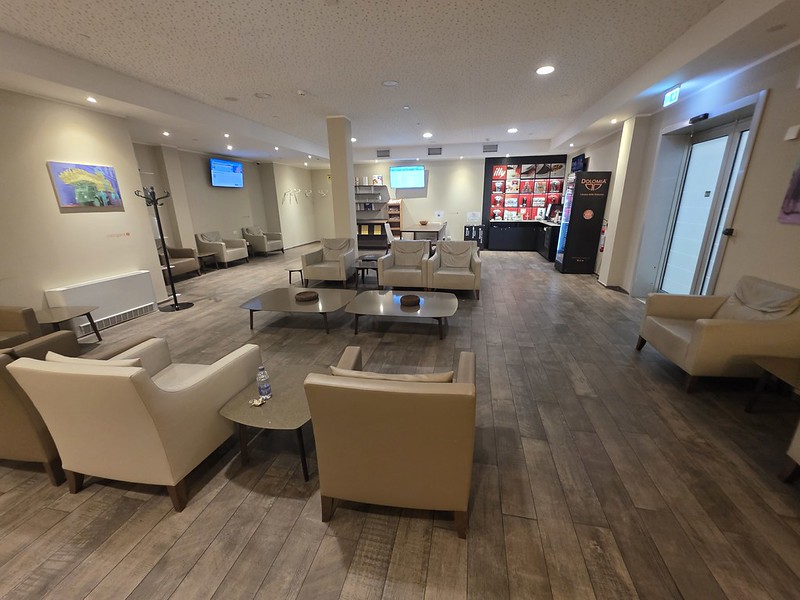
I opted for one of those desks at the rear which had power outlets. It’s a basic lounge, but it’s clean, comfortable and there are toilets inside. It felt quite exclusive to be honest (mainly as there was no-one else in there), although there’s a limited selection of food and drink.
There’s quite a large coffee display to look at for anyone who might be bored. Other than that, there a couple of different forms of snacks and cans of fizzy drink.
This is pretty much the entire selection that’s available, the two forms of snacks, water, fizzy drink and a coffee. That’s certainly better than nothing and I appreciated the comfort of the lounge, but I’m not sure that many people would pay for entry.
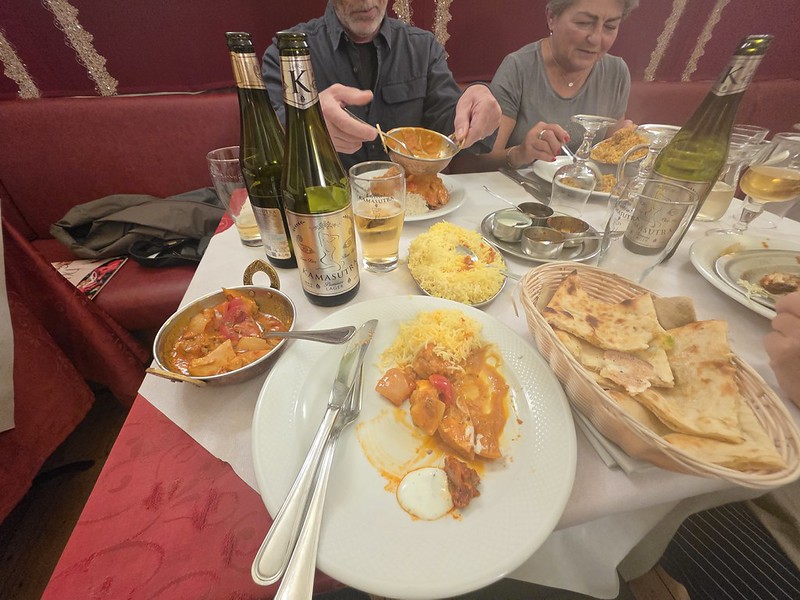
Indian food is my favourite cuisine, so as I was allowed to choose where in Trieste we went on my birthday evening, I opted for Yoga Indian restaurant. I’d add that I usually choose dining venues when it’s not my birthday, but I appreciated the gesture.
I liked the directness of the menu. Steve and I arrived on time, whereas the ladies were out likely getting drunk on cocktails, so they were late. We weren’t sure of the protocol of whether to wait for the ladies to arrive before we ordered, or whether we should just get on with the ordering as we were hungry.
We ordered the starters as we knew the ladies wouldn’t want us being hungry. The prices were to the lower end of the scale, the lager was typical Indian and the chicken pakora were delicious. A very positive start to the meal.
Bev then came charging in to disturb our peace. I had sent them an AI photo of the table full with food (a very impressive one actually, AI really is getting good) to try and speed them up as they might think that they were missing out, but it transpired that the ladies didn’t even see it as they were stumbling their way to the restaurant.
I opted for the chicken karahi and the portion size was generous with the chicken being tender and the sauce having a richness of flavour and some spice to it. The vegetable naan felt healthy and the lemon rice actually had a punchy lemon flavour, just as I like it.
Despite my deliberately and very clearly banning frivolity or fun, Bev and Susanna had gone out to buy a birthday dessert. They then decided to sing happy birthday to my great annoyance, so Bev might not be invited anywhere next year. The restaurant were very helpful to Bev’s endless series of demands and I was fortunate that the large group about to enter hadn’t actually yet come in.
Overall, I was very pleased with this meal as it met my expectations of the evening. The dining environment was clean and comfortable, the staff were friendly and the food had a depth of taste and flavour. The prices were reasonable, we were never left waiting (well, Steve and I were, but that wasn’t the restaurant’s fault) and I felt sufficiently full when leaving. All very lovely.